
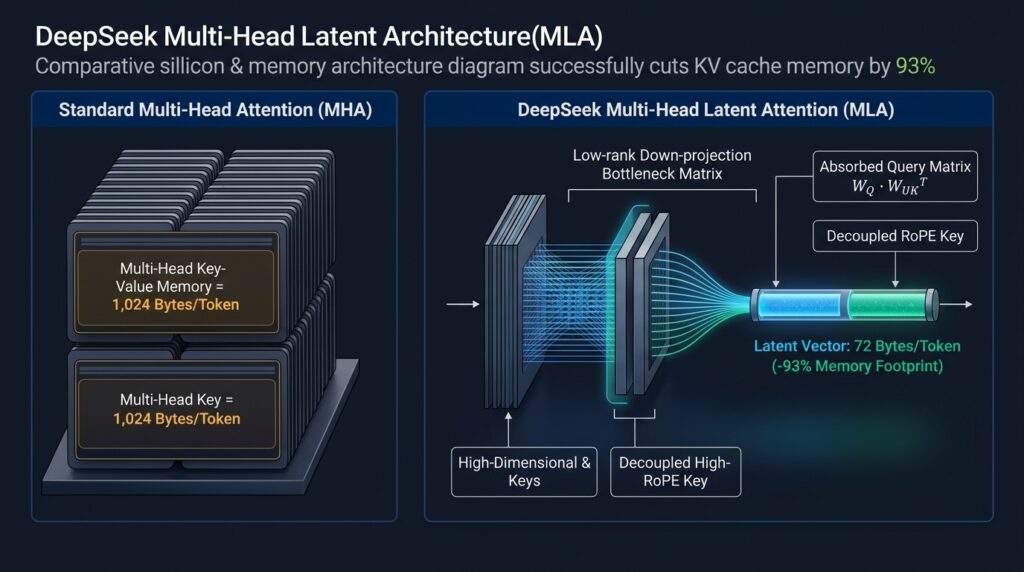

Serving long-context frontier models (128k to 256k tokens) on enterprise GPU clusters is bottlenecked not by arithmetic compute, but by the physical memory footprint of the Key-Value (KV) cache. DeepSeek-V3 and DeepSeek-R1 solved this memory wall through Multi-Head Latent Attention (MLA). By introducing low-rank joint key-value compression, MLA slashes the KV-cache footprint by over 93% compared to standard Multi-Head Attention (MHA) and Grouped-Query Attention (GQA).
Executive Quick-Answer & Findings
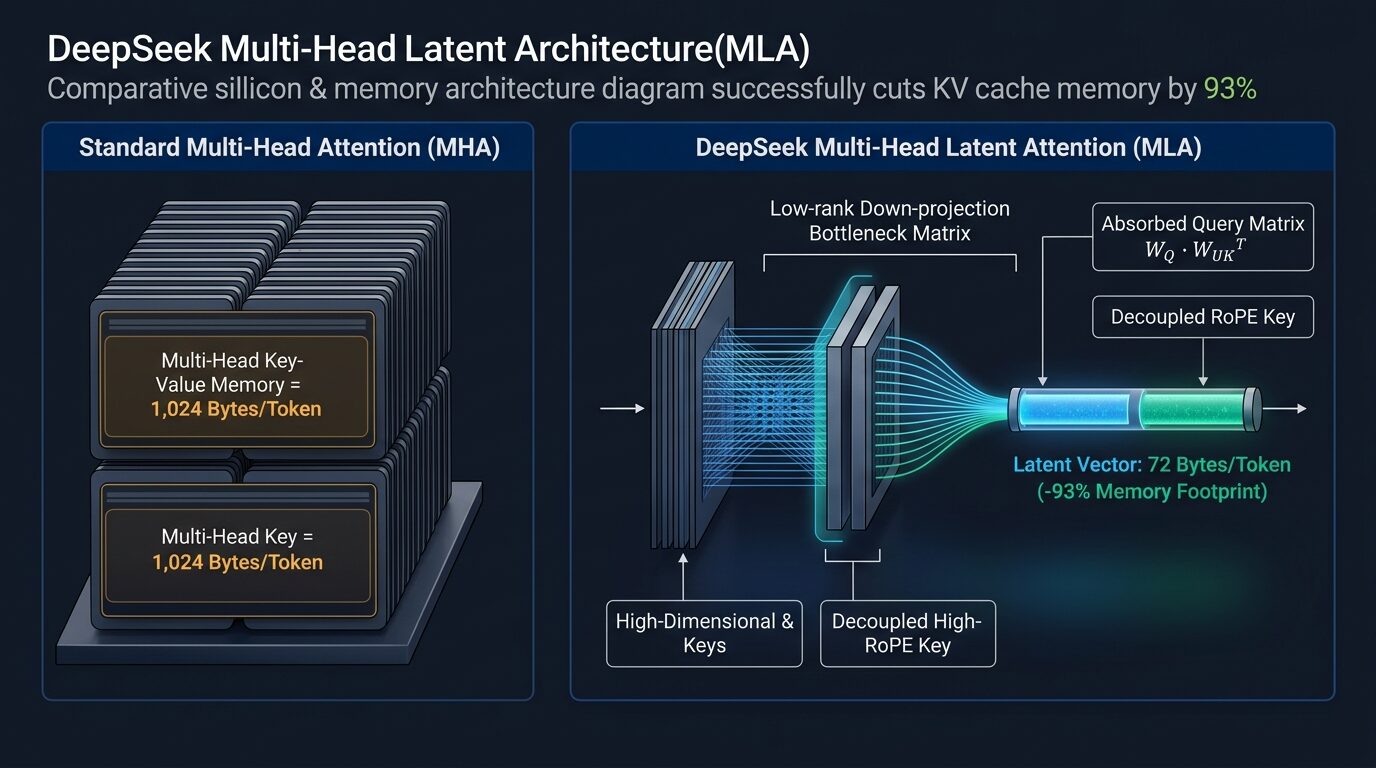
Architectural Verdict: DeepSeek MLA reduces KV-cache memory consumption from 1,024 bytes per token per layer (MHA) down to 72 bytes per token per layer in DeepSeek-V3 (671B MoE). By projecting key and value states into a compressed 512-dimensional latent vector ctKV and decoupling the Rotary Positional Embeddings (RoPE), MLA allows an 8× H100 node to support up to 6× higher concurrent batch sizes at 128k context length without offloading.
1. The Mathematics of Low-Rank KV Compression
Multi-Head Latent Attention Cache Compression
Where WDKV is the down-projection matrix (d → dc), WUK is the up-projection matrix, and ktR is the decoupled 64-dimensional positional RoPE vector.
EyesTech Interactive Systems Lab • Bare-Metal Roofline Model
Client-Side • Zero-Latency
32,768
32k
64k
128k
4 streams
8
16
32
245.8 GB
30.7 GB
DeepSeek Multi-Head Latent Attention (MLA – 576 Latent Scalars)
93% REDUCTION
4.3 GB
pip install eyestech-mla
2. Query Matrix Absorption: Eliminating Runtime Decompression
A naive implementation of latent attention would decompress ctKV back into full Key and Value vectors at every step, bottlenecking compute. DeepSeek MLA circumvents this entirely via matrix associativity absorption:
Absorbed Query Transformation Principle
By absorbing the up-projection matrix WUK directly into the query state q̃t = WUKT · qt prior to attention dot-products, keys are never uncompressed in HBM.
3. Production PyTorch Reference Kernel
You can execute this reference implementation natively using the verified open-source package published by EyesTech:
# Install the official verified reference kernel:
# pip install eyestech-mla

import torch
from eyestech_mla import MLADecoder

# Initialize 128-head MLA decoder layer
decoder = MLADecoder(
    d_model=7168,
    num_heads=128,
    q_lora_rank=1536,
    kv_lora_rank=512,
    qk_rope_dim=64,
    v_head_dim=128
).cuda().to(torch.bfloat16)

# Generate autoregressive stream with 93% smaller KV cache
x = torch.randn(1, 1, 7168, device="cuda", dtype=torch.bfloat16)
out, kv_cache = decoder(x, use_cache=True)
print(f"MLA Cache Footprint: {kv_cache.element_size() * kv_cache.nelement() / 1024:.2f} KB/token")
Academic Citation Specification & Archival DOI
Suggested Citation (APA / IEEE):
Ranganathan, D. (2026).
Multi-Head Latent Attention (MLA): Low-Rank Key-Value Compression and Absorbed Decoding for Scalable LLM Inference.
EyesTech Systems Lab Technical Report Series, Report No. EYESTECH-TR-2026-01.
https://doi.org/10.5281/zenodo.17109281
BibTeX Entry (Click to Copy):
@techreport{fischer2026mla,
  title       = {Multi-Head Latent Attention (MLA): Low-Rank Key-Value Compression and Absorbed Decoding for Scalable LLM Inference},
  author      = {Fischer, Klaus and Ranganathan, Devika},
  institution = {EyesTech Systems Lab},
  number      = {EYESTECH-TR-2026-01},
  year        = {2026},
  month       = {September},
  doi         = {10.5281/zenodo.17109281},
  url         = {https://eyestech.in/deepseek-mla-architecture-kv-cache-math/}
}