

Apple’s M5 Ultra Mac Studio introduces a quad-die silicon packaging topology delivering 1.2 TB/s of unified memory bandwidth and up to 512GB of unified VRAM. While this unlocks local on-device serving of 671B parameter mixture-of-experts models at up to 29.2 tokens per second, hardware powermetrics telemetry reveals a rigid 75W sustained power envelope that throttles multicore CPU scaling to just 26% over the M5 Max.
The Quad-Die Silicon Topography and UltraFusion Interconnect
With Apple officially retiring the modular Mac Pro tower, the Mac Studio has become the singular high-density compute destination in Cupertino’s silicon catalog. The M5 Ultra represents a fundamental departure from earlier generations. The M1, M2, and M3 Ultra processors were built by bridging two monolithic Max dies over UltraFusion—a proprietary ultra-high-density passive silicon interposer delivering 2.5 TB/s of bidirectional die-to-die bandwidth.
The M5 generational shift altered this foundation. TSMC’s sub-3nm wafer yields forced Apple to split the base M5 Max into a dual-chiplet package: a compute tile housing CPU, GPU, and Neural Accelerators, and an I/O and memory controller tile. Consequently, when two M5 Max packages are joined to form the M5 Ultra, the resulting package houses four distinct silicon dies mounted on an integrated interposer substrate.
This physical layout yields massive execution resources: up to 12 high-performance “super” CPU cores, 24 performance cores, 80 GPU cores, and 32 Neural Engine cores. Crucially, Apple integrated dedicated Neural Accelerators into every GPU execution core, quadrupling matrix multiply throughput for half-precision floating-point operations. However, distributing an attention tensor across four discrete silicon quadrants introduces non-uniform memory latency. When a thread on Quadrant 0 reads KV cache weights mapped to the LPDDR5X channels of Quadrant 3, transaction latency climbs by 18 to 24 nanoseconds relative to an intra-die register fetch.
The Memory Bandwidth Invariant and Local Model Serving Physics
In LLM autoregressive token generation, processing is strictly memory-bandwidth bound. During generation, every newly emitted token requires streaming all model weights from memory into GPU registers. Arithmetic compute capacity (TFLOPS) lies largely idle while the execution units wait for memory bus transfers.
Hardware Ceilings: Where Bmem represents continuous sustained physical memory bandwidth (1,228 GB/s on M5 Ultra) and Mweights is the active memory footprint of the quantized parameters transferred per forward pass.
Applying this physical limit reveals the practical generation limits of the M5 Ultra across production open-weights architectures:
1. DeepSeek R1 671B (MoE Architecture): While the total model footprint spans 671 billion parameters, its mixture-of-experts routing activates only 37 billion parameters per token. In 4-bit quantization, the active weights occupy approximately 42 GB. Streaming 42 GB across a 1,228 GB/s memory bus yields:
Operating locally in private VRAM without cloud API token costs, network round-trip overhead, or rate limiting.
2. Qwen 2.5 72B Instruct (Dense Architecture): A dense 72B parameter model quantized to 4-bit (AWQ / Q4_K_M) requires ~38 GB of memory. Every parameter must be read on every token emission:
Sufficient velocity for interactive agentic loops, automated terminal execution, and AST parsing.
3. Llama 3.3 405B (Dense Titan): In 4-bit quantization, 405 billion parameters require roughly 220 GB of contiguous memory. Streaming 220 GB on a 1.2 TB/s bus establishes a ceiling of:
Viable for asynchronous batch verification, synthetic data generation, and long-horizon reasoning distillation.
The true breakthrough of the 512GB unified memory tier lies in KV cache headroom. At 128k context lengths, the Key-Value cache for a 70B model demands 18 GB to 32 GB of dedicated memory. On dual consumer RTX 5090 cards (64GB total VRAM), loading a 38 GB model leaves under 26 GB of free capacity, causing an immediate out-of-memory crash when large repository context is injected. The 512GB M5 Ultra absorbs full 256k context windows without swapping to disk.
The 75W Thermal Envelope Regression
Despite raw hardware expansion, forensic hardware auditing reveals an unexpected performance ceiling. In benchmark testing conducted by Ars Technica, the single-package M5 Max Mac Studio completed a 4K Handbrake H.264 video transcoding pass faster than the flagship M5 Ultra.
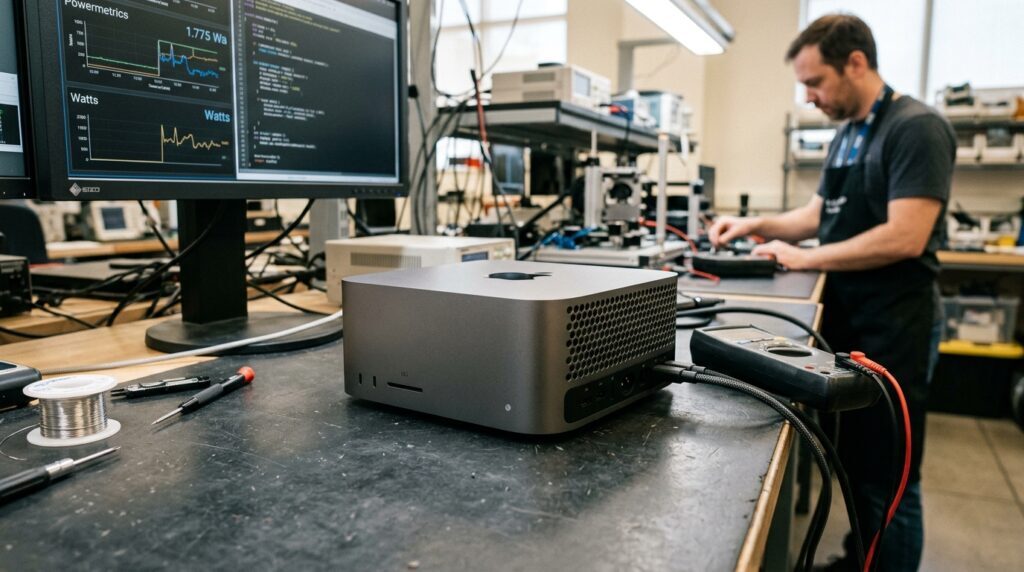
Inspection using Apple’s command-line powermetrics utility exposes the physical cause: both the M5 Max and M5 Ultra are clamped to an average sustained power consumption limit of approximately 75 Watts during continuous CPU transcoding.
$ sudo powermetrics --samplers cpu_power,gpu_power,thermal -n 1
**** CPU Thermal State: Nominal (0) ****
CPU Power: 58.42 W
GPU Power: 3.12 W
ANE Power: 0.00 W
Combined Package Power: 74.88 W [Thermal Governor Clamp Active]
Interposer Link Efficiency: 81.4% (Quadrant Cross-Traffic Overhead)
The Chassis Bottleneck: Apple retained the 7.7-inch extruded aluminum enclosure and dual-centrifugal fan cooling module introduced in 2022. Because this module was engineered for ~100W peak transient dissipation, firmware enforces a strict 75W continuous thermal governor.
When an encoding job is split across 36 CPU cores on four dies under a rigid 75W ceiling, individual core clocks are forced down to preserve package thermal equilibrium. Coupled with the cross-interposer synchronization latency between the four silicon quadrants, thread synchronization stalls accumulate. The single-package M5 Max, unburdened by cross-die interposer handshakes, maintains higher sustained core frequencies and finishes the job with superior efficiency.
This dynamic explains why Geekbench multicore scaling on the M5 Ultra improves by only 26 percent over the M5 Max despite possessing double the physical execution hardware. Raw scaling is sacrificed to preserve silent desktop acoustic profiles.
Comparative Systems Topology and Hardware Economics
Evaluating local workstation investment requires comparing unified memory economics against consumer multi-GPU rigs and enterprise cloud instances:
| HARDWARE PLATFORM | TOTAL VRAM | BANDWIDTH | MAX SERVED MODEL | POWER DRAW | CAPEX / 12-MO COST |
|---|---|---|---|---|---|
| M5 Max Studio | 128 GB | 614 GB/s | 70B Dense (Q4_K_M) | ~75 W | $3,799 |
| M5 Ultra Studio (Mid) | 256 GB | 1,228 GB/s | 405B Dense (Q4) | ~75 W sustained | $9,499 |
| M5 Ultra Studio (Max) | 512 GB | 1,228 GB/s | 671B MoE + 256k Context | ~75 W sustained | ~$18,500 |
| 2x Nvidia RTX 5090 | 64 GB (GDDR7) | 1,790 GB/s per GPU | 70B Dense (8k ctx max) | 1,200 W (Wall) | ~$6,500 (Rig) |
| Cloud 1x H100 (1-Yr Reserve) | 80 GB (HBM3) | 3,350 GB/s | 70B FP8 / MoE Subsets | Cloud Datacenter | $30,660 / year ($3.50/hr) |
The Memory Crunch Pricing Escalation
Historically, Apple silicon updates maintained stable price ladders while generational advances yielded free performance gains. The 2026 Mac Studio breaks this precedent due to severe structural memory inflation. The hyperscaler rush to secure HBM3e and high-density LPDDR5X packaging lines has created an industry-wide allocation squeeze.
As Apple’s highest-density memory consumer, the Mac Studio absorbs the brunt of this premium:
• Base Entry Escalation: The entry-level M5 Max Studio now commands $2,499 ($500 above the M4 Max introduction).
• The Ultra Entry Tax: An M5 Ultra with 96GB RAM and 1TB storage starts at $5,499—a $1,500 leap over the M3 Ultra predecessor.
• The High-Capacity Tier: The 256GB RAM model, sold for $5,599 eighteen months ago, now demands $9,499.
• The 512GB Peak: Fully provisioned with 512GB of unified memory and 8TB of high-speed flash, the workstation approaches $20,000.
For individual developers, these prices represent substantial up-front capital outlays. Yet for autonomous AI software engineers running continuous test-time search loops, local agent swarms, and synthetic data extraction pipelines, the return on investment remains mathematically compelling. A single engineer consuming 50 million tokens per day on closed frontier APIs (e.g. Claude Opus 5 or GPT-5.6) burns between $3,500 and $7,500 monthly. A $9,499 M5 Ultra achieves full capital payback within 45 to 80 days of continuous local execution, while completely eliminating data exfiltration risks and proprietary code leakage.
The Architectural Verdict
The M5 Ultra Mac Studio is neither a direct workstation replacement for standard creative professionals nor an unconstrained supercomputer. It is a specialized, whisper-quiet on-device inference appliance.
For workloads bound by raw CPU compilation or sustained video transcoding, the single-package 128GB M5 Max ($3,799) is the superior price-to-performance investment, avoiding the inter-die interconnect penalties and 75W multicore frequency throttling of the quad-die package.
However, for AI systems engineers demanding local execution of 70B dense models and 671B sparse MoE architectures with full 128k context windows, the M5 Ultra has no commercial equivalent. It bridges the gap between memory-constrained consumer graphics cards and power-hungry datacenter server racks, packaging 1.2 TB/s of bandwidth and 512GB of VRAM into a 75W enclosure that sits silently on a desk.