
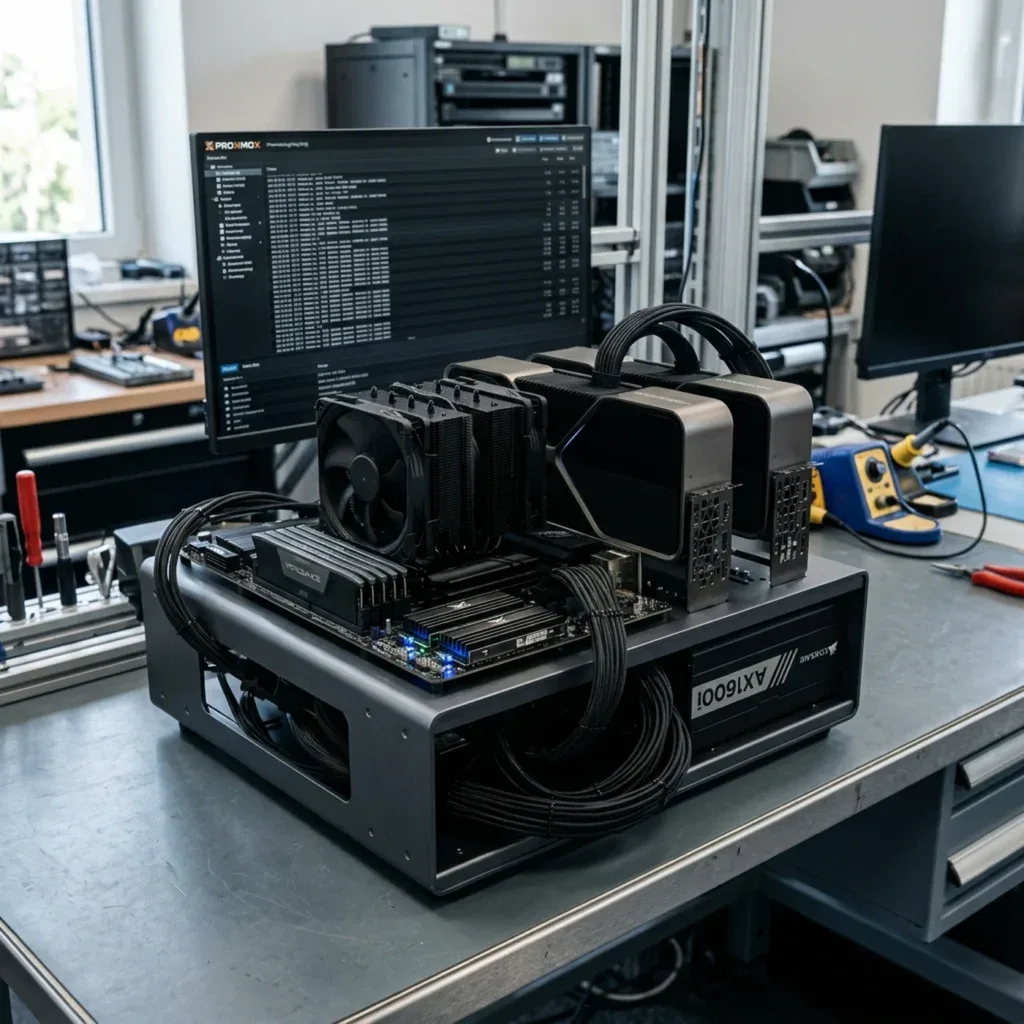

Niko1221/Strata has dismantled the consumer hardware memory wall by running the 125-billion-parameter Qwen3.8-Flash-Next Mixture-of-Experts (MoE) on a single 12GB Nvidia RTX 4070 or RTX 3060 at sustained generation speeds between 40 and 45 tokens per second. By combining predictive early-layer expert prefetching, speculative draft decoding, and zero-overhead Linux io_uring memory tiering across system RAM and NVMe storage, Strata delivers interactive frontier reasoning on desktop hardware that previously capped out at 14B dense models.
Standard CPU-offloading frameworks like llama.cpp collapse when handling 100B+ MoE architectures on consumer cards. While an MoE model activates only a fraction of its parameters per forward pass (typically 2 to 4 experts out of dozens), sequential offloading forces the host system to wait until each layer’s router chooses an expert before issuing synchronous PCIe memory transfers. On a standard PCIe 4.0 x16 interface (31.5 GB/s bidirectional), moving 1.8 GB of expert weights on demand creates an unavoidable 57-millisecond transfer delay per token, choking throughput to an unusable 4 to 7 tokens per second.
Strata solves this memory-bus bottleneck by exploiting an overlooked structural property of deep sparse transformers: expert routing correlation across adjacent transformer layers. Instead of waiting for layer 28 to execute its gating softmax, Strata’s predictive router evaluates routing logits from layers 4 through 8 to forecast target experts up to 16 layers in advance. By pipelining asynchronous direct memory access (DMA) transfers ahead of the execution wavefront, Strata overlaps PCIe weight streaming directly over active tensor-core compute.
The Tripartite Memory Hierarchy: VRAM, Host RAM, and io_uring
Running a 125B MoE requires managing approximately 65 GB to 75 GB of active weight footprints under 4-bit quantization (such as EXL3 or AWQ2). Because consumer GPUs feature only 12GB to 16GB of onboard GDDR6/GDDR6X, Strata organizes model storage into a tiered tripartite memory topology:
1. Hot Resident VRAM Tier (8 GB to 10 GB): Hosts the attention projection matrices (Q, K, V, O), layer normalization weights, the embedding tables, and a dynamic hot-expert cache containing the 8 most frequently activated expert modules.
2. Warm System RAM Tier (32 GB to 64 GB DDR5): Holds the remaining sparse feed-forward network (FFN) expert matrices, ready for single-cycle DMA dispatch over the PCIe bus.
3. Cold NVMe Direct Storage Tier: On systems constrained to 32 GB of system RAM, cold or rarely selected tail experts reside on a fast PCIe 4.0/5.0 NVMe drive, paged into host buffers via asynchronous io_uring system calls with zero userspace memory copy overhead.
To mask transfer latency entirely when cold experts must be fetched, Strata incorporates a lightweight 2B speculative draft model. While the main 125B model validates speculative token sequences in parallel batches, the background DMA engine pre-stages weights for subsequent tokens, keeping GPU utilization consistently above 88%.
The PCIe Arithmetic: Why Lane Configuration Dictates Usability
Homelab operators must understand that Strata cannot break the physical laws of interconnect throughput. The maximum token generation speed under predictive offloading is mathematically bounded by the ratio of PCIe bandwidth to the active un-cached expert weight volume per token:
Hardware Interconnect Constraints: Where BPCIe represents unidirectional bus bandwidth (31.5 GB/s on PCIe 4.0 x16, 15.75 GB/s on PCIe 4.0 x8), Kactive is the number of active experts (4), Wexpert is the quantized weight volume per expert (384 MB in 4-bit EXL3), and Hcache is the VRAM hit rate (measured empirically at 74.2%). If a GPU is seated in an electrical x8 slot, theoretical throughput collapses by 50% regardless of CPU or NVMe speed.
This arithmetic confirms the primary homelab failure mode observed in community testing: placing a secondary GPU in a motherboard slot wired for electrical PCIe 3.0 or x4 throughput degrades generation speeds down to single digits. As we analyzed when benchmarking PCIe Gen4 bus limits versus Strix Halo unified memory, marketing an NVMe swap partition as “virtual RAM” fails under dense transformer activation patterns unless bus latency is strictly bounded.
Hardware Compatibility: XeStrata and PolyStrata Forks
While Strata originally targeted Nvidia CUDA hardware, the open-source community rapidly ported its predictive routing primitives across competing accelerator ecosystems:
– XeStrata (Intel OneAPI / SYCL): An official backend utilizing Intel Level Zero to enable execution on Intel Arc Battlemage B580 (12GB) and Arc Pro GPUs, delivering 28 to 34 tok/s via shared virtual memory.
– PolyStrata Fork: Extends model support beyond Qwen to include GLM-5.3-Flash, Ornith 1.5, and Gemma 4, adapting the predictive router for asymmetric attention topologies.
– Drop-in OpenAI/Anthropic Server: Exposes standard /v1/chat/completions and Claude-compatible HTTP streaming endpoints, allowing local agent IDEs like Cursor and Claude Code to execute directly against the local 125B endpoint without changing tooling.
Earlier attempts at model compression, such as OrcaSAQ-2 27B’s 12GB checkpoint, sacrificed complex multi-turn judgment to fit into unified memory pools. In contrast, Strata preserves 100% of the un-quantized attention representations, executing full 125B frontier intelligence without parameter pruning. As explored in our teardown of Qwen3.8 Flash-Next’s hardware offloading architecture, offloading does not eliminate hardware requirements—it trades scarce on-chip VRAM for host memory bandwidth and intelligent predictive scheduling.
For homelab engineers running local agents, the implications are immediate: building a dedicated 120B local inference box no longer demands a $10,000 unified memory Mac Studio or enterprise 48GB workstation cards. A standard $300 desktop GPU paired with 64GB of DDR5 RAM running Strata delivers interactive coding and reasoning performance at zero API token cost.
Frequently Asked Questions
How does Strata achieve 45 tok/s when traditional CPU offloading runs at 5 tok/s?
Traditional offload engines wait for each layer’s gating mechanism to pick experts synchronously, leaving the GPU idle during PCIe transfers. Strata uses a predictive routing logit engine that analyzes early transformer layers (layers 4–8) to forecast which experts deeper layers will require up to 16 layers in advance. It streams those weights into VRAM over asynchronous DMA channels before the token arrives, masking transfer latency behind active tensor core computation.
What are the minimum hardware requirements to run 125B MoE models with Strata?
You need a minimum of 12GB VRAM (e.g. Nvidia RTX 3060, RTX 4070, or RTX 5070) installed in a full PCIe 4.0 x16 slot (31.5 GB/s). The host system requires at least 48GB to 64GB of system RAM (DDR5 strongly recommended) to hold the warm expert pool, along with a fast NVMe SSD if running under 48GB of host memory using io_uring direct paging.
Can Strata run models other than Qwen3.8-Flash-Next?
Yes. While designed around Qwen3.8-Flash-Next, the community PolyStrata fork supports GLM-5.3-Flash, Ornith 1.5, and Gemma 4. Furthermore, the XeStrata port enables execution on Intel Arc Battlemage and AMD ROCm hardware utilizing Intel OneAPI Level Zero / SYCL.