

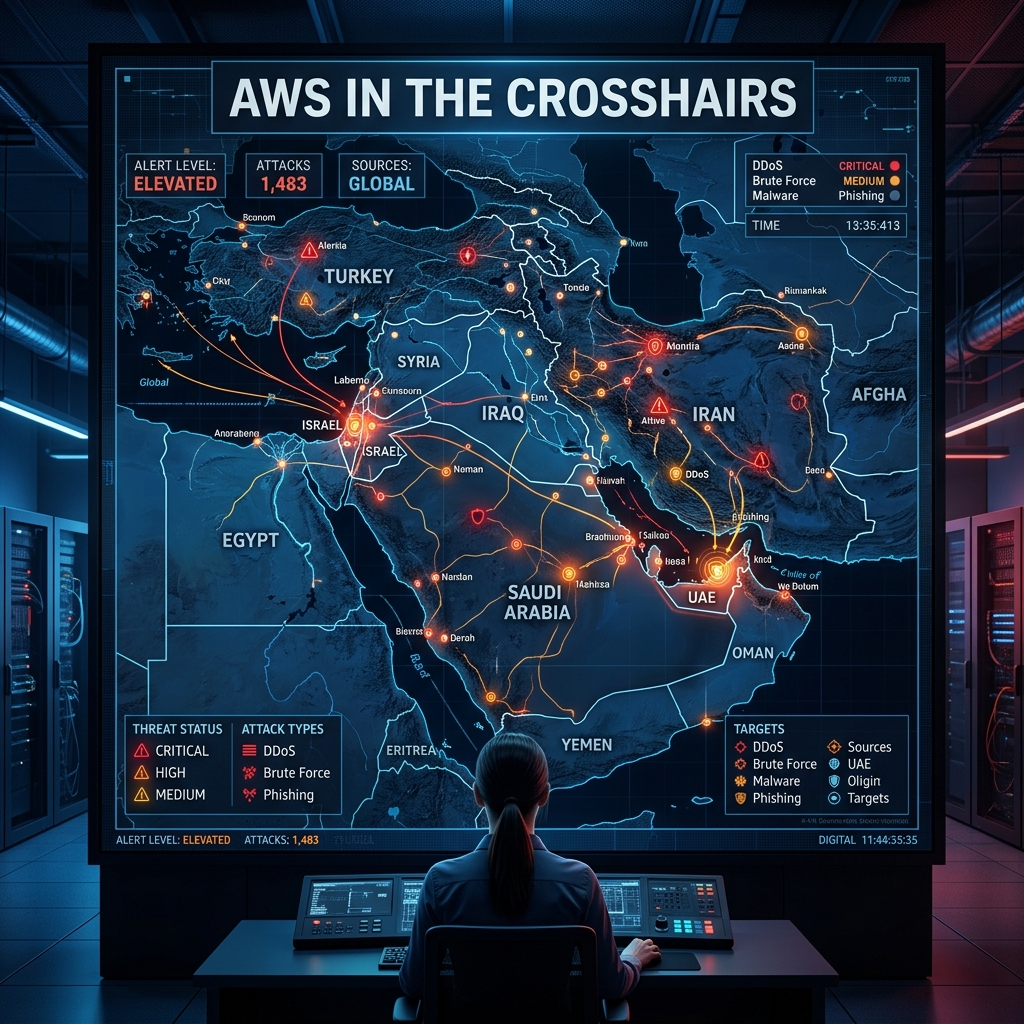

Hyperscale data centers are no longer just digital havens—they are military targets. Following the unprecedented April 2026 Iranian drone strikes on AWS infrastructure in Bahrain and the UAE, the era of the ‘security premium’ has arrived. Here is the deep dive.
Something fundamentally, irreversibly broke in the global technology ecosystem in early April 2026, and for the first time in modern computing history, the root cause wasn’t a botched software deployment, a catastrophic BGP routing error, or an unpatched zero-day vulnerability in an obscure open-source dependency.
Over the past few weeks, the internet’s most assumed constant—the physical invulnerability of the enterprise cloud—evaporated under the blinding flash of high-explosive drone strikes.
We are not talking about a Distributed Denial of Service (DDoS) attack heavily abstracted behind digital firewalls. We are talking about concrete-shattering, steel-melting physical warfare. Amazon Web Services (AWS) data centers located within the Middle East—specifically the crucial ME-SOUTH-1 region in Bahrain and the ME-CENTRAL-1 region in the United Arab Emirates (UAE)—were targeted and struck by kinetic military assets.
This is the moment the abstract concept of the “cloud” crashed violently back down to earth. For decades, we have debated digital sovereignty, data privacy frameworks, compliance regulations, and uptime Service Level Agreements (SLAs). We built massive, beautiful pieces of infrastructure assuming the battleground was exclusively virtual. We assumed that as long as our encryption was solid and our firewalls were configured correctly, our data and our compute were untouchable.
We were entirely wrong.
The Paradigm Shift: From Digital Haven to Military Target
To fully appreciate the gravity of the April 2026 strikes, one must understand how hyperscale data centers have traditionally been viewed by the nation-states in which they operate. Historically, these gargantuan facilities—often spanning millions of square feet and consuming horrifying amounts of localized power—were treated as sacrosanct economic engines. They were viewed identically to vital hospitals or neutral diplomatic embassies; regardless of what geopolitical friction existed in a given region, the data center was off-limits because targeting it would amount to an attack on the globalized digital economy. No state actor wanted the smoke associated with taking down critical financial routing, medical logistics, or basic communication infrastructure.
The Islamic Revolutionary Guard Corps (IRGC), by deploying Shahed-type suicide drones into the cooling towers and power substations of these AWS facilities, has completely rewritten the modern rules of engagement.
Their logic, publicly claimed via state-linked media, marks a horrifying new era for enterprise tech: Western commercial hyperscale data centers are now classified as legitimate strategic military targets because they host workloads—including advanced AI simulations and intelligence processing—that support “the enemy.” In late March, this philosophy was amplified when Iranian state media openly listed other major tech giants, naming Google Cloud, Microsoft Azure, Oracle, and Apple infrastructure as potential future targets in the region.
The Anatomy of the Strike
What exactly happens when a drone strikes a hyperscaler? It is a cascading failure of physical engineering that no amount of software redundancy can initially mitigate.
While exact, classified damage reports are naturally tightly controlled by Amazon and regional authorities, industry whistleblowers and physical security analysts have painted a chaotic picture of the events in ME-SOUTH-1 and ME-CENTRAL-1. The strikes did not need to penetrate deep into the server halls themselves to cause catastrophic outages. Hyperscale data centers are essentially massive thermal management engines. They draw gigawatts of power to run the servers, and equally massive amounts of power and chilled water to remove the heat actively generated by that compute.
By targeting the external infrastructure—substations, critical power delivery pipelines, and the external cooling tower arrays—the attackers triggered immediate, unavoidable thermal runaway conditions inside the facilities. When the cooling systems were compromised, the internal temperatures in the server farms spiked astronomically within minutes. Standard emergency protocols dictate an immediate hard shutdown of the compute layers to prevent literal fires from breaking out on the server racks.
Furthermore, the secondary damage proved just as calamitous. Shrapnel and explosive force triggered internal fire suppression systems. In data centers, this usually means the release of inert gases, but in cases of severe structural breach where external environmental control is lost, high-pressure water and foam systems were activated. The irony is bitter: in saving the building from burning to the ground, the fire suppression protocols irreversibly water-logged tens of millions of dollars of high-end enterprise hardware.
The Immediate Fallout: AWS Scrambles
The immediate ripple effect across the enterprise technology landscape was pure, unadulterated chaos. When your Availability Zone goes from “optimal” to “hard down” because the physical building it resides in has a new, unplanned skylight courtesy of a loitering munition, all of your standard incident response playbooks go straight out the window.
Wiping the Bills and Migrating the Workloads
AWS issued emergency Tier-1 advisories to all affected enterprise clients. The command was simple and desperate: execute massive disaster recovery failovers immediately, abandoning the compromised physical locations and migrating critical traffic out of the Middle East and into European or Asian availability zones. Due to data sovereignty laws (which dictate that certain types of regional data cannot leave the geographic borders of the country), this forced multi-national corporations into an impossible legal and operational bind.
In a panicked move to stem the bleeding, manage public relations disasters, and quell the apocalyptic outrage storming across tech Twitter and LinkedIn, Amazon took an unprecedented step. They announced the total waiving of all usage-related charges for the impacted regions for the entire month of March 2026.
But as any hardened SysAdmin or DevOps engineer will tell you: waiving a cloud bill does not rebuild shattered server racks. A line-item discount on your monthly AWS invoice does not magically dry out the water damage inside compromised core routers, nor does it recover the exabytes of un-replicated customer data stuck on hard drives buried under concrete rubble.
AWS CEO Matt Garman stated that Amazon teams have been working 24/7 in conjunction with regional construction and military authorities to restore the ME-SOUTH-1 and ME-CENTRAL-1 facilities. However, the tech community was quickly issued a severe reality check on the speed of recovery. When a software bug takes down an integration pipeline, a senior engineer can roll back a commit and push a fix in thirty minutes. When a drone strikes a facility, the recovery timeline isn’t measured in milliseconds or sprint cycles; it is measured in months, requiring heavy construction equipment, hazardous materials clearing, and military escorts. This isn’t rebooting a server; this is construction in an active warzone.
Contrast and Divergence: The Economics of Safe Havens
To truly grasp the impact of the Middle East drone strikes on the global economy, we must compare this situation to the massive, peaceful infrastructure investments happening concurrently in stabilizing regions.
Think about the sheer scale of global digital investment currently underway in 2026. The world is in the grips of an unprecedented AI arms race, requiring computational density that borders on the absurd.
Just recently, we extensively covered the announcement of Microsoft’s $5.4 Billion AI Bet in Canada, a localized mega-project intended to secure North American AI training dominance. Taking it a step further, the tech sector is still grappling with the sheer magnitude of SoftBank’s $25 Billion Stargate Project, the most monolithic bet on AI compute the planet has ever seen.
These staggering financial bets, representing the GDP outputs of small nations, are entirely built on the fundamental, bedrock assumption of physical safety. Microsoft pouring billions into Canadian data centers relies on the fact that those centers will only ever be threatened by exceptionally harsh winters or the occasional squirrel chewing through a fiber-optic cable.
In the Middle East, that assumption of safety is unequivocally dead.
Prior to the escalations resulting in these strikes, AWS had proudly announced a monumental, $5.3 billion infrastructure investment intended for a new regional roll-out in Saudi Arabia, slated for completion by the end of 2026. While Amazon’s corporate PR machine insists they are maintaining their vital, long-term commitments to the entrepreneurial spirit of the region, the geopolitical math for building these facilities has definitively, catastrophically changed.
Pricing the “Security Premium”
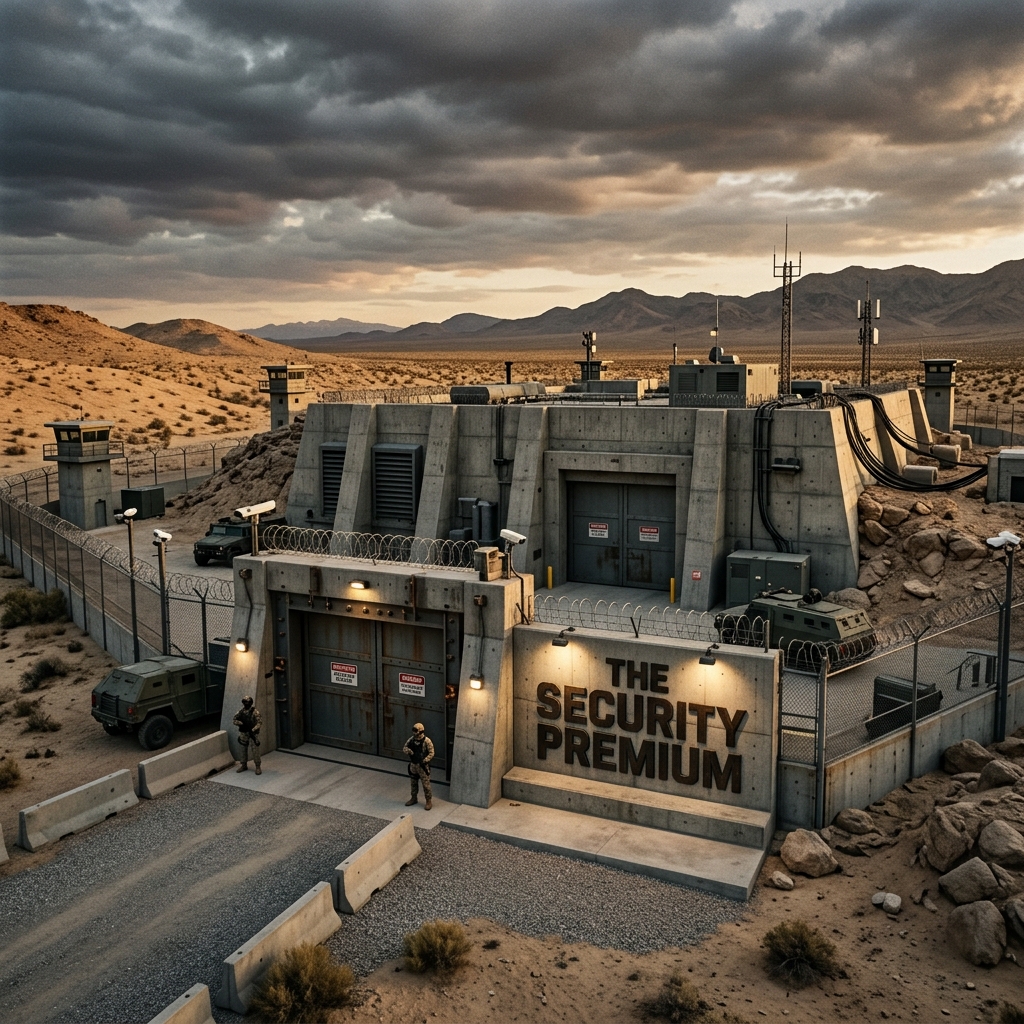
This introduces the tech industry to a terrifying new metric. Forget your CPU usage costs, your egress data transfer fees, and your provisioned IOPS. We are entering the brutal era of the “Security Premium.”
You can no longer simply purchase a massive plot of inexpensive desert land, pour a few acres of concrete foundation, rig up a traditional cooling array, and start installing half-million-dollar AI training server racks. Hyperscale facilities located anywhere near volatile geopolitical zones will now require military-grade physical hardening.
The Architecture of the Hardened Data Center
What does physical hardening actually look like for a civilian tech company? It sounds like bad science fiction, but it is now the standard requirement for securing CAPEX investments in conflict zones:
- Subterranean Topographies: The days of massive, sprawling above-ground server warehouses are over in these regions. Future facilities will need to be buried deep underground. Going subterranean provides inherent protections against direct kinetic strikes, artillery, and loitering munitions, while simultaneously providing incredibly efficient, natural thermal insulation for the cooling systems. The cost of excavating and securing these massive underground bunkers, however, dwarfs traditional construction costs.
- Anti-Drone Defense Protocols: Data centers will now require localized air defense capabilities. This doesn’t necessarily mean surface-to-air missiles bolted to the roof of the administrative building. Rather, expect to see the heavy implementation of massive physical anti-drone netting enveloping external cooling equipment, paired with sophisticated electronic warfare (EW) signal jammers designed to sever the command and control links of incoming loitering munitions before they can acquire a visual lock on the facility.
- EMP Shielding Architecture: As the threat of warfare scales, so too does the spectrum of attacks. Physical data centers must now be constructed to act as massive Faraday cages. Electromagnetic Pulse (EMP) shielding—designed to protect the incredibly delicate solid-state drives and microprocessors from being permanently fried by high-altitude detonations or concentrated microwave weaponry—will become a non-negotiable architectural standard.
- Hyper-Dispersed Geographic Footprints: Previously, hyperscalers built massive centralized zones because economies of scale made it cheaper. With the capability of long-range precision strikes proven, the design philosophy must shift from centralization to aggressive distribution. Instead of one massive facility housing 100,000 servers, we will see ten smaller, heavily fortified micro-facilities spread hundreds of miles apart. If a strike takes out one bunker, the localized mesh network immediately reroutes to the surviving nodes.
This extreme, military-grade physical security protocol adds a massive, unavoidable “security premium” to any Capital Expenditure (CAPEX) sheet. And make no mistake, the massive extra billions required to build bunkers instead of warehouses will absolutely, without question, be passed directly down to the enterprise consumer. Cloud computing in the Middle East is about to become astronomically expensive.
The Death of Pure Digital Sovereignty
Where does the attack on AWS ME-SOUTH-1 leave the concept of digital sovereignty? For years, national governments have tightly legislated that resident data—be it healthcare records, financial ledgers, or citizen identity databases—cannot legally leave the physical borders of the country. By mandating localized data centers, governments believed they were retaining absolute control over their sovereign information.
The Iranian drone strikes have shattered this illusion.
What good is legal digital sovereignty if the sovereign physical infrastructure is actively on fire? When AWS sent the panicked instructions for clients to failover to backup regions, many enterprises realized that doing so would put them in direct violation of local compliance laws. They were forced to choose between breaking international data residency laws or completely losing their operational capabilities as their servers drowned in fire suppression foam.
Enterprise architects and Chief Information Security Officers (CISOs) are now realizing that their disaster recovery models are fundamentally broken. For the past decade, we assumed threat vectors were entirely digital in nature. We ran drills for ransomware lockouts. We ran simulations for Distributed Denial of Service tsunamis. We built redundancies for BGP misconfigurations.
We never ran simulations for the physical ground underneath our availability zones becoming an active kinetic battlefield.
The Geopolitical Chessboard and the AI Amplifier
Why did this escalation happen now, in April 2026? The answer lies in the nature of what is actually being processed on those servers.
We are no longer just hosting WordPress blogs, e-commerce storefronts, and Netflix streaming buffers. Modern hyperscale data centers are the engines of the Artificial Intelligence revolution. The processing power required to train large language models, execute complex algorithmic trading, and simulate advanced aerodynamic or logistical models has made compute the single most valuable resource in the global economy.
State actors like the IRGC recognize that in the modern era, military superiority is inextricably linked to computational superiority. By crippling a nation’s access to cloud compute, you cripple its ability to innovate, to simulate, and to execute modernized warfare. Data centers are no longer the benign filing cabinets of the internet; they are the strategic foundries where the weapons of tomorrow are designed.
Conclusion: The Future is Underground
As companies desperately race to redesign and re-implement true multi-region architectures that account for physical destruction, the entire technology community has suffered the most severe reality check of the century.
We spent the last twenty years building the most sophisticated, beautiful, and complex virtual abstractions the world has ever seen. We believed that we had transcended the messy, physical realities of the world and ascended into a purely digital existence. But the drone strikes on AWS ME-SOUTH-1 and ME-CENTRAL-1 have aggressively yanked us out of the matrix.
At the end of the day, no matter how elegant your code is, no matter how robust your container orchestration is, and no matter how advanced your AI models become, all software fundamentally lives on hardware.
And hardware, as we have brutally learned in April 2026, can be broken. The concept of the ethereal cloud is dead. The future of data centers isn’t in the sky; it’s buried deep underground, heavily fortified, and bracing for impact.
Har Har Mahadev 🔱, Jai Maa saraswati🌺