


Anthropic’s new model is a serious upgrade candidate for long-running agents—but its lower cache price does not automatically make it the cheapest model to run.
Anthropic launched Claude Fable 5.1 on September 1, 2026, alongside Claude Mythos 5.1. The two products use the same underlying model with different safeguards; Fable is the generally available version, while Mythos is limited to trusted-access programs. The release is being framed around long-horizon coding, research, computer use, and multi-agent work.
The launch numbers are striking. Fable 5.1 reports 52.6% on Terminal-Bench-Science 0.1, 55.8% on Terminal-Bench 4.0, 77.9% on OSWorld 2.0 partial, and 73.4% on CursorBench 3.2.0—beating Fable 5 and Opus 5 on every row in Anthropic’s comparison table. At the same time, its cache-read price is $0.25 per million tokens, down from the $1.00-per-million comparison implied by Fable 5’s documented 0.1x cache-read rate.
That is the useful story, but not the whole story. Higher effort can mean more output tokens, longer latency, more tool turns, and more subscription usage. One external evaluation found Fable 5.1’s maximum-effort cost per completed task higher than Fable 5’s and substantially higher than Opus 5’s. The upgrade decision is therefore about the workflow denominator—not the model’s headline price.
The short answer
Use Fable 5.1 as an escalation tier when all four conditions are true:
- the task is difficult enough that Opus 5 fails your own eval or creates too much review work;
- the workflow reuses a large, stable context across many turns;
- the output can be checked with tests, screenshots, diffs, or another artifact-level gate;
- your provider route, retention policy, fallback behavior, and budget are acceptable.
For routine drafting, short chats, and low-risk code changes, it is not an automatic replacement for cheaper models. Start with a real effort sweep, especially medium, before assuming xhigh or max is the production setting.
What changed in Fable 5.1?
The model ID is claude-fable-5-1. Anthropic documents a 1-million-token context window, a 128,000-token maximum output, adaptive thinking that is always enabled, and five effort levels: low, medium, high, xhigh, and max. The default effort is high.
The API list price is:
| Component | Price per million tokens |
|---|---|
| Input | $10 |
| 5-minute cache write | $12.50 |
| 1-hour cache write | $20 |
| Cache read | $0.25 |
| Output | $50 |
| Batch input / output | $5 / $25 |
Those are the model’s official platform prices. Anthropic says the lower cache-read rate should reduce typical workload cost by about 25% and highly agentic workload cost by approximately 45% compared with Fable 5. The key word is workload: a cache read is only one line on a bill that can also contain fresh input, cache writes, output, tool calls, retries, fallbacks, and human review.
Fable 5.1 is available through Anthropic’s API, Claude Code, paid Claude plans, AWS, Google Cloud, and Microsoft Foundry, according to the product page. Availability in a product or cloud marketplace should not be confused with a promise of India-region processing or a specific data-residency contract.
The official benchmark shape
Anthropic’s launch page reports this comparison:
| Evaluation | Fable 5.1 | Fable 5 | Opus 5 | GPT-5.6 Sol |
|---|---|---|---|---|
| Terminal-Bench-Science 0.1 | 52.6% | 24.7% | 29.0% | 22.4% |
| Terminal-Bench 4.0 | 55.8% | 42.0% | 52.3% | 37.3% |
| GDPval-AA v2 | 1853 | 1723 | 1824 | 1711 |
| OSWorld 2.0, partial | 77.9% | 72.9% | 75.4% | — |
| OSWorld 2.0, strict | 41.7% | 36.1% | 39.6% | — |
| Humanity’s Last Exam, no tools | 60.9% | 57.8% | 56.6% | — |
| Humanity’s Last Exam, with tools | 65.0% | 63.8% | 63.6% | — |
| AutomationBench | 31.4% | 17.1% | 26.9% | 19.6% |
| CursorBench 3.2.0 | 73.4% | 70.5% | 70.0% | 67.2% |
Source: Anthropic’s Fable 5.1 and Mythos 5.1 announcement. Bold values are the highest values in Anthropic’s displayed row.
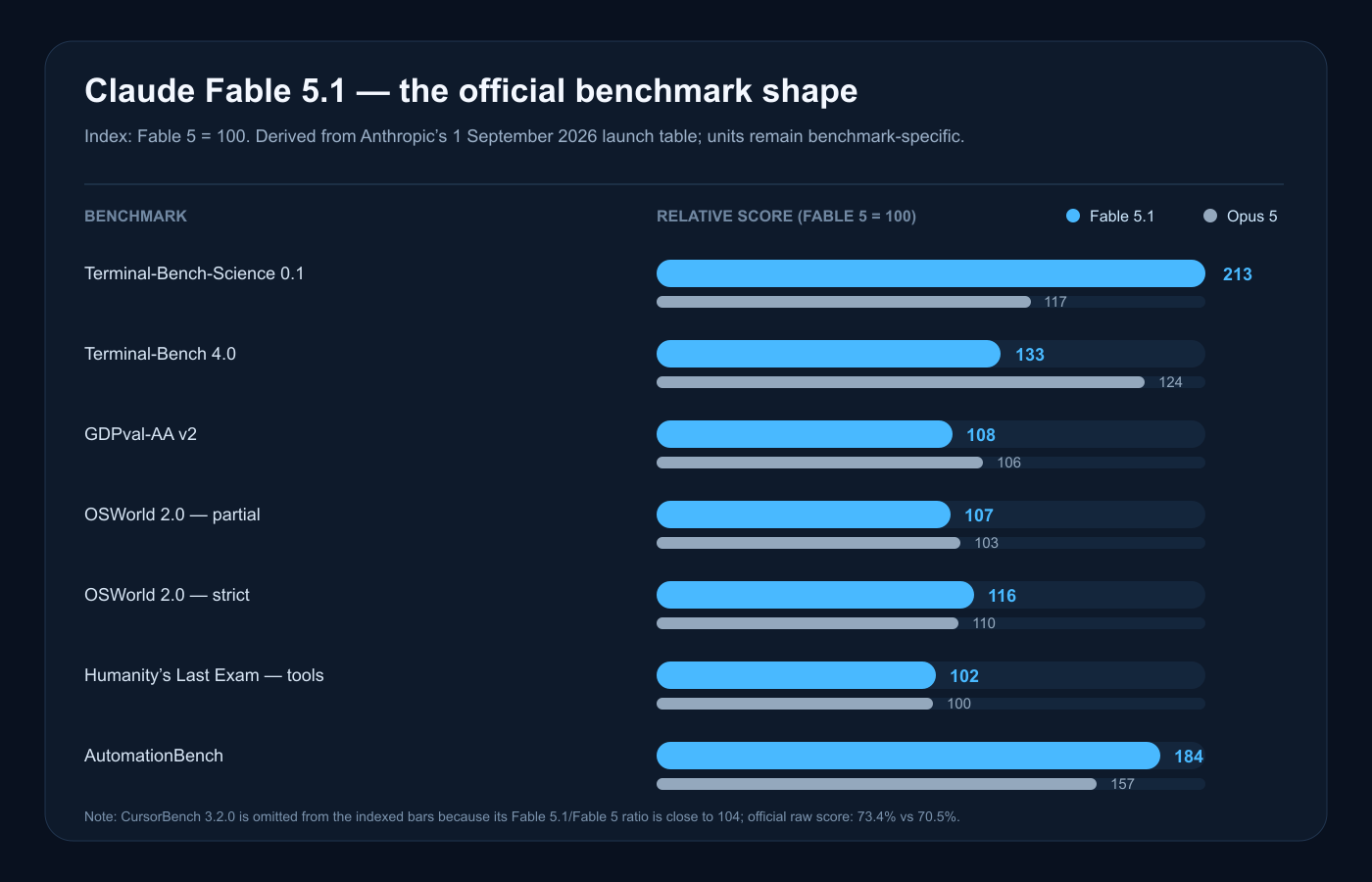
Reading the chart: the index is a within-benchmark comparison, not a universal capability score. A 213 on Terminal-Bench-Science does not mean “twice as intelligent” as a 100 on another benchmark.
The shape is more informative than the single headline. Fable 5.1’s largest relative lead over Fable 5 appears on Terminal-Bench-Science and AutomationBench. Its gains are smaller on Humanity’s Last Exam with tools and CursorBench. GDPval-AA v2 is closer to a real-work signal than a pure knowledge test, but the gap between 1,853 and 1,824 still needs uncertainty and harness context before it becomes a procurement conclusion.
There are also important caveats in Anthropic’s own release. The runs used production safeguards. Safety interventions scored zero on affected OSWorld tasks and some AutomationBench tasks. Terminal-Bench-Science reports standard errors of approximately ±3.5–4.5 points per model. OSWorld uses the benchmark authors’ August 2026 task release and should not be compared directly with earlier versions.
So the defensible statement is: Anthropic’s published evaluation table shows a broad Fable 5.1 lead, with especially large gains on selected agentic tasks. It is not an independent leaderboard, and it does not tell a buyer the cost per successful production task.
Why “cheaper” can still cost more
The quiet product change is the 75% reduction in cache-read cost. Fable 5.1’s official rate is $0.25/M. The Fable 5 comparison in the chart below is inferred from Anthropic’s documented 0.1x cache-read rate multiplied by the shared $10/M input price: $1.00/M.
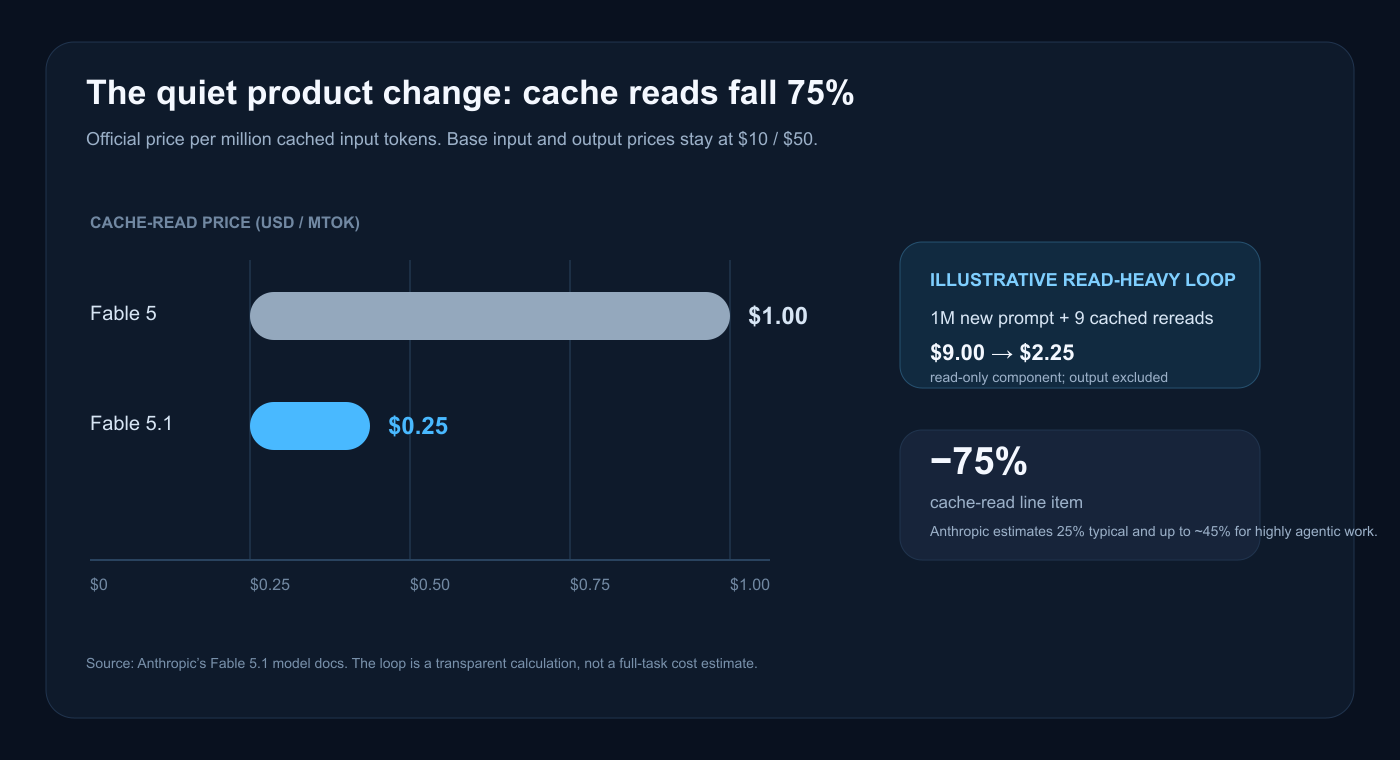
Illustration: one million new input tokens plus nine one-million-token cache rereads. It excludes output, cache writes, tools, retries, and provider fees.
For a stable agent loop with one million new input tokens and nine million cached rereads, the read-only component is $2.25 on Fable 5.1 versus $9.00 on that Fable 5 comparison. That is a clean 75% saving on the repeated context. It is not a promise that the whole task costs 75% less.
An external Artificial Analysis launch analysis makes the denominator problem visible. It reports an Intelligence Index of 66 for Fable 5.1 at maximum effort, 63 for Opus 5, and 62 for Fable 5. But its reported cost per Intelligence Index task is $3.76 for Fable 5.1, versus $3.14 for Fable 5 and $2.34 for Opus 5. The external numbers use a different harness from Anthropic’s launch table, so they should not be merged into one ranking. Their value is diagnostic: a cheaper cache line can coexist with a more expensive completed task.
The formula a platform team should measure is:
workflow cost = fresh input + cache reads + cache writes + output + retries/fallbacks
Then add the cost that token dashboards often omit: review time, failed tool calls, latency-sensitive infrastructure, and the value of an incorrect artifact.
Effort is part of the product
Fable 5.1 is not one fixed behavior. Anthropic’s prompting guide recommends starting at high effort and then sweeping low, medium, xhigh, and max against the actual task.
Effort affects text, tool calls, function arguments, and thinking—not only an invisible reasoning budget. At low effort, the model may search or retrieve less and lean more on memory. At xhigh and max, it may spend substantially more tokens drafting before returning the answer. Anthropic also notes that Fable 5.1 can make more variable parallel tool calls, provide fewer progress updates, and rewrite whole files for small edits.
That behavior is visible in early builder discussion. Some users say high-effort sessions exhaust subscription allowances quickly; others find medium practical. Those reports are useful signals about variance, not authoritative plan accounting. The official plan rules and your own token logs should decide.
The first production sweep should record:
- success rate against a fixed task set;
- output and cache-read tokens;
- number of tool turns and retries;
- wall-clock latency;
- human correction or review time;
- fallback and refusal rate;
- cost per accepted artifact.
That last metric is the one launch-day model comparisons rarely provide.
The migration is not just a model-ID change
Teams moving from Fable 5 should read the official migration guide before changing production traffic.
| Area | Fable 5.1 change | What to do |
|---|---|---|
| Forced tools | tool_choice: any and named forced tools return HTTP 400 | Use auto, strict schemas, and explicit prompting |
| Thinking | Adaptive thinking is always enabled | Do not send a disabled-thinking configuration |
| History | Earlier models cannot read Fable 5.1 thinking blocks | Keep model-bound blocks in the producing conversation |
| Prefix edits | Changing system, tools, or earlier history can invalidate blocks | Keep history append-only; handle prefix mismatch deliberately |
| Effort | Behavior and spend change across effort levels | Re-run the sweep; revisit max_tokens |
| Progress | Fewer visible updates may arrive by default | Use thinking.display: "updates" where the UI needs progress |
| Tool parallelism | Calls may be more variable or arrive one at a time | Batch independent requests explicitly and measure round trips |
This is an architectural migration. A model router, transcript store, tool executor, progress UI, and fallback handler all need review. The safest rollout is a shadow or canary route with a task-level acceptance test, not a global string replacement.
What X is showing about Three.js
The most entertaining Fable 5.1 evidence is arriving as short browser demos. Public X posts observed for this analysis include:
- an Airbus H145 helicopter scene attributed to a first Fable 5.1-versus-Fable 5 high-effort comparison (post by @minchoi);
- city-builder and Minecraft-style scenes described as being produced in Three.js (city-builder post, Minecraft-style post);
- a Starship simulator with a black hole and double pendulum, alongside a report that an audit caught a sea-rendering failure (post by @YFarmX);
- a sound-designed Snake game and longer game prototypes (Snake demo, subway FPS demo).
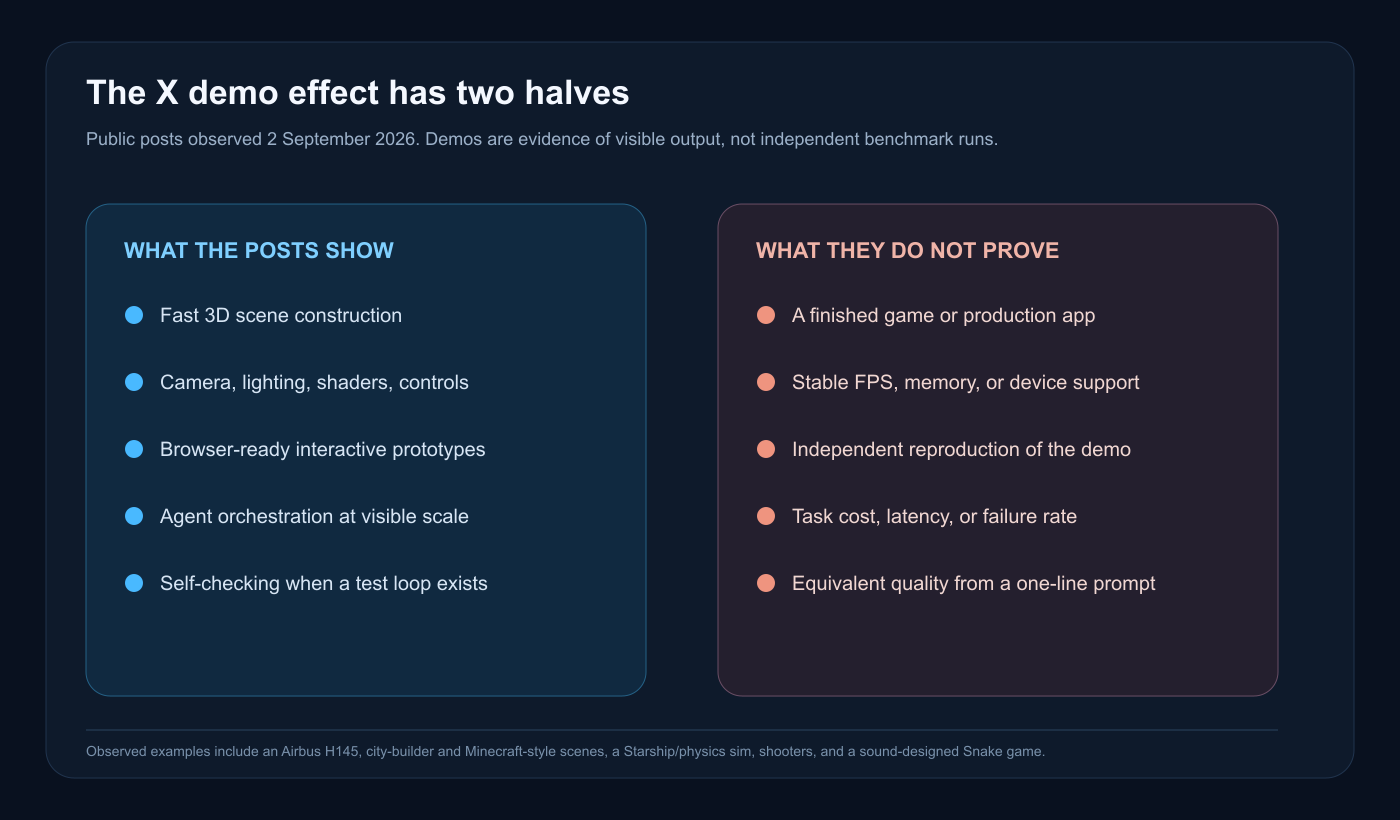
These are observed demos, not EyesTech benchmarks. Posts can change or disappear, and most do not include a public repository or controlled reproduction.
The pattern is still useful. Fable 5.1 appears capable of building a coherent interactive scaffold quickly: scene graphs, cameras, lighting, shaders, controls, UI, and browser packaging. But a 30-second video cannot establish stable frame rates, memory behavior, mobile support, accessibility, security, maintainability, or the amount of prompting and agent orchestration behind the result.
The self-checking example is more important than the spectacle. If a visual critic, screenshot loop, test harness, or human review catches a broken ocean shader, the workflow is doing real engineering work. “One prompt” is not the unit of reliability; the verified artifact is.
India deployment: check the route before the model
For Indian teams, the question is not just whether $0.25/M cache reads convert favorably into rupees. It is where the data is processed, who controls retention, which provider handles a safety fallback, and whether the contract meets the workload’s requirements.
At an illustrative ₹85 to the dollar—excluding GST, payment fees, and provider markups—the Anthropic list prices are:
| Component | Approximate illustration |
|---|---|
| Input | ₹850/M tokens |
| Output | ₹4,250/M tokens |
| Cache read | ₹21.25/M tokens |
These figures are only arithmetic. A buyer should separately confirm the direct Anthropic API, AWS, Google Cloud, and Microsoft Foundry route; processing region; retention owner; fallback behavior; India billing; and any residency or regulatory requirement. The reviewed provider documentation did not establish a general India-region guarantee, so this article makes no such claim.
The same principle applies to sensitive cyber and biology workloads. Anthropic says Fable’s safeguards are more permissive in some benign cases than earlier systems, but interventions and fallbacks remain part of the product. A workflow whose economics depend on never falling back is not production-ready until that fallback path is measured.
The practical routing rule
| Workflow | Starting point | Escalate to Fable 5.1 when… |
|---|---|---|
| Routine chat, drafting, or summarization | Lower-cost model | The task is unusually difficult and review cost dominates |
| General complex reasoning | Opus 5 | Opus fails the task-specific eval at acceptable effort |
| Long codebase work with stable context | Opus 5, then Fable 5.1 | Cache reuse is high and accepted-artifact cost falls |
| Multi-hour research or computer use | Fable 5.1 candidate | There is a test, screenshot, or artifact-verification loop |
| Sensitive cyber or biology work | Controlled router | Safeguards, fallbacks, retention, and audit requirements pass |
| India-regulated enterprise data | Provider review first | Region, retention, contract, and fallback conditions are satisfied |
The core decision can be stated simply: Fable 5.1 earns its premium when it reduces failure and review, not merely when it produces more tokens or a better demo.
Verdict: a selective upgrade, not a blanket migration
Fable 5.1 is a meaningful release. Anthropic’s official table shows broad gains on agentic and computer-use evaluations. The 1M context window and $0.25/M cache reads make it unusually interesting for long-running workflows with a stable prompt prefix. The official migration notes are unusually concrete, which is helpful: they tell teams exactly where a naïve swap will break.
But the launch should not be reduced to “the new model is cheaper.” Maximum effort can increase the task bill. Lower effort can reduce search and retrieval. Tool calls may become less predictable. Social 3D demos can hide long prompts, many agent turns, or missing verification. Cloud availability does not settle India-region processing or data governance.
The right rollout is an escalation route:
- Keep a cheaper default for routine work.
- Use Opus 5 as the general complex-reasoning baseline.
- Send only hard, cache-heavy, high-review-cost tasks to Fable 5.1.
- Sweep effort levels and measure accepted-artifact cost.
- Put tests, screenshots, diffs, or human gates after every consequential action.
EyesTech did not run an independent Fable 5.1 API or Claude Code benchmark for this package. This is a source-led flagship analysis, not a product review. Anthropic’s claims, external measurements, and X demos should all be rechecked as public harnesses and pricing data mature.
Update note: recheck pricing, plan limits, provider availability, migration behavior, external cost-per-task data, and the linked social demos at publication time, then again at 30 and 90 days.
Get the EyesTech Signal: model claims are easy to repeat. The useful question is what changes in the system around them—cost, latency, controls, and the quality of the artifact that actually ships.