
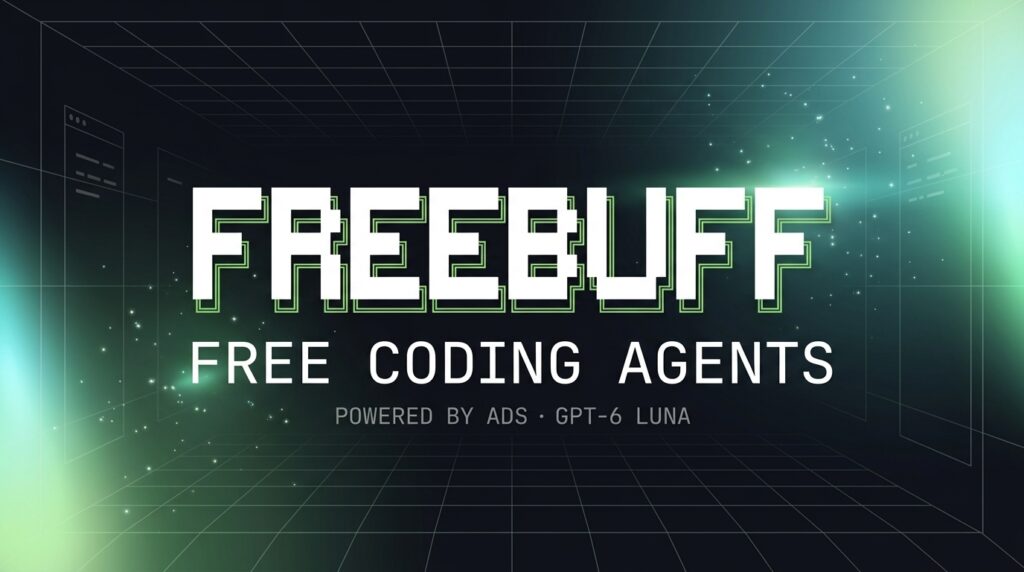

Five hours of GPT-6 Luna for $0 sounds like one of those deals that disappears when you click through. This one is real—but the asterisk is big. Freebuff lists Luna in its free full-access model picker, with no personal API key required. Not every account gets that picker. We checked Freebuff’s offer and documentation on September 26 to pin down who gets Luna, how to start, and what you can use if it isn’t there.
OpenAI released GPT-6 Luna on September 22. Freebuff now puts it inside an ad-supported coding agent for eligible users. You can run that agent in a terminal, desktop app, or browser. The first thing to check is not a price page. It is the model list shown to your own account.
The catch is in the five-hour promise
Freebuff’s full-access picker shows 100 Freebucks per day. Spend all of them on GPT-6 Luna and the page advertises up to five hours. Pick another model for part of the day and you have less allowance left for Luna. Those hour totals are alternatives, not free hours you can stack together.
The daily balance refills at midnight Pacific time and does not roll over. Freebuff also says session limits and capacity apply. In other words, five hours is the displayed maximum for a qualifying account, not five guaranteed hours of uninterrupted model time. The precise balance and models in your signed-in picker are what matter.
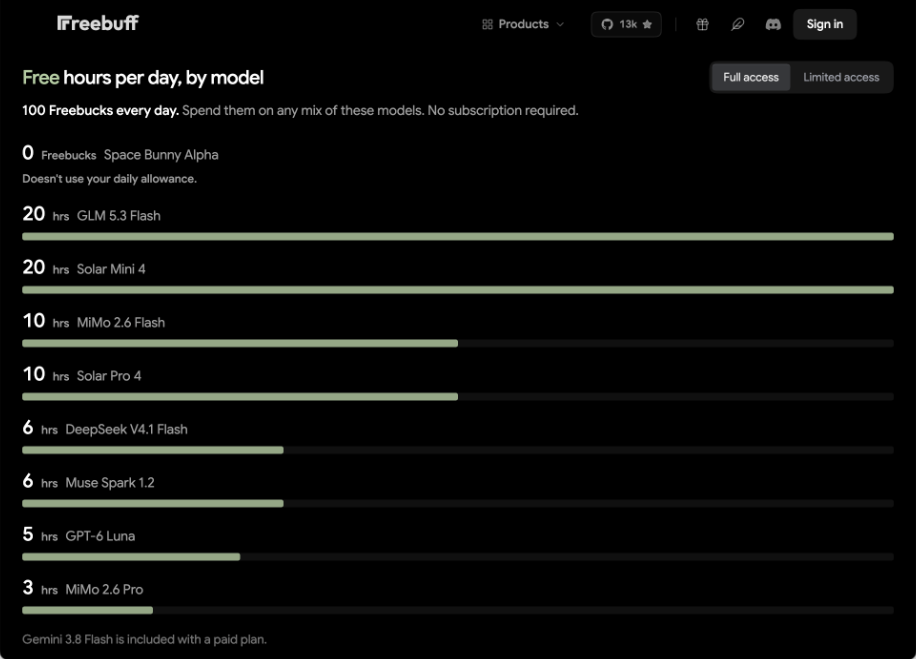
There is a second catch if you are outside a supported region or use a VPN. Freebuff’s own repository says those users receive limited access. That catalog includes GLM 5.3 Flash, DeepSeek V4.1 Flash, MiMo 2.6 Flash, Solar Mini 4, and Solar Pro 4; it does not list GPT-6 Luna. Because access varies, check the model picker instead of assuming any country-specific allowance applies to you.
Check your account, then start coding
The quickest route is simple. Visit Freebuff, sign in, and open its model picker. If Luna appears with a free balance, select it and read the session rules shown there. If it does not appear, try one of the free models your account does show. That gives you an answer in your own region before you hand the agent a project.
For the terminal version, install the official CLI and launch it in a project directory:
npm install -g freebuff
cd your-project
freebuff
Freebuff’s quick-start guide documents those commands. Its desktop and web versions are linked from the same site. The agent can find files, edit code, run checks, and use specialist agents for research or review. Freebuff has not publicly promised that each specialist always uses one fixed model, so choose based on the access and results you actually see.
No Luna in your picker? You still have free options
That is the part worth keeping in view. The limited-access catalog still includes coding models such as GLM 5.3 Flash and DeepSeek V4.1 Flash. Freebuff says its agents can work across a real repository, not just complete the next line of code. You may not get Luna’s five-hour offer, but you can still try an agent on a small bug fix, a test, or a side project without supplying your own model API key. See Freebuff’s current model list.
How can Freebuff afford to offer this?
Freebuff says text ads help pay for its included models. Luna’s published API price is also low: OpenAI lists $0.10 per million input tokens, $0.01 per million cached input tokens, and $0.50 per million output tokens at Standard rates. Flex processing is half that price, and Freebuff’s public routing code puts Flex first for Luna, with Standard as a fallback.
That explains why an ad-supported offer is plausible. It does not tell us Freebuff’s actual cost per coding session or its ad revenue; the company has not published the usage and revenue data needed to calculate a real margin. For readers, the practical question is simpler: does your account show the model, and how much time does it show today?
Before you point it at private code
Free is still a data decision. Freebuff’s privacy policy says prompts, messages, code, files, and agent activity are processed to provide the service. Prompts and messages—including code pasted into them—may be analyzed to personalize ads. The policy says separately uploaded files and connected repository contents are not provided to advertising companies.
Data may be used for AI training only when the selected model or feature clearly shows a training notice. Freebuff Cloud also has a separate, limited evaluation rule for connected GitHub repositories. If you are opening a work repository, read the current model notice and your organization’s rules first. For a personal project, this is still worth a minute of attention before you paste secrets or connect an entire repo.
Is it worth trying?
Yes—if the models and data terms fit your project. A full-access account that shows GPT-6 Luna has a genuine no-API-key route to a capable OpenAI coding model. A limited-access account still has free agents to test on real work. Open the picker, choose a small task, and let the result decide whether Freebuff belongs in your workflow.
Frequently asked questions
Is GPT-6 Luna free for every Freebuff user?
No. Freebuff advertises up to five free hours for full-access users who spend their daily allowance on Luna. Its limited-access documentation does not list Luna. Check the picker in your own account.
When do the free hours reset?
Freebuff says daily Freebucks refill at midnight Pacific time and do not carry over. The hours shown for different models share the same daily allowance. See the current offer.
Can I use it on a private repository?
First check the project’s data rules and the selected model’s training notice. Freebuff’s privacy policy explains what it processes and when prompts may inform ads. The right answer depends on the repository and your organization’s requirements.
Reporting note: Eyestech checked Freebuff’s public offer, repository, model routing, privacy policy against OpenAI’s model documentation and our personal use in our region on September 26, 2026. We did not test signed-in accounts in every region( cause it was not possible) ; Freebuff can change model availability and limits.