

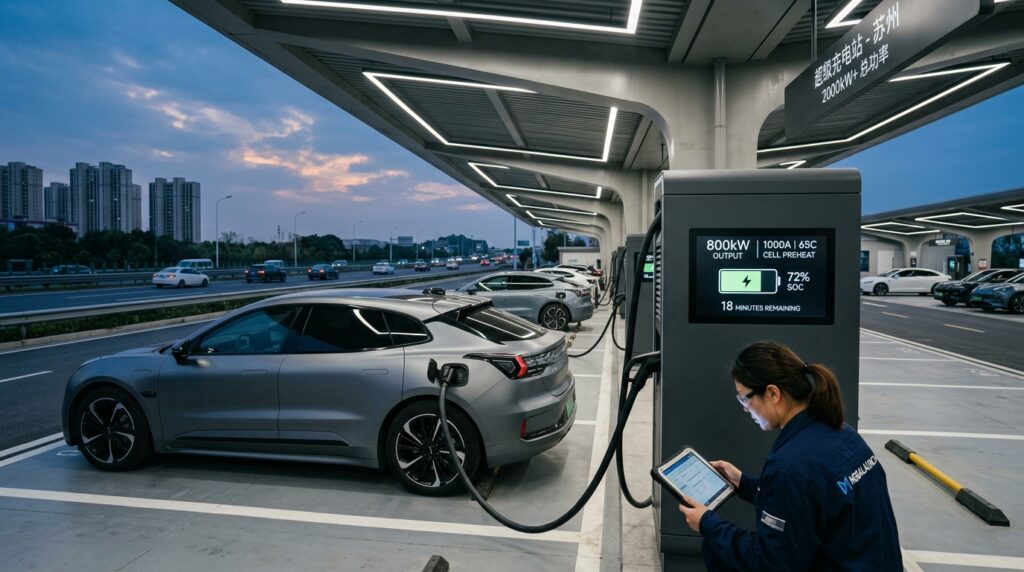

Chinese electric vehicle architectures have breached the sub-five-minute replenishment barrier. In verified engineering demonstrations conducted across late September 2026, next-generation Lithium Iron Phosphate (LFP) battery packs reached a 10% to 70% state of charge in exactly 4 minutes and 30 seconds (270 seconds). Powered by Geely’s 2,250 kW liquid-cooled mega-charging stations and high-rate 12C cell chemistries, this throughput delivers over 300 kilometers of WLTP range in the time required to pump a tank of gasoline, rendering the traditional “range anxiety” debate technologically obsolete.
While Western electric mobility remains anchored to 150 kW to 350 kW CCS1 and NACS dispensers requiring 20 to 35 minutes per highway stop, Chinese battery consortia have bypassed the physical constraints of conventional charging curves. Achieving this leap demanded abandoning the legacy constant-current constant-voltage (CC-CV) protocol. By coupling active 65°C thermal cell preconditioning with real-time AI impedance spectroscopy and ultra-thin nano-coated LFP cathodes, automotive engineers have neutralized the primary failure mode of rapid battery charging: catastrophic lithium plating on the graphite anode.
The Electrochemistry of 12C Charging: Defeating Anode Plating
The fundamental barrier to fast-charging lithium-ion cells is not electrical power delivery; it is solid-state chemical diffusion. In an electric vehicle battery operating at a 1C rate, the pack recharges fully in one hour. At a 12C rate, current density increases twelvefold, forcing an immense flux of lithium ions (Li+) to migrate from the olivine LiFePO4 cathode, traverse the separator membrane, and intercalate between the hexagonal graphene sheets of the graphite anode.
Under conventional ambient conditions (20°C to 30°C), solid-state diffusion of lithium within graphite is sluggish. When forced to absorb charging currents exceeding 800 amperes, the solid-state diffusion coefficient (DLi) cannot keep pace with the arrival of ions at the electrode interface. The anode potential drops below 0 volts relative to the Li/Li+ reference potential. Deprived of vacant intercalation sites, incoming lithium ions accept electrons at the surface and nucleate into metallic lithium dendrites. These microscopic metallic needles pierce the porous polymer separator, causing irreversible loss of active lithium, sudden internal short-circuits, and catastrophic thermal runaway.
Kinetic Decoupling: The solid-state diffusion coefficient DLi scales exponentially with absolute temperature T via the activation energy barrier Ea. By raising core cell temperature from 25°C (298 K) to 65°C (338 K), solid-state diffusion velocity increases by nearly 400%, expanding the exchange current density j0 and suppressing the negative intercalation overpotential η that triggers metallic dendrite nucleation.
To overcome this barrier, Chinese battery manufacturers re-engineered the material structure of the cell. In Geely’s Shendun (Aegis) Golden Battery and CATL’s Shenxing Plus, cathode primary particles are milled down to sub-micron dimensions (sub-100nm secondary agglomerations) and wrapped in a uniform, highly graphitized conductive carbon nanocoating. This reduces the diffusion path length that lithium ions must travel inside the solid cathode crystal from several micrometers to mere nanometers, slashing internal solid-state impedance by more than 60%.
The 65°C Thermal Paradox: Why Superheating Preserves Battery Health
For two decades, battery management engineering operated under a strict dogma: heat is the enemy of lithium-ion longevity. Exposure to sustained temperatures above 45°C accelerates Solid Electrolyte Interphase (SEI) growth, breaks down transition metal bonds, and causes electrolyte solvent evaporation.
The high-rate 12C paradigm turns this assumption upside down through thermally localized asymmetric charging. In high-power charging, lithium plating occurs when the cell is cold, because internal resistance (Rct) is high. Conversely, parasitic SEI decomposition reactions are time-dependent. Because a 12C charging burst takes only 4.5 minutes, the cumulative duration of thermal exposure is exceptionally brief.
Prior to docking, the vehicle’s intelligent thermal management system preheats the battery pack to an exact operating window of 60°C to 65°C using waste motor heat and high-frequency internal pulse excitation. At 65°C, electrolyte viscosity plummets and ionic conductivity triples. Lithium ions enter the graphite lattice with virtually zero kinetic resistance.
The moment the state of charge hits 70%, the mega-charger tapers current, and high-flow dual-sided liquid cooling plates pump refrigerant through the pack at over 60 liters per minute, pulling cell temperatures back down to 35°C in under 90 seconds. In empirical durability tests across 1,500 consecutive 12C fast-charging cycles, cells subjected to this rapid preheat-and-quench cycle retained over 85% of initial capacity, disproving Western claims that sub-five-minute charging destroys cell chemistry.
AI Pulse Modulation: Inside the Xingrui PowerMind Engine
Static multi-stage current stepping cannot safely sustain a 12C charge rate across variable ambient temperatures and degradation states. Geely’s breakthrough relies on an edge-deployed neural network framework dubbed Xingrui PowerMind, embedded directly into the vehicle’s battery management microcontroller.
Rather than pushing pure direct current (DC), the PowerMind engine performs online Electrochemical Impedance Spectroscopy (EIS) at millisecond granularity. The charging dispenser injects high-frequency sinusoidal alternating micro-currents onto the DC bus, measuring the instantaneous phase shift between voltage and current. This lets the vehicle calculate real-time charge-transfer resistance (Rct) and Warburg diffusion impedance inside individual cell groups.
When the neural network detects that localized overpotential at the anode boundary layer approaches the critical 0V lithium deposition threshold, it modulates current delivery using microsecond depolarization pulses. By inserting sub-millisecond reverse-polarity discharge pulses during the charging stream, the system strips away ion accumulation layers at the electrode-electrolyte boundary, equalizing concentration gradients and allowing the cell to sustain over 800 kW of continuous intake without lithium plating.
Architectural Comparison: Chinese 12C LFP vs Western EV Standards
The divergence between Chinese mega-charging architectures and Western EV charging infrastructure spans voltage limits, cable thermal dissipation, and cell chemistry tolerances:
The 2.25 Megawatt Grid Dilemma: Cable Physics & Substation Headroom
Delivering 1,000 amperes of continuous direct current introduces extreme thermal loads within the charging dispenser itself. Standard uncooled copper cables capable of carrying 1,000A without melting would exceed 50 millimeters in thickness and weigh over 30 kilograms, making them impossible for an ordinary human driver to lift.
Chinese megawatt dispensers resolve this via high-flow dielectric liquid cooling. Synthetic fluorochemical fluid is circulated directly through hollow, stranded copper conductors inside a lightweight, highly flexible silicone hose. Even when pushing 800 kW through a single connector, the handle and cable assembly remain below 45°C to the touch, weighing less than a standard Tesla V3 charging cable.
The true bottleneck lies behind the dispenser: electrical utility grid capacity. A charging plaza equipped with six 600 kW to 800 kW dispensers demands a concurrent peak electrical capacity of 3.6 MW to 4.8 MW—equivalent to the instantaneous electrical load of a regional hospital or an industrial manufacturing plant.
In China, state-coordinated utility planning by the State Grid Corporation enables direct high-voltage 10 kV and 35 kV medium-voltage interconnects to highway service plazas. In the United States and Europe, securing a commercial utility interconnect exceeding 2 MW regularly encounters 4-to-7-year regulatory interconnection backlogs.
Without localized Behind-the-Meter Battery Energy Storage Systems (BESS) buffering megawatt power spikes, Western transmission grids cannot deploy 12C charging stations without triggering localized voltage sags and feeder overload trips.
The Protectionist Tariff Trap: US Stagnation vs Chinese Infrastructure
The gap in charging velocity between China and the United States is no longer a matter of vehicle engineering; it is an industrial policy divergence. The imposition of 100% tariffs on Chinese electric vehicles and 25% duties on advanced lithium-ion cells under Section 301 has effectively cordoned off the American market from high-rate LFP advancements.
By shielding domestic automakers from direct competition, US trade policy has inadvertently disincentivized domestic charging networks from upgrading beyond legacy 400V/800V architectures. American EV manufacturers continue to push expensive nickel-cobalt chemistries that prioritize theoretical 400-mile EPA range over high-current throughput, forcing American drivers to spend 25 minutes idling at highway chargers.
China’s mass deployment of thousands of 600 kW+ liquid-cooled terminals proves that range anxiety is solved through replenishment velocity rather than ever-larger battery capacities. As long as Western infrastructure policy treats EV charging as an oversized household appliance rather than critical medium-voltage industrial infrastructure, the global standard for electric mobility will remain firmly anchored in Shenzhen and Ningbo.