



OpenAI will reopen subscriptions to its premier $200-per-month ChatGPT Pro tier on Wednesday, September 30, ending a three-week freeze on new sign-ups triggered by unprecedented demand for its frontier reasoning models. However, the plan’s return carries an aggressive structural restructuring: OpenAI is overhauling its usage formula to deliver half the dollar-equivalent API spend of the previous $200 tier.
The reduction was disclosed late Tuesday in a public message posted to X by Thibault “Tibo” Sottiaux (@thsottiaux), OpenAI’s Head of Core Products & Platform and product lead for ChatGPT and Codex, ahead of an expected suite of product announcements.
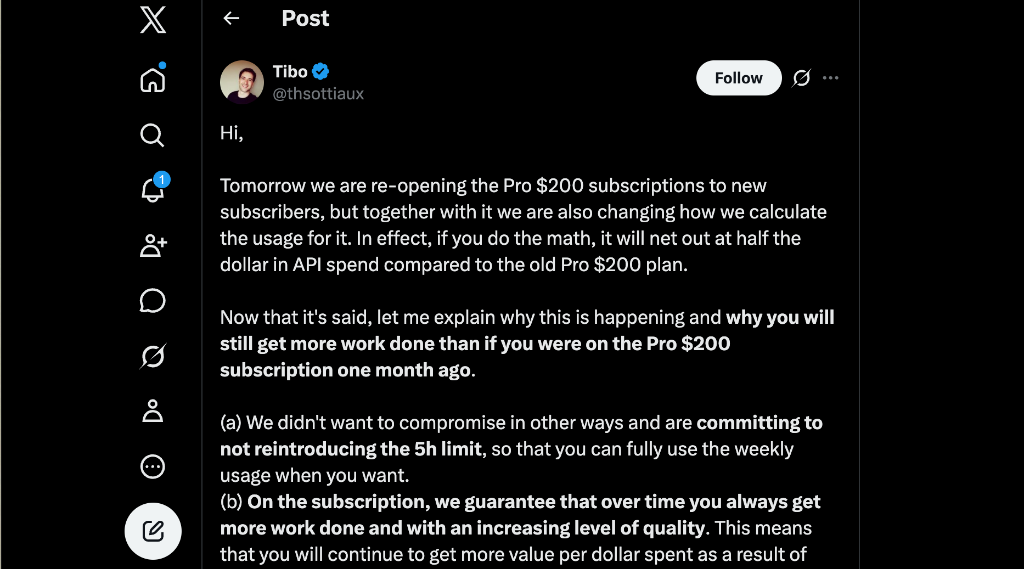
“Tomorrow we are re-opening the Pro $200 subscriptions to new subscribers, but together with it we are also changing how we calculate the usage for it. In effect, if you do the math, it will net out at half the dollar in API spend compared to the old Pro $200 plan.”
The announcement formalizes a permanent contraction in compute allowances for OpenAI’s heaviest consumer tier, even as the monthly price tag remains fixed at $200. For power users, quantitative researchers, and software engineers who previously leveraged the subscription to run deep recursive agentic workflows, the math represents a sudden 100 percent increase in the cost per raw compute unit.
The Terms: What Changes on September 30
| Policy Dimension | Pre-Pause $200 Plan | Reopened $200 Plan (Sept 30) |
|---|---|---|
| API Dollar Allowance | 100% (Baseline Allowance) | 50% Reduction (Net Half Dollar Value) |
| 5-Hour Rolling Throttle | Enforced / Under Active Consideration | Permanently Removed (Burst Freedom) |
| GPT-6 Sol & Luna Throughput | Standard API Rate | Roughly Net-Neutral (Offset by 50% Price Drop) |
| GPT-6 Astra / Flagship Capacity | Full Capacity (~200 msg/week baseline) | Direct ~50% Drop in Usable Token Volume |
| Sign-Up Status | Paused on September 10, 2026 | Reopened for New Subscriptions |
The Defense: “You Will Still Get More Work Done”
Anticipating immediate backlash from power users, Sottiaux argued that subscribers would still outproduce what they were doing a month ago due to rapid architectural optimizations and aggressive API price reductions.
“On the subscription, we guarantee that over time you always get more work done and with an increasing level of quality,” Sottiaux wrote. “This means that you will continue to get more value per dollar spent as a result of models getting more efficient and us passing down the improvements in the form of API price reductions.”
OpenAI specifically pointed to price reductions introduced earlier this week for GPT-6 Sol and GPT-6 Luna, both of which saw their API list prices cut by 50 percent. For subscribers whose automated pipelines rely primarily on Sol or Luna, the 50 percent cut in dollar allocation balances against the 50 percent cheaper token cost, leaving gross token throughput roughly neutral.
The Model Arbitrage Disparity: Sottiaux’s offset holds true only for discounted efficiency models. OpenAI’s flagship frontier engine, GPT-6 Astra, did not receive an accompanying 50 percent price reduction.
For enterprise engineers executing autonomous Codex runs that require multi-turn chain-of-thought verification, deep repository context parsing, and recursive tool calling on Astra, the effective token volume has been cut in half. The cost per completed complex engineering task has effectively doubled.
The Concession: The 5-Hour Throttle Is Gone
To temper the capacity reduction, OpenAI committed to permanently removing the rolling 5-hour usage limit on the $200 plan.
In late August, OpenAI implemented rolling 5-hour throttles on its lower-tier plans (ChatGPT Plus and Business Standard) to combat severe cluster contention caused by recursive background agents. While this prevented users from consuming their entire monthly quota in an afternoon, it crippled developers working under production deadlines, abruptly pausing workflows mid-execution until the rolling window expired.
By abandoning the 5-hour window for Pro subscribers, OpenAI is fundamentally shifting its compute management strategy:
- Unconstrained Burst Freedom: Subscribers can consume their entire weekly compute allowance in an uninterrupted, high-concurrency sprint without arbitrary time-based lockouts.
- The Hard Quota Ceiling: Once that smaller weekly pool is exhausted, users cannot wait out an hourly timer. Access to frontier reasoning remains locked until the next billing week resets.
Behind the Pause: Compute Economics and Agentic Drain
OpenAI abruptly halted new sign-ups for the $200 tier on September 10, 2026, after soaring adoption of GPT-6 Astra placed immense strain on company infrastructure. While existing subscribers were permitted to renew, new onboarding was frozen.
The root cause was adverse selection in agentic workloads. Unlike standard conversational prompts, autonomous Codex runs repeatedly loop through file trees, compile code, read diagnostic outputs, and execute tests. Power users were routinely extracting between $600 and $1,000+ worth of raw API compute every month out of a single $200 flat fee, burning company margins.
In his note, Sottiaux made an unusual admission, explicitly confirming that OpenAI aims to close the gap between fixed subscription tiers and consumption-based developer billing:
“Over time, we see prices go low enough that it makes sense for most to buy usage as needed without there being a significant gap between what you get in a subscription and what you get in the API for a dollar spent.”
This statement signals an industry-wide transition. The era of venture-subsidized, flat-rate “all-you-can-eat” compute for elite frontier AI models is drawing to a close, replaced by strict usage parity and consumption metering.
What to Expect Next
OpenAI plans to package the reopening tomorrow inside a series of feature announcements that “won’t draw on the usage” quota, according to Sottiaux. These additions are anticipated to focus on low-overhead workflow tooling, including local workspace indexing and UI integration improvements.
Meanwhile, references to an unannounced $500-per-month “Pro Max” tier have recently surfaced in front-end application code, suggesting that OpenAI is preparing to segment extreme enterprise users into an even higher-priced compute bracket.
New sign-ups for the restructured $200 Pro tier go live tomorrow, September 30. For developers upgrading, the takeaway is clear: enjoy the freedom from hourly throttles, but audit your token burn carefully—because the compute reservoir is only half as deep as it was a month ago.