
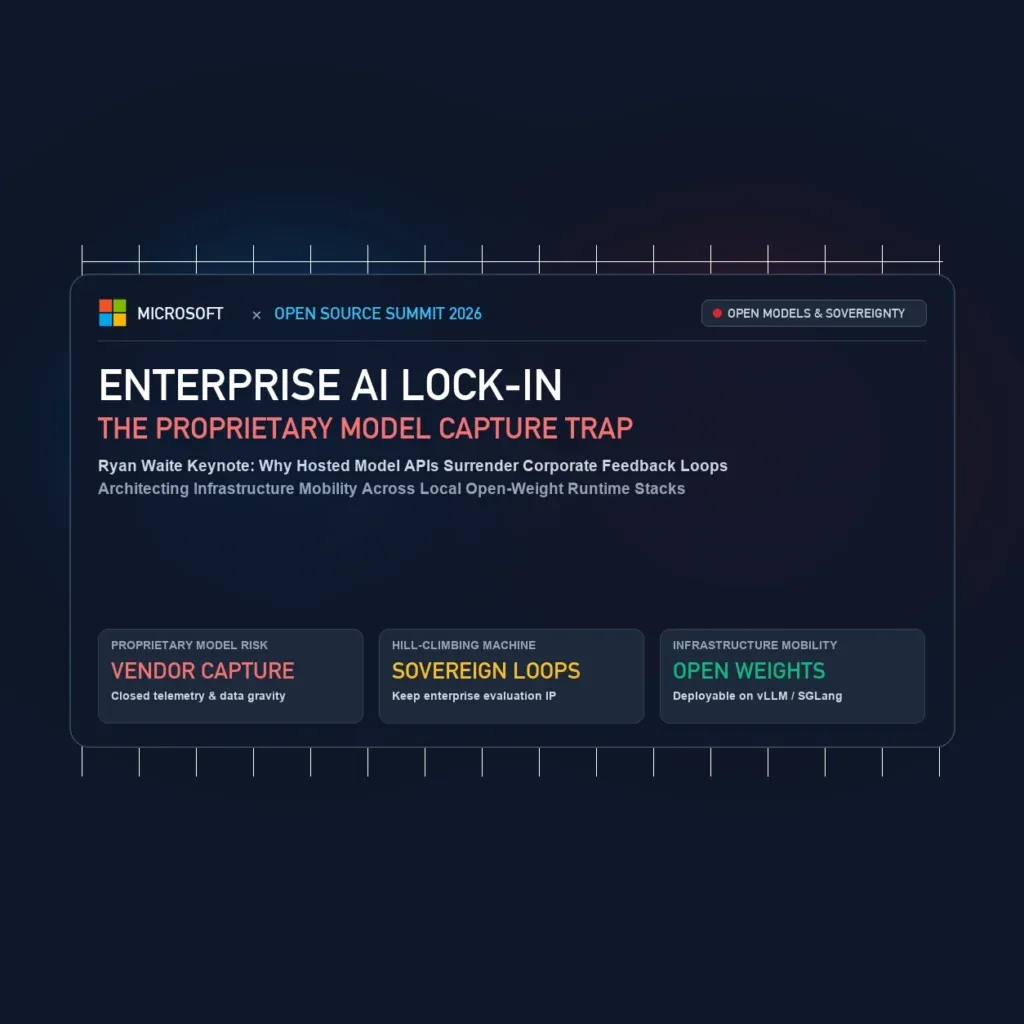

When an enterprise routes every prompt, retrieval context, and employee correction through a proprietary frontier model API, it does not own the intelligence compounding inside its systems. It is financing the training telemetry of an external vendor while creating structural architectural dependencies that make model switching nearly impossible. That warning did not come from an open-source activist. It came directly from Microsoft leadership on stage at Open Source Summit Europe 2026 in Prague.
Delivering a keynote on October 9 titled “From Open Source to Agentic Systems: Building the AI Native Era,” Ryan Waite, Director of Open Source Ecosystems and Incubations at Microsoft, urged enterprise technology leaders to aggressively protect their organizational sovereignty. Waite advised corporate IT architects to treat AI models as replaceable commodities and avoid surrendering their internal organizational feedback loops to closed platforms. The statement carries immense weight coming from Microsoft—the primary commercial benefactor of OpenAI and the global distributor of closed-model subscriptions across Azure OpenAI Service.
The Enterprise AI Capture Invariant
The commercial value of enterprise AI does not reside in generic model parameters rented over an HTTP endpoint. It resides in the organizational learning loop—the proprietary evaluation rubrics, correction traces, and domain-specific preference pairs generated by corporate staff. When that telemetry is locked behind a third-party vendor’s black-box API, the enterprise surrenders its competitive moat and exposes its operational stack to arbitrary pricing shifts and model deprecations.
The “Hill-Climbing Machine” and the Feedback Loop Asset
Waite described modern artificial intelligence as a “hill-climbing machine.” In this mental model, general-purpose base weights provide baseline statistical pattern matching, but climbing the performance hill requires continuous cycles of human context, task verification, and correction. Every time an internal engineer refines an agent’s code generation, a claims adjuster corrects a policy summary, or an analyst corrects a financial breakdown, a high-value signal is generated.
When an organization builds its workflows around proprietary endpoints, those correction signals remain stranded in proprietary session caches or leak into external telemetry. In earlier reporting on Microsoft-Decision-1, our colleagues noted how routing an operational control layer through hosted foundry endpoints introduces immediate architectural coupling to cloud infrastructure. Waite’s keynote takes that observation to its logical conclusion: if a company cannot extract, export, or train against its own task trajectories, it does not own its hill-climbing machine.
• Enterprise Prompt & Context → Hosted Cloud API
• Human Corrections → Opaque Session Cache
• Model Weights → Closed Black-Box (Zero Access)
• Telemetry Outcome → Vendor captures alignment loop
• Enterprise Prompt & Context → Internal Gateway Proxy
• Human Corrections → Private Parquet / Iceberg Lake
• Model Weights → Open Weights (vLLM / SGLang / Ollama)
• Telemetry Outcome → Enterprise trains proprietary LoRA/DPO
The Four Vectors of Proprietary AI Model Capture
Vendor lock-in in modern AI architecture does not resemble traditional relational database stickiness. It operates across subtle semantic, legal, and operational planes that quietly entrench dependency:
1. Tokenizer and Prompt Latent Coupling
Enterprise engineering teams spend months optimizing brittle prompt templates, few-shot examples, and system instructions for a specific proprietary model family. Because vocabulary tokenizers differ fundamentally across providers (for instance, OpenAI’s o200k_base versus Anthropic’s Claude tokenizer or Qwen’s byte-pair encoding), prompt sensitivity is tightly coupled to the specific model’s latent representation. Swapping models often breaks output formatting, degrades JSON schema compliance, and requires exhaustive regression testing.
2. Synthetic Distillation Terms of Service Bans
Most enterprise leaders fail to read Section 2(c) of commercial API agreements. Commercial terms from major frontier labs explicitly forbid using model outputs to train, fine-tune, or distill competing models. If an organization generates millions of customer service summaries, synthetic code snippets, or translation pairs via a proprietary API, that corpus is legally contaminated. The enterprise cannot legally use its own operational history to train an internal open-weight model, permanently entrenching dependency on the API vendor.
3. Tool-Calling Protocol Entanglement
Proprietary tool-use interfaces (such as OpenAI Assistant APIs or proprietary JSON mode mechanisms) require bespoke state management, function call schemas, and error retry patterns. When agent harnesses are written directly against vendor-specific SDKs rather than standardized, model-agnostic abstraction layers like the Model Context Protocol (MCP) or OpenAI-compatible tool specifications, replacing the backend engine demands a complete rewrite of the orchestration layer.
4. Data Gravity and Network Egress Economics
As enterprises scale Retrieval-Augmented Generation (RAG) pipelines, proprietary vector stores and embedding models anchor massive data stores within a single hyperscaler’s environment. Moving terabytes of multi-turn conversational history and high-dimensional embeddings across cloud boundaries incurs severe network egress fees and latency penalties, effectively creating an operational moat around the incumbent host.
The Arithmetic Proof: DPO Alignment and Sovereign TCO
The mathematical reality of fine-tuning demonstrates why retaining the feedback dataset is far more critical than renting generic model weights. When an enterprise fine-tunes a base model via Direct Preference Optimization (DPO), the optimization objective updates the policy parameters strictly from validated human correction pairs:
The Sovereign Data Asset: In the DPO objective, the policy parameter update θ depends entirely on the empirical preference dataset D = {(x, yw, yl)}, where x is the enterprise input, yw is the validated outcome, and yl is the rejected generation. While frontier models establish the base reference policy πref, the preference dataset D represents the irreducible intellectual property of the enterprise.
Consider the economic math at production scale. An enterprise processing 100 million tokens per day across multi-agent coding and document reasoning pipelines faces a retail cloud API bill of approximately $3,000 to $5,000 per day ($1.1M to $1.8M annually) with zero asset accumulation. Self-hosting a cluster of 8× NVIDIA H100 or H200 accelerators running vLLM with FP8/FP4 quantization costs approximately $20,000 to $25,000 per month ($240,000 to $300,000 annually) in reserved colocation compute—a 74% to 83% net reduction in total cost of ownership while keeping all trajectory telemetry within the enterprise firewall.
The 3-Tier Architecture for Infrastructure Mobility
Enterprises do not need to abandon frontier commercial models entirely to avoid lock-in. Instead, engineering teams must build an intermediate abstraction layer that treats commercial APIs as temporary scaffolding while migrating operational workloads to sovereign open-weight runtimes.
# sovereign_router.py - Enterprise Model-Agnostic Gateway with Trajectory Capture
import os
import json
import time
from typing import Dict, Any, List
import httpx

class SovereignAIRouter:
    def __init__(self, private_vllm_url: str, fallback_api_url: str, data_lake_client):
        self.local_endpoint = private_vllm_url.rstrip("/")
        self.fallback_endpoint = fallback_api_url.rstrip("/")
        self.lake = data_lake_client

    async def complete_task(self, prompt: str, schema: Dict[str, Any], max_tokens: int = 1024) -> Dict[str, Any]:
        payload = {
            "model": "qwen2.5-72b-instruct",
            "messages": [{"role": "user", "content": prompt}],
            "response_format": {"type": "json_object", "schema": schema},
            "temperature": 0.0,
            "max_tokens": max_tokens
        }

        t0 = time.perf_counter()
        # 1. Primary Route: High-speed sovereign internal inference
        try:
            async with httpx.AsyncClient(timeout=10.0) as client:
                res = await client.post(f"{self.local_endpoint}/v1/chat/completions", json=payload)
                res.raise_for_status()
                data = res.json()
                provider = "sovereign_vllm"
        except (httpx.ConnectError, httpx.TimeoutException):
            # 2. Resilient Fallback: Managed cloud API
            payload["model"] = "gpt-4o"
            async with httpx.AsyncClient(timeout=30.0) as client:
                res = await client.post(f"{self.fallback_endpoint}/chat/completions", json=payload)
                res.raise_for_status()
                data = res.json()
                provider = "cloud_fallback"

        latency_ms = (time.perf_counter() - t0) * 1000
        output_text = data["choices"][0]["message"]["content"]

        # 3. Trajectory Logging: Retain feedback loop in private enterprise store
        await self.lake.log_trajectory({
            "prompt": prompt,
            "response": output_text,
            "provider": provider,
            "latency_ms": latency_ms,
            "schema_compliant": True,
            "timestamp": time.time()
        })

        return {"content": output_text, "provider": provider, "latency_ms": latency_ms}
Open Weights Are Not an Automatic Panacea
Advocating for infrastructure mobility does not mean uncritically romanticizing open models. Self-hosting open-weight architectures introduces real operational overhead that engineering teams must budget for. Running a 70B parameter model at low latency requires dedicated GPU clusters, tensor parallelism management, KV-cache paged allocation, and continuous kernel maintenance. Earlier teardowns of local engines like Ollaya and Ollama demonstrated that while local execution eliminates cloud per-token pricing and API throttles, it demands rigorous memory bandwidth planning and quant precision selection.
Beyond compute management, enterprise architects must scrutinize model licenses before claiming sovereignty. Releasing model weights does not make a system “open source” in the traditional Open Source Initiative (OSI) sense. While models like Mistral and Qwen are frequently distributed under permissive Apache 2.0 licenses, models like Meta’s Llama series contain commercial user thresholds and distribution limitations. An enterprise seeking true mobility must ensure its models can be deployed across multi-cloud and on-premise environments without intellectual property encumbrances, similar to the sovereign software initiatives pioneered by public-sector migrations like the Dutch Government DAWO-NixOS transition.
The Strategic Verdict: Own the Loop or Rent the Future
Ryan Waite’s keynote at the Open Source Summit highlights an inflection point in enterprise AI strategy. The initial phase of enterprise AI adoption was characterized by rapid experimentation and indiscriminate adoption of proprietary commercial APIs. The next phase will be defined by cold-eyed architectural evaluation.
Renting a hosted intelligence endpoint is acceptable for non-differentiating exploratory tasks. But allowing a third-party vendor to capture your core institutional learning loop is an unforced strategic blunder. By building model-agnostic abstraction layers, storing private trajectory datasets, and establishing local open-weight deployment pipelines, enterprises can enjoy the agility of modern AI without becoming captive tenants in someone else’s datacenter.
Frequently Asked Questions
What is AI model lock-in?
AI model lock-in occurs when an enterprise designs its workflows, prompt structures, tool schemas, and data pipelines around a specific proprietary model provider. Because tokenizers differ, commercial terms prohibit model distillation, and internal feedback loops are not exported, migrating to an alternative model requires costly operational and software rewrites.
What did Microsoft Director Ryan Waite warn at the Open Source Summit?
At Open Source Summit Europe 2026, Ryan Waite warned enterprises against proprietary model capture. He emphasized that AI acts as an organizational “hill-climbing machine” driven by continuous human feedback loops, and urged companies to architect infrastructure mobility across local and open-weight models to retain ownership of their proprietary evaluation data.
How can enterprises build portable AI infrastructure?
Enterprises achieve infrastructure mobility by deploying model-agnostic API gateway proxies (like LiteLLM), storing all request-response-correction trajectories in private columnar data lakes, and distilling domain tasks into open-weight models (such as Llama 3.3, Qwen 2.5, or DeepSeek) hosted on private cloud or on-premise clusters.