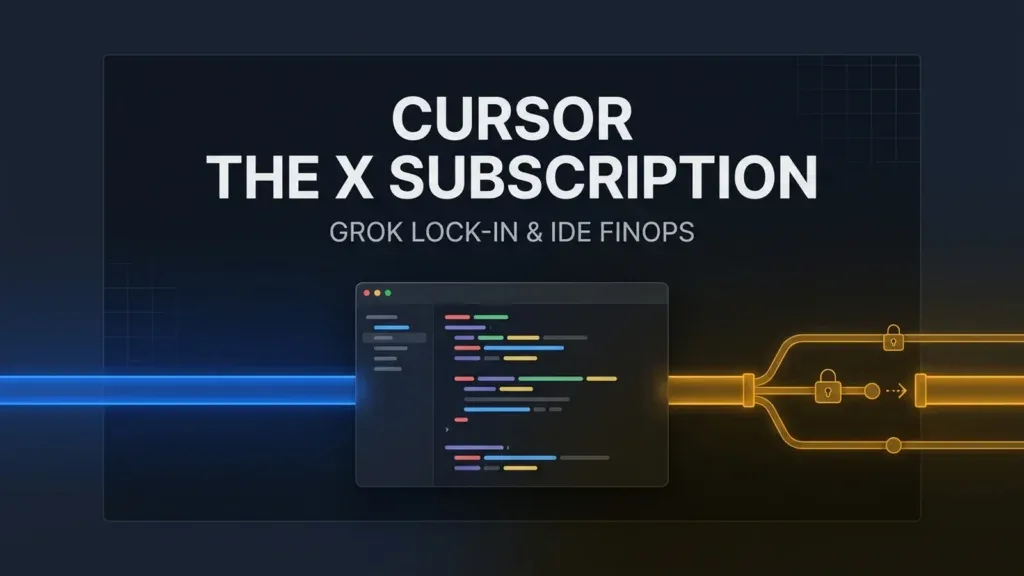

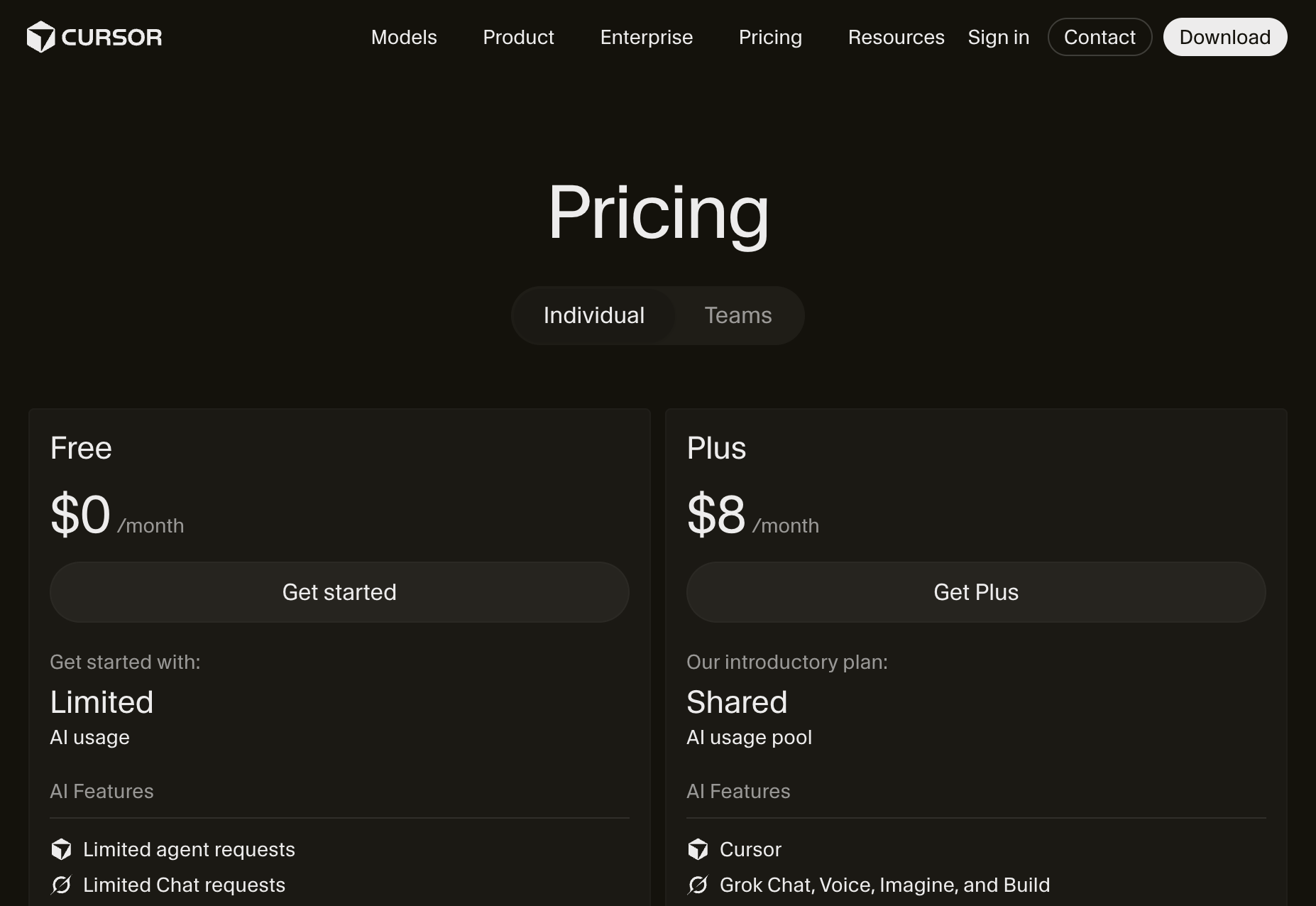
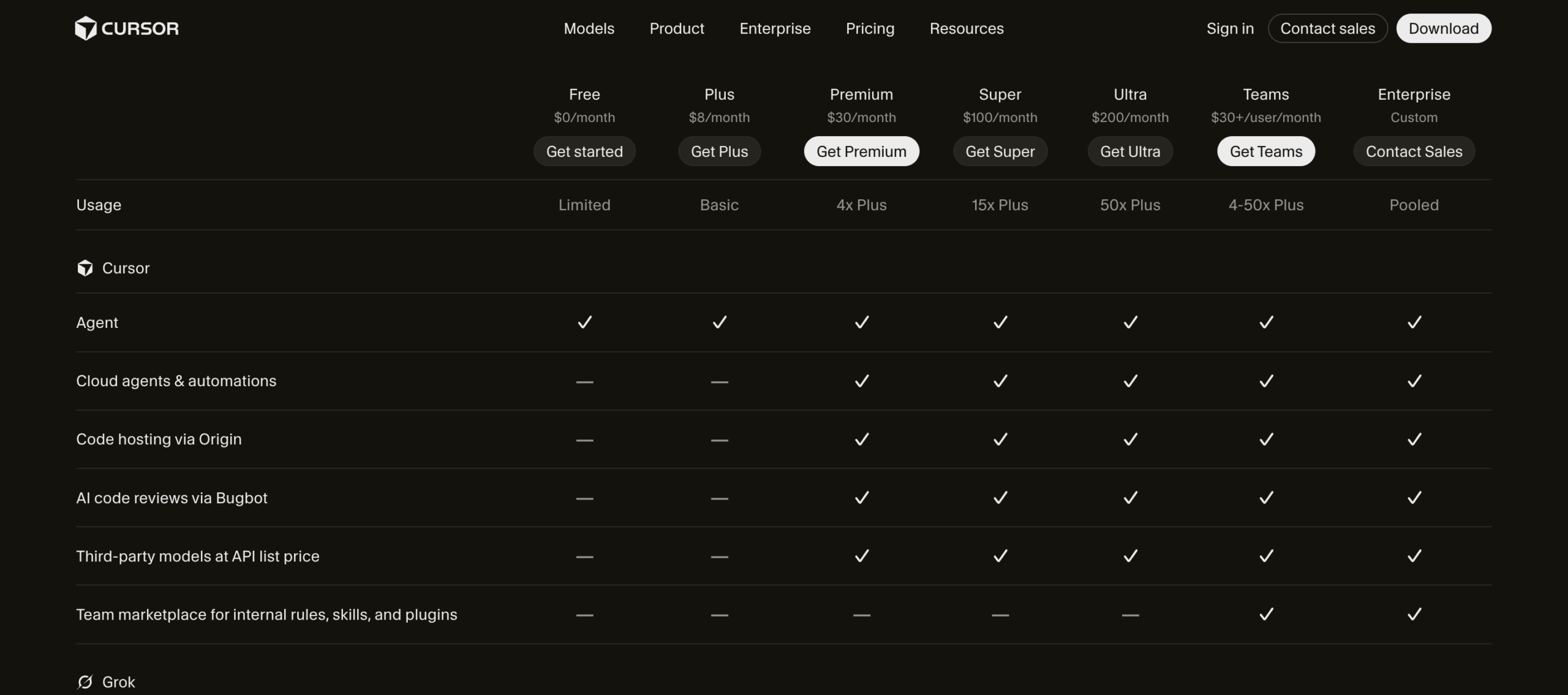
In mid-October 2026, SpaceX Super Intelligence (xAI) officially introduced The X Subscription, merging Cursor, Grok, Grok Bot, and X Premium into a unified multi-tier billing plan spanning Free ($0), Plus ($8/mo), Premium ($30/mo), Super ($100/mo), and Ultra ($200/mo). While marketed as an aggressive 50% discount consolidating fragmented creator and developer tools, the shared usage quota strictly applies to xAI’s proprietary Grok models. For developers relying on Anthropic’s Claude or OpenAI’s GPT models inside Cursor, third-party access has been stripped entirely from the flat-rate quota and pushed to unbundled API list prices, triggering up to an 875% monthly cost explosion for production coding agent workflows.
The shift marks the end of Cursor’s era as an open, model-agnostic editor. Since its breakout in 2023, Cursor built its moat by offering developers a frictionless, flat-rate $20 per month subscription covering fast requests to whichever frontier model led the industry—most notably Anthropic’s Claude 3.5 and 5.5 Sonnet. By bundling the IDE into xAI’s consumer media network and restricting flat-rate allowances to Grok 4.7, Cursor has ceased operating as a neutral developer tool and pivoted into a proprietary distribution channel for xAI compute. For individual software engineers running multi-file autonomous agents, the resulting FinOps friction transforms an affordable daily driver into a metered enterprise expense.
The Architectural Friction: Grok Lock-In and the Weekly Cliff
Under the new subscription terms, Cursor’s developer workflow encounters three major architectural points of friction that fundamentally alter developer ergonomics:
1. The Grok AST Manipulation Deficit
While Grok 4.7 performs admirably on greenfield boilerplate generation, single-file scripts, and conversational debugging, developer telemetry across production repositories reveals a persistent performance delta on dense Abstract Syntax Tree (AST) manipulations. In multi-file refactoring, strict TypeScript generic constraints, and large-scale Rust dependency graph restructuring, Claude Sonnet maintains a documented edge in pass rates and architectural coherence. By soft-locking unmetered agent loops to Grok, developers are forced to choose between lower code quality or punitive out-of-pocket metered billing.
2. The Weekly Reset Quota Cliff
Unlike legacy SaaS subscriptions that provide smooth monthly allocations with gentle rate-limiting, The X Subscription utilizes a shared weekly-refreshing pool. For software development teams operating on agile sprint cycles, sprint planning and crunch days early in the week rapidly burn out the pooled Grok allowance across both the IDE and desktop chat apps. When the weekly pool is exhausted on Wednesday afternoon, coding agents halt completely until Monday morning unless the user purchases an immediate upgrade to the $100 Super or $200 Ultra tiers.
3. Account Entrapment and Enterprise Security Isolation
Activating The X Subscription requires unifying a developer’s local Cursor environment with an X (formerly Twitter) personal handle. For commercial engineering teams and regulated enterprises, this introduces an immediate compliance violation. Corporate Information Security (InfoSec) policies routinely ban linking developer workstations and proprietary repository access to social media profiles. Furthermore, once an account migrates to the unified bundle, returning to legacy standalone $20/month Cursor Pro plans is structurally blocked. We examined this shifting control plane during our teardown of the post-IDE agent multiplexer revolt, where developers increasingly find their workstations subordinated to external platform agendas.
The Arithmetic Reveal: Calculating the 800% Monthly TCO Shock
To understand why software engineers are sounding alarms across Hacker News and developer communities, we must evaluate the Total Cost of Ownership (TCO) arithmetic. Under the legacy plan, a $20/month flat fee granted 500 fast requests to Claude Sonnet or GPT-4o, followed by a slower unmetered fallback pool.
• Ptier: Base subscription cost ($30.00/month for Premium).
• Vin, Vout: Monthly input and output token consumption generated by autonomous multi-file refactoring agents.
• Rin, Rout: Anthropic API list rates ($3.00/M input, $15.00/M output for Claude 3.5/5.5 Sonnet).
• Hcache: Effective prompt caching discount factor (~30% realistic hit rate in rapidly mutating codebases).
In modern autonomous agent workflows, Cursor does not just complete single lines of code; it ingests entire directory trees, AST symbol indexes, and lint outputs on every iteration. An active software engineer running agent loops averages 30 million input tokens and 2 million output tokens per month. Let us trace the exact cost structure:
- Effective Input Token Cost: 30M tokens × $3.00/M × (1 − 0.30 cache hit) = $63.00
- Output Token Cost: 2M tokens × $15.00/M = $30.00
- Base Subscription Fee: $30.00
- Total Monthly Outlay: $30.00 + $63.00 + $30.00 = $123.00 per month
For heavy power users maintaining complex microservice repositories—who burn 50M input tokens and 3.5M output tokens—the monthly API bill reaches $157.50 in metered credits on top of the $30 base subscription, pushing monthly IDE spend to $187.50 to $195.00 per developer. Compared to the historical $20 flat rate, this represents a 615% to 875% cost inflation. As analyzed in our macro report on AI inference and hardware economics, enterprise software seats cannot sustain uncapped token meters without dedicated spend barriers.
The Five Tiers of The X Subscription
| Subscription Tier | Monthly Price | Grok Model Allowance | Third-Party Model Terms | X Platform Features |
|---|---|---|---|---|
| Free | $0 | Limited daily requests | Not available | Basic posting |
| Plus | $8 / mo | Base shared pool | Locked to Grok only | Checkmark, fewer ads |
| Premium (Most Popular) | $30 / mo | 4× Plus pool + Cloud Agents | Available at API list price | Ad-free, priority handle |
| Super | $100 / mo | 15× Plus pool + Peak Priority | Available at API list price | Full X Premium+ suite |
| Ultra | $200 / mo | 50× Plus pool + Early Models | Available at API list price | Maximum VIP allowances |
The Horizon: The Death of Model-Agnostic Developer Tooling
The introduction of The X Subscription crystallizes a broader tectonic shift across the artificial intelligence landscape: the death of the independent, model-agnostic software development environment. As frontier model training costs escalate into the tens of billions of dollars, frontier AI labs cannot afford to treat developer IDEs as neutral utilities. An IDE is the highest-value data telemetry pipeline in existence, capturing code edits, compilation errors, terminal traces, and developer corrections in real time.
By bundling Cursor into xAI’s broader commercial ecosystem, Elon Musk is executing a classic vertical integration play. By heavily subsidizing Grok compute while making rival models economically prohibitive through raw API pass-through billing, xAI aims to convert Cursor’s millions of active developers into captive inference consumers for Colossus cluster hardware. Just as Anthropic structured pricing tiers to protect margins around Claude Haiku 5.5’s 100K token cliff, xAI is utilizing billing boundaries to force architectural migration.
For individual engineers, the decision calculus is straightforward: if your daily coding workflows can tolerate Grok 4.7’s architectural limitations, the $30 Premium bundle offers remarkable aggregate value across chat, coding, and social media. But for software professionals who depend on Claude or GPT to maintain production systems without regression, Cursor is no longer a $20/month flat-rate companion. It is now an expensive metered runtime where every autonomous agent invocation carries a tangible financial invoice.
Frequently Asked Questions
Can I keep my existing $20/month Cursor Pro plan?
Yes. Existing subscribers are permitted to remain on their legacy standalone Cursor Pro plans for the time being. However, once an account chooses to migrate or link to The X Subscription, reversing the account back to legacy standalone pricing is structurally blocked.
How are Claude and GPT models billed under The X Subscription?
Third-party models are completely excluded from the flat monthly usage pools. On the Premium ($30/mo) tier and above, they remain accessible but are metered strictly at underlying API list prices via a prepaid top-up credit balance from the first request.
What happens when I exhaust my shared weekly Grok allowance?
Because limits reset on a weekly basis rather than monthly, exhausting your shared pool locks out high-performance Grok agents across Cursor, Grok apps, and X until the following weekly reset cycle begins, unless you purchase tier upgrades or metered add-on compute.