
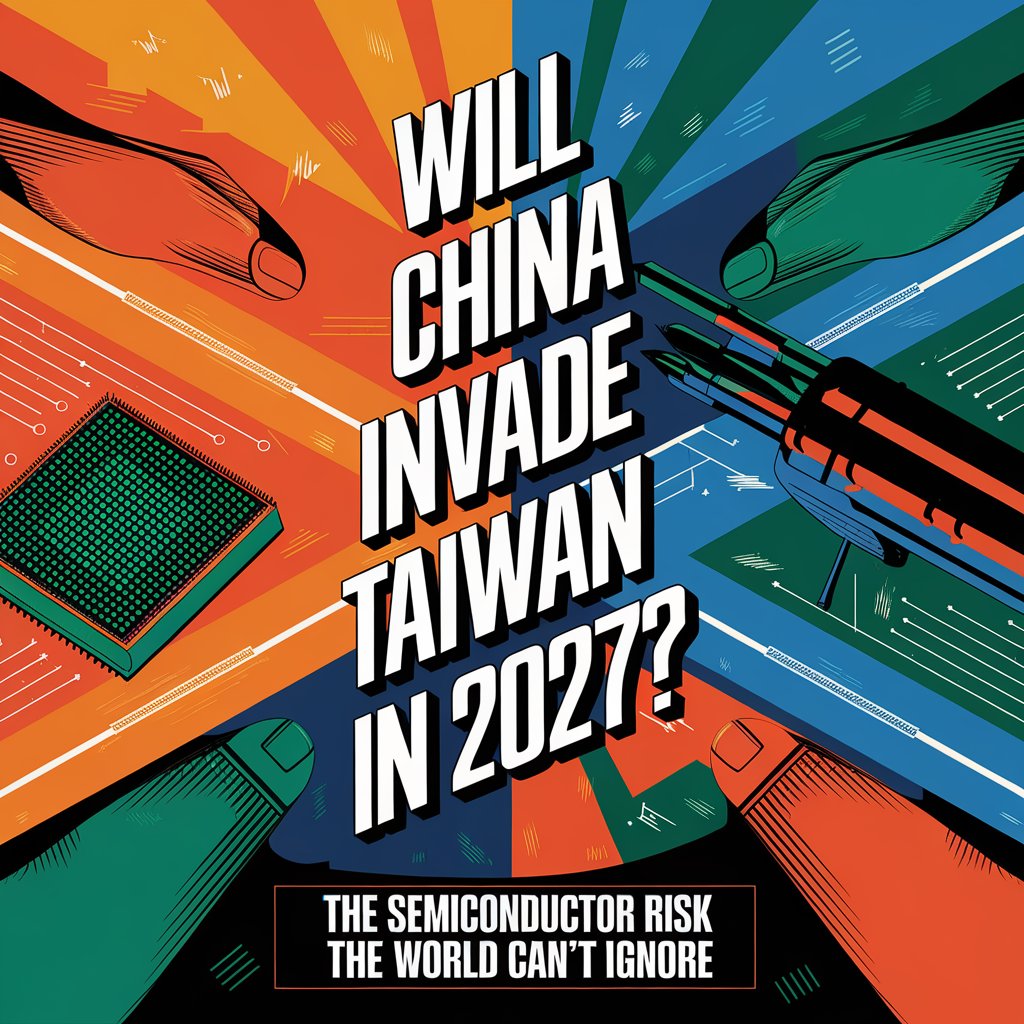

The question keeps returning in geopolitical debates, market briefings, and defense circles: will China invade Taiwan in 2027? It is one of the most searched and most misunderstood strategic questions in the world today. The short answer is that no serious analyst can say with certainty that China will attack Taiwan in 2027. But the deeper answer is more important: 2027 matters because it is widely seen as a key military readiness milestone for China, and because Taiwan remains central to the global semiconductor supply chain.
That combination is what makes the issue so dangerous.
This is not only a military story. It is also an economic, technological, and industrial story. Taiwan is not just a flashpoint in East Asia. It is the center of the world’s most advanced chip manufacturing ecosystem. If China were to move against Taiwan, the consequences would stretch far beyond the Taiwan Strait. The shock would hit artificial intelligence, smartphones, cloud computing, automotive production, defense systems, consumer electronics, and the global financial system.
So the real question is not simply whether China will invade Taiwan in 2027. The real question is this: what changes if Beijing believes that by 2027 it has stronger military options, while Taiwan still holds an outsized role in semiconductor production?
Why 2027 Matters in the China-Taiwan Debate

The year 2027 has become important largely because of repeated U.S. assessments that Chinese leader Xi Jinping wants the People’s Liberation Army, or PLA, to be more capable by then. That point has often been misread in public discussion. A readiness goal is not the same as an order to invade. Being prepared for an option is different from deciding to use it.
That distinction is critical.
Public U.S. intelligence and congressional reporting have repeatedly stressed that 2027 should be viewed as a capability milestone, not a confirmed war date. The latest threat assessment released by the U.S. intelligence community in March 2026 says Chinese leaders do not currently appear to have decided to invade Taiwan in 2027 and do not have a fixed timeline for doing so. But it also makes clear that Beijing continues to build military options, study the likelihood of U.S. intervention, and seek leverage over Taiwan.
That means 2027 matters because it could mark the beginning of a more dangerous window, not necessarily the exact year of war.
Will China Attack Taiwan in 2027? What the Evidence Actually Suggests
A lot of online content treats this as a yes-or-no question, but reality is more complicated. There are several reasons why a full-scale Chinese invasion of Taiwan would still be extremely risky.
First, Taiwan’s geography favors the defender. The Taiwan Strait is difficult, weather conditions can be harsh, and suitable landing zones are limited. Taiwan’s western coastline is heavily populated and relatively easy to defend compared with what an amphibious assault force would need.
Second, a large-scale invasion would be one of the hardest military operations in modern warfare. It would require transport, logistics, air and missile coordination, naval protection, sustained supply lines, and control of ports or beaches under fire. Even if China has improved dramatically, a cross-strait invasion remains a far more difficult task than many headlines suggest.
Third, Beijing has to consider the United States and possibly other partners. Any Chinese move against Taiwan would unfold under uncertainty about U.S. military intervention, sanctions, export controls, capital flight, and long-term strategic backlash.
This is why many analysts increasingly argue that blockade, quarantine, coercion, or limited-force scenarios may be more plausible than an immediate all-out invasion. That matters enormously for search readers because many people imagine the Taiwan issue in terms of beaches, missiles, and troop landings. But the first phase of a real crisis may look more like maritime pressure, customs-style interference, cyber disruption, selective strikes, and economic strangulation.
In other words, if China “hits” Taiwan, it may not begin with the kind of invasion most people picture.
Taiwan and Semiconductors: Why the Whole World Is Watching
To understand why Taiwan matters so much, you have to understand semiconductors.
Semiconductors are the foundational components inside modern electronic systems. They are essential for smartphones, servers, electric vehicles, industrial machinery, telecom systems, military hardware, AI accelerators, and advanced computing. Without chips, modern economies do not function.
Taiwan plays an outsize role in this ecosystem. The island is home to Taiwan Semiconductor Manufacturing Company, or TSMC, the most important contract chipmaker in the world. Taiwan’s chip industry is especially important in leading-edge semiconductors, the most advanced chips used in high-performance computing, advanced smartphones, and AI infrastructure.
The U.S.-China Economic and Security Review Commission says Taiwan remains the single most important producer in semiconductor supply chains and a key source of non-Chinese access to both advanced and foundational chips. That alone explains why Taiwan cannot be viewed as just another territorial dispute.
When people ask, “why does China want Taiwan?” the answers usually focus on nationalism, history, legitimacy, and military strategy. Those are real factors. But from a global perspective, Taiwan’s semiconductor role changes the stakes. A Taiwan crisis would not simply affect Asia. It would disrupt the digital backbone of the global economy.
Why Semiconductor Supply Chains Make a Taiwan Conflict So Dangerous
The semiconductor supply chain is not easy to replace. This is one of the biggest mistakes casual commentary makes.
Chip manufacturing is not like moving generic industrial output from one factory to another. It depends on highly specialized talent, precision equipment, long qualification timelines, trusted suppliers, advanced packaging, stable power and water systems, and years of customer validation. Even when new fabs are built in the United States, Japan, or Europe, they do not instantly remove dependence on Taiwan.
That is why Taiwan’s chip concentration is so dangerous in a crisis. If shipping lanes are disrupted, if insurers pull back, if ports stop functioning normally, if undersea cables are hit, or if escalation creates uncertainty around deliveries, semiconductor markets could tighten immediately.
The problem is not only physical destruction. The problem is reliability.
A semiconductor ecosystem can seize up long before a fab is bombed. Customers may hoard supply. Prices may spike. Production schedules may break. Stock markets may reprice technology firms. Governments may prioritize strategic industries. Export restrictions could multiply. A blockade or partial quarantine could have profound effects even without a classic invasion.
That is why the Taiwan issue is inseparable from semiconductors. It is not just about whether Chinese forces can reach Taiwan. It is about whether the world can absorb what happens if Taiwan’s chip output becomes uncertain.
The TSMC Factor: Could China Seize the World’s Most Important Chipmaker?
A common online theory is that China would invade Taiwan to seize TSMC and dominate global chip production. That idea is too simplistic.
In practice, taking control of a world-class semiconductor ecosystem is not like capturing a warehouse. TSMC’s value does not come only from buildings and machines. It comes from skilled engineers, supply chain trust, software ecosystems, equipment support, customer relationships, and delicate manufacturing processes that can be disrupted easily.
This is why many analysts argue that TSMC is difficult to seize intact. Even without deliberate sabotage, conflict itself could halt production. Power instability, labor disruption, sanctions, blocked spare parts, software limits, damaged logistics, or equipment support withdrawal could cripple output. If global suppliers cut off service, the value of captured facilities would fall sharply.
So China may not be able to “take” Taiwan’s semiconductor ecosystem in the way some people imagine. But that does not reduce the danger. It may actually increase it. If Beijing knows it cannot easily preserve the full value of Taiwan’s chip industry, it may think in terms of strategic denial, coercive leverage, or political pressure, not clean acquisition.
That is one reason a blockade scenario matters so much. China may not need to occupy every fab to create global leverage. It may only need to make the world believe that access to Taiwan’s chips is no longer guaranteed.
China’s 2027 Timeline and the Semiconductor Paradox
This creates what might be called the semiconductor paradox.
On one hand, Taiwan’s importance to global chip production helps deter war. A major conflict would impose huge costs on everyone, including China. Chinese manufacturers, exporters, and technology sectors would not escape the fallout. Semiconductor disruption would hit Chinese industry too.
On the other hand, Taiwan’s centrality also makes it a uniquely powerful pressure point. If Beijing believes the military balance is shifting in its favor by 2027, and if it thinks the United States may hesitate in the face of economic shock, it might conclude that coercion below full invasion has become more attractive.
That is why 2027 is not just about military readiness. It is about the interaction between military capability and economic leverage.
The sharper thesis is this: China does not need to launch a full invasion in 2027 for 2027 to be a dangerous turning point. It only needs to believe it has more usable options against a Taiwan that remains critical to semiconductor supply chains.
Could a China-Taiwan Blockade Trigger a Global Chip Crisis?
Yes, and this may be the most underappreciated risk.
Research from Rhodium Group and analysis from CSIS suggest that even a blockade-type scenario around Taiwan could put massive amounts of global economic activity at risk. The semiconductor channel is central to that disruption because chips sit inside modern production systems across multiple industries.
A blockade would not only affect chip exports directly. It could also disrupt the import of materials, chemicals, precision tools, and supporting inputs needed to keep fabs operating smoothly. Semiconductor manufacturing depends on extreme stability. Strategic uncertainty alone can damage the system.
This is why businesses, investors, and policymakers increasingly study not just invasion scenarios but also gray-zone and economic coercion scenarios. Markets tend to react to uncertainty before destruction. If confidence in Taiwan’s reliability breaks, the semiconductor shock could begin before large-scale combat.
For SEO readers searching terms like “China Taiwan semiconductor risk,” “TSMC war impact,” or “what happens to chips if China invades Taiwan,” this is the key point: the most realistic early-stage threat may be disruption, not occupation.
Why the World Is Trying to Reduce Dependence on Taiwan Chips
The United States, Japan, the European Union, and others have all tried to reduce semiconductor concentration risk. New fabs, subsidies, industrial policies, and supply chain initiatives are part of that effort. TSMC’s investment in Arizona is one of the most visible examples.
But diversification takes time.
Even where progress is real, it is still difficult to replicate Taiwan’s role quickly, especially in advanced manufacturing and the broader cluster effects around talent, equipment, packaging, and supplier integration. The world is moving toward a more geographically distributed chip system, but it is not there yet.
That means the next few years remain especially sensitive. If Beijing sees a narrowing window before diversification lowers Taiwan’s leverage, that could influence strategic calculations. If Washington and allies believe supply chain concentration remains too high, that may also shape deterrence policy.
Semiconductors do not just raise the cost of war. They also change the timing pressures around it.
So, Will China Invade Taiwan in 2027?
The most honest answer is no one knows.
What the evidence does support is more nuanced and more useful:
China has strong political reasons to keep pressure on Taiwan.
2027 is widely seen as a major PLA capability milestone.
A full invasion would still be extraordinarily risky.
Blockade or quarantine scenarios may be more plausible near-term options.
Taiwan’s semiconductor dominance makes any crisis globally explosive.
That is the real story.
If China moves against Taiwan, semiconductors will not be a side issue. They will be at the center of the crisis. They shape deterrence, escalation, global market reaction, industrial resilience, and the strategic calculations of every major power involved.
Final Take: The 2027 Taiwan Risk Is Really a Semiconductor Risk
The phrase “China invades Taiwan in 2027” is dramatic, but it is too blunt to capture what is really happening. A better way to understand the coming years is this: 2027 may mark the point when China has more credible military options, while Taiwan still remains indispensable to the world’s chip economy.
That is what makes the issue so dangerous.
A Taiwan conflict would not just be about sovereignty, naval power, or regional balance. It would be about who controls, interrupts, or destabilizes the semiconductor ecosystem that powers the modern world. If Beijing believes it can gain leverage without paying the full cost of invasion, the risk of coercion grows. If the world remains deeply dependent on Taiwan-made chips, the consequences of even limited disruption become enormous.
So the semiconductor angle is not a side note. It is the core of the story.
The future of Taiwan is tied to the future of advanced computing, AI infrastructure, industrial production, and technological power. That is why 2027 matters. Not because war is guaranteed, but because the intersection of military readiness and semiconductor dependence could make even a limited crisis one of the most consequential shocks of the twenty-first century.