
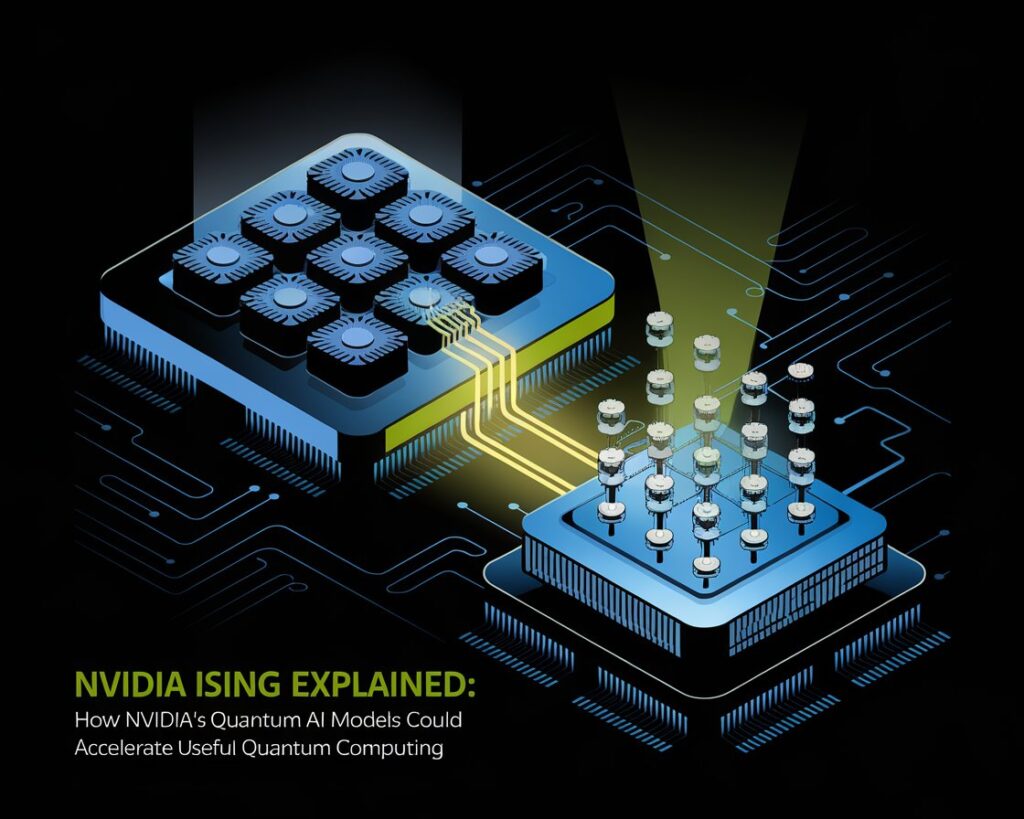

NVIDIA Ising is the first open-source AI model family built for quantum computing, targeting calibration and error correction. Here’s what it does, why it matters, and whether it can speed up the path to useful quantum computers.
Quantum computing has spent years trapped in a strange place: full of promise, but still too fragile for broad real-world use. The core issue has never been hype alone. It has been reliability. Qubits drift, quantum systems generate noise, and tiny errors can ruin calculations before they become useful. That is why NVIDIA’s launch of Ising, the world’s first open-source AI model family built specifically for quantum computing, is drawing so much attention.
Instead of building another quantum chip, NVIDIA is targeting the layer that may matter just as much: the AI and control stack that helps quantum hardware stay calibrated and decode errors fast enough to operate effectively. If quantum computing has long been a hardware challenge wrapped inside a control problem, NVIDIA Ising is an attempt to solve the control problem directly.
Quick Answer: What Is NVIDIA Ising?
NVIDIA Ising is a new family of open-source AI models built to help quantum computers become more reliable and usable. It focuses on two of the biggest bottlenecks in the field:
- Quantum calibration, which means tuning unstable quantum hardware so it performs correctly
- Quantum error correction decoding, which means identifying and correcting qubit errors fast enough to keep computations on track
According to NVIDIA, Ising can reduce calibration time from days to hours and improve quantum error decoding with up to 2.5x faster performance and 3x higher accuracy compared with the open-source decoder baseline pyMatching.
That is why this launch matters. It is not just another AI product announcement. It is a strategic play at the layer that could help make quantum computing practical.
Why Quantum Computing Still Struggles
For all the excitement around quantum computing, the technology still faces a basic engineering reality: qubits are not stable enough.
Unlike classical bits, which are either 0 or 1, qubits can exist in superpositions and become entangled with one another. That gives quantum systems their theoretical power, but it also makes them extremely sensitive to noise, heat, interference, and small environmental disturbances.
The Reliability Problem
This is the central reason quantum computing has moved more slowly than headlines often suggest.
Quantum processors do not simply need to compute. They need to remain coherent and controllable while errors are constantly detected and corrected. If that sounds hard, it is because it is. Even very advanced systems still face meaningful error rates, and useful large-scale applications require error rates far lower than what most hardware can currently support on its own.
Google’s quantum team, for example, has pointed out that current devices typically suffer failures at rates that are still far too high for very large computations. IBM has also emphasized that useful quantum systems will depend on deep integration between quantum processors and classical systems that can manage error mitigation and correction in real time.
Why Better Hardware Alone Is Not Enough
This is where many conversations about quantum computing go wrong. They focus only on the number of qubits or on a company’s chip roadmap.
But quantum computing is not just a hardware race.
It is also a systems engineering race involving:
- Hardware stability
- Calibration quality
- Error correction
- Real-time control systems
- Fast classical compute
- Hybrid software stacks
That broader view helps explain why NVIDIA Ising is so significant. NVIDIA is not trying to outbuild every quantum hardware company on qubit design. It is trying to own a critical enabling layer for all of them.
What NVIDIA Ising Actually Does
NVIDIA Ising is designed around two practical quantum tasks that eat up time, expertise, and infrastructure across the industry.
Ising Calibration
Calibration is the process of tuning a quantum device so its gates, pulses, and operating conditions line up with expected performance. Quantum hardware drifts over time, so calibration is not a one-time setup. It is an ongoing challenge.
In practice, calibration is often complex, repetitive, and highly specialized. It may involve reading plots, examining signals, adjusting parameters, and rerunning tests repeatedly until performance is acceptable.
NVIDIA’s answer is Ising Calibration, a vision-language model built specifically for quantum calibration workflows.
Rather than being a general-purpose chatbot with a quantum label attached, Ising Calibration is trained to interpret quantum measurement outputs and help recommend calibration actions. NVIDIA says this can reduce calibration time from days to hours, which could dramatically improve research and development speed in quantum labs.
Ising Decoding
The second major component is Ising Decoding, which focuses on quantum error correction.
Quantum error correction works by encoding logical qubits across many physical qubits and repeatedly collecting syndrome data that signals where errors may have occurred. A classical decoder must then process that information and infer the most likely correction.
This is a time-critical task. The faster and more accurately a decoder works, the better the odds that a quantum system can stay stable long enough to execute meaningful workloads.
NVIDIA says Ising Decoding improves on pyMatching with up to:
- 2.5x faster decoding
- 3x higher accuracy
That is a strong claim, especially because pyMatching is already a respected open-source decoder in the quantum community.
Why NVIDIA Is Calling AI the Control Plane of Quantum Computing
One of the most important ideas behind this launch is Jensen Huang’s framing that AI is becoming the control plane of quantum computing.
That phrase matters because it shifts how we think about the problem.
For years, the quantum conversation has centered on hardware breakthroughs: more qubits, better error rates, new qubit types, better cryogenic systems. Those things still matter. But if quantum machines cannot be calibrated, stabilized, and corrected in real time, none of that hardware progress becomes broadly useful.
The Control Layer Is the Missing Layer
In classical cloud computing, the control plane is the system that manages, coordinates, and directs resources. NVIDIA is applying a similar idea to quantum computing.
The theory looks like this:
- Quantum hardware performs the quantum operations
- Classical accelerated compute processes the surrounding data
- AI helps interpret signals, automate calibration, and improve error correction
- The entire hybrid stack becomes more usable, scalable, and efficient
That is exactly the kind of multi-layer infrastructure play NVIDIA likes to make.
The company already dominates large parts of the AI compute ecosystem with GPUs, CUDA, inference stacks, enterprise software, simulation tools, and domain-specific model platforms. Adding Ising to that portfolio is a logical extension of a broader strategy: build the AI layer for every major frontier technology.
Why Open Source Could Be a Big Deal
A major part of the Ising announcement is that NVIDIA is open-sourcing the model family and related tooling.
That matters because quantum computing has historically been a highly specialized field. Many research groups and companies rely on custom internal tools, domain-specific expertise, and fragmented workflows. This slows ecosystem-wide progress.
What Open Source Changes
By making Ising available to the broader community, NVIDIA lowers the barrier for adoption and experimentation.
That could help:
- Startups working on new qubit modalities
- National labs and university research groups
- Hardware vendors that need stronger calibration automation
- Teams building fault-tolerant quantum workflows
Open source also increases the odds that Ising becomes a shared layer rather than a niche internal project. If enough labs and companies adapt it to their hardware, it could push the field toward a more standardized AI-assisted approach to quantum control.
That would be strategically valuable for NVIDIA, because standardized ecosystems often reward the company that sits at the center of the software and compute stack.
How Ising Calibration Could Speed Up Quantum Progress
The most immediate value of Ising may come from faster calibration.
That sounds almost mundane compared with the grand promises often attached to quantum computing, but in practice it is hugely important.
Why Calibration Matters So Much
Quantum systems drift. The ideal settings on Monday may not hold by Wednesday. Teams often spend large amounts of time recalibrating systems instead of running useful experiments.
That slows everything:
- Research iteration
- Hardware benchmarking
- Device validation
- Application development
- Comparative testing across architectures
If NVIDIA Ising can truly compress calibration from days into hours, it does not just save labor. It accelerates the entire development cycle.
Faster Loops Mean Faster Learning
Deep tech progress often depends less on one big leap and more on tighter feedback loops. When teams can run more experiments, recover systems faster, and reduce time lost to manual tuning, they learn faster.
That is what makes Ising strategically interesting. Even if it does not “solve quantum computing,” it may speed up the pace at which the field solves its own hardest problems.
How Ising Decoding Connects to Fault-Tolerant Quantum Computing
If calibration helps quantum systems work better today, decoding is essential for where the field wants to go next: fault-tolerant quantum computing.
Fault tolerance means a quantum computer can continue operating correctly even when physical qubits are noisy, because errors are continuously detected and corrected at the logical level.
Why Decoding Is So Hard
The decoder must analyze syndrome data and decide what correction is needed before errors pile up. This has to happen under strict latency constraints. In future systems, these decoding tasks may happen thousands of times per second and under microsecond-level timing requirements.
That is a serious classical computing challenge attached to a quantum computing problem.
NVIDIA’s approach suggests that AI can help shoulder this burden. Its technical materials indicate that Ising Decoding uses compact neural architectures to improve localized syndrome decoding.
If that approach continues to perform well in real environments, it could become an important building block in future fault-tolerant systems.
Who Is Already Using NVIDIA Ising?
Another reason this launch stands out is that it is not being presented as a purely hypothetical future product.
According to NVIDIA, institutions already working with Ising or related workflows include:
- Harvard
- Fermilab
- Lawrence Berkeley National Laboratory
- IonQ
- IQM Quantum Computers
- Sandia National Laboratories
- Cornell University
- UC San Diego
- UC Santa Barbara
- University of Chicago
- Yonsei University
- And several other academic, enterprise, and national lab partners
This is important because quantum technology often lives in the gap between impressive research and real operational use. Early ecosystem traction does not guarantee long-term dominance, but it does suggest Ising is already being taken seriously by the people closest to the problem.
Does NVIDIA Ising Change the Quantum Timeline?
This is the question many readers really care about.
The honest answer is: not overnight, but possibly in meaningful ways.
What Ising Does Not Mean
Ising does not mean we suddenly have general-purpose fault-tolerant quantum computers ready for broad commercial deployment.
It does not remove the need for:
- Better physical qubits
- More scalable architectures
- Better fabrication
- Better cryogenics
- Better interconnects
- Better logical error rates
Quantum computing remains a long game.
What Ising Might Mean
What Ising may do is compress parts of the development curve.
If calibration becomes faster and decoding becomes more accurate, then researchers can:
- Tune devices more efficiently
- Run more experiments in less time
- Extract better performance from existing hardware
- Improve hardware-software co-design
- Advance toward fault tolerance more quickly
That does not erase the timeline, but it may stop it from moving in a purely linear way.
In frontier technologies, improvements in tooling and control infrastructure can have outsized effects. Sometimes the breakthrough is not the chip itself. Sometimes it is the layer that makes the chip usable.
Why This Fits NVIDIA’s Bigger Strategy
Ising also makes sense when viewed inside NVIDIA’s broader roadmap.
NVIDIA has spent years building not just chips, but platforms:
- CUDA for accelerated computing
- AI training and inference systems
- Omniverse and simulation environments
- BioNeMo for biology
- Robotics models and tooling
- CUDA-Q for quantum-classical development
- The NVIDIA Accelerated Quantum Research Center for hybrid quantum-GPU research
Ising extends that same playbook into quantum control.
The Strategic Bet
NVIDIA appears to be betting that the future of quantum computing will not belong solely to whoever builds the best standalone QPU.
Instead, it may belong to whoever best combines:
- Quantum hardware
- Classical accelerated computing
- AI-assisted control
- Scalable software frameworks
- Hybrid development tools
If that is true, then Ising is much more than a side project. It is a claim on the future architecture of useful quantum systems.
The Real Significance of NVIDIA Ising
The biggest takeaway is simple.
Quantum computing was never just a hardware problem. It was also a control problem.
That is what NVIDIA Ising is designed to address.
By focusing on calibration and error correction, NVIDIA is targeting the practical layers that determine whether fragile quantum machines can become reliable enough to matter. By open-sourcing the model family, it is giving the broader ecosystem a shared AI foundation to experiment with. And by integrating this move into its larger accelerated computing strategy, NVIDIA is reinforcing its role as the infrastructure company behind emerging technology waves.
That does not guarantee victory. Quantum computing is still uncertain, competitive, and technically unforgiving.
But it does make one thing clear: the race is no longer only about who builds the best quantum chip.
It is also about who builds the intelligence layer that makes quantum systems usable.
And right now, NVIDIA wants that layer to be Ising.
FAQ: NVIDIA Ising and Quantum Computing
What is NVIDIA Ising?
NVIDIA Ising is an open-source AI model family built specifically for quantum computing. It is designed to improve quantum hardware calibration and quantum error-correction decoding.
Is NVIDIA Ising a quantum computer?
No. NVIDIA Ising is not a quantum computer or a quantum chip. It is an AI model family that helps quantum systems become more stable and effective.
Why is NVIDIA Ising important?
It targets two of the biggest blockers in quantum computing: calibration and error correction. These are core reliability problems that must be solved before quantum systems become widely useful.
What is quantum calibration?
Quantum calibration is the process of tuning a quantum processor so it performs correctly despite drift, instability, and hardware imperfections. It is essential because quantum systems are highly sensitive and change over time.
What is quantum error correction decoding?
Quantum error correction decoding is the classical process of interpreting syndrome data from a quantum computer to detect likely errors and determine the correct response. It must happen very quickly for fault-tolerant systems to work.
How much faster is NVIDIA Ising?
According to NVIDIA, Ising Calibration can reduce calibration time from days to hours, while Ising Decoding can run up to 2.5 times faster and 3 times more accurately than pyMatching in the benchmarks NVIDIA cited.
Is NVIDIA Ising open source?
Yes. NVIDIA announced Ising as an open-source model family, with models and related resources being made available to the community.
Who is using NVIDIA Ising?
NVIDIA says organizations including Harvard, Fermilab, Berkeley Lab, IonQ, IQM, Sandia, Cornell, UC San Diego, UC Santa Barbara, and others are already using or evaluating Ising-related workflows.
Does NVIDIA Ising mean quantum computing is here?
No. Quantum computing still faces major hardware and scaling challenges. But Ising could help speed progress by improving the AI and control systems around quantum hardware.
Could NVIDIA dominate quantum computing too?
It is too early to say. But NVIDIA is clearly trying to become a major infrastructure layer in the quantum ecosystem, especially where AI, accelerated classical computing, and quantum hardware intersect.