
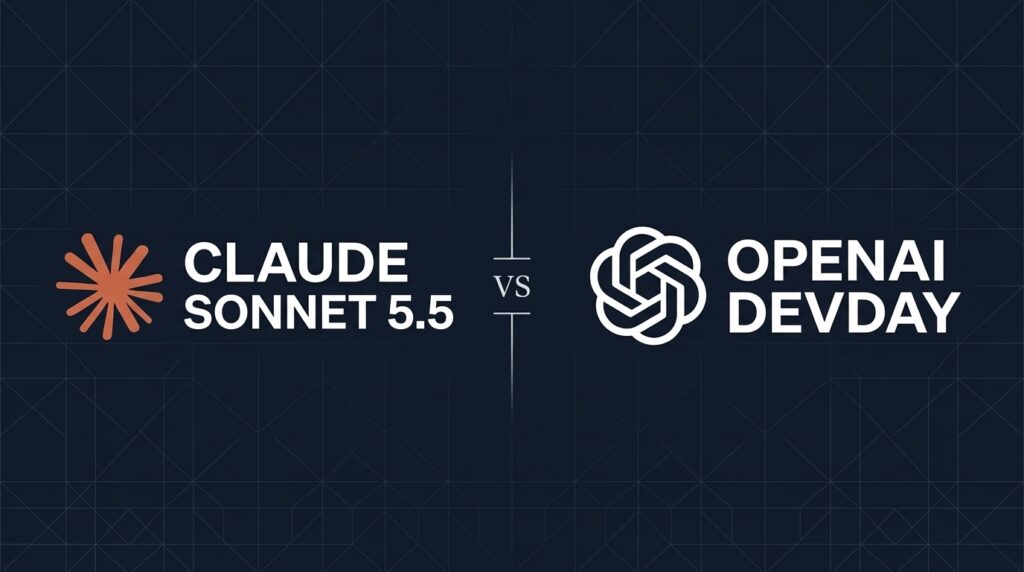

On the eve of OpenAI DevDay 2026 in San Francisco, the frontier AI competition has reverted to its signature tactic: aggressive counter-programming.
Binary diffs extracted from the latest macOS distribution of Claude Code (v2.1.283 → v2.1.284) and tracked by AI evaluation platform LuminaBench confirm that Anthropic is actively staging Claude Sonnet 5.5 (claude-sonnet-5-5). Beyond the model identifier and provider routing strings, leaked deployment manifests reveal an aggressive economic recalculation: dollar-for-dollar parity with OpenAI’s newly launched GPT-6 Sol tier, paired with a massive 1-million-token context window and a 128,000-token maximum completion ceiling.
The Binary Leak: Verified Strings vs. Early Telemetry
To separate ground truth from social chatter, compiled artifacts must be isolated from staging telemetry:
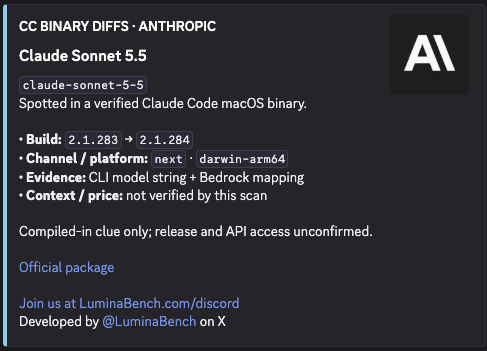
claude-sonnet-5-5 and provider routing hooks.| Dimension | Verification Status | Evidence Source | Technical Detail |
|---|---|---|---|
| Model Identifier | Verified | Claude Code macOS Binary | claude-sonnet-5-5 in CLI build 2.1.284 |
| Provider Routing | Verified | Cloud Router Table | Anthropic 1P API, AWS Bedrock, GCP Vertex, Foundry |
| Adaptive Thinking | Verified | CLI Argument Parser | Flags: medium, xhigh, and max effort |
| Context Window | Unconfirmed Telemetry | LuminaBench Extraction | 1,000,000 tokens input |
| Max Generation | Unconfirmed Telemetry | LuminaBench Extraction | 128,000 tokens completion |
| Base Pricing | Unconfirmed Telemetry | Billing Registry Manifest | $2.00 / 1M input · $10.00 / 1M output |
| Prompt Caching | Unconfirmed Telemetry | Billing Manifest | $0.20 read · $2.50 write (5m) · $4.00 write (1h) |
While the compiled model string and cloud provider mappings prove that Anthropic has built and staged the binary distribution, the pricing and token metrics stem from staging config blocks. Anthropic has not yet published an official system card.
What the Community Caught: Embedded Reports from X
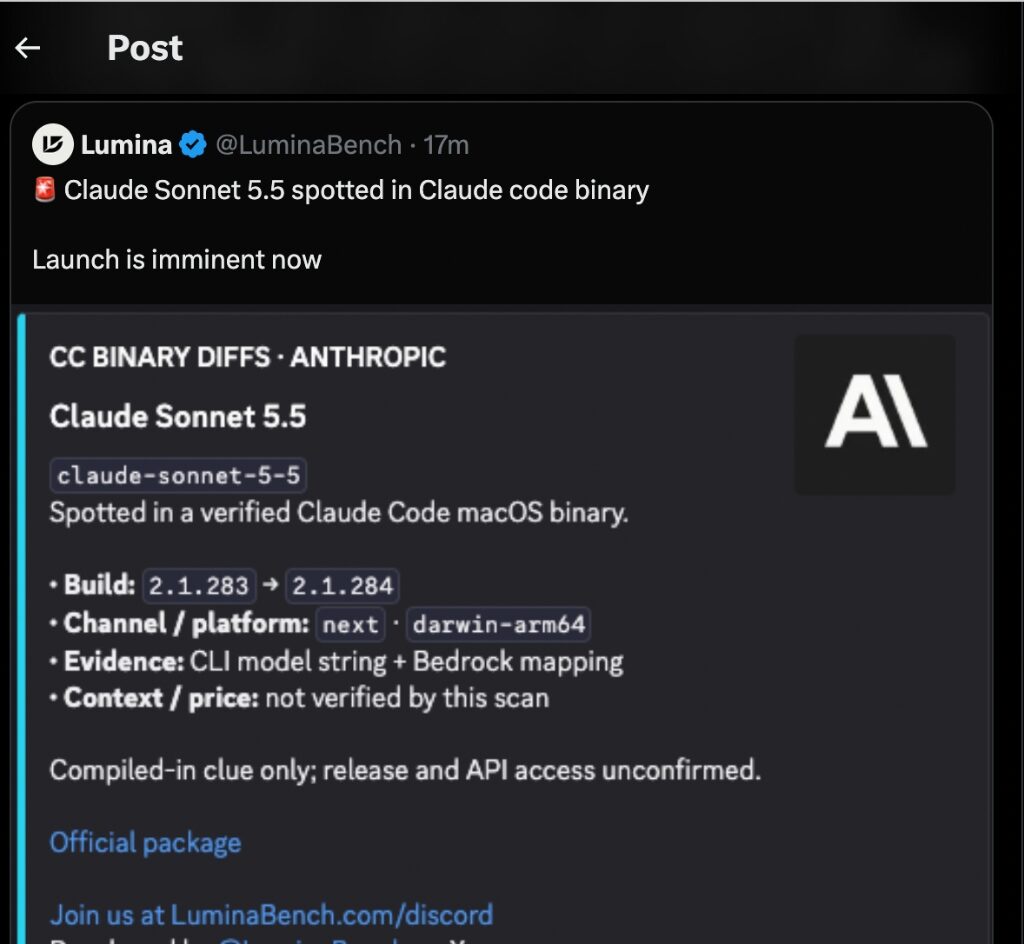
The tracking was broken across developer channels by AI evaluation platform LuminaBench, revealing both the initial binary confirmation and the subsequent parameter leak:
🚨 Claude Sonnet 5.5 spotted in Claude code binary
Launch is imminent now
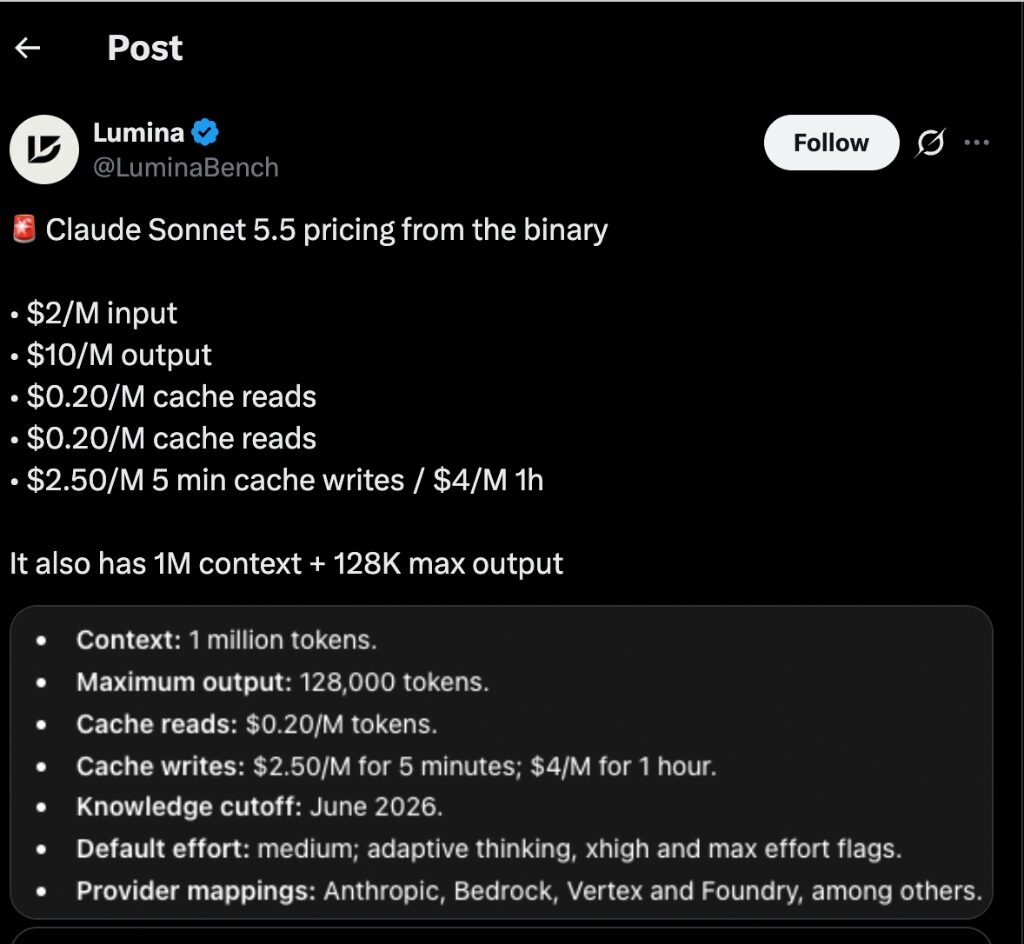
Shortly after the initial binary confirmation, LuminaBench published a second telemetry pass capturing the active staging flags and billing manifests:
🚨 Claude Sonnet 5.5 pricing from the binary
• $2/M input
• $10/M output
• $0.20/M cache reads
• $2.50/M 5 min cache writes / $4/M 1h
It also has 1M context + 128K max output
The Eve of DevDay: Timing the Airwave Takeover
The appearance of Sonnet 5.5 within 24 hours of Sam Altman taking the keynote stage at the Fort Mason Center is calculated.
OpenAI’s DevDay 2026 is widely anticipated to focus on two fronts:
- The “o” Always-On Assistant: As covered in our teardown of the leaked “o” always-on assistant, OpenAI is preparing a persistent, low-latency agent framework designed to anchor consumer and enterprise desktop environments.
- GPT-6 Developer Runtime: Deeper agentic tooling and workflow optimizations following the debut of the GPT-6 architecture.
Historically, major tech keynotes rely on an uninterrupted 48-hour cycle where developers rebuild their product roadmaps around new API features. When Anthropic delivered Claude Opus 5.5 at $4.00/$20.00 per million tokens on September 22, it explicitly stated that Sonnet 5.5 and Haiku 5.5 would arrive “in the coming weeks.” Staging Sonnet 5.5’s release pipeline right as DevDay begins is designed to split developer attention, dominate social timelines, and force immediate benchmark comparisons before OpenAI’s announcements settle.
Economic Parity: The Direct Strike at GPT-6 Sol
The most telling detail in the leaked telemetry is the pricing structure: $2.00 per million input tokens and $10.00 per million output tokens, paired with a $0.20 prompt cache read.
This is not an arbitrary tier. It is an exact dollar-for-dollar match of OpenAI’s workhorse release covered in our GPT-6 Sol benchmarks and pricing breakdown. Whereas Claude Opus 5.5 commands a flagship premium, Anthropic appears determined to ensure that running Sonnet 5.5 imposes zero price penalty against Sol.
When GPT-6 Sol hit the market, it achieved a 68.8% score on DeepSWE v1.1 while cutting previous generation coding costs in half. However, production telemetry from agent workflows has consistently shown that frontier reasoning chains consume tens of thousands of tokens per complex pass. By matching GPT-6 Sol at $2/$10 and matching prompt cache reads at $0.20/M, Anthropic eliminates cost as a disqualifying variable. If Sonnet 5.5 matches or exceeds Sol’s coding and tool-calling performance at the exact same compute budget, developer mindshare across agentic environments like Claude Code, Cursor, and Windsurf stays firmly anchored in Anthropic’s orbit.
Architectural Levers: 128K Output and Adaptive Thinking
Beyond pricing, two technical specifications in the leak represent genuine workflow expansions:
- 128,000-Token Output Buffer: Standard frontier completion windows have historically hovered between 8,192 and 16,384 tokens, occasionally stretching to 64K. A 128K generation ceiling enables full multi-file code generation, comprehensive monolithic refactors, and complete test suite synthesis in a single synchronous turn without fragile rolling summarization passes.
- Tiered Adaptive Thinking: Following the reasoning controls introduced in recent frontier architectures, Sonnet 5.5 exposes explicit
medium,xhigh, andmax effortflags. This allows agent orchestrators to run tight, deterministic sub-agent tool loops on lower effort budgets while escalating to high-compute test-time search only when encountering complex logical invariants or architectural refactoring.
Multi-Cloud Day-One Parity
The binary diffs highlight another maturity milestone: simultaneous multi-cloud routing strings. Rather than confining the model to 1st-party Anthropic API endpoints for an exclusive preview window, the mappings list:
- Anthropic First-Party API
- Amazon Bedrock
- Google Cloud Vertex AI
- Microsoft Foundry
Enterprise procurement cycles rarely move fast enough to switch providers for a point-release. Pre-baking Bedrock and Vertex bindings ensures that enterprise engineering teams can toggle their environment variables the moment the weights go live.
Editorial Takeaway
Whether Anthropic pushes the public release trigger during Sam Altman’s keynote tomorrow or holds it for the immediate aftermath, the tactical objective has already succeeded: the developer community is running side-by-side spec checks before OpenAI even walks onto the stage.
If the leaked specs hold true in production, Sonnet 5.5 will not just be an iterative maintenance release—it will be an aggressive, economically defensive moat thrown around Anthropic’s developer mindshare.