
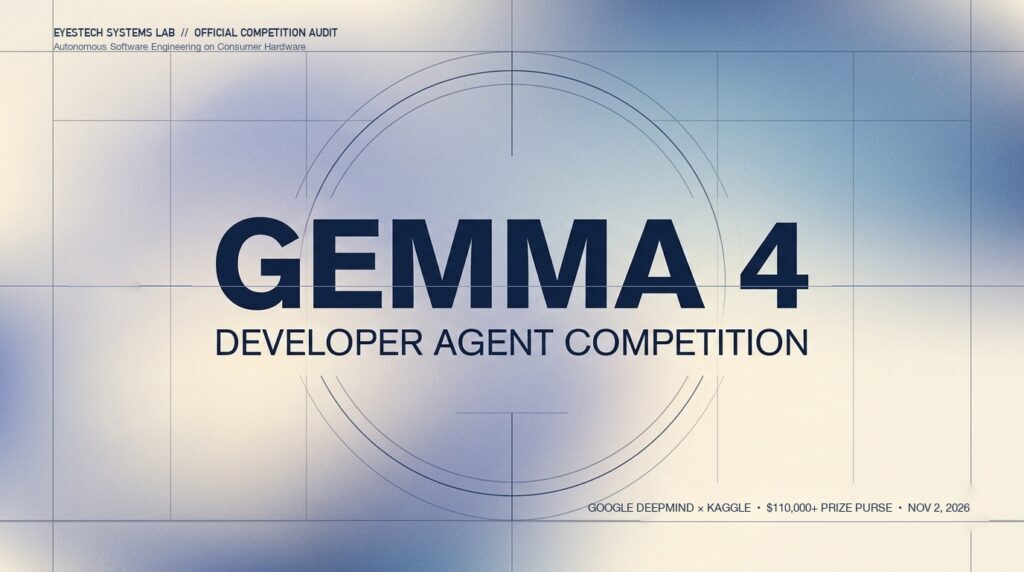

Google DeepMind and Kaggle have opened registration for the Gemma 4 Developer Agent Competition, offering a $110,000 total prize purse—including multiple $10,000 specialist bounties—to developers who can successfully post-train open Gemma 4 weights into autonomous, offline software engineering agents capable of running on consumer hardware.
The challenge targets one of the most glaring operational liabilities in modern software automation: virtually every production coding assistant—from commercial agent harnesses to enterprise copilots—depends on massive, proprietary cloud APIs that burn dozens of dollars in inference tokens per resolved bug. By enforcing an air-gapped Kaggle container environment evaluated on real-world Python bug fixes inspired by SWE-bench Verified, the competition asks a fundamental engineering question: can open-weight models running on a single consumer GPU (16GB to 24GB VRAM) match cloud-level issue resolution without internet access or datacenter clusters?
Registration is open now on Kaggle, with team registration closing on November 2, 2026, and final container submissions evaluated in early December 2026.
Prize Purse Distribution: The $10,000 Category Bounties
The competition’s $110,000 purse is structured to reward both end-to-end benchmark accuracy and breakthroughs in local runtime efficiency. In addition to the main automated leaderboard, Google and Kaggle have funded four dedicated $10,000 specialist awards:
| Track / Award | Purse Allocation | Objective & Scope | Evaluation Metric |
|---|---|---|---|
| Main Leaderboard (Top 3) | $65,000 Total | Top-ranked autonomous systems on hidden test repositories ($30k 1st, $20k 2nd, $15k 3rd). | Automated pass@1 on unit test verification suites. |
| LiteRT Edge Bounty | $10,000 USD | Best agent deployment leveraging Google LiteRT on ARM / on-device NPUs. | Lowest thermal wattage and memory consumption per resolved task. |
| llama.cpp / GGUF Runtime | $10,000 USD | Most optimized execution engine utilizing GGUF / llama.cpp or Ollama. | Peak sustained token throughput on 16GB consumer memory. |
| Unsloth Fine-Tuning Award | $10,000 USD | Best parameter-efficient fine-tuning (PEFT/QLoRA) using Unsloth. | Highest tool-call precision and lowest training VRAM overhead. |
| Best New Application | $10,000 USD | Most creative autonomous workflow extending beyond single-file bug fixing. | Practical developer utility, novelty, and ergonomic implementation. |
| Paper & Research Track | $15,000 USD | Open-access paper detailing failure modes, ablations, and novel agent architectures. | Methodological rigor, reproducibility, and open-source contributions. |
The Cloud Dependency Dilemma in Autonomous Engineering
Over the past two years, state-of-the-art benchmarks on SWE-bench and SWE-bench Lite have climbed from single-digit success rates to over 40–50%. However, this progress has arrived with a massive hidden cost: total reliance on massive, closed-weight models served via proprietary cloud APIs.
In standard commercial agent setups, a single autonomous bug-fix workflow executes an iterative loop:
1. Repository Indexing: Scanning directory trees and locating culprit files via AST search or dense embeddings.
2. Reproduction: Writing targeted unit test scripts that reliably trigger the reported issue.
3. Multi-Turn Reasoning: Prompting a cloud model with expansive context windows (often 64k to 128k tokens per turn) across 15 to 30 sequential agent cycles.
4. Patch Application & Verification: Applying unified diff patches and executing test suites until verification passes.
When executed against commercial API pricing, resolving a single complex issue can consume millions of cumulative input and output tokens, running costs from $8.00 to $35.00+ per pull request. More critically, reliance on remote API models creates three severe operational bottlenecks:
• Privacy and IP Restrictions: Proprietary enterprise codebases, financial transaction systems, and air-gapped security infrastructure cannot legally stream raw ASTs and git histories to third-party cloud endpoints.
• Network Latency: Round-trip API latency for 30 consecutive chain-of-thought calls can stretch debugging cycles to dozens of minutes.
• Provider Lock-In and Non-Deterministic Drift: API provider updates can silently degrade tool-calling adherence and regex patch generation overnight.
The Gemma 4 Developer Agent challenge attempts to invert this paradigm: force the entire planning, navigation, file editing, and test verification cycle down to an open model running strictly on local silicon.
Architectural Comparison: Cloud-Bound vs. Consumer-Hardware Agents
Comparing the operational profile of a frontier cloud-hosted agent against the Kaggle competition specification demonstrates the engineering trade-offs participants must solve:
| Operational Dimension | Cloud API Agent (Frontier) | Local Gemma 4 Agent (Competition Spec) |
|---|---|---|
| Inference Environment | Multi-cluster H100 / TPU v5p clouds via HTTPS endpoints. | Air-gapped Kaggle container on a single consumer accelerator (16GB–24GB VRAM). |
| Network Requirements | Constant broadband internet & active API keys required. | Strictly 0 kbps egress (air-gapped) |
| Cost per Resolved Bug | $8.00 – $35.00+ in remote token charges. | $0.00 marginal cost (local electricity only) |
| Target Model Weights | Proprietary frontier weights (hundreds of billions of parameters). | Gemma 4 family (9B, 27B MoE, 31B dense; 4-bit / 8-bit quantized). |
| Primary Failure Mode | Rate limits, token budget runaway, context window bloat. | KV-cache OOM aborts, tool schema degradation, infinite diff oscillation. |
Inside the Evaluation Harness: What Participants Must Build
Building a successful submission is fundamentally an exercise in agent harness engineering and parameter-efficient fine-tuning (PEFT). Kaggle requires participants to package their system as a standardized submission.zip container that boots within the sandbox without external downloads.
Each submission must provide an agent.yaml configuration defining four core components:
• Base Weights & Quantization: Typically Gemma 4 (such as google/gemma-4-31B-it or dense/MoE variants) coupled with LoRA/QLoRA adapter weights.
• Inference Engine: Optimized local execution engines such as vLLM, LiteRT, or llama.cpp.
• Tool Protocol: The exact JSON schema definitions for local bash execution, windowed file viewing, AST symbol searching, and test harness execution.
• Context Compaction Strategy: Deterministic pruning logic to discard compiler warnings, summarize historical sub-actions, and prevent context exhaustion within finite VRAM.
Below is the architectural representation of the minimal agent.yaml configuration and execution harness expected by the evaluation sandbox:
version: "1.0"
agent:
  name: "gemma4-local-dev-agent"
  model:
    base: "google/gemma-4-31B-it"
    adapter_path: "./lora_adapters/checkpoint-final"
    quantization: "bitsandbytes-4bit"
    max_context_tokens: 32768
    temperature: 0.1
    top_p: 0.95
harness:
  max_iterations: 25
  timeout_seconds: 1200
  tools:
    - name: "bash_exec"
      description: "Run safe shell commands inside the container"
      timeout: 60
    - name: "view_file"
      description: "Read file lines with windowed line numbers"
    - name: "apply_patch"
      description: "Apply unified git diff to targeted source files"
    - name: "run_pytest"
      description: "Execute unit test suites against modified workspace"
strategy:
  context_compaction: "sliding_window_with_error_priority"
  stop_on_first_pass: true
Where Small Offline Models Break: Four Critical Engineering Boundaries
Winning this competition cannot be achieved by simple prompt engineering. Smaller open-weight models face distinct structural boundaries when thrust into autonomous tool-calling loops without a massive cloud backend to catch their mistakes:
| Failure Boundary | Root Cause | Failure Signature | Engineering Mitigation |
|---|---|---|---|
1. Tool Schema Adherence
SYNTAX DRIFT | Quantization noise causes 4-bit weights to drop JSON delimiters under long multi-turn token pressure. | Model emits unescaped markdown or conversational apologies instead of valid structured tool calls. | Constrained grammar decoding (Outlines / JSON schema masks) enforcing 100% token adherence. |
2. KV-Cache Memory Limits
CUDA OOM | Uncompressed KV tensors across 32k context and large test logs exceed consumer VRAM limits. | Fatal CUDA Out-of-Memory abort mid-way through a 25-step debugging trajectory. | FP8 KV-cache quantization combined with deterministic AST pruning of compiler outputs. |
3. Infinite Modification Loops
CYCLE TRAP | Agent lacks global trajectory memory and alternates repeatedly between conflicting assertions. | Repeatedly edits the same 3 lines of code back and forth until the 25-step budget expires. | State-machine cycle detection that forces a git checkout rollback upon detecting identical diff hashes. |
4. Multi-Hunk Diff Syntax
PATCH REJECT | Sub-30B models struggle with exact line-offset arithmetic in standard unified diff headers. | Git patch command rejects with malformed patch errors, leaving target files partially modified. | Full-block replacement tools or AST node replacement schemas instead of raw regex hunks. |
Why the $110K Prize Pool Matters for the Open-Source Ecosystem
Google’s decision to back an offline developer agent challenge with over $110,000 in cash awards signals a strategic realignment across developer tooling. While proprietary cloud API models have dominated headlines, enterprise adoption remains heavily bottlenecked by recurring token costs, intellectual property exposure, and unpredictable model deprecations.
If the open-source community proves that a quantized Gemma 4 checkpoint running on consumer silicon can reliably navigate, edit, and test real-world software repositories, autonomous engineering will cease to be an expensive cloud service reserved for teams with massive API budgets. It becomes a permanent, private, zero-marginal-cost utility executing silently inside the developer’s local terminal.
Sources: Google DeepMind Research; Kaggle Competitions Board (Gemma 4 Developer Agent Challenge); LiteRT Documentation & Edge Benchmarks; SWE-bench Verified Technical Audit.