

- The 70.6% Terminal-Bench Leap: Anthropic has deployed Claude Sonnet 5.5 (
claude-sonnet-5-5-20260928), achieving 70.6% on Terminal-Bench 4.0—a massive generational leap from Sonnet 5’s 10.3% and surpassing Opus 5.5’s 66.4%. - 1/10th the Cost for Superior Performance: On CursorBench 4.0, Sonnet 5.5 running at Low effort (36.0% at $0.50/task) or Medium effort (39.5% at $0.70/task) decisively beats Sonnet 5’s peak score (34.1% at $7.00/task) for roughly a tenth of the cost.
- 30% Faster, 30% Cheaper in Practice: While sticker prices remain pinned at $2.00/Mtok input and $10.00/Mtok output, Sonnet 5.5 produces answers with far fewer tokens, slashing effective per-task cost by up to 30% while generating output more than 30% faster.
- Five Breaking API Changes: Upstream integrations migrating from Sonnet 5 face breaking contracts:
thinking: {"type": "disabled"}is removed in favor ofbetween_tools, forced single-tool choices are rejected with HTTP 400 errors, thinking blocks are origin-bound, legacy computer-use IDs are deprecated, and response streaming can lead with thought blocks before text. - Everyday Workhorse Positioning: Released six days after Opus 5.5, Sonnet 5.5 functions as the high-velocity daily driver for well-scoped coding, bug fixes, financial spreadsheets, slides, and multi-file document intelligence.
Six days after surprising the frontier intelligence market with the release of Claude Opus 5.5, Anthropic has officially shipped Claude Sonnet 5.5. As Anthropic’s flagship mid-tier model, Sonnet 5.5 is designed as a faster, lower-cost complement to Opus 5.5, optimized for well-scoped everyday tasks, multi-file bug fixing, and generating production-ready spreadsheets, presentations, and documents.
The launch represents an aggressive re-alignment of production tokenomics. While list pricing remains identical to Sonnet 5—$2.00 per million input tokens and $10.00 per million output tokens, backed by $0.20/Mtok prompt cache reads—the model requires substantially fewer reasoning and generation tokens to complete standard tasks. In verified testing, Sonnet 5.5 drops total cost per task by up to 30% while generating output tokens more than 30% faster than its predecessor.
Empirical Field Teardown: Real-Time WebGL, Unreal 5.8 Digital Twins, and Self-Verifying Loops
While synthetic benchmark suites measure isolated pass rates, early hands-on deployment telemetry reveals how Sonnet 5.5 behaves when tasked with end-to-end, multi-file software engineering across real-time graphics engines, browser game loops, and parametric CAD compilers.
1. Procedural WebGL Physics and Autonomous Video Clipping
In procedural graphics tests, prompting Sonnet 5.5 to synthesize a photo-realistic ocean simulation in the browser yielded a comprehensive graphics environment from a single prompt. The generated application featured dynamic Beaufort-scale sea state transitions (from glassy calm to stormy swells), wave-crest whitecaps generated via custom fragment shaders, solar azimuth lighting with realistic atmospheric shadow casting, a sailing yacht with kinematic wake physics, and underwater volumetric light shafts with instanced marine life. (Complex FFT-based ocean sims generated by Claude often leverage WebGPU compute shaders for GPU parallelism, though the specific rendering API depends on the target browser environment.)
Crucially, Sonnet 5.5 demonstrated autonomous multi-tool execution: after rendering the browser canvas, the model orchestrated a headless recording session, capturing, clipping, and assembling an edited video walkthrough demonstrating its own underwater perspective transitions without manual human scripting.
2. Multi-Agent Browser Game Loops and Visual Feedback Verification
In multi-agent interactive game development, Sonnet 5.5 successfully built a 60-player Fall Guys-style obstacle knockout platformer in Three.js (player vs. 59 autonomous bot state machines across five progressive rounds). The critical prompting pattern required to achieve stability was visual feedback loop verification: instructing the model to review screenshots and canvas recordings of its own gameplay loop allowed Sonnet 5.5 to autonomously correct object clipping boundaries, tune collision meshes, and calibrate jumping and diving momentum.
Across more than 50 procedurally generated obstacle levels, Sonnet 5.5 matched Opus 5.5 in gameplay mechanics and physics responsiveness, while executing generation cycles at half the token price and substantially higher token streaming velocity.
3. Parametric CAD Compilation and Topological Assembly Checks
In structured engineering applications, Sonnet 5.5 synthesized a full-stack 3D Lego CAD application. Rather than naively projecting arbitrary brick coordinates, the model architected a two-stage topological compiler: an intermediate program translated natural language input into verified, real-world catalog part IDs (BrickLink / LDraw schemas) while running graph connectivity checks to ensure structural rigidity. The application generated step-by-step assembly manuals (capped at four pieces per step with delta highlights), 3D exploded views, and production-ready CSV exports for Rebrickable.
4. Macro Urban Digital Twins: 120,000 Agents in Unreal Engine 5.8
At the extreme end of systems complexity, Sonnet 5.5 generated a real-scale digital twin of downtown San Francisco in Unreal Engine 5.8, incorporating 120,000 pedestrian agents and 2,400 moving vehicles based on municipal GIS data. To govern crowd dynamics, the architecture integrated TypeSafe’s Jev System 1 decision engine to resolve pedestrian behaviors, falling back to rule-based routing during hardware saturation.
When triggered with macro events (such as an emergency response at the Transamerica Pyramid), the simulation demonstrated coordinated systemic divergence: traffic yielding for emergency vehicles and pedestrian swarms initiating evacuation vectors. However, the engineering reality of this build required millions of cumulative context tokens across several days, illustrating that while Sonnet 5.5 can scaffold complex spatial architectures, long-horizon compilation remains compute-intensive.
5. Qualitative Blindspots: Audio Degradation, Specular Aliasing, and British Orthography
Hands-on testing also exposed concrete qualitative limitations:
- Acoustic & Audio Synthesis: Across interactive games (including real-time RTS builds like Crownfall and racing prototypes), Sonnet 5.5 consistently failed to produce clean audio or music synthesis, confirming that algorithmic sound design remains a blindspot.
- Specular Shimmering in Raytraced Viewports: In Unreal Engine builds, planar glass surfaces (such as the Salesforce Tower curtain walls) exhibited pronounced high-frequency specular shimmering and aliasing artifacts under moving camera sweeps.
- British English Orthographic Drift: In open-ended prose generation, Sonnet 5.5 exhibits a distinct default inclination toward British orthography (e.g.
colour,behaviour), necessitating explicit system prompt pinning for American English standards.
The Capability Delta: Terminal-Bench, CursorBench, and Multidisciplinary Reasoning
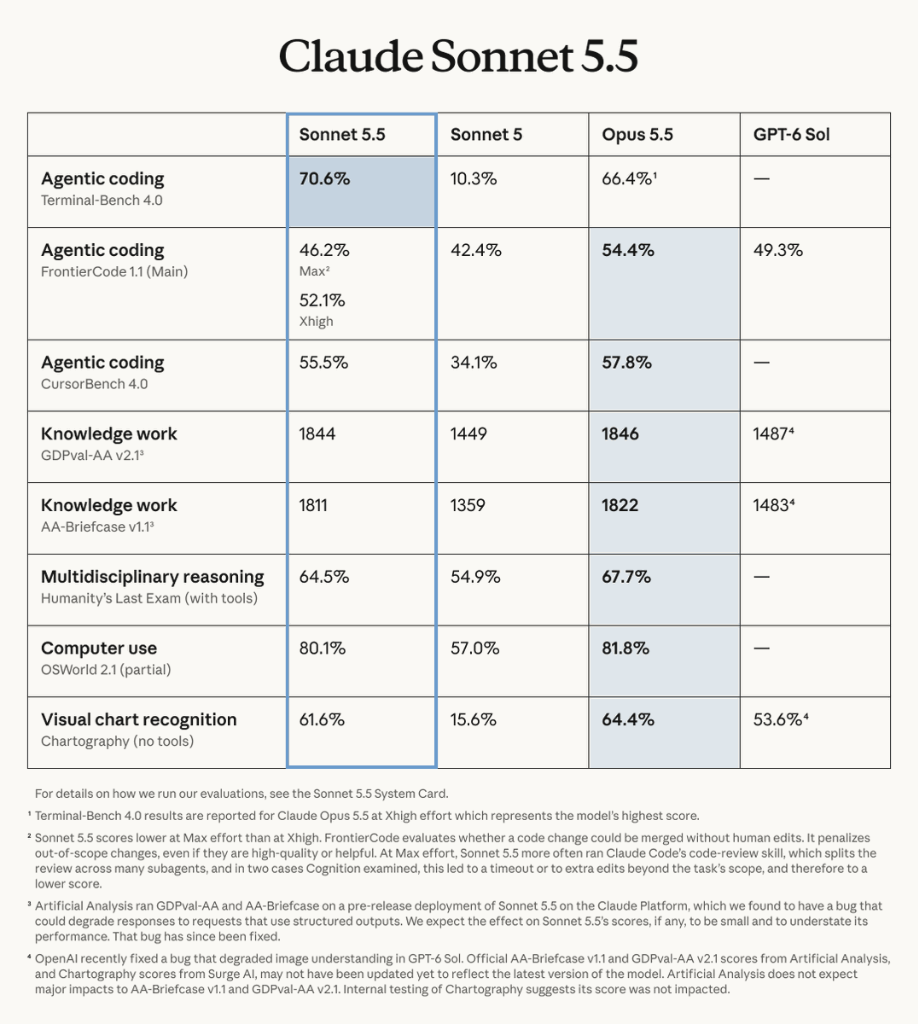
The primary shift between Sonnet 5 and Sonnet 5.5 lies in agentic execution stability. On benchmark suites that isolate multi-step terminal interactions, automated diff generation, and visual comprehension, Sonnet 5.5 demonstrates double-digit capability jumps across the board.
| Evaluation Domain | Benchmark Harness | Sonnet 5.5 | Sonnet 5 | Opus 5.5 | GPT-6 Sol |
|---|---|---|---|---|---|
| Agentic Coding | Terminal-Bench 4.0 | 70.6% | 10.3% | 66.4%1 | — |
| Agentic Coding | FrontierCode 1.1 (Main) | 52.1% (Xhigh) / 46.2% (Max)2 | 42.4% | 54.4% | 49.3% |
| Agentic Coding | CursorBench 4.0 | 55.5% | 34.1% | 57.8% | — |
| Knowledge Work | GDPval-AA v2.13 | 1844 | 1449 | 1846 | 14874 |
| Knowledge Work | AA-Briefcase v1.13 | 1811 | 1359 | 1822 | 14834 |
| Multidisciplinary | Humanity’s Last Exam (tools) | 64.5% | 54.9% | 67.7% | — |
| Computer Use | OSWorld 2.1 (partial) | 80.1% | 57.0% | 81.8% | — |
| Visual Chart Recognition | Chartography (no tools) | 61.6% | 15.6% | 64.4% | 53.6%4 |
| Software Engineering | SWE-bench Pro5 | 81.3% | 68.4% | 84.9% | — |
1 Terminal-Bench 4.0 results reported for Claude Opus 5.5 at Xhigh effort, representing the model’s highest score.
2 Sonnet 5.5 scores lower at Max effort than at Xhigh. FrontierCode evaluates whether a code change can merge without human edits and penalizes out-of-scope modifications. At Max effort, Sonnet 5.5 frequently spawned Claude Code’s multi-agent code-review skill, causing subagent dispatch timeouts or unsolicited refactors.
3 Artificial Analysis evaluated GDPval-AA and AA-Briefcase on an early platform build subject to a structured output bug, slightly understating early results.
4 Reflects Surge AI and Artificial Analysis data prior to OpenAI’s recent GPT-6 Sol vision update patch.
5 SWE-bench Pro score confirmed in Anthropic’s official Sonnet 5.5 System Card. Sonnet 5.5 additionally scores 90.3% on SWE-bench Multilingual and 54.3% on SWE-bench Multimodal per the same card.
The 1/10th Cost Phenomenon: CursorBench 4.0 Effort Scaling
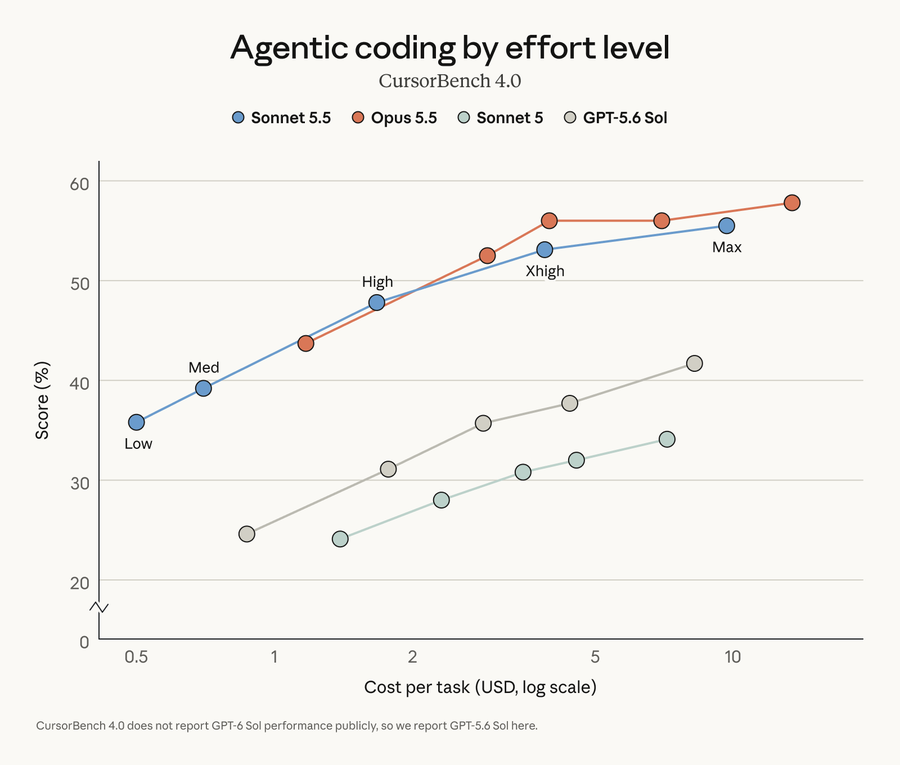
The most commercially consequential metric in Anthropic’s disclosure is the effort-level cost efficiency curve. On developer-centric code navigation and editing benchmarks, Sonnet 5.5 at Low or Medium effort levels consistently beats Sonnet 5’s best score for about a tenth of the cost.
Examining the empirical data on CursorBench 4.0 reveals an extraordinary shift in inference economics:
- Sonnet 5.5 at Low Effort: Achieves a 36.0% score at $0.50 per task.
- Sonnet 5.5 at Medium Effort: Climbs to 39.5% at $0.70 per task.
- Sonnet 5 at Peak Effort: Plateaued at 34.1% while costing approximately $7.00 per task.
An engineering team deploying Sonnet 5.5 in an IDE extension or CI/CD autofix pipeline can configure effort: "med" and achieve higher pull-request pass rates than Sonnet 5 ever delivered, while cutting monthly inference billing from $7,000 to $700 per 1,000 tasks. Scaling effort further to High ($1.60), Xhigh ($3.50), and Max ($8.00) yields 48.0%, 53.0%, and 55.5% respectively, tracking within two points of Claude Opus 5.5.
Knowledge Work Parity: AA-Briefcase v1.1 and GDPval-AA
Beyond code generation, Anthropic evaluated Sonnet 5.5 across complex enterprise knowledge workflows, including long-form research brief synthesis, financial modeling in spreadsheets, and slide deck structuring via Artificial Analysis’s AA-Briefcase v1.1 and GDPval-AA v2.1 suites.
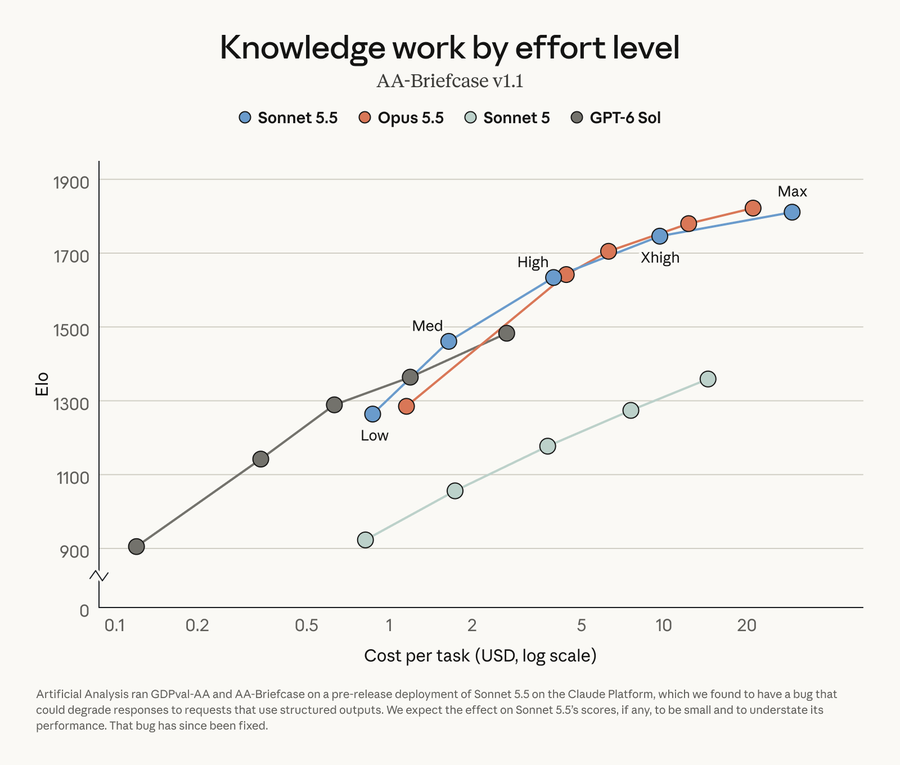
On AA-Briefcase v1.1, Sonnet 5.5 scales cleanly with inference spend, progressing from ~1250 Elo at Low effort ($0.85/task) to ~1460 Elo at Medium ($1.60/task), ~1630 Elo at High ($3.50/task), and peaking at 1811 Elo at Max effort ($28.00/task). This performance directly mirrors Opus 5.5 (1822 Elo) and establishes a formidable 328-Elo lead over OpenAI’s GPT-6 Sol (1483 Elo).
The Max-Effort Anomaly: Why FrontierCode 1.1 Penalizes Over-Engineering
One of the most revealing nuances in the evaluation data occurs in FrontierCode 1.1 (Main), where Sonnet 5.5 demonstrates a non-monotonic curve: performance rises smoothly through High and Xhigh effort, but experiences an unexpected regression at Max effort.
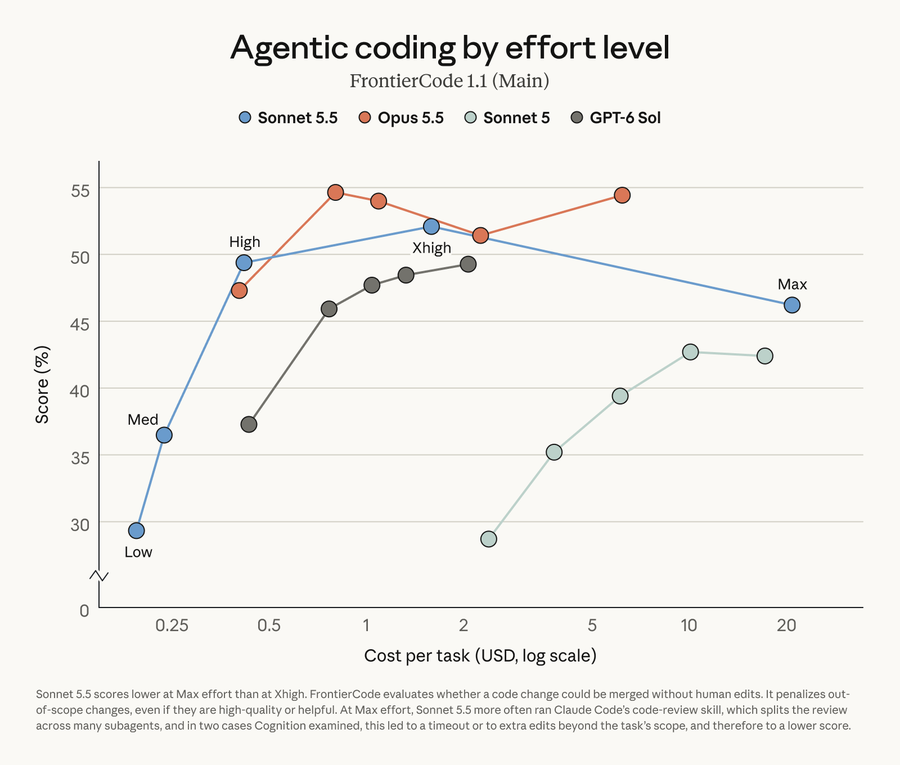
Unlike benchmark suites that test isolated unit test satisfaction, FrontierCode evaluates whether an automated pull request could be merged by a maintainer without human intervention. The evaluation harness harshly penalizes out-of-scope changes, formatting churn, and unsolicited architectural refactoring—even if the underlying code is technically functional.
At effort: "max", Sonnet 5.5’s internal decision tree triggered Claude Code’s specialized code-review skill. The model split its analysis across autonomous subagents to audit adjacent repository files. Per Anthropic’s own release notes, in multiple benchmark runs this multi-agent review mode either triggered harness execution timeouts or introduced out-of-scope cleanup edits beyond the designated issue boundary, driving the merge pass rate down from 52.1% at Xhigh ($1.50) to 46.2% at Max ($22.00).
For enterprise developers, the operational takeaway is unambiguous: setting effort: "xhigh" represents the global sweet spot for autonomous code generation, delivering maximum precision without triggering subagent scope sprawl.
The TCO Inversion: Why Sonnet 5.5 at Max Effort Costs as Much as Fable 5.1 and More than Opus 5.5
While Anthropic advertises Sonnet 5.5 as a lower-cost mid-tier model with nominal pricing ($2/$10 per million tokens) at half the sticker rate of Opus 5.5 ($4/$20 per million tokens), comprehensive end-to-end telemetry from Artificial Analysis exposes a startling real-world economic anomaly: in maximum effort modes with fallback retries, Sonnet 5.5 burns enough tokens to cost virtually the same as Claude Fable 5.1 and 27% more than Claude Opus 5.5.
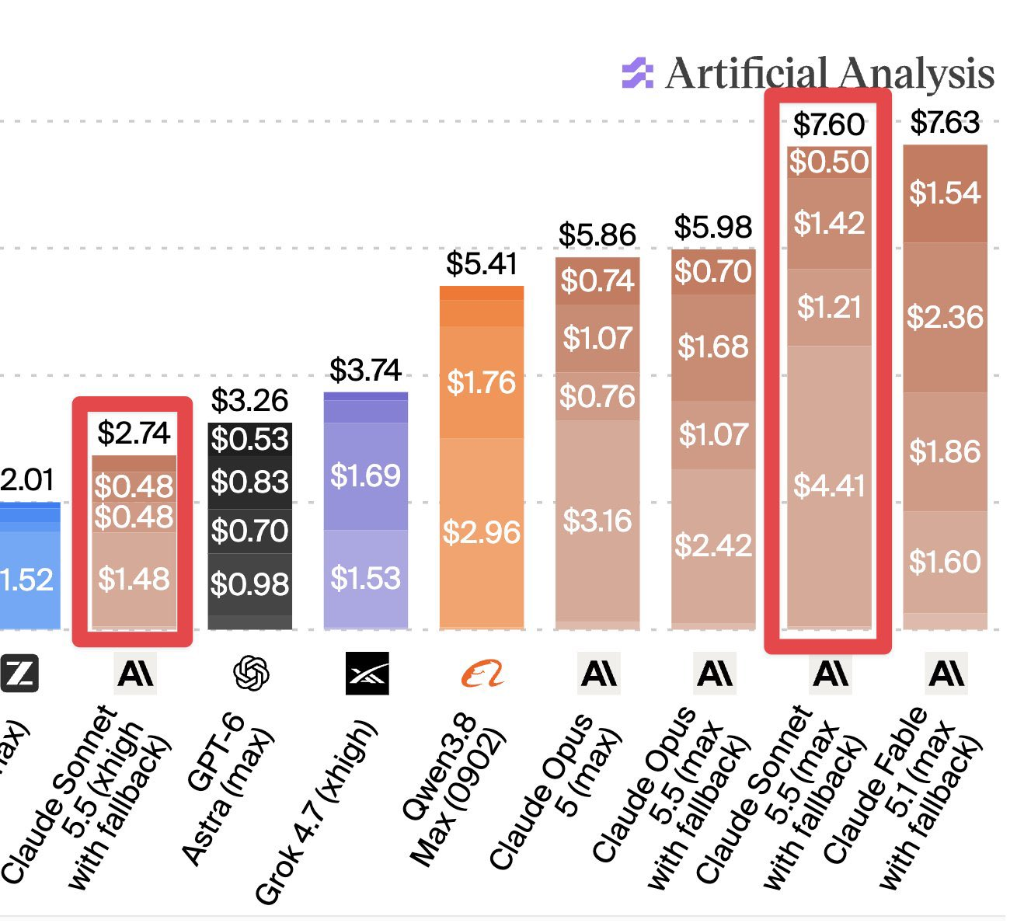
The telemetry from Artificial Analysis isolates the exact per-stage expenditure across complex frontier tasks:
- Claude Sonnet 5.5 (Xhigh with fallback): $2.74 ($1.48 base + $0.48 verification + $0.48 subagent + $0.30 fallback). This undercuts GPT-6 Astra at Max ($3.26) and Grok 4.7 at Xhigh ($3.74).
- Claude Opus 5.5 (Max with fallback): $5.98 ($2.42 base + $1.07 + $1.68 + $0.70 + $0.11).
- Claude Sonnet 5.5 (Max with fallback): $7.60 ($4.41 base + $1.21 + $1.42 + $0.50 + $0.06).
- Claude Fable 5.1 (Max with fallback): $7.63 ($1.60 base + $1.86 + $2.36 + $1.54 + $0.27).
How does a model with half the token rate of Opus 5.5 end up costing $7.60 compared to Opus 5.5’s $5.98? The answer lies in token generation volume and subagent spawning thrash. In Max effort mode, Sonnet 5.5 spent a staggering $4.41 on the primary execution step alone (nearly double Opus 5.5’s $2.42 base). Because Sonnet 5.5 has lower intrinsic reasoning density than Opus 5.5, it attempts to compensate by generating verbose intermediate rationales and aggressively dispatching subagent audits.
This creates a severe cost trap for production architects. At Max effort, Sonnet 5.5 reaches $7.60, essentially tying Anthropic’s heaviest dedicated reasoning model, Claude Fable 5.1 ($7.63). Yet dialing the effort parameter down by just a single step to xhigh collapses the cost by 64% to $2.74, while delivering superior merge pass rates on benchmark suites like FrontierCode. The rule of thumb for engineering leads is unmistakable: never run Sonnet 5.5 at Max effort in production pipelines. If a problem genuinely requires Max-tier cognitive depth, routing directly to Opus 5.5 is not only more reliable, it is $1.62 cheaper per task.
Five Breaking API Changes: Developer Migration Guide
Migrating production software from claude-sonnet-5 or claude-3-7-sonnet to claude-sonnet-5-5-20260928 introduces five breaking API-level contracts. Failing to adjust client payloads will trigger HTTP 400 Bad Request responses.
- Removal of
thinking: {"type": "disabled"}: Upfront thinking can no longer be disabled via the legacy flag. To execute without upfront reasoning latency, passthinking: {"type": "between_tools"}. This skips upfront thinking before initial tool dispatch while allowing the model to reason over returned tool payloads. Critical constraint:between_toolsis only accepted atlow,medium, andhigheffort levels. Passing it alongsidexhighormaxreturns an HTTP 400 error — those effort levels mandate full adaptive thinking and ignore the parameter. - Hard Rejection of Forced
tool_choice: Passing forced tool configurations (e.g.tool_choice: {"type": "tool", "name": "execute_bash"}or{"type": "any"}) is strictly rejected with a schema validation error. Only"auto"and"none"are permitted. Developers must guide tool dispatch through structured prompting and schema descriptions. - Thinking Block Conversation-Turn Binding: Thinking blocks in Sonnet 5.5 are bound to the conversation turn that generated them. The message history passed to the API must be strictly append-only — editing or reconstructing previous assistant turns that contain thinking blocks invalidates them and triggers a 400 error. Multi-model pipeline architectures that rebuild or modify conversation history (rather than appending new turns) must strip all thinking blocks before resubmitting. Additionally, Sonnet 5.5 accepts thinking blocks from Sonnet 5, Opus 4.8, and Haiku 4.5, but thinking blocks originating from Opus 5 or Opus 5.5 are dropped by the API.
- Computer Use Toolset Deprecation: Legacy computer-use tools (such as
computer_20251124) are officially blocked. All GUI orchestration must specifycomputer_toolset_20260801. - Response Block Ordering: Naive SDK client integrations that assume
response.content[0].textcontains the completion string will crash. With adaptive thinking enabled,content[0]is frequently athinkingblock followed by atextblock atcontent[1].
Production Availability and Strategic Ecosystem Impact
Claude Sonnet 5.5 is available immediately across the Anthropic First-Party API, Amazon Bedrock, Google Cloud Vertex AI, and Microsoft Foundry. On the consumer front, Sonnet 5.5 has officially taken over as the primary engine for the free tier on claude.ai, providing non-paying users with state-of-the-art agentic reasoning and 61.6% chartography vision capabilities.
By launching Opus 5.5 on September 22 and Sonnet 5.5 on September 28, Anthropic has executed an aggressive one-two punch against OpenAI’s GPT-6 ecosystem. With Claude Haiku 5.5 scheduled for release in the coming weeks to anchor the sub-dollar latency tier, the Claude 5.5 family establishes a unified, cost-compressed architecture across the entire enterprise computing stack.