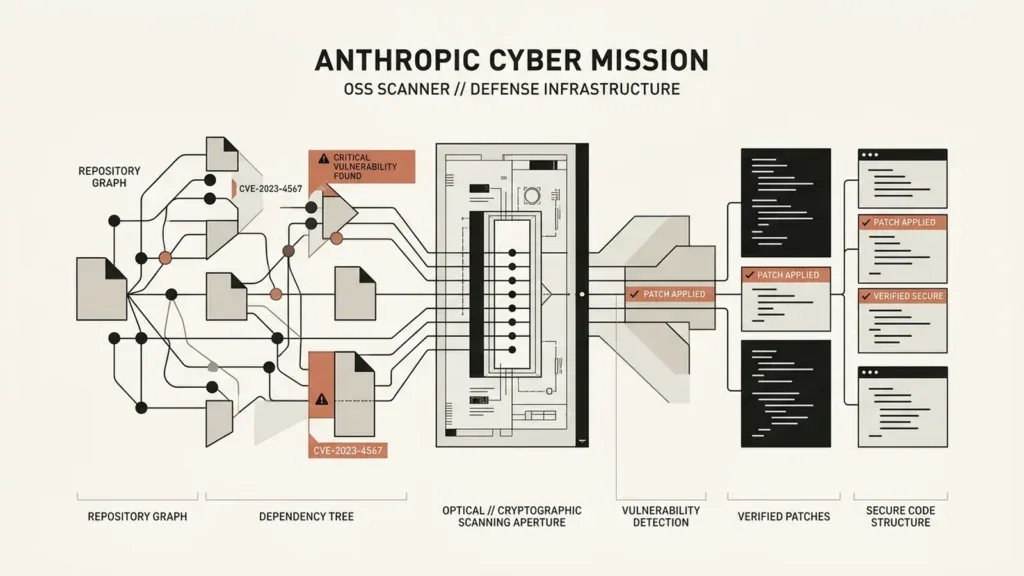

On October 8, 2026, Anthropic officially launched the Anthropic Cyber Mission, establishing two permanent defensive security tracks: the Critical Infrastructure Defense Program (CIDP) alongside 11 founding partners including CrowdStrike, Palo Alto Networks, and Rockwell Automation, and the OSS Scanner, an automated vulnerability engine offering free periodic scans to critical open-source software repositories. In an unprecedented operational shift, Anthropic is bypassing human-in-the-loop coordinated vulnerability disclosure, beaming fully automated, unreviewed zero-day proof-of-concept exploits directly to repository maintainers under an expected 90% true-positive threshold.
The initiative acknowledges a brutal asymmetry in modern software defense: while state-sponsored threat actors and autonomous agents can discover software exposures at machine speed, traditional coordinated vulnerability disclosure (CVD) creates multi-month triage backlogs. During Anthropic’s earlier trials under Project Glasswing—where partners leveraged models with advanced cyber capabilities like Claude Mythos to hunt memory corruptions—months routinely elapsed between an AI flagging an exploit and maintainers deploying a validated patch. By automating disclosure directly to development teams, Anthropic aims to close that window. Yet removing the human verification filter inverts the security trust boundary, shifting the cognitive and liability burden of reviewing AI-generated exploits squarely onto open-source maintainers.
The Architectural Friction of Unreviewed Disclosure
Under traditional vulnerability disclosure, an automated static or dynamic analysis finding undergoes human reproduction, severity scoring (CVSS), and environment validation before an external team alerts the maintainers. Anthropic’s OSS Scanner breaks this protocol deliberately. Maintainers enrolled in the fast track receive raw model outputs containing four discrete payloads:
- Mechanistic Vulnerability Breakdown: An automated root-cause explanation tracing memory layout, control-flow corruption, or input unsafety.
- Executable Proof-of-Concept (PoC): A self-contained reproduction script demonstrating reliable code execution, state poisoning, or panic crashes.
- Historical Commit Attribution: Exact Git commit context and author blame tags identifying when the vulnerability entered the mainline tree.
- Autonomous Candidate Patch: Model-generated source code modifications designed to remediate the vulnerability without regressing public interfaces.
This unreviewed disclosure model introduces three acute failure modes for engineering teams:
1. The 10% Triage Tax on Volunteer Maintainers
Anthropic publicly states an expected true-positive rate above 90%. In an enterprise setting with a dedicated Security Operations Center (SOC), a 10% false-positive rate is considered exceptional. In open-source infrastructure—where foundational libraries like OpenSSL, cURL, or Linux kernel subsystems are stewarded by small cohorts of volunteer developers—a 10% failure rate is an active operational tax. Every hallucinated exploit or miscalculated severity requires hours of manual decompilation, dynamic tracing, and test suite reconstruction to falsify.
2. The Synthetic Patch Hallucination Hazard
Providing an automated candidate patch sounds like an unalloyed benefit, but in systems-level programming languages (C, C++, Rust), AI-generated patches frequently introduce secondary edge cases. A patch may successfully eliminate a buffer overflow while introducing a lock inversion, a subtle reference count leak, or an off-by-one boundary failure that escapes standard unit tests. We observed related vulnerabilities during our audit of Claude Code’s hook execution architecture, where execution assumptions in pre-trust environments exposed developers to ambient script injection.
3. Asymmetric Exposure Risk
If an automated scanner identifies a zero-day vulnerability in an open-source library that also runs across critical operational technology, generating an unreviewed ticket creates a high-value confidential asset. If the maintainer’s communications channel, personal email, or private GitHub repository is compromised, that unverified PoC becomes an actionable weapon before the maintainer has had breakfast.
The Asymmetry Arithmetic: Machine-Speed Recon vs Human Remediation
The operational friction in the Anthropic Cyber Mission stems from a mathematical mismatch between automated reconnaissance speed and physical remediation velocity. In automated defensive security, the net defensive advantage over an adversary is defined by whether the defender can complete the full remediation pipeline before the adversary can weaponize the exposure.
• Δdef > 0: Defender advantage (system patched before weaponized exploit generation).
• Tscan: Model scanning duration (collapsed from weeks to minutes by Claude).
• Tdeploy: Downstream production propagation. In operational technology (OT), Tdeploy dominates the equation, rendering rapid automated scanning incapable of closing the threat window alone.
While frontier models collapse Tscan from months to minutes, they do nothing to reduce Tdeploy. In software packages managed by package managers (PyPI, npm, crates.io), downstream dependency propagation typically requires weeks. In industrial operational technology (OT)—such as the power generation facilities and water treatment plants targeted by the CIDP—Tdeploy can literally span decades. As Anthropic acknowledged in its official release, operational technology controllers often cannot be taken offline without risking catastrophic regional power failures, leaving verified vulnerabilities unpatched in physical hardware for years.
Comparing Defensive Protocols: CVD vs. OSS Scanner vs. CIDP
| Architectural Dimension | Traditional CVD | OSS Scanner (Fast Track) | Critical Infrastructure (CIDP) |
|---|---|---|---|
| Target Codebase | General Software & Web APIs | High-Impact OSS Repos | OT / SCADA / ICS / Power Grids |
| AI Scanning Engine | Static AST / Heuristics | Claude Frontier Weights | Claude + On-Site Specialists |
| Verification Gate | Human Analyst Triage | Zero Human Pre-Triage | Partner OT Engineers |
| Payload Disclosed | Bug Advisory & CVSS | PoC, Explanation, Patch | Compensating Controls |
| Remediation Window | 30 to 90 Days Embargo | Immediate Maintainer Action | Months to Decades |
| Funding Mechanism | Bounty Program Budgets | 0xDAF + PSF / OpenSSF Grants | Public-Private Consortium |
The Operational Technology Quagmire: Why OT Defies AI Speed
The second pillar of Anthropic’s mission—the Critical Infrastructure Defense Program—confronts a completely different trust boundary. Operational technology does not fail like cloud microservices. In cloud environments, a failing node is terminated by Kubernetes and rescheduled in seconds. In industrial automation, a malformed packet sent to a programmable logic controller (PLC) controlling an electric turbine can cause physical kinetic destruction.
Anthropic’s strategy of pairing frontier models with 11 established vendors (such as Dragos, Rockwell Automation, and Nozomi Networks) is a direct acknowledgment that AI models cannot safely operate as autonomous agents in OT environments. The primary value of Claude in CIDP is not automated code patching, but synthesizing massive cross-telemetry streams from air-gapped industrial networks where human security analysts are physically constrained.
However, revealing vulnerabilities in legacy industrial equipment often creates severe regulatory and physical liability. When a proprietary controller manufactured in 2004 contains a hard-coded credential or a remote buffer overflow, the manufacturer may no longer employ the engineers who wrote the original assembly routine. In those scenarios, an AI discovering the flaw does not create a fix—it creates an unfixable vulnerability notice that operators must manage through network segmentation and firewalls.
The Horizon: Automated Bug Hunting and the 2028 Defense Inversion
Anthropic forecasts that within two years, the security calculus will invert: automated AI tools will make defensive software design fundamentally easier than offensive exploitation. But bridging the transitional chasm between 2026 and 2028 requires rigorous guardrails.
To mitigate the cognitive tax on maintainers, Anthropic has committed funding through the Defender Advantage Fund (0xDAF) to coordinating bodies like OpenSSF, the Apache Software Foundation, and the Python Software Foundation, while providing free Claude Max 20x allocations to active project stewards. Yet funding alone cannot resolve the trust boundary dilemma. As we documented in our examination of Cloudflare’s post-quantum certificate architecture, upgrading foundational protocols requires universal, zero-defect verification across legacy and modern endpoints alike.
If the OSS Scanner succeeds, it will establish autonomous machine-speed auditing as the industry standard. If it falters under false positives and secondary patch regressions, it will reinforce the fundamental security invariant of modern enterprise engineering: in any pipeline operating without a human verification gate, the receiver of the automated output inherits 100% of the operational risk.
Frequently Asked Questions
How does Anthropic’s OSS Scanner differ from Google’s OSS-Fuzz?
While Google’s OSS-Fuzz relies on coverage-guided fuzzing harnesses running continuous automated inputs against instrumented binaries, Anthropic’s OSS Scanner uses frontier Claude models to semantically reason over static source code, uncover complex logic flaws, and autonomously generate functional exploit PoCs alongside candidate source code patches.
Can open-source maintainers opt out of unreviewed reports?
Yes. The fast track is strictly opt-in for projects with active triage capacity. Projects that prefer vetted disclosures remain covered under Anthropic’s human-verified Coordinated Vulnerability Disclosure (CVD) policy, where findings undergo manual confirmation before reaching maintainers.
What is the Defender Advantage Fund (0xDAF)?
Launched in August 2026, the Defender Advantage Fund (0xDAF) is Anthropic’s philanthropic cybersecurity pool that keeps the OSS Scanner free for open-source software, funds infrastructure grants for foundations like OpenSSF and the Python Software Foundation, and distributes free Claude Max subscriptions to maintainers.