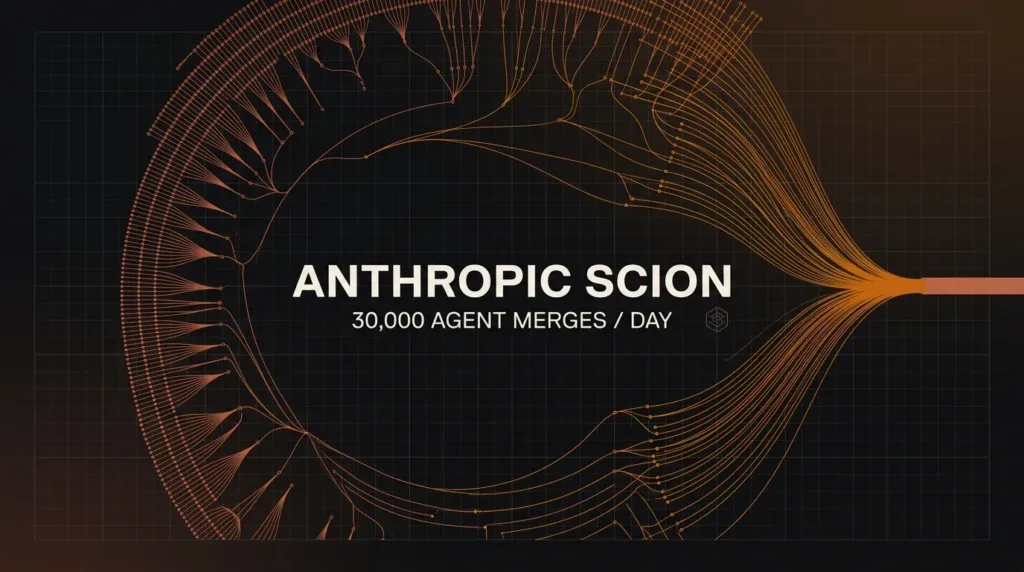

On September 9, 2026, Anthropic’s primary software monorepo recorded 30,401 merges in twenty-four hours—an operational velocity driven almost entirely by autonomous Claude agent swarms. Standard distributed Git collapsed under the strain of 25 million daily checkouts, threatening to consume over 600 petabytes of daily transfer bandwidth. Anthropic resolved the crisis by deploying Scion, a proprietary version control engine anchored on Google Cloud Spanner compare-and-swap transactions and tiered in-memory streaming caches.
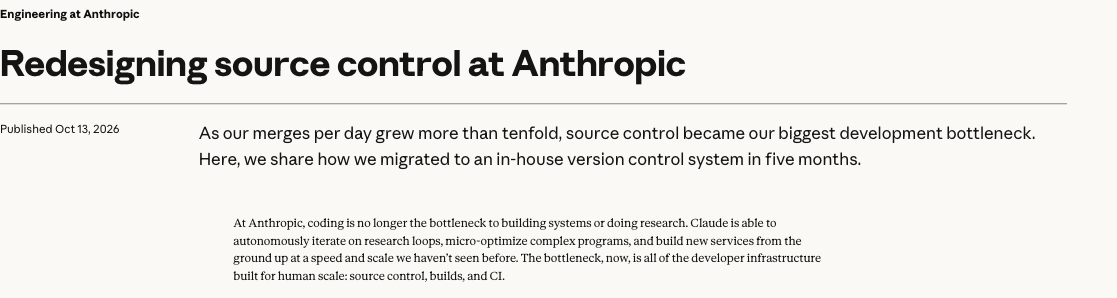
When software organizations deploy autonomous coding agents at production scale, their primary architectural failure mode is rarely prompt quality or context window exhaustion. It is filesystem and revision control contention. In May 2026, Anthropic’s internal engineering monorepo sustained approximately 2,500 daily code changes—a volume typical for an elite, high-velocity engineering organization operating standard trunk-based development on GitHub Enterprise.
Four months later, that figure escalated by more than a factor of ten. By September 2026, commit velocity surpassed 30,000 landed revisions per day, with individual automated systems submitting concurrent change requests every fraction of a second. The underlying Git repository—spanning 100 gigabytes of historical object storage and a 25-gigabyte working copy—reached catastrophic operational failure. Checkouts stalled for minutes, internal mirror replicas drifted permanently out of phase, and developer terminal latency turned interactive rebasing into an exercise in queue starvation.
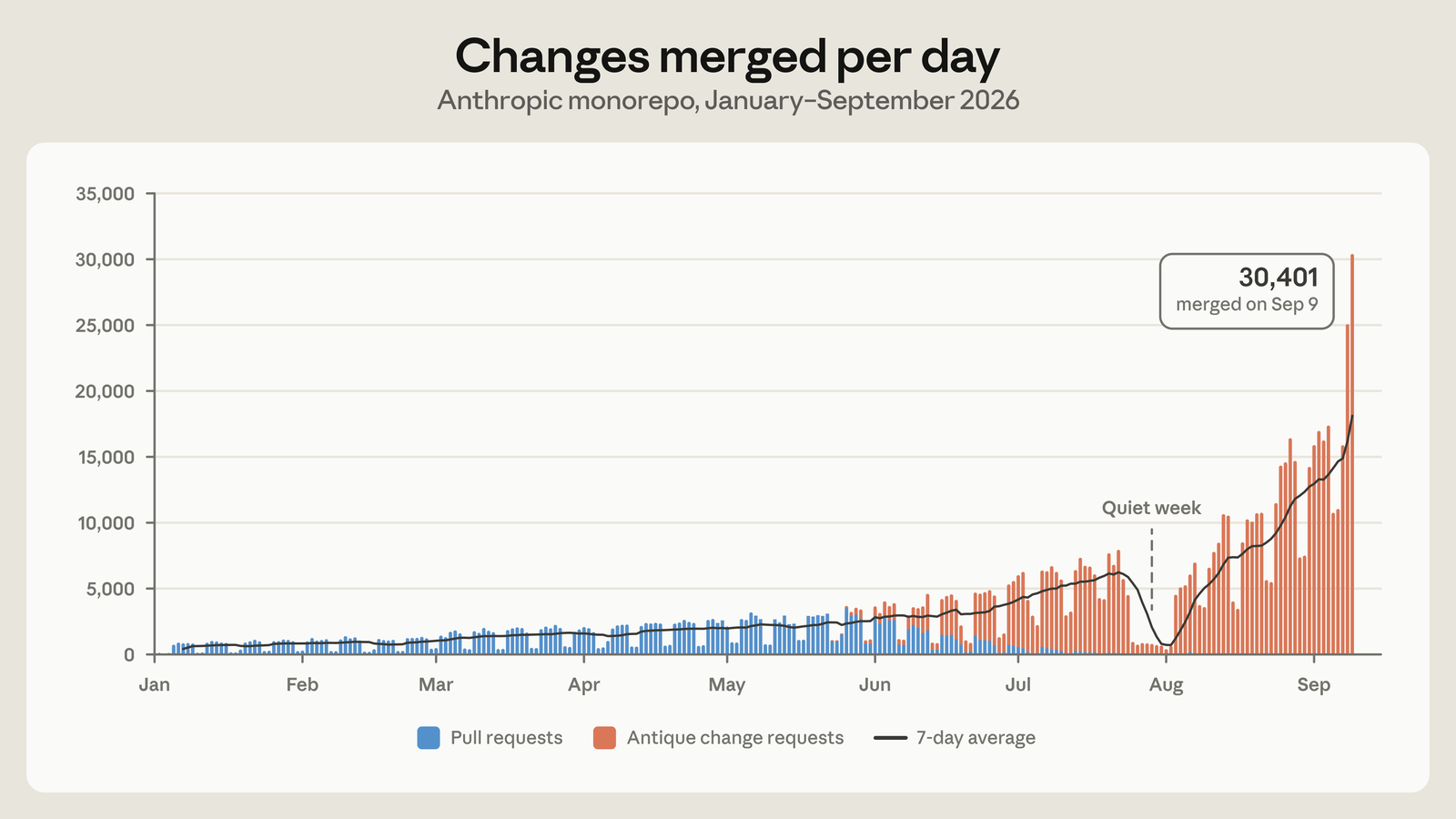
To survive this influx, a seven-engineer systems team inside Anthropic spent five months architecting Scion: a distributed, server-centric revision control engine accompanied by Antique, a bespoke, high-throughput code review interface replacing GitHub pull requests. According to Anthropic’s published telemetry, the migration slashed local repository status checks from 3.9 seconds down to 19 milliseconds, reduced sandbox worktree provisioning for agent workers from 7.1 minutes to 5.1 seconds, and recovered 25 percent of the CPU capacity across their entire continuous integration fleet.
Yet beneath these performance victories lies a fierce systems controversy. Within hours of Anthropic publishing their engineering disclosure, distributed systems veterans pointed out that Scion’s core architectural data model is an almost verbatim replication of Meta’s open-source Mononoke engine, developed in 2018 for the Sapling SCM. While Anthropic framed Scion as an architectural breakthrough designed and implemented in record time by an internal preview snapshot of Claude Mythos, systems engineers across the community revealed how frontier models absorb open-source distributed systems literature from their training data, allowing corporate labs to replicate complex engineering paradigms while sequestering the resulting software behind proprietary enterprise walls.
Why Git Collapsed Under Autonomous Agent Swarms
To diagnose why Git failed inside Anthropic, one must inspect the fundamental physics of the Git object model. Git was conceived in 2005 by Linus Torvalds for human-speed coordination over asynchronous email threads. Its foundational assumptions are decentralized: every participant clones a complete, self-contained directed acyclic graph (DAG) of the entire project’s history, and every local working copy computes state independently before pushing changes to an upstream remote.
That model functions adequately when humans submit pull requests every few hours. It breaks down completely when hundreds of autonomous agent workers execute automated feature generation, test repair, and dependency updates in tight loops. At 30,401 merges per day, Anthropic’s repository received an average of 0.35 landed commits every single second, sustained over twenty-four hours, with peak bursts reaching multiple writes per second.
refs/heads/main.lock requires an exclusive filesystem lock. Microsecond collisions trigger exponential backoff queues and stale push rejections.main. Sandboxes pull stale refs, producing semantic rebase conflicts and cascading bisection loops.In a traditional relational database, sustained throughput of 0.35 writes per second is negligible. In Git, it constitutes a catastrophic denial-of-service condition due to three systemic bottlenecks:
Global Reference Lock Contention
Git enforces branch pointer integrity through filesystem-level atomic locks. Updating refs/heads/main requires acquiring an exclusive lock on .git/refs/heads/main.lock. While a push is active, hooks execute, object validation occurs, and the ref pointer advances before releasing the lock. When dozens of agents attempt to land commits concurrently, the vast majority encounter lock contention, forcing exponential backoff retries, queue deadlocks, and stale ref rejections.
Packfile Delta Recompression Overhead
Git does not transmit raw files over the wire; it executes a complex packfile negotiation protocol. When a client performs a fetch or clone, the server enumerates objects, traverses the commit DAG, computes sliding-window delta compression between matching blobs, and streams a packed binary payload. On a 100-gigabyte repository history, repeated delta generation across 25 million daily automated checkouts produces massive CPU exhaustion on the server tier.
Mirror Desynchronization and Network Saturation
To survive 25 million daily checkouts, Anthropic previously operated hundreds of read-only Git mirrors backed by periodic cloud storage snapshots. However, under continuous agent merges, mirror replication lag created a fatal consistency breakdown. Agent sandboxes pulling from read replicas frequently received tree states several commits behind the true tip of main. Pushes based on these stale snapshots generated semantic rebase conflicts, triggering cascading agent bisect loops that multiplied redundant checkouts.
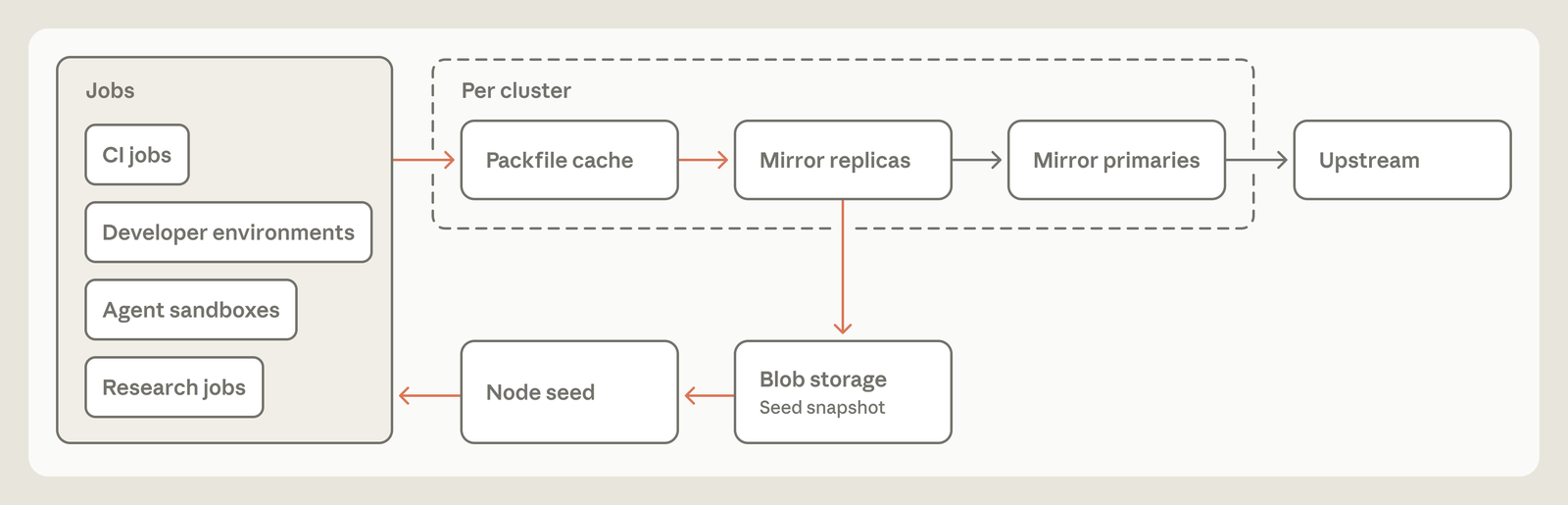
Had Anthropic continued serving fresh clones over standard Git packfile transport, streaming the 25-gigabyte working copy across 25 million automated runs would have demanded over 600 petabytes of network egress per day. Even with local disk caching and bare clones, the infrastructure required several hundred specialized mirror instances just to buffer the read pressure. As developer and agent code output surged—a phenomenon detailed in our investigation of the post-IDE agent multiplexer revolt—the revision control system itself became Anthropic’s single largest engineering bottleneck.
Network Bandwidth Deflation: Under a legacy Git packfile topology, 25 million automated checkouts pulling a 25 GB monorepo would produce 625 petabytes of daily network egress. Scion transfers only a 40 KB root directory index, populating file bodies lazily on demand via regional in-memory caches (>99% hit rate) and deflating daily network egress by over 99.7%.
Inside the Scion Engine: Changeset WAL and Spanner CAS
Scion dismantles Git’s decentralized premise entirely, replacing it with an asymmetric, server-centric architecture modeled on cloud-native transactional databases. In Scion, client workstations and agent runner containers do not possess a copy of the repository’s history, nor do they traverse a local Merkle tree to compute diffs.
Instead, the Scion repository exists exclusively as an append-only write-ahead log (WAL) partitioned across Google Cloud Spanner and immutable object storage.
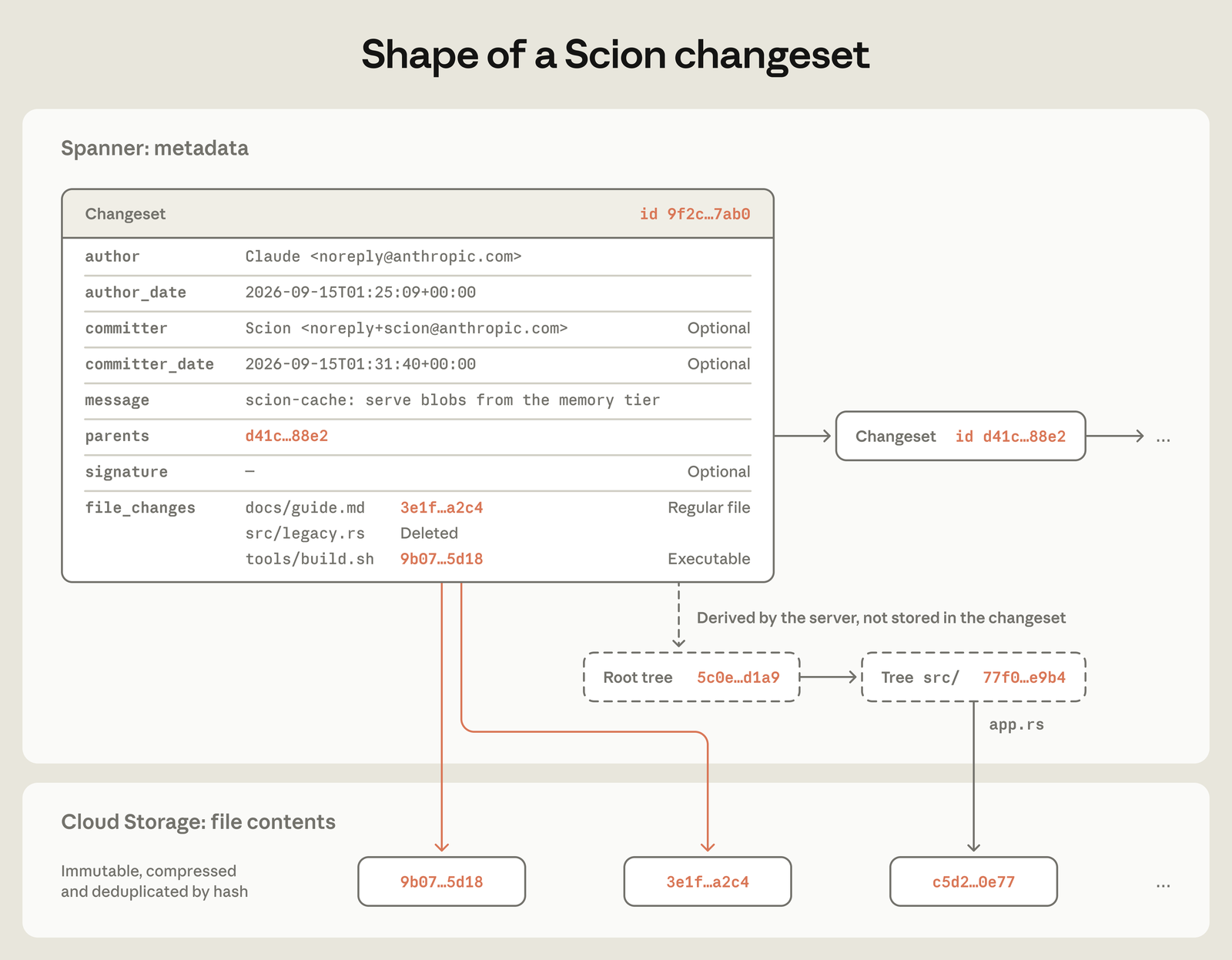
The Changeset Data Structure
Unlike a Git commit—which links together parent hashes, commit messages, author signatures, and an entire recursive tree object graph—a Scion changeset is a lightweight, normalized record. It encapsulates:
- Identity & Metadata: Author identity, commit timestamp, and explicit parent changeset IDs.
- Forward Changeset Delta: An enumerated list of file paths added, modified, or deleted in that specific revision.
- Pointers to Blob Storage: Content-addressed SHA-256 hashes referencing raw file blobs residing in cloud storage, completely separated from repository metadata.
By isolating the changeset to an atomic delta, Scion avoids Git’s structural trap: creating a commit does not require hashing every unchanged subtree or serializing intermediate directory manifests.
Decoupled Branch Heads via Spanner Compare-And-Swap
The core technical breakthrough that eliminated Git’s lock contention is how Scion records branch updates. Rather than locking a ref file or running an exclusive distributed consensus round across the entire repository graph, advancing the tip of a branch in Scion is executed as a single Compare-And-Swap (CAS) transaction on a single row in Google Cloud Spanner.
When an autonomous agent or developer lands a change:
- The client uploads new file blobs directly to cloud storage, receiving content-addressed hashes.
- The client constructs the changeset record referencing those hashes and parent revisions.
- The client issues an atomic commit request to
scion-server. - The server executes a Spanner transaction:
UPDATE branches SET head_changeset_id = :new_id WHERE branch = 'main' AND head_changeset_id = :expected_parent_id.
If another commit landed concurrently, the CAS transaction fails instantly without locking the database. However, unlike Git, which forces the client to pull, re-pack, and re-push, Scion’s server layer can evaluate whether the concurrent commit touched disjoint directory trees. If no path collision exists, the server rebases the changeset metadata optimistically and re-applies the CAS transaction entirely on the server side.
Asymmetric Tiering: Daemon, Regional Cache, and Object Store
Client workstations and agent runners never interact directly with Spanner or cloud storage. As shown in the tiered architecture diagram, Scion implements a three-tier streaming pipeline:
scion-daemon(Local Worker): A background daemon running on each host that intercepts file access, communicates over local Unix domain sockets, and manages local virtualized worktrees. Because security at the daemon socket boundary is critical, vulnerabilities here can expose developer environments to severe privilege escalations, reflecting the operational risks analyzed in our Claude Code token compromise and hook security audit.scion-cache(Regional In-Memory Tier): High-memory proxy instances deployed in each cloud region and compute cluster. These proxies maintain active working tree manifests and warm file blobs in RAM, sustaining an audited >99% cache hit rate.scion-server(Central Control Plane): The authoritative coordinator that commits changesets to Spanner and orchestrates background derived data computations.
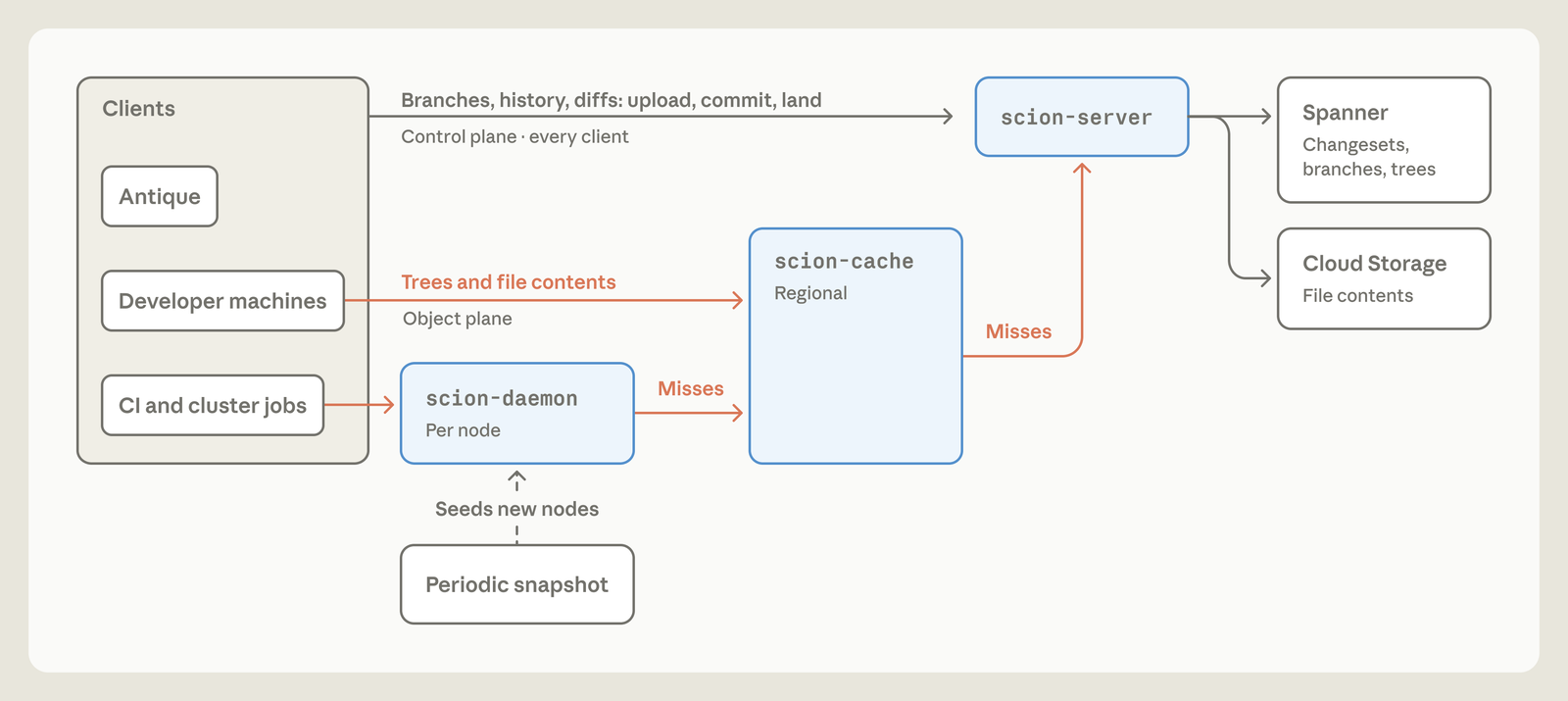
When an agent needs to execute tests against a fresh revision, scion-daemon does not download 25 gigabytes of files. It materializes only the root directory structure and directory index, populating file bodies lazily on-demand when the compiler or runtime issues a filesystem read call.
Arithmetic Reveal: Fleet Economics and Latency Compounding
The economic and operational dividend of replacing decentralized Git with a database-backed streaming engine is staggering. In an agentic engineering environment, latency compounds multiplicatively: if an autonomous harness must wait several minutes for checkouts, status inquiries, and commit verification between iterative test runs, agent throughput collapses while token spend and cloud compute idling skyrocket.
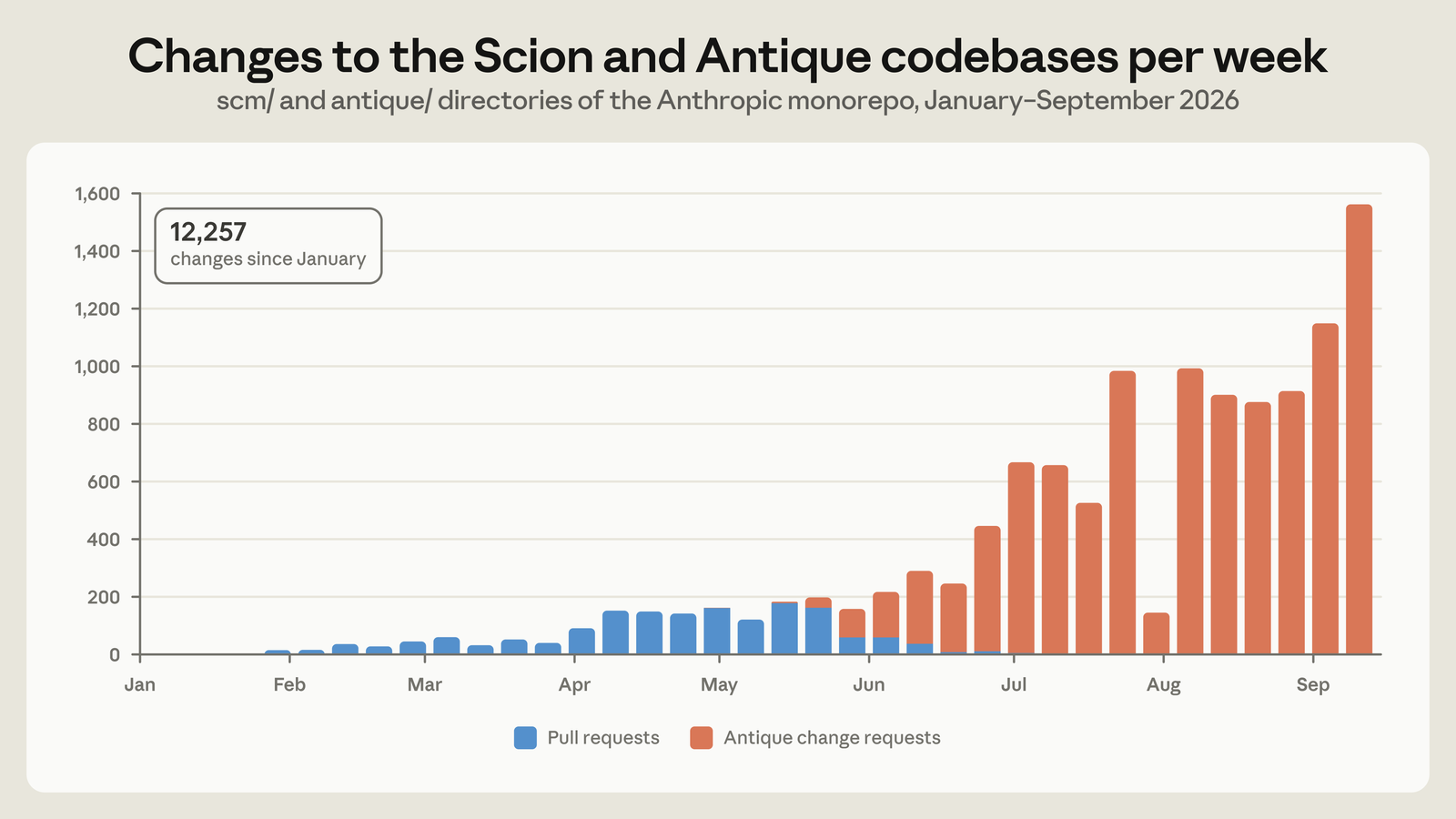
Between January and September 2026, Anthropic logged 12,257 internal revisions across their scm/ and antique/ directories while building and tuning Scion. When deployed across the entire engineering population and agent fleet, empirical performance benchmarks revealed order-of-magnitude improvements across every operational vector.
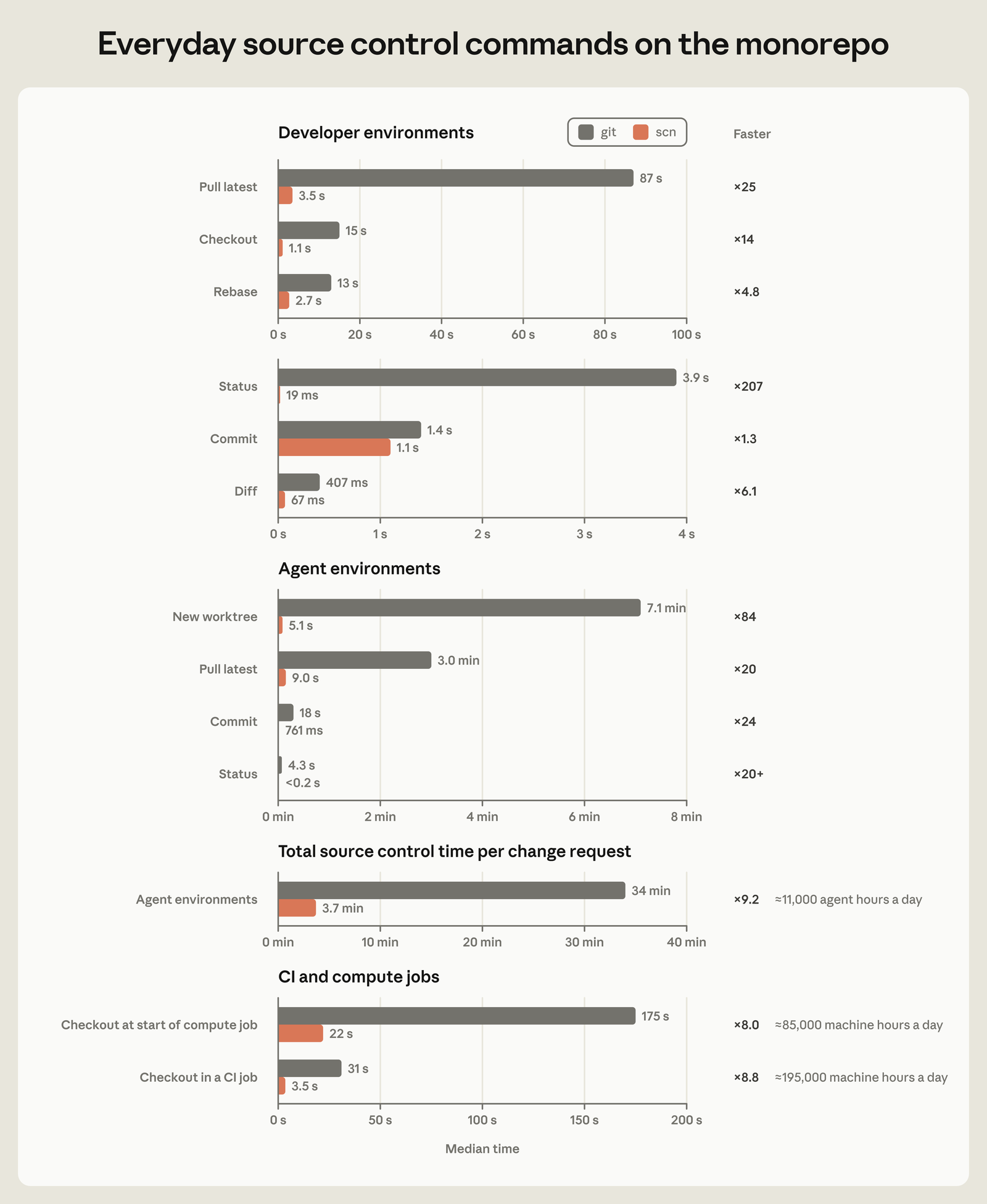
scn) against Git across developer workflows, agent execution loops, and automated CI pipelines.Git vs. Anthropic Scion: Critical Path Latency Reduction
Forensic operational telemetry across 25 million daily automated checkouts and 30,401 landed agent merges.
status • Developer Terminal)
207× FASTERcommit • Agent Loop)
24× FASTERpull • Agent Harness)
20× FASTEREmpirical Performance Teardown: Native Scion (scn) vs. Git
The following benchmark table incorporates the impervious styling standards required for production systems analysis, establishing explicit performance deltas between standard Git and Scion:
| Operation & Target Context | Git Baseline | Scion (scn) | Measured Multiplier | Operational Consequence |
|---|---|---|---|---|
| Status (Developer Terminal) | 3.90 s | 19 ms | 207× faster | Sub-perceptual local responsiveness |
| New Worktree (Agent Sandbox) | 7.10 min (426 s) | 5.10 s | 84× faster | Instantaneous sandbox provisioning |
| Commit (Agent Loop) | 18.0 s | 761 ms | 24× faster | Eliminates commit serialization lag |
| Pull Latest (Agent Harness) | 3.00 min (180 s) | 9.00 s | 20× faster | Rapid context refresh across swarms |
| Status (Agent Automation) | 4.30 s | <0.20 s | >20× faster | Near-zero harness polling tax |
| Pull Latest (Developer Terminal) | 87.0 s | 3.50 s | 25× faster | Eliminates terminal context fragmentation |
| Checkout (Developer Branch) | 15.0 s | 1.10 s | 14× faster | Seamless branch switching across monorepo |
| Diff (Developer Review) | 407 ms | 67 ms | 6.1× faster | Instantaneous terminal diff generation |
| Rebase (Developer Branch) | 13.0 s | 2.70 s | 4.8× faster | Frictionless local branch alignment |
| CI Job Checkout (Container Runner) | 31.0 s | 3.50 s | 8.8× faster | 195,000 machine hours saved/day |
| Compute Job Checkout (Training Cluster) | 175 s | 22.0 s | 8.0× faster | 85,000 machine hours saved/day |
| Total SCM Overhead / Change | 34.0 min | 3.70 min | 9.2× faster | 11,000 agent hours saved/day |
The arithmetic of these gains resolves directly into machine resource economics:
- 280,000 Daily Machine Hours Saved: Combining 195,000 machine hours saved across standard CI test jobs with 85,000 machine hours recovered from heavy compute training clusters yields 280,000 machine hours returned to Anthropic’s compute pool every twenty-four hours.
- 25% Fleet-Wide CPU Recovery: Continuous integration runners previously spent a quarter of their active cycles decompressing packfiles and computing index trees. Eliminating that overhead recovered 25 percent of total CI CPU capacity immediately.
- 200x Infrastructure Footprint Reduction: By substituting hundreds of drifting Git mirror VMs and snapshot servers with lightweight, state-free
scion-cacheproxies and Spanner rows, the physical server footprint dedicated to version control shrank by two orders of magnitude. - 11,000 Agent Working Hours Recovered Daily: In agent harnesses, source control overhead dropped from 34 minutes per landed change to 3.7 minutes—recovering 11,000 agent execution hours every single day.
The Mathematics of Recursive Derived Data
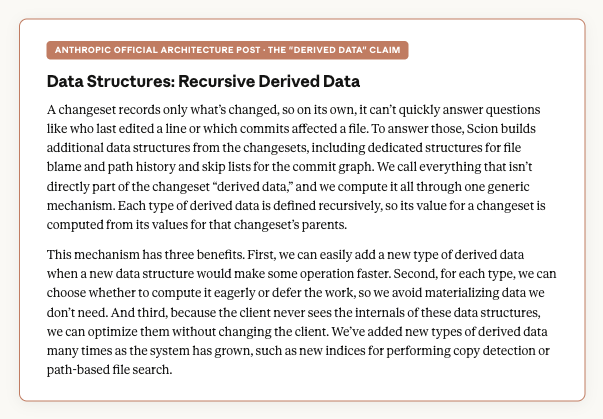
The primary mathematical challenge of an append-only write-ahead log is that raw changesets cannot answer historical graph queries efficiently. If a changeset contains only what changed, answering git blame (identifying who modified line 42 of a file) or computing reachability in a commit graph would require traversing thousands of individual changeset rows sequentially across Spanner.
To solve this, Scion implements what Anthropic describes as recursive “derived data”:
Each file version forms an independent node in a derived Merkle DAG. When changeset Cn is committed, Scion’s ingestion worker recursively computes the derived data for Cn strictly from the derived data of its parent changesets Parents(Cn) and the file delta.
For commit ancestry resolution, Scion constructs skip lists across the commit DAG. Evaluating whether commit A is an ancestor of commit B drops from a linear DAG crawl of O(N) down to O(log N) logarithmic skip pointer evaluations. Because derived data is decoupled from the transactional write path, Spanner can commit the WAL row immediately, allowing asynchronous workers to materialize the query indexes in the background.
Logarithmic Commit Resolution: To verify whether a commit is an ancestor of the current branch head, traditional Git traverses intermediate tree objects linearly across the commit DAG (O(N) complexity). Scion maintains precomputed skip lists across the changeset graph, reducing ancestor reachability checks to logarithmic skip pointer jumps (O(log N)) and enabling sub-millisecond graph queries.
Where Does This Workflow Fail After the Demo?
As an agent reliability analyst, my core editorial inquiry is never whether an architectural system looks impressive in a curated engineering announcement. My question is: Where does this workflow fail after the demo?
When you dismantle Git’s global locks and enable 30,000 autonomous agent commits per day, you do not magically eliminate the fundamental laws of distributed state concurrency. You merely displace the friction points. Telemetry and systems mechanics expose four critical failure boundaries inside Scion’s production operation:
The Optimistic Post-Merge Collision Storm
To eliminate queue latency, Anthropic intentionally eliminated serialized merge queues. In a standard enterprise environment, a merge queue tests PRs sequentially against the anticipated future state of main. If PR #101 modifies a shared interface, PR #102 is tested against PR #101’s output before landing.
Scion drops this serialized gate. Changes land optimistically via Spanner compare-and-swap transactions. If two autonomous agents submit PRs simultaneously—Agent A modifying an internal API signature in //services/auth and Agent B adding a new consumer call in //services/gateway—both commits land cleanly because their file paths do not conflict.
The collision occurs post-merge in the build graph. The main branch breaks, halting downstream deployments. Anthropic’s solution is not to reintroduce locks, but to deploy an automated agent swarm that continuously bisects broken main states, identifies the offending changeset, and generates an automated revert PR.
While this prevents commit serialization bottlenecks, it induces high-velocity volatility: during heavy agent activity, engineers and agents experience “ghost breakages” where main fails compilation for three-to-five-minute windows while automated revert swarms fight to restore branch equilibrium.
Regional Cache Invalidation Latency Under Burst Queries
Scion’s performance relies on regional scion-cache instances achieving a >99% hit rate. However, derived data (such as the file blame index and code search indices) is computed lazily and asynchronously.
When an agent swarm initiates a large-scale refactor touching hundreds of files across the monorepo, hundreds of downstream CI test jobs launch immediately to validate the changes. If those CI runners request blame information, AST call graphs, or file blobs before the regional cache has finished ingesting and materializing the derived data from Spanner, a “cache thundering herd” ensues. Uncached queries bypass the regional tier and strike the central scion-server control plane directly, causing latency spikes that degrade terminal responsiveness for human engineers.
Monotonic Write-Ahead Log Bloat
In standard Git, repositories periodically run git gc—a stop-the-world garbage collection routine that identifies orphaned loose objects, packs them into packed archives, and prunes unreferenced unreachable commits.
Scion deliberately eliminates stop-the-world garbage collection to ensure zero maintenance downtime. The consequence is monotonic state expansion: every exploratory branch, abandoned agent test commit, temporary fixture, and scratch revision committed to the WAL persists indefinitely across Spanner rows and cloud storage buckets. Over multiple quarters of 30,000 daily agent commits, historical metadata scales without upper bounds, forcing Anthropic’s infrastructure team to continuously engineer custom tombstoning and lifecycle pruning layers to prevent cloud storage bills from expanding exponentially.
The Slack “Superfan” Operational Tax
Perhaps the most telling operational admission in Anthropic’s engineering disclosure is their deployment of dedicated Claude agents as Slack “superfans.” Anthropic assigned autonomous Claude instances to monitor incoming telemetry and error logs for specific microservices, including scion-daemon, scion-cache, and the Antique review backend.
While marketed as an innovative application of LLMs in DevOps, this pattern reveals an underlying operational truth: Scion’s distributed moving parts—local Unix socket daemons, regional streaming proxies, asynchronous derived data workers, and Spanner CAS transactions—are so complex and volatile that human site reliability teams cannot monitor them manually at 30,000 merges/day. The system requires continuous, autonomous synthetic overseers just to prevent silent performance regressions from paralyzing the fleet.
The Mononoke Controversy: Open-Source Lineage vs. The Corporate AI Origin Myth
“Claude’s ability to write code was both what put us in this situation and how we quickly built a high-quality system in five months… All of the engineers who worked on this system would now rate Claude as better at writing code than them.”
In Anthropic’s telling, when Git collapsed under agent code generation, their engineers turned to Claude to design and implement an entire enterprise revision control system from scratch. Anthropic specifically credited an internal preview snapshot of Claude Mythos—the frontier reasoning model explored in our analysis of why Anthropic locked down Claude Mythos Preview—with rewriting their initial handwritten Git ingestion pipeline, achieving a 20-fold reduction in memory consumption and a 4-fold speedup.
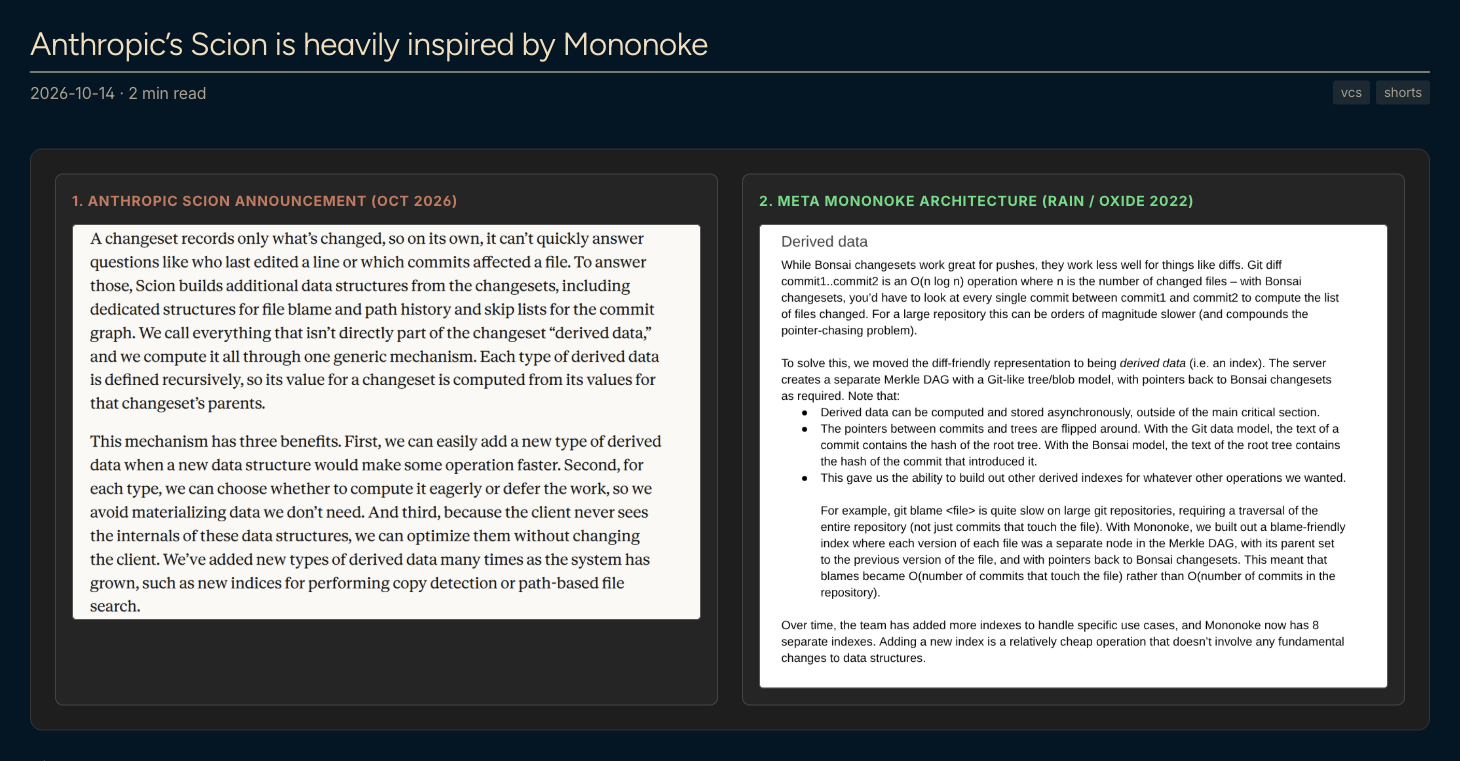
Within twenty-four hours of the announcement, Rain (@sunshowers), a former Meta systems engineer who spent years building Meta’s open-source Mononoke version control engine for the Sapling SCM, published a devastating technical rebuttal on sunshowers.io. Rain demonstrated that Scion’s architecture was not a novel invention formulated de novo by Claude Mythos, but a direct, line-for-line replication of Meta’s 2018 Mononoke engine.
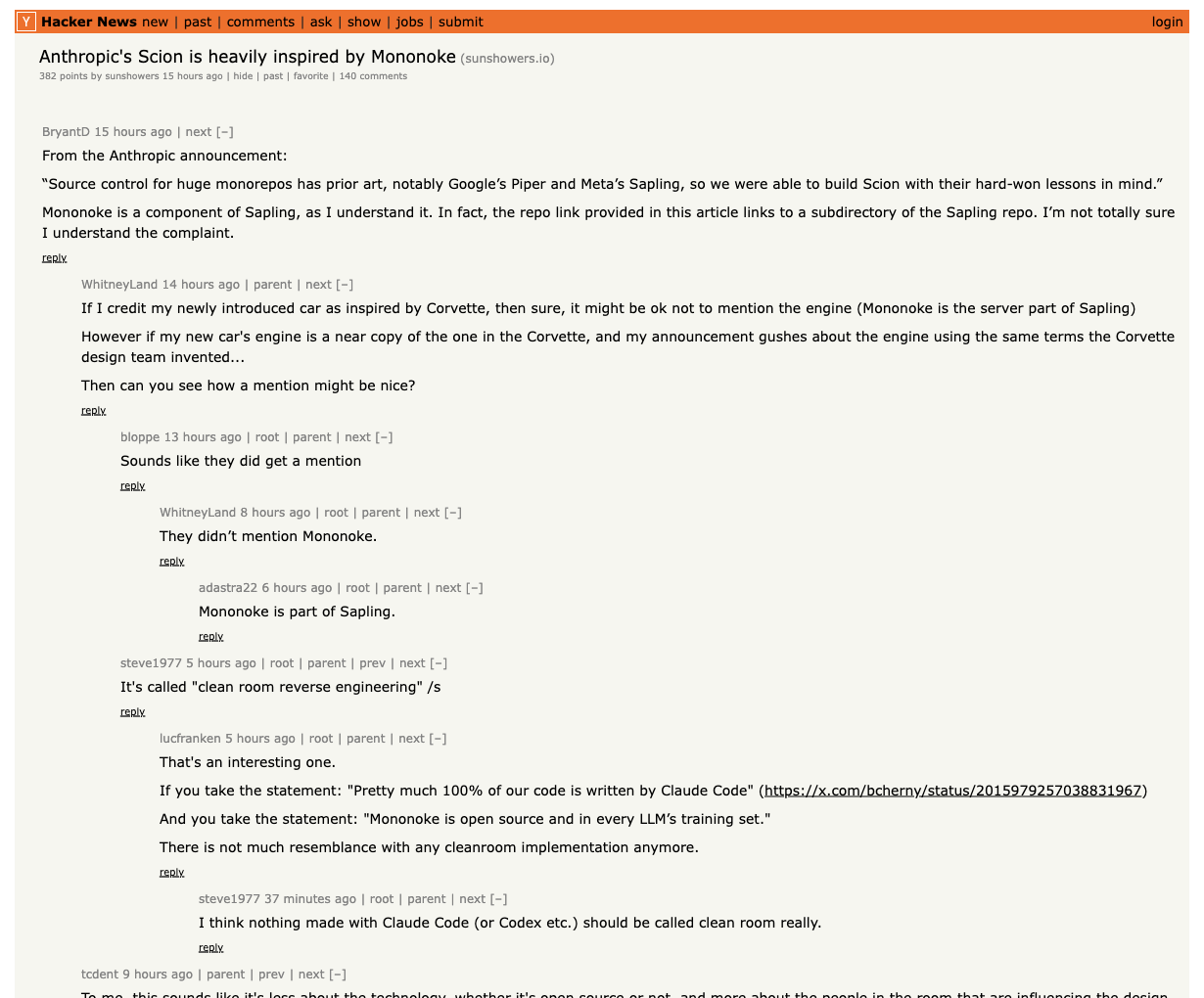
Architectural Parity Teardown: Meta Mononoke (2018) vs. Anthropic Scion (2026)
The architectural alignment between Meta’s open-source Mononoke and Anthropic’s proprietary Scion extends far beyond general distributed systems design patterns. It penetrates the specific terminology, Merkle graph topology, and indexing algorithms:
| Architectural Vector | Meta Mononoke / Sapling (2018–2022) | Anthropic Scion (2026) | Lineage & Structural Relationship |
|---|---|---|---|
| Primary Ingestion Unit | Bonsai Changeset (Atomic WAL delta) | Scion Changeset (Atomic WAL delta) | Direct conceptual parity |
| Tree/Commit Pointer Inversion | Trees reference changeset parent hashes | Trees reference changeset parent hashes | Identical inverted Merkle DAG |
| Blame Computation Engine | Recursive Derived Merkle DAG | Recursive “Derived Data” DAG | Identical terminology and mechanism |
| Blame Complexity | O(commits touching target file) | O(commits touching target file) | Identical algorithmic reduction |
| Commit Ancestry Index | Skip lists over commit DAG | Skip lists over commit graph | Identical graph skip-list design |
| Client/Server Model | Asymmetric (EdenFS daemon + Sapling CLI) | Asymmetric (scion-daemon + scn CLI) | Identical local-daemon virtual filesystem |
| Primary Metadata Store | RocksDB / Cassandra / Manifold | Google Cloud Spanner (CAS rows) | Cloud-native RDBMS adaptation |
| Object Caching Layer | Regional Memcached / Eden cache | Regional in-memory scion-cache | Standard memory-streaming proxy tier |
| Licensing & Availability | Open Source (GPLv2 / MIT) | 100% Proprietary / Closed Source | Open source absorbed into closed moat |

“The level of inspiration goes well beyond ‘hard-won lessons’. Here the data model is a direct copy, down to the terminology… To solve this, we moved the diff-friendly representation to being derived data (i.e. an index). The server creates a separate Merkle DAG with a Git-like tree/blob model, with pointers back to Bonsai changesets as required… Mononoke is open source and in every LLM’s training set. If you ask Opus 5.5 or GPT-6 Astra about prior art, they both immediately point out the similarities to Mononoke. Giving credit to those that came before us is now easier—and more important—than ever.”
This discrepancy reveals a deeply uncomfortable trend in frontier AI commercialization: open-source prior art laundering. Meta’s engineering teams spent nearly a decade developing, testing, and open-sourcing Mononoke and Sapling under GPL and MIT licenses to solve Facebook’s monorepo scale bottlenecks. That entire corpus of architecture design documents, Rust implementations, and benchmark analyses was scraped into the pre-training datasets of frontier LLMs.
When Anthropic tasked Claude with solving its monorepo crisis, the model did not invent an original revision control theory from first principles. It synthesized the most robust monorepo architecture present in its training weights: Meta’s Mononoke.
Yet in Anthropic’s official engineering disclosure, Meta’s eight years of pioneering open-source engineering was relegated to a single passing footnote mentioning Sapling. Worse, Anthropic confirmed that Scion will remain strictly proprietary and closed-source, maintaining it as an internal competitive advantage.
This stance stands in jarring contrast to Anthropic’s public posture on open source. While Anthropic actively promotes initiatives like the Anthropic OSS Scanner—scanning public open-source repositories for zero-day vulnerabilities and broadcasting unreviewed patches—the company has locked down the very developer infrastructure it derived from the open-source commons.
The Horizon: The Next Scaling Cliff at 300,000 Merges
Scion solved Anthropic’s immediate scaling crisis at 30,000 merges per day, but the system now approaches a new distributed systems horizon.
As autonomous agents transition from generating simple pull requests to orchestrating multi-step architectural refactors, the volume of landed changes will not remain static at 30,000 per day. When Anthropic’s engineering velocity scales by another factor of ten to 300,000 merges per day—representing over 3.5 sustained commits every second—even Scion’s architecture will confront physical limits:
- Single-Row Spanner Contention: While a Spanner CAS transaction is vastly faster than a filesystem ref lock, executing multiple CAS updates per second against a single table row (
branch = 'main') eventually encounters Spanner’s Paxos leader lease limits and write-lock mutation rate ceilings. - Derived Data Worker Saturation: As branch commit velocity outpaces asynchronous indexing throughput, the lag between a changeset landing and its blame/search DAG materializing will widen, forcing regional caches to operate on increasingly stale derived state.
- Semantic Conflict Explosion: Lock-free optimistic landing works only as long as agent changes touch disjoint packages. In an interconnected monorepo where core libraries, schemas, and types are shared across services, parallel agent PRs will inevitably collide in semantic logic, overwhelming automated revert swarms and forcing a return to serialized validation gates.
Anthropic proved that when autonomous coding agents break traditional software tooling, distributed database architectures can replace human-centric decentralized tools. But as frontier AI labs continue to build corporate moats on the backs of open-source engineering lineages, the broader industry must reckon with the real cost of agentic velocity: trading transparent, decentralized developer control for closed, proprietary cloud databases that only the largest AI labs have the resources to operate.
Frequently Asked Questions
Why did Git collapse at 30,000 daily merges inside Anthropic?
Git was engineered for decentralized, human-cadence asynchronous development. Under autonomous Claude agent swarms landing 0.35 commits every second across 25 million daily automated checkouts, Git encountered three compounding physical bottlenecks: exclusive lock contention on .git/refs/heads/main.lock, CPU exhaustion from sliding-window packfile delta recompression over a 100 GB history, and mirror desynchronization that triggered cascading agent bisection and rebase loops.
How does Anthropic Scion achieve lock-free branch updates?
Scion eliminates repository-wide lock contention by managing branch heads as single-row Compare-And-Swap (CAS) transactions inside Google Cloud Spanner. Rather than serializing pushes through a monolithic merge queue, Scion lands changesets optimistically. If concurrent commits touch non-overlapping directory subtrees, Scion’s server-side coordinator automatically rebases changeset metadata and re-executes the CAS transaction without requiring client retries.
What is the architectural relationship between Anthropic Scion and Meta Mononoke?
As documented by former Meta systems engineer Rain (@sunshowers), Scion’s foundational data architecture is conceptually identical to Meta’s open-source Mononoke engine, developed in 2018 for the Sapling SCM. Key shared innovations include isolating commits to atomic changeset deltas in a write-ahead log, inverting tree pointers to reference parent revisions, precomputing skip lists across the commit DAG to reduce ancestry checks from O(N) to O(log N), and computing file blame across recursive derived data Merkle DAGs.
Why is Scion closed-source despite its open-source lineage?
Anthropic confirmed that Scion will remain proprietary and closed-source, maintaining the infrastructure as an internal competitive advantage to accelerate internal model training and agent iteration. This decision sparked criticism across the systems community, contrasting with Meta’s open-source release of Mononoke and Sapling and Anthropic’s own public security scanning initiatives.