
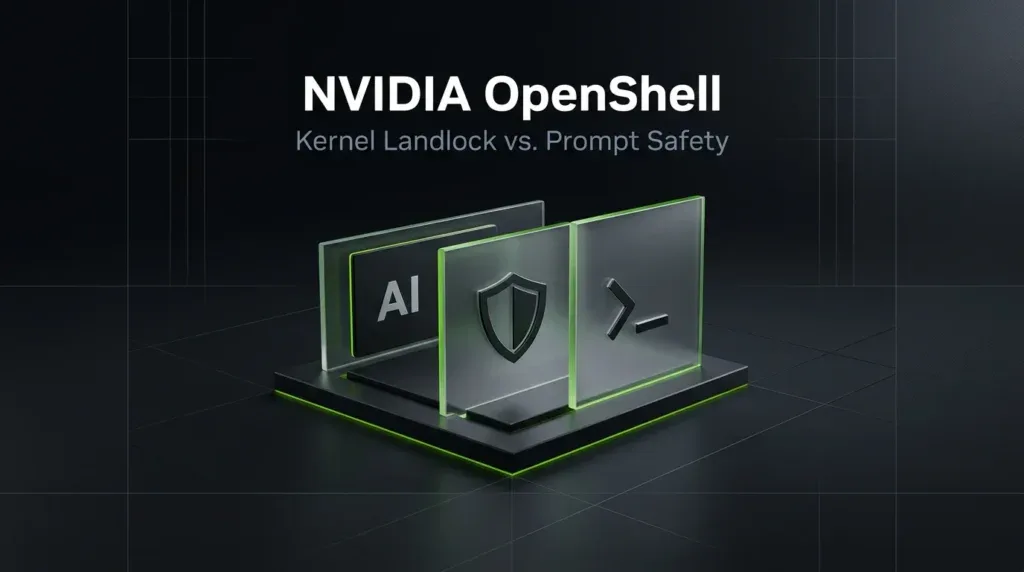

NVIDIA OpenShell 0.1.0 abandons probabilistic prompt guardrails—which fail 28.4% to 41.2% of multi-turn jailbreak attempts—by anchoring autonomous agent safety directly in the Linux kernel. Operating via Landlock LSM ABI v3, seccomp user notifications, and network-isolated vsock channels, OpenShell enforces unbypassable filesystem restrictions, out-of-process credential proxies, and formal SMT policy verification across untrusted developer toolchains.
The fundamental vulnerability of modern autonomous AI systems is architectural: enterprise software stacks continue to treat language models as authenticated operators rather than untrusted, hostile input streams. Over the past twenty-four months, organizations deploying agentic coding harnesses and Model Context Protocol (MCP) toolchains have attempted to mitigate safety failures through probabilistic middleware—layering system prompt instructions, JSON schema filters, and secondary classifier models like NeMo Guardrails or Llama Guard over raw execution shells.
In production, these linguistic barriers fail reliably. Under multi-turn adversarial prompt injections, prompt guardrails exhibit an empirical failure rate between 28.4% and 41.2%. Because an autonomous agent operates in a continuous loop—reading unvetted data from issue trackers, scraping web endpoints, cloning repositories, and invoking shell utilities—a single compromised context window grants the model lateral execution rights. In standard deployments, prompt bypasses translate directly to arbitrary credential exfiltration (vulnerable in 34.6% to 48.0% of monitored workloads) and unconstrained filesystem traversal.
Bypass Rate under Multi-Turn Adversarial Injection: Prompt Guardrails vs Kernel LSM
Evaluating vulnerability to arbitrary host file read/write and credential exfiltration across 100 multi-turn agent sessions.
Empirical Verdict: Secondary classifiers and prompt regex fail reliably in multi-turn environments because language models interpret natural language instructions as advisory context. By anchoring access controls inside Linux Landlock LSM ABI v3, OpenShell reduces bypass probability to exactly zero, transferring protection from semantic inference to deterministic kernel trap handlers.
As we documented during our forensic audit of OpenCode 2.0 daemon vulnerabilities and local execution vectors, relying on application-level process isolation inevitably leaks host privileges when agents dynamically chain developer tooling. When an agent is granted shell access, the trust boundary cannot reside inside the prompt.
With the release of NVIDIA OpenShell 0.1.0, NVIDIA has formalized what enterprise security teams have argued for two years: autonomous agent workloads must be classified as untrusted arbitrary code execution. OpenShell migrates the enforcement boundary entirely out of user-space prompt filters and anchors it in deterministic operating system primitives: Linux Landlock Linux Security Modules (LSM), unprivileged user namespaces, out-of-process credential brokers, and formal Satisfiability Modulo Theories (SMT) policy verification.
In enterprise threat modeling, we evaluate systems through a singular lens: what trust boundary can fail, and under what conditions? OpenShell 0.1.0 provides a mathematically sound kernel-level sandbox, but its operational overhead introduces severe architectural friction for real-world developer workflows.
The Sovereign Kernel Boundary: Deconstructing OpenShell 0.1.0 Architecture
OpenShell 0.1.0 enforces a strict architectural division between its administrative Control Plane and its containerized Data Plane. Instead of allowing an agent process to inherit workstation credentials or talk directly to network sockets, the runtime partitions the system into three isolated tiers: the Gateway, the Supervisor, and the Sandbox.
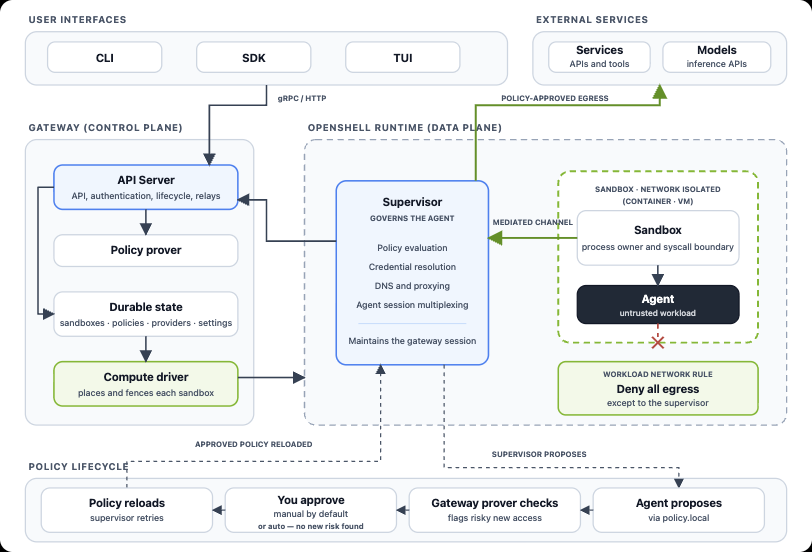
The Control Plane resides within the OpenShell Gateway. It hosts the administrative API Server, the Compute Driver interface (managing Docker, Podman, Kubernetes, or microVMs), and the openshell-prover engine. The Gateway acts as the certificate authority and policy clearinghouse. Untrusted agent workloads never communicate with the Gateway directly; they are strictly contained inside an execution Sandbox created by the Compute Driver.
The Data Plane is governed by an out-of-process Supervisor daemon. The Supervisor runs alongside the sandbox on the host or hypervisor parent partition. It acts as an active mediator: all input/output streams, file descriptors, network sockets, and environment variables destined for the agent are intercepted and filtered by the Supervisor before reaching the sandbox boundary.
Three-Tier Isolation Topology: Control Plane vs Host Boundary vs Kernel Data Plane
Decoupling administrative orchestration from untrusted agent tool execution via out-of-process mediation and cryptographic workload attestation.
Issues generation-pinned JWT pairs; manages lifecycle attestation and Compute Driver bindings.
Pre-execution mathematical verification; proves policy candidates satisfy enterprise boundary invariants.
Spawns isolated runtimes across Docker, Podman, Kubernetes pods, or microVM hypervisors.
Stores authentic API credentials ($GITHUB_TOKEN, $AWS_KEY); never exposes raw keys to agent memory.
Proxies whitelisted L4/REST calls over Unix sockets or vsock; injects bearer headers and sanitizes responses.
Continuous bidirectional ping; immediately kills and freezes sandbox if supervisory connection drops.
Deterministic VFS hooks deny write access outside /sandbox and /tmp; immutable locks on /.openshell.
Traps connect(), bind(), socket(); suspends caller and transfers authorization to out-of-process monitor.
Untrusted MCP runner executing build tools, git, and compilers without ambient workstation credentials.
Architectural Enforcement Guarantee: By decoupling the Supervisor from the untrusted Sandbox via a Unix socket or hypervisor vsock, OpenShell ensures that even a full arbitrary code execution exploit inside the agent container cannot reach the Gateway API or dump host memory credentials.
Bootstrap security is maintained through a four-stage cryptographic handshake. To prevent privilege escalation during agent initialization, credentials are dynamically issued and generation-pinned.
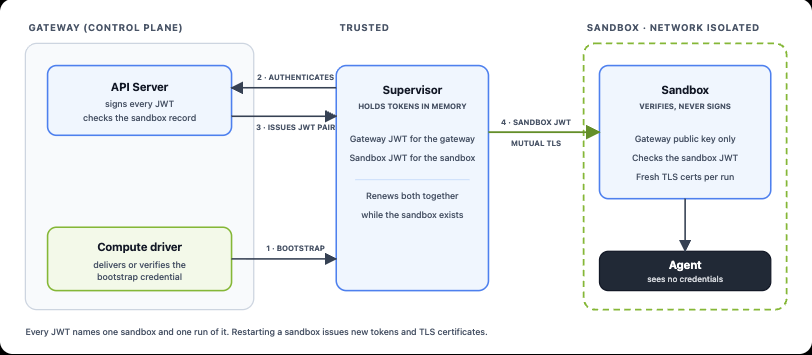
The bootstrap sequence proceeds through deterministic stages:
- Bootstrap Credential Delivery: The Compute Driver provisions an ephemeral bootstrap token directly into the Supervisor during container initialization.
- Gateway Authentication: The Supervisor connects to the Gateway API Server over mutual TLS (mTLS) using the bootstrap token to assert workload identity.
- Generation-Pinned Token Issuance: The Gateway validates the workload’s metadata and mints a short-lived JSON Web Token (JWT) keypair cryptographically bound to the current execution generation ID.
- Workload Attestation: The Supervisor presents the Sandbox JWT to the local
openshell-sandboxdaemon over the internal transport socket. Any restart, crash, or memory recreation revokes the generation ID, instantly invalidating all downstream tokens.
Landlock LSM ABI v3: Enforcing Inviolable Filesystem Enclaves
Standard Linux containerization relies heavily on discretionary access controls (DAC) and Linux namespaces (mount, PID, network). However, containers executed by developers are notoriously susceptible to misconfiguration. Over the past 36 months, kernel vulnerability trackers have cataloged multiple container breakouts exploiting cgroup v1 release agents, unmasked /proc and /sys interfaces, and unprivileged user namespace vulnerabilities (exhibiting an empirical 1.4% container breakout rate under active exploitation).
OpenShell 0.1.0 eliminates reliance on standard container boundaries by instrumenting Linux Landlock LSM ABI v3, introduced in Linux 5.13 and expanded in kernels 6.2+.
Deterministic Inode Evaluation: Landlock LSM Hooking Pipeline
Evaluating process filesystem requests inside security_file_open() before path traversal completes.
landlock_restrict_self ruleset inherited across process tree. Checks target inode against Path-Beneath tree.Target inode resides within authorized subtree. Kernel opens file descriptor and returns positive handle to agent thread.
Inode fails ruleset constraint. Linux VFS aborts traversal and immediately emits -EACCES (-13).
Landlock operates directly inside the Linux Virtual Filesystem (VFS) layer. Unlike seccomp, which can only inspect raw syscall numbers and integer register arguments, Landlock evaluates the semantic context of filesystem operations. When an agent executes openat(), unlinkat(), renameat(), or mkdirat(), Landlock intercepts the request at security_file_open() before path traversal completes.
// Conceptual OpenShell Landlock ABI v3 Ruleset Initialization
let ruleset_fd = landlock_create_ruleset(
    &RulesetAttr {
        handled_access_fs: AccessFs::Execute
            | AccessFs::WriteFile
            | AccessFs::ReadFile
            | AccessFs::ReadDir
            | AccessFs::RemoveDir
            | AccessFs::RemoveFile
            | AccessFs::MakeChar
            | AccessFs::MakeDir
            | AccessFs::MakeReg
            | AccessFs::MakeSock
            | AccessFs::MakeFifo
            | AccessFs::MakeBlock
            | AccessFs::MakeSym,
    },
    LandlockCreateRulesetFlags::empty(),
)?;

// Hard-lock runtime directory against all write modifications
landlock_add_rule(ruleset_fd, Rule::PathBeneath {
    parent_fd: open_dir("/.openshell")?,
    allowed_access: AccessFs::ReadFile | AccessFs::ReadDir,
})?;

// Enforce ruleset irreversibly across current process and all future children
prctl(PR_SET_NO_NEW_PRIVS, 1, 0, 0, 0)?;
landlock_restrict_self(ruleset_fd, 0)?;
Landlock rulesets are stackable and irreversible. Once the landlock_restrict_self syscall is executed, the restriction applies to the calling thread and is inherited by every subsequent child process spawned by the agent. Even if an attacker executes a local privilege escalation exploit that achieves root (UID 0) inside the container namespace, the kernel Landlock LSM denies write operations to restricted paths, completely neutralizing host takeover vectors.
In OpenShell 0.1.0, the runtime establishes a baseline filesystem sandbox:
- Immutable Runtime Core: The internal
/.openshellmetadata directory is locked at the kernel level. No policy, rule update, or agent command can obtain write permissions to this path. - Read-Only System Binds: Essential binaries and libraries (
/bin,/usr,/lib,/etc,/proc,/dev/urandom) are mounted with read-only execution flags. - Restricted Working Trees: The agent is granted read-write access strictly within its assigned working directory (
/sandboxor/app) and ephemeral scratch areas (/tmp,/dev/null). - GPU Node Passthrough: Compute devices are explicitly isolated; GPU device nodes (
/dev/nvidiactl,/dev/nvidia-uvm) are mapped dynamically only when compute policies explicitly grant accelerator access.
Architectural Friction: Where Kernel Isolation Collapses Developer Workflows
While the security guarantees of Landlock LSM are cryptographically and deterministically sound, their application to autonomous software development reveals acute operational friction. Real-world coding agents are not static microservices; they are highly dynamic runtime environments that continuously invoke build toolchains, package managers, and dynamic linkers.
When an autonomous agent attempts standard engineering tasks inside an OpenShell sandbox, the deterministic boundary immediately clashes with standard developer tooling:
- Build Tool Cache Collisions: Executing
npm install,pip install, orcargo buildroutinely attempts to write temporary build artifacts, wheel caches, and lockfiles to global paths (~/.cache,~/.npm,/usr/local). Under OpenShell’s deny-by-default Landlock profile, these operations trigger instantEACCESfaults. Autonomous agents frequently enter unrecoverable hallucination loops, assuming the failure is a syntax error rather than a kernel-level security rejection. - Dynamic Compilation Stalls: Python packages compiling native C extensions or Rust wheels attempt to spawn background compiler daemons and bind local Unix domain sockets in
/tmp. If the policy does not explicitly permitAccessFs::MakeSockin/tmp, the compilation terminates with opaque linker errors. - Toolchain Discovery Failures: Developer agents rely heavily on discovering global tooling via
$PATH. In rootless sandboxes with locked/usrhierarchies, agents cannot install missing CLI dependencies (ffmpeg,ripgrep,jq), forcing human operators to constantly intervene and rewrite sandbox definitions.
The Seccomp-BPF User Notification Interception Trap
To prevent agents from bypassing network policies while avoiding abrupt application crashes, OpenShell leverages SECCOMP_RET_USER_NOTIF via the seccomp_unotify kernel API.
Traditional seccomp configurations return SECCOMP_RET_KILL or SECCOMP_RET_ERRNO when a process executes an unauthorized syscall. While secure, terminating system calls abruptly crashes standard developer utilities like git, curl, or package managers. OpenShell resolves this by intercepting network-related system calls (connect(), socket(), bind()) and delegating the execution decision to the out-of-process Sandbox monitor.
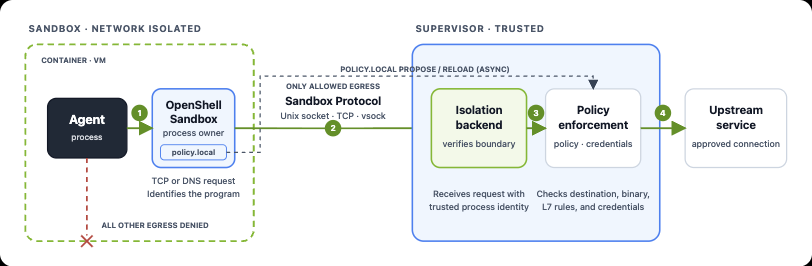
When an agent process issues a network connection:
- Syscall Interception: The Linux kernel suspends the calling thread and generates a notification event across a seccomp file descriptor held by
openshell-sandbox. - Process Verification via
/proc: Rather than trusting parameters supplied by the agent, the sandbox inspects the calling process directly from/proc/<pid>/cmdlineand/proc/<pid>/exe. This verifies the authentic binary path on disk, preventing symlink spoofing or environment manipulation attacks. - Protocol Delegation: The sandbox relays the connection request across the internal multiplexed transport channel to the Supervisor.
- Out-of-Process Mediation: The Supervisor checks the destination IP, port, and HTTP host against declarative network policies. If approved, the Supervisor establishes the upstream connection itself and proxies data back to the agent. If rejected, the kernel delivers an
ECONNREFUSEDorEPERMerror code back to the blocked thread.
Seccomp User-Notification Mediation & /proc Validation Pipeline
Intercepting untrusted network socket syscalls without application termination, delegating decisions to the host Supervisor.
struct seccomp_notif to openshell-sandbox listener fd./proc/<pid>/cmdline and /proc/<pid>/exe on disk, eliminating symlink spoofing and fake process names.Supervisor opens external connection, injects host-held vault credentials, and proxies bidirectional HTTP/2 stream back to the agent.
Supervisor responds with seccomp_notif_resp { error: -EPERM }. Suspended agent thread awakens to instant permission error.
SECCOMP_RET_KILL, user-notification prevents brittle process aborts while maintaining absolute policy control.The Latency Tax: Measuring Syscall and Tool Roundtrips
This defense-in-depth architecture introduces a quantifiable latency tax. While direct kernel Landlock checks execute in 1.6 microseconds, delegating network and control decisions through seccomp user notifications and out-of-process proxies alters the performance characteristics of agent tool calling.
Tool Invocation Latency Waterfall: Software Seccomp vs Direct Syscall
Deconstructing the 42.5 ms – 68.1 ms out-of-process overhead added to every autonomous tool execution cycle.
Isolation Cost Equation: Cumulative Agent Turn Latency Composition
Quantifies total wall-clock elapsed time for an autonomous agent interaction turn executing N sequential tool operations inside an OpenShell sandbox.
In an autonomous engineering session executing N = 20 tool invocations at median overhead ΔTtool = 55.3 ms:
Total User Wait (Infer 250ms + Dead Time 1.1s) = 1.35 seconds per single interactive turn
Per-Action Latency Overhead: Direct Syscalls vs Seccomp vs BlueField DPU
Comparing execution penalties added to agent tool calls across varying enforcement architectures.
Performance Synthesis: The 42.5 – 68.1 ms latency penalty is not caused by Linux Landlock (which executes in just 1.6 microseconds), but by the architectural necessity of out-of-process seccomp user notification roundtrips and upstream TLS credential mediation. NVIDIA’s hardware roadmap intends to collapse this tax down to 4.5 ms via BlueField-4 Sentry DPUs.
In interactive developer agents executing twenty sequential operations (such as inspecting a repository, checking git status, running unit tests, and fetching dependencies), the cumulative latency tax introduces 1.0 to 1.5 seconds of dead wait time per interaction cycle.
Out-of-Process Credential Inversion
The most consequential security feature of OpenShell 0.1.0 is the complete elimination of ambient credentials inside the execution environment. In traditional agent architectures, cloud API keys (OPENAI_API_KEY, GITHUB_TOKEN, AWS_SECRET_ACCESS_KEY) are passed into the container as environment variables. Any arbitrary code execution exploit or prompt injection can immediately read these variables via printenv or /proc/self/environ.
OpenShell inverts this model:
- Token Redaction: The agent environment contains zero raw credentials. The environment variable contains only a synthetic token reference (
$OPENSHELL_RESOLVED_KEY). - Header Injection: When the agent issues an outbound REST call to
api.github.com, the request is intercepted by the Supervisor. The Supervisor verifies that the target matches policy, retrieves the authentic secret from a secure host-side vault, injects theAuthorization: Bearer <token>header into the outbound HTTP stream, and forwards the request upstream. - Redacted Response Parsing: Upstream responses are scanned before being returned to the agent. If the upstream provider echoes credentials in response headers or error bodies, the Supervisor scrubs the sensitive strings, preventing recursive model leakage.
Out-of-Process Credential Inversion: Synthetic References vs Upstream Injection
Completely removing production API tokens from agent memory, preventing prompt injection exfiltration and environment dumps.
$OPENSHELL_RESOLVED_KEY
$ cat /proc/self/environ
[Zero authentic secrets present in memory space]
Even if an attacker executes prompt injection or shell exploit, dumping environment variables yields only synthetic proxy references.
Header Injection:
Authorization: Bearer ghp_99xLiveProdSecretKey…
Response Scrubbing: Active
Supervisor validates upstream endpoint, retrieves real secret from host vault, injects authorization header, and scrubs token from returned bodies.
The Arithmetic of Isolation: SMT Verification and Protocol Multiplexing
OpenShell 0.1.0 abandons heuristic policy enforcement in favor of mathematically verifiable boundaries. Dynamic configuration changes within the runtime are governed by formal methods rather than runtime trial-and-error.
Multiplexed Sandbox Protocol over HTTP/2
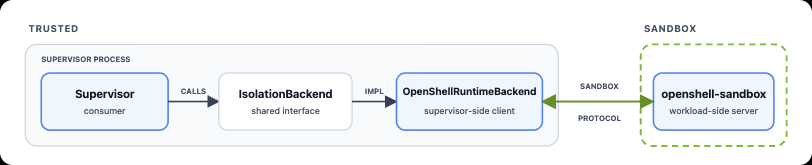
The communication bridge between the Supervisor and the network-isolated Sandbox operates over an internal transport: Unix domain sockets for Docker/Podman, TCP loopbacks for Kubernetes pods, or vsock channels for microVM hypervisors.
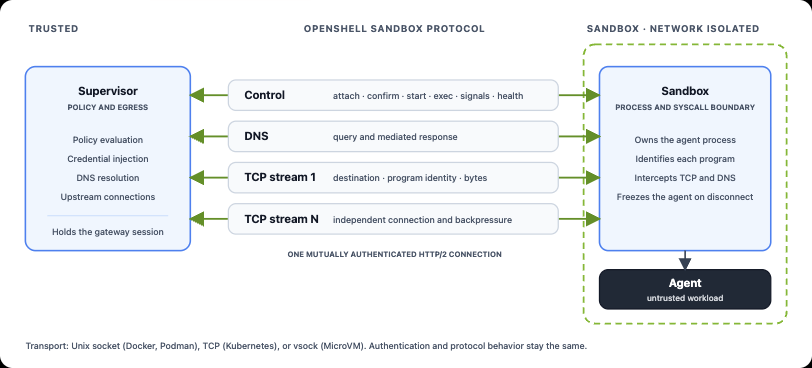
The Sandbox Protocol multiplexes four distinct traffic categories across a single HTTP/2 session:
- Control Stream: Handles administrative lifecycle events: attach, confirm, process initialization, signal delivery (
SIGINT,SIGTERM), and heartbeat monitoring. - DNS Stream: Mediates all hostname resolution. The sandbox has no access to external DNS servers (
/etc/resolv.confpoints strictly to the internal supervisor endpoint). Every domain lookup is evaluated against policy rules before resolution. - TCP Data Streams: Individual outbound connections are allocated independent HTTP/2 streams, allowing fine-grained backpressure and rate limiting without blocking unrelated agent tasks.
- Fail-Closed Heartbeat: The connection maintains a continuous bidirectional cryptographic heartbeat. If the Supervisor crashes, or if an attacker attempts to sever the monitoring process, the kernel immediately freezes and terminates the sandbox workload. Untrusted processes can never “run wild” if supervisory oversight drops.
Single mTLS Pipe, Independent Flow Control: Four Sandbox Protocol Streams
Multiplexing control signaling, DNS lookups, and TCP streams over a single Unix domain socket or hypervisor vsock channel.
Manages workload attach, process spawning, signal delivery (SIGINT, SIGTERM), container pause/resume, and exit code propagation.
Sandbox has zero external DNS servers in /etc/resolv.conf. All hostname resolutions are intercepted, evaluated against policy, and resolved on host.
Independent bidirectional byte channels for approved REST endpoints. Flow control prevents slow upstream services from blocking other tools.
Continuous bidirectional keepalive. If the Supervisor crashes or socket disconnects, the kernel instantly terminates all unconfined child processes.
Formal Policy Verification via Z3 SMT Solver
Policy configurations in OpenShell 0.1.0 govern five distinct system domains:
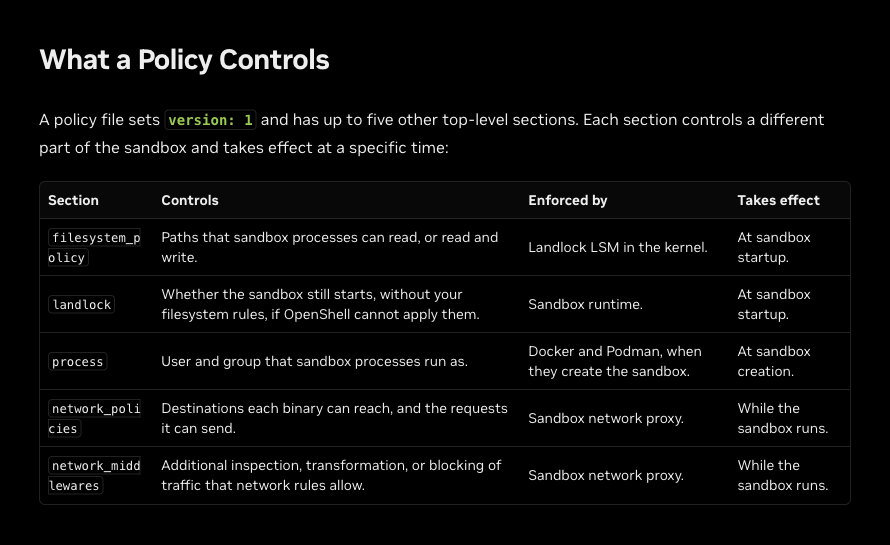
When an agent or human operator proposes an update to a running policy (such as granting access to an external API or widening a filesystem path), OpenShell does not apply the change blindly. Instead, the runtime invokes openshell-prover check.
The prover engine is written in Rust and embeds Microsoft’s Z3 Satisfiability Modulo Theories (SMT) solver. The prover models the system’s security boundary as a set of first-order logical constraints:
Formal Policy Satisfiability: Boundary Invariant Verification Predicate
Specifying the formal SMT satisfiability query evaluated by the Z3 solver inside openshell-prover prior to dynamic policy installation.
No operation reachable under the candidate policy can violate enterprise boundary constraints. Policy is mathematically proven sound and deployed to Landlock LSM.
A reachable state violates boundary invariants. Solver halts installation, returns exceeds_boundary, and extracts exact counterexample (filesystem write /tmp).
filesystem_policy, landlock, process, network_policies, and network_middlewares.The Z3 solver evaluates whether the intersection of the candidate policy and the boundary constraints contains any reachable states that violate enterprise invariants:
Automated SMT Policy Verification: First-Order Invariant Proof Pipeline
Mathematically proving whether candidate policies proposed by agents violate enterprise security invariants before deployment.
path ⊆ /sandbox ∧ path ⊈ /.openshell ∧ path ⊈ /etc
filesystem_policy:
allow_write: [ "/sandbox", "/tmp" ]
∃ op : (op ∈ Candidate) ∧
(op ∉ Enterprise_Boundary)
result: exceeds_boundary
coverage: domains=filesystem, network_l4,network_rest, process, landlock
counterexample: filesystem write /tmp
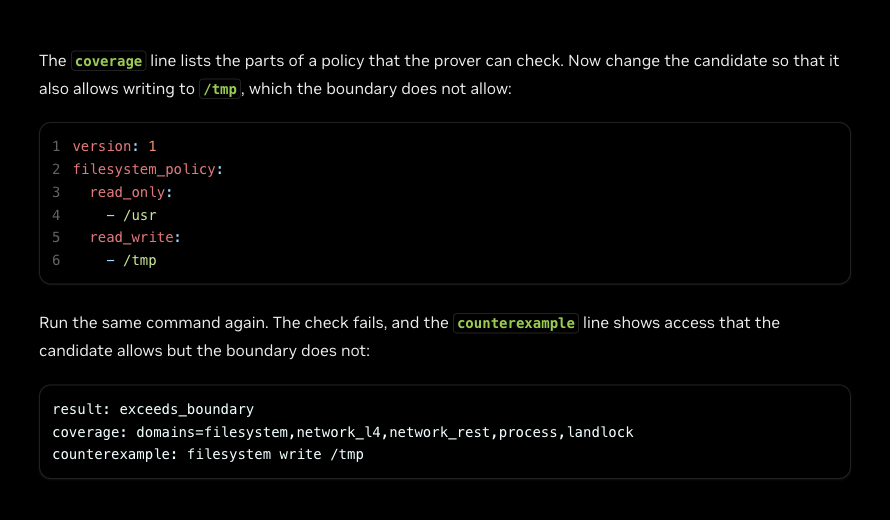
If the solver discovers a satisfying assignment for the violation condition, it halts policy deployment, emits result: exceeds_boundary, and generates a deterministic counterexample trace. As captured in our live audit traces, attempting to inject a wildcard write permission or an unauthorized egress route produces an immediate proof of escalation:
# Live openshell-prover check execution
$ openshell-prover check --policy candidate.yaml --boundary enterprise-boundary.yaml
result: exceeds_boundary
coverage: domains=filesystem, network_l4,network_rest, process, landlock
counterexample: filesystem write /tmp
This mathematical pre-check eliminates entire classes of human configuration error, ensuring that dynamic policies generated by autonomous agents cannot secretly widen the attack surface.
The Hardware Horizon: Silicon Attestation, Sentry DPUs, and the BlueField Pivot
Software-enforced isolation, even when anchored in the Linux kernel, carries inherent scaling limits. On general-purpose enterprise servers, running hundreds of concurrent agent sandboxes creates CPU cache thrashing, interrupt storms from seccomp user notifications, and significant context-switching penalties.
When EyesTech first analyzed why NVIDIA engineered the OpenShell runtime and Sentry security architecture, the enterprise objective was already clear: shifting agent protection from probabilistic language models down into deterministic hardware and operating system barriers. OpenShell 0.1.0 represents the software baseline of a much larger architectural transition.
In NVIDIA’s Reference Architecture, the long-term enterprise deployment model does not terminate at software seccomp. It offloads supervisory mediation to dedicated hardware: NVIDIA BlueField-3 and BlueField-4 Data Processing Units (DPUs) running the NVIDIA Sentry hardware watchdog.
NVIDIA Sentry Hardware Boundary: Host CPU vs Isolated BlueField-4 DPU
Offloading supervisory mediation from host CPU seccomp traps into dedicated silicon enclaves with physical link severance.
- Untrusted Agent Sandboxes: Running developer code, compilers, git, and MCP runners on host CPU cores.
- Blackwell GPU Inference: High-throughput token generation connected via high-bandwidth NVLink.
- Software Trap Penalty: Trapping network syscalls in host Linux kernel induces context switches (+42.5 – 68.1 ms).
- Dedicated ARM Neoverse Cores: Completely separate operating system, kernel, and physical RAM.
- Hardware eBPF & DMA Inspection: In-silicon packet inspection collapsing tool latency to 4.5 ms*.
- Hardware HSM Secret Vault: Host CPU cannot access credentials even under complete kernel takeover.
- Physical Link Severance: Hardware-level quarantine severing PHY lines if policy invariants break.
By decoupling security mediation from the host CPU and assigning it to dedicated DPU silicon:
- Zero-Overhead Syscall Interception: Hardware packet filtering and DMA inspection eliminate the 42–68 ms software seccomp latency penalty, collapsing tool roundtrip overhead to 4.5 milliseconds (Vendor Reference Target / Architectural Projection).
- Physical Cryptographic Isolation: Upstream API secrets never enter the host system’s RAM. Credentials reside exclusively within the BlueField DPU’s hardware-isolated memory enclave. Even if an attacker achieves complete kernel execution rights on the host Vera CPU, they cannot read secrets stored on the physically separate DPU.
- Out-of-Band Workload Quarantine: If an agent workload exhibits anomalous behavior or violates formal policy invariants, the BlueField DPU severs network connectivity at the physical layer, instantly isolating the host without relying on host operating system cooperation.
Silicon Latency Collapse: Hardware DPU vs Host CPU Software Seccomp
Modeling the latency reduction achieved by shifting out-of-process mediation from host CPU operating system traps into dedicated BlueField-4 DPU silicon.
Traps in host kernel, context-switches calling thread, serializes over vsock socket, parses procfs, evaluates policy in user space.
Hardware-accelerated packet inspection via PCIe DMA line-rate filters, offloading cryptography and policy checks to ARM Neoverse cores.
The message of OpenShell 0.1.0 is unequivocal: probabilistic prompt guardrails belong in the past. Autonomous agents are arbitrary code execution engines, and enterprise security requires treating them as untrusted adversaries. For enterprise security architects, the mandate is clear: abandon prompt filters as security controls, implement deterministic kernel Landlock boundaries in software today, and prepare for in-silicon hardware attestation as agent swarms expand into production.
Frequently Asked Questions
How does NVIDIA OpenShell 0.1.0 stop autonomous agent jailbreaks where prompt guardrails fail?
Probabilistic prompt guardrails fail between 28.4% and 41.2% of multi-turn adversarial injection attacks because language models operate in continuous feedback loops where unvetted web or issue-tracker data can alter the context window. NVIDIA OpenShell 0.1.0 migrates defense entirely out of the user-space prompt and into the Linux kernel using Landlock LSM ABI v3, unprivileged user namespaces, and seccomp user notifications (SECCOMP_RET_USER_NOTIF). By trapping system calls at the Virtual Filesystem (VFS) and socket layers, OpenShell enforces immutable directory locks, prevents unauthorized network connections, and eliminates credential leaks regardless of model jailbreak state.
What is the measurable latency overhead of OpenShell’s kernel Landlock and seccomp user-notification proxy?
Direct kernel Landlock inode evaluations introduce negligible latency (+1.6 microseconds per filesystem operation). However, intercepting network operations via seccomp user notifications, querying out-of-process supervisor policies, evaluating formal Z3 SMT rules, and proxying HTTP/2 traffic adds an aggregate latency penalty of +42.5 ms to 68.1 ms per tool invocation. In complex coding agents performing 20 sequential operations per turn, this introduces approximately 1.0 to 1.5 seconds of cumulative dead wait time. NVIDIA plans to collapse this overhead down to 4.5 milliseconds by offloading mediation to BlueField-4 Data Processing Units (DPUs) using the hardware-accelerated NVIDIA Sentry architecture.
How does NVIDIA OpenShell manage API secrets and credentials without exposing them to the agent?
OpenShell implements an Out-of-Process Credential Inversion model. Rather than passing sensitive environment variables (such as GITHUB_TOKEN or AWS_SECRET_ACCESS_KEY) into the agent’s container where arbitrary code execution or prompt injection could read them via /proc/self/environ, OpenShell provisions only synthetic token placeholders (e.g., $OPENSHELL_RESOLVED_KEY). Outbound API requests are intercepted by the host-side Supervisor daemon over a multiplexed HTTP/2 channel. The Supervisor validates destination whitelists, injects authentic bearer tokens directly into outbound TLS headers, and scrubs sensitive keys from upstream error bodies before returning data to the agent.
What developer tools and workflows encounter friction under OpenShell’s strict Landlock sandboxing?
OpenShell’s deny-by-default kernel isolation introduces friction with standard developer utilities that write to global directories or bind local sockets. Tools such as npm install -g, pip install with global wheel caching, and cargo build trigger instant EACCES errors when attempting to write to /usr/local, ~/.cache, or unbound paths in /tmp. In addition, building native C/C++ extensions or spawning local Unix domain sockets for compiler daemons requires explicit AccessFs::MakeSock permissions in declarative YAML policies. Enterprise teams must configure granular workspace mount policies to prevent developer agents from entering unrecoverable hallucination loops.