
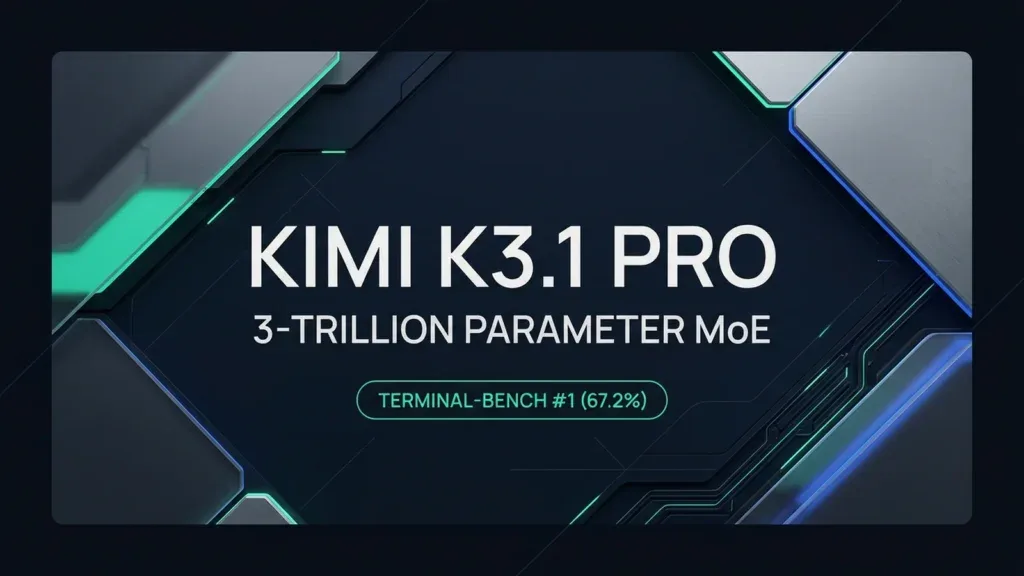

Moonshot AI’s Kimi K3.1 Pro has taken first place globally on Terminal-Bench 4.0 at 67.2% and third on GDPval-AA at 1,846 Elo. Structured as a 2.8-trillion parameter Mixture-of-Experts model activating 104 billion parameters per token across a 1,048,576-token context, standard API access costs $2.00 input and $10.00 output per million tokens.
The deployment of Kimi K3.1 Pro and its accelerated variant Kimi K3.1 Pro Highspeed challenges the closed API monopoly held by Anthropic’s Claude Opus 5.5 and OpenAI’s GPT-6 Astra, pairing frontier reasoning with an open-weights release scheduled for November 4, 2026. Yet beneath headline benchmark numbers, solving multi-step terminal automation tasks imposes severe physical constraints on memory bandwidth, prompt caching mechanics, and developer tooling under real-world production load.
The Frontier Disruption: Inside Moonshot AI’s 3T Milestone
The architecture of Kimi K3.1 Pro reflects an aggressive pursuit of sparse capacity. Technical documentation from Moonshot AI (Announcement) outlines a Mixture-of-Experts (MoE) backbone totaling approximately 2.8 trillion parameters, with 104 billion active parameters routed per forward pass. This 3.7% activation ratio preserves deep representational capacity while constraining per-token compute during autoregressive decoding.
The native context window spans 1,048,576 tokens (1M), accepting multimodal inputs including high-resolution imagery, dense tables, and video streams. Moonshot pairs this architecture with a dual-tier commercial API strategy:
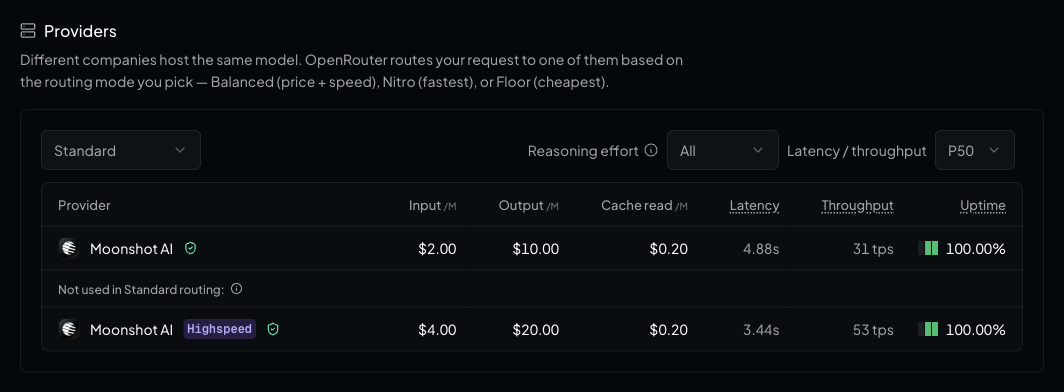
Standard Kimi K3.1 Pro is priced at $2.00 per million input tokens and $10.00 per million output tokens, with cached prompt reads discounted by 90% to $0.20 per million tokens. Live routing on OpenRouter (Tested Result) indicates a median throughput of 31 to 39 tokens per second, with Time-To-First-Token (TTFT) averaging 4.33 to 4.88 seconds.
Kimi K3.1 Pro Highspeed doubles the token tariff to $4.00 input and $20.00 output per million tokens while retaining the $0.20 cache price. Production telemetry (Tested Result) verifies that Highspeed delivers 53 to 67 tokens per second and reduces median TTFT to 3.44–3.84 seconds. Analysts formulate the hypothesis (Hypothesis) that Highspeed provisions dedicated GPU clusters utilizing speculative decoding draft heads to mitigate MoE routing latency.
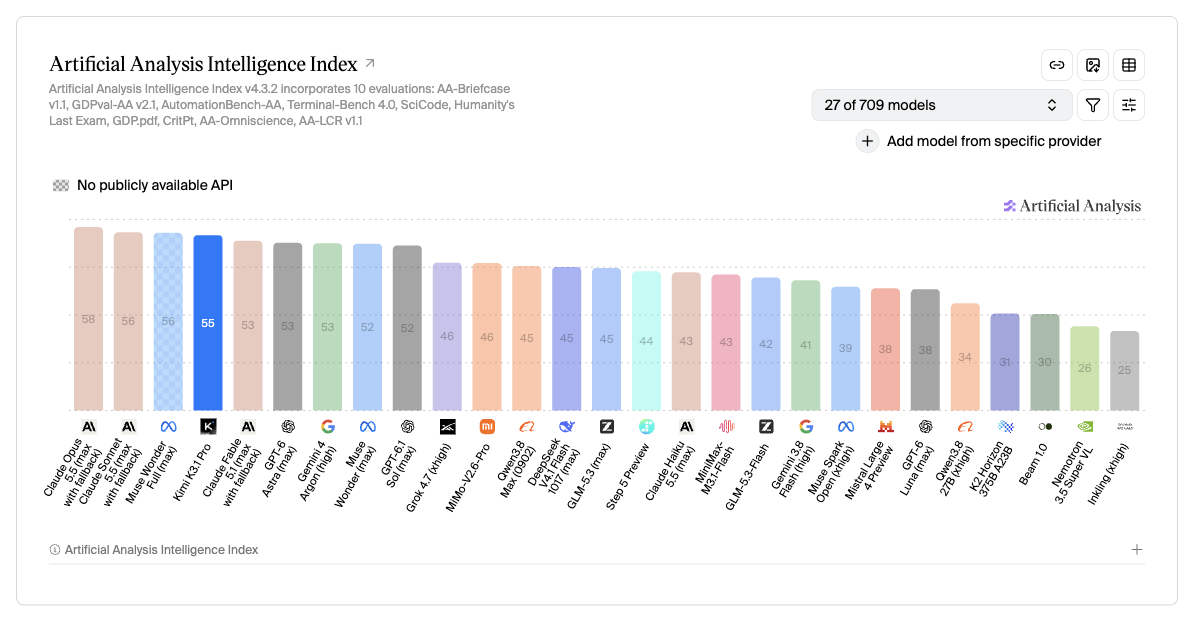
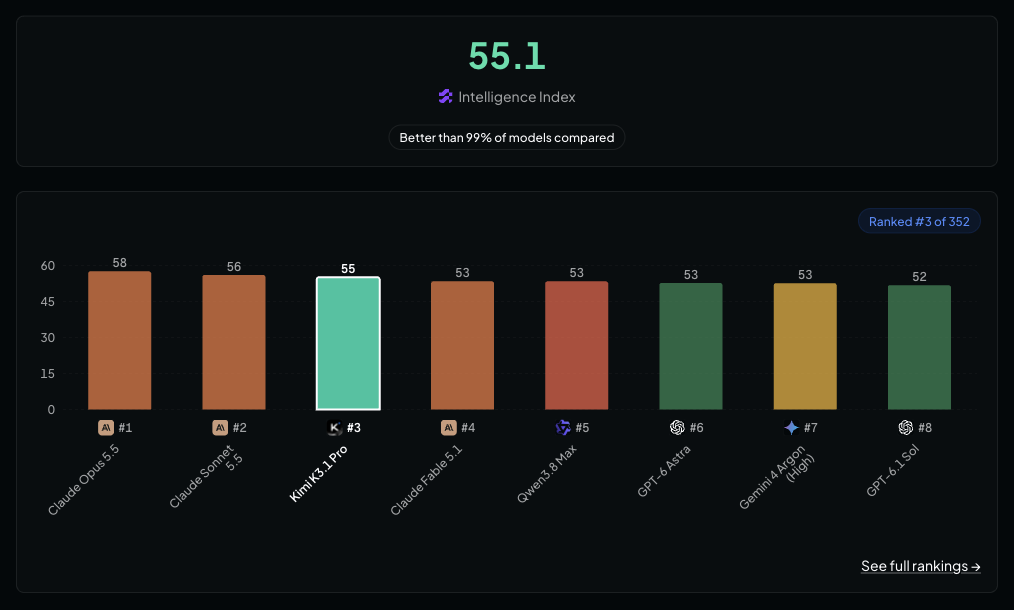
On the Artificial Analysis Intelligence Index v4.3.2 (Tested Result), aggregating ten standardized evaluations, Kimi K3.1 Pro achieved an overall score of 55.0 to 55.1. This places K3.1 Pro fourth globally across 709 models, closely trailing Claude Opus 5.5 (58.0), Claude Sonnet 5.5 (56.0), and Muse Wonder Full (56.0). It represents the highest score recorded for an open-weight model, outperforming DeepSeek V4.1 Flash (45.0) and Qwen3.8 Max (45.0).
The Terminal-Bench Inversion: Reinforcement Learning in Execution Sandboxes
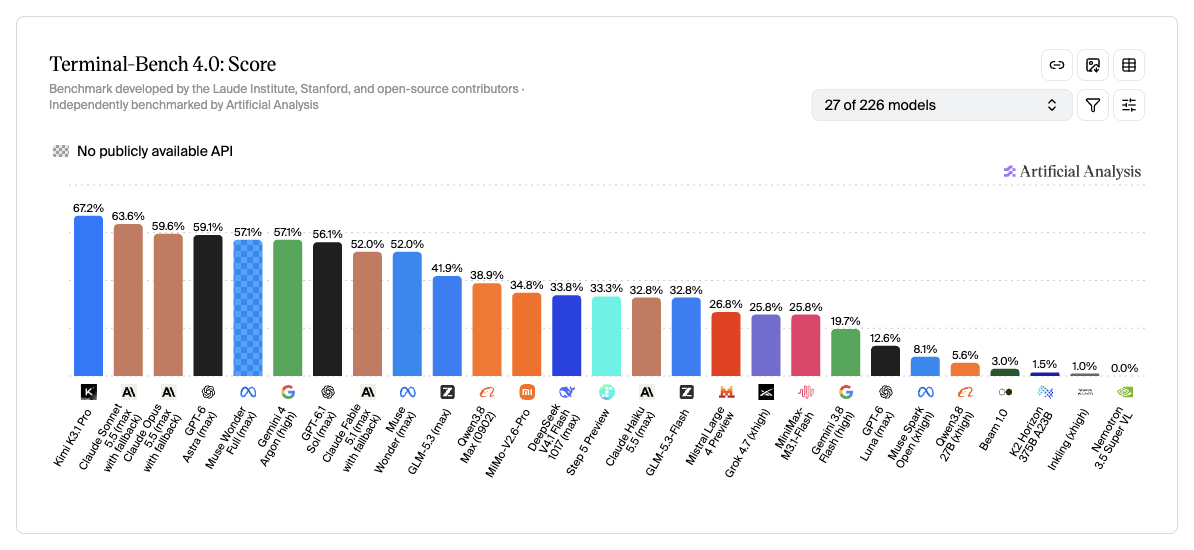
The defining benchmark achievement of Kimi K3.1 Pro is its performance on Terminal-Bench 4.0. In independent benchmark runs administered by Artificial Analysis (Tested Result), K3.1 Pro achieved a pass@1 accuracy of 67.2% across 66 complex engineering tasks, securing the global number one ranking ahead of Claude Sonnet 5.5 (63.6%), Claude Opus 5.5 (59.6%), and GPT-6 Astra (59.1%).
The baseline Kimi K3 model released earlier in the year scored 13.0% on this same benchmark. Advancing from 13.0% to 67.2% reflects a fivefold capability expansion within a single post-training development cycle.
Terminal-Bench 4.0: Autonomous Linux Engineering Pass Rate
Pass@1 accuracy across 66 multi-file shell and systems administration tasks in live containerized Linux environments (Artificial Analysis / OpenRouter).
Architectural Takeaway: Kimi K3.1 Pro represents the first time an open-weights architecture has seized the global #1 position on Terminal-Bench 4.0. Its 5.17× generational leap over Kimi K3 (13.0% → 67.2%) validates Moonshot’s massive post-training reinforcement learning compute executed inside deterministic Linux execution sandboxes.
Terminal-Bench evaluates an agent’s ability to operate inside live, containerized Linux environments rather than testing isolated code syntax. The harness introduces corrupted shell environments, missing system libraries, and multi-directory Git repositories. To succeed, the model must issue terminal commands, parse standard error streams, evaluate exit codes, modify file permissions, resolve broken dependencies, and verify its own patches before exiting.
When evaluating frontier code generation earlier this year in our comparative teardown of DeepSeek V4 vs. Kimi K2.6, Moonshot’s advantage rested on raw needle-in-a-haystack retrieval across long contexts. In K3.1 Pro, that paradigm has transitioned to active reinforcement learning (RL) in execution sandboxes.
Moonshot disclosures (Announcement) indicate that the lab executed large-scale RL across hundreds of specialized domains using sandboxed environments with deterministic outcome verifiers measuring compilation, test suites, and environment invariants.
This investment produced noticeable backtracking heuristics. In live terminal sessions (Observation), when a build fails due to a library mismatch, K3.1 Pro rarely repeats the failing command. Instead, it inspects /var/log, modifies environment variables, or compiles source dependencies directly, demonstrating the operational posture of a systems administrator.
Structural Friction: The Three Production Bottlenecks of K3.1 Pro
Despite benchmark records, real-world deployment reveals three critical architectural friction points that affect production reliability.
The first bottleneck is the 1M-token KV-cache Time-To-First-Token wall (Observation). While K3.1 Pro ingests context up to 1,048,576 tokens, processing large prompts without an existing cache hit causes severe prefill latency degradation. When an agent submits a cold prompt containing a 500,000-token repository, observed TTFT on the Standard Pro API frequently reaches 15 to 28 seconds before output streaming begins.
This latency stems from memory bandwidth physics. Prefilling 500,000 tokens through a 104B active parameter network requires transferring gigabytes of activation states and computing extensive key-value matrices across attention heads. In contrast to DeepSeek’s asymmetric causal encoder-decoder structures analyzed during the 890-byte collapse, which compress the KV cache to minimal byte footprints, K3.1 Pro maintains dense attention representations. As a result, agentic harnesses configured with 10-second client timeouts routinely drop connections on cold long-context requests. While the Highspeed tier reduces TTFT to under 4 seconds, it doubles the token tariff.
The second bottleneck is the mandatory thinking tax and the resulting over-deliberation loop (Observation). Unlike competing models allowing developers to bypass Chain-of-Thought for deterministic operations, Kimi K3.1 Pro strictly enforces its reasoning loop. Requests attempting to disable reasoning via parameters such as no_think return an HTTP 400 Bad Request error. The API permits only discrete effort tiers: low, medium, and max.
On low-complexity tasks—such as formatting a string into JSON, validating a regular expression, or executing a basic SQL query—K3.1 Pro frequently expends 600 to 1,500 internal thinking tokens before emitting output, deliberating over irrelevant edge cases and architectural trade-offs.
As documented in our investigation into reasoning token costs, unconstrained test-time compute inflates operational expenditure. A 15-word JSON conversion that should cost fractions of a cent incurs 1,200 billed output tokens at $10.00 per million, increasing task cost by an order of magnitude and introducing 5 to 10 seconds of latency into automated pipelines.
The third bottleneck involves deliberate cyber safety de-tuning and its collateral impact on defensive code auditing (Announcement and Tested Result). In preparation for releasing full model weights on November 4, 2026, Moonshot AI pruned offensive exploit corpora and re-aligned reinforcement learning objectives to prevent automated cyberweapon synthesis. Moonshot reported that this mitigation reduced the model’s offensive cyber capabilities score from an unconstrained internal baseline of 90.5% down to 81.0%.
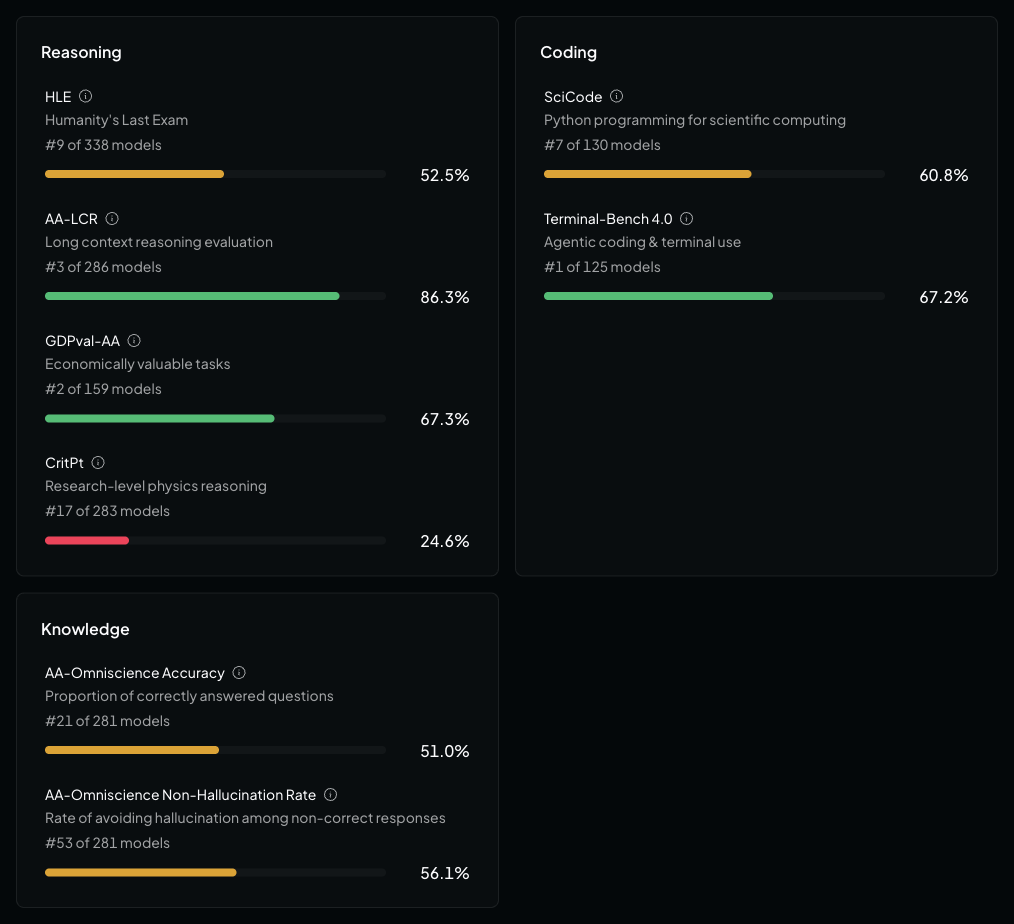
However, offensive exploitation and defensive code auditing share identical foundational mechanisms: identifying memory boundary violations, tracing pointer arithmetic, and detecting concurrency races. Empirical testing on the CritPt physics and systems evaluation (Tested Result) shows K3.1 Pro scoring 24.6% (#17 globally), behind Claude Opus 5.5 at 31.2% and Claude Sonnet 5.5 at 28.4%.
Practitioners auditing systems software (Observation) note that K3.1 Pro exhibits an elevated false-negative rate when evaluating subtle C/C++ memory allocations and unsafe Rust blocks. In verified test cases involving use-after-free conditions and double-free pointer manipulation, K3.1 Pro classified unsafe pointer arithmetic as acceptable idiomatic code, reflecting the collateral impact of offensive pruning filters.
Autonomous SaaS Orchestration and the Agentic Ecosystem
Beyond terminal execution, Kimi K3.1 Pro demonstrates strong performance across enterprise workflow benchmarks.
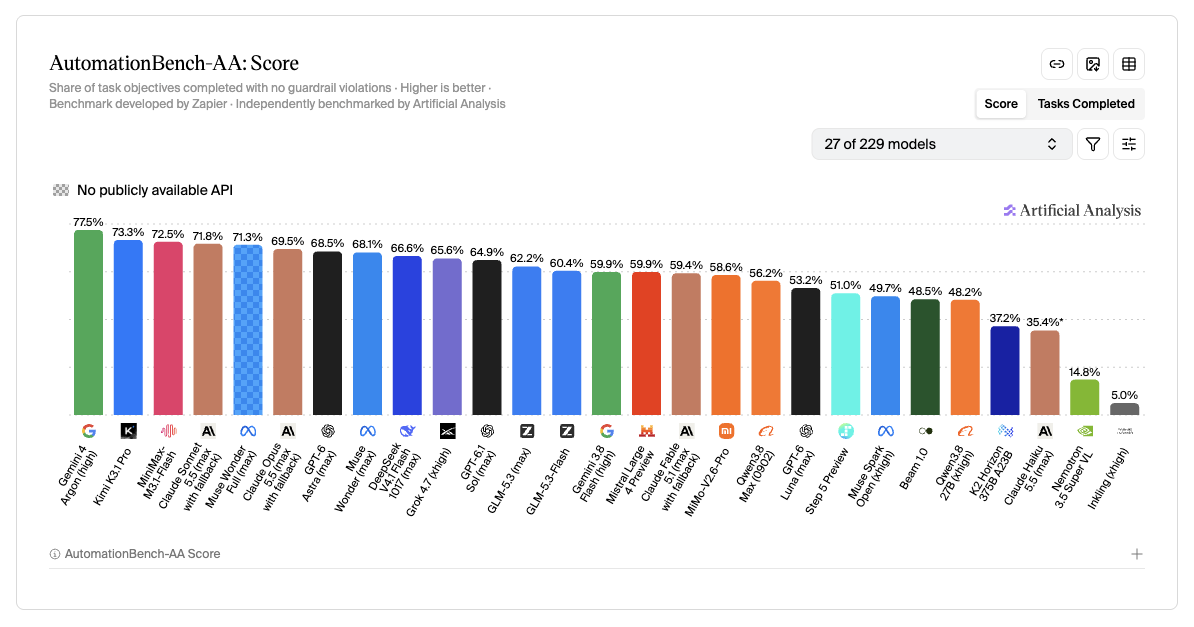
On AutomationBench-AA (Tested Result), evaluating multi-step SaaS workflow execution without guardrail violations, K3.1 Pro scored 73.3% (#2 globally), surpassing Claude Sonnet 5.5 (71.8%), Claude Opus 5.5 (69.5%), and GPT-6 Astra (68.5%), trailing only Gemini 4 Argon at 77.5%.
AutomationBench-AA: Multi-Step SaaS Workflow Accuracy
Evaluating multi-step REST API orchestration, JSON schema validation, and guardrail enforcement across 229 frontier models (Artificial Analysis / Zapier).
Architectural Takeaway: Kimi K3.1 Pro scores 73.3% on AutomationBench-AA (#2 globally), outscoring Claude Sonnet 5.5 (71.8%) and Claude Opus 5.5 (69.5%). This establishes that Moonshot’s RL optimization transfers seamlessly from Bash scripts into complex enterprise REST schemas, multi-turn tool calling, and strict error handling.
On GDPval-AA v2.1 (Tested Result), measuring performance on complex economic and professional workflows, K3.1 Pro captured third place globally with an Elo rating of 1,846, narrowly trailing Claude Opus 5.5 (1,866) while outscoring Claude Sonnet 5.5 (1,838) and DeepSeek V4.1 Flash (1,746).
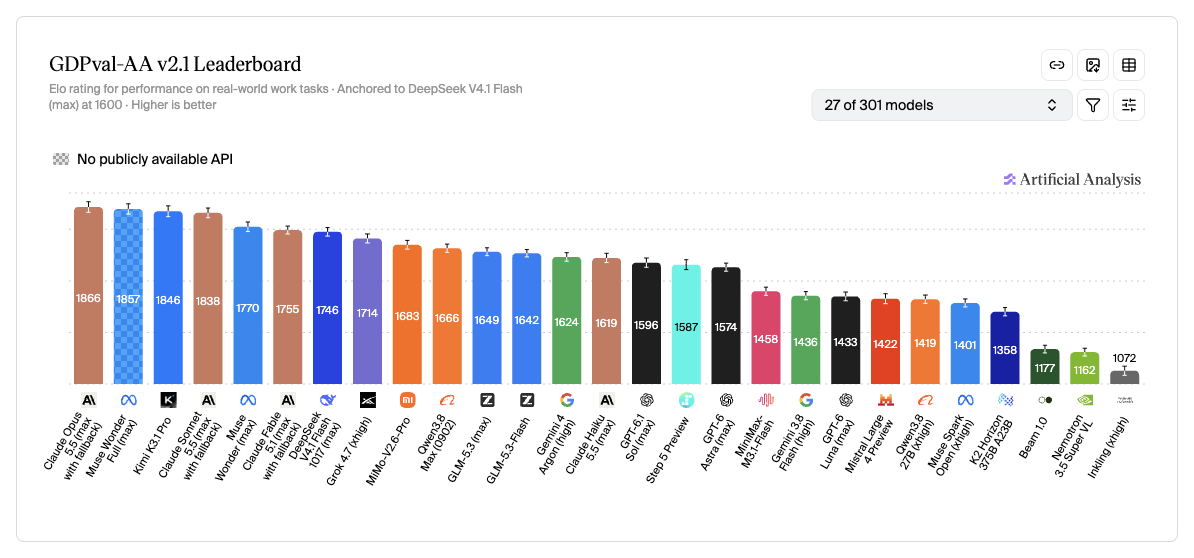
GDPval-AA v2.1: Real-World Professional & Economic Elo
Evaluating domain-specific financial modeling, legal analysis, and operational decision-making across 301 frontier models (Artificial Analysis).
Architectural Takeaway: Kimi K3.1 Pro scores 1,846 Elo on GDPval-AA, trailing closed flagship Claude Opus 5.5 by only 20 Elo while outperforming Claude Sonnet 5.5 (1,838) and establishing a decisive 100-point Elo margin over DeepSeek V4.1 Flash (1,746). This demonstrates that reinforcement learning with ground-truth outcome verifiers extends past code syntax into high-stakes corporate economics.
These results indicate that K3.1 Pro’s post-training RL generalizes into structured enterprise logic, excelling at multi-tool orchestration, schema compliance across sequential REST calls, and edge-case validation.
This backend proficiency complements Moonshot’s client-side tooling. When examining client automation with the Kimi browser extension, the focus centered on recording DOM interactions and converting web actions into reusable skills. With K3.1 Pro, that agentic architecture scales from client browser UI scripting to cloud-native systems administration.
However, factual knowledge retrieval remains a measurable vulnerability. On the Artificial Analysis Omniscience evaluation (Tested Result), K3.1 Pro achieved an accuracy of 51.0% (#21 globally) with a non-hallucination rate of 56.1% (a 43.9% hallucination rate). While outperforming DeepSeek V4.1 Flash (49.0% hallucination rate), it trails Claude Opus 5.5 (39.0%) and GPT-6 Astra (42.0%).
During adversarial testing (Observation), community researchers observed sporadic distillation artifacts within K3.1 Pro’s raw Chain-of-Thought reasoning traces. Under specific extraction prompts, the model’s internal deliberation emitted phrasing characteristic of Western frontier system rules. This suggests that Moonshot’s synthetic training data generation pipeline likely incorporated trajectory distillation from existing frontier models before subjecting the network to reinforcement learning against ground-truth sandbox verifiers.
The Arithmetic of Inference: Cache Amortization and Silicon Economics
Assessing the economic feasibility of Kimi K3.1 Pro requires evaluating prompt caching amortization, KV-cache memory pressure, and cluster hardware topology.
Consider the mathematical behavior of prompt caching across multi-turn agentic workflows. When an agent executes a multi-step debugging loop, the system prompt and repository context remain static across iterative tool calls, while only incremental command outputs and reasoning steps append to the sequence.
Let P_miss represent the un-cached input price ($2.00 per million tokens), P_hit represent the cached input price ($0.20 per million tokens), and H_cache represent the cache hit rate. The effective amortized cost per million input tokens, C_effective, is formulated as:
Prompt Caching Amortization: Effective Per-Token Cost
Quantifies the real-world input tariff across iterative multi-turn developer sessions, factoring in cache hit rates against cold prefill tariffs.
In an agentic session loading 100k repo tokens across 20 iterations (1 initial cold miss + 19 warm cache hits → Hcache = 19/20 = 0.95):
Total Session Cost (2,000,000 input tokens) = 2.0 × $0.29 = $0.58 (vs. $4.00 un-cached)
Frontier Comparison: Running the exact same workload on Claude Opus 5.5 ($15.00 miss, $3.75 hit at 95% cache hit) evaluates to Ceffective = $4.31 / Mtok. Opus 5.5 is 14.9× more expensive for iterative long-context development loops.
Across a 20-iteration session where the initial prompt loads 100,000 tokens and subsequent iterations achieve a 95% cache hit rate (H_cache = 0.95), the effective input token cost resolves to:
C_effective = (1 − 0.95) × $2.00 + 0.95 × $0.20 = $0.10 + $0.19 = $0.29 per million tokens
Across 2,000,000 cumulative input tokens processed throughout that agent session, the comparative expenditure illustrates the caching dividend:
Total Input Cost = 2.0 × $0.29 = $0.58 (compared to $4.00 without prompt caching).
The 90% caching discount delivers an effective 85.5% net cost reduction. By contrast, querying Claude Opus 5.5 ($15.00 input, $3.75 cached) at a 95% cache hit rate yields an effective rate of $4.31 per million tokens—nearly fifteen times higher than K3.1 Pro.
However, maintaining that warm cache creates massive physical memory overhead on host servers (Calculation). In transformer architectures employing multi-head or grouped-query attention, the memory footprint of the Key-Value cache per concurrent sequence, M_kv, is given by:
Persistent Key-Value (KV) Cache Memory Allocation
Quantifying the physical GPU high-bandwidth memory (HBM) required to retain attention states across K3.1 Pro’s native 1,048,576-token context window.
A single 1M context sequence exceeds the total HBM3e capacity of an entire NVIDIA H200 (141 GB). Requires multi-GPU tensor parallelism just to store one session’s KV buffer.
Quantizing attention states to FP8 halves memory consumption but still locks ~100 GB of addressable HBM per active user, driving multi-tenant memory saturation.
Silicon Latency Takeaway: This memory scale directly uncovers the physical mechanism behind K3.1 Pro’s 15–28 second cold prefill latency wall. Transferring 500k to 1M tokens through memory busses to assemble attention states saturates HBM bandwidth. This physical reality explains why Moonshot maintains the accelerated Highspeed tier ($4.00 / $20.00) using dedicated reserved GPU nodes.
Where L_layers represents transformer layers, d_head is the dimension per head, n_kv_heads is the number of KV heads, C_ctx is the sequence length in tokens, and B_precision is the storage precision in bytes per value.
For a 2.8-trillion parameter MoE network operating across a native 1,048,576-token context window with 16-bit precision (B_precision = 2 bytes in BF16/FP16), the static KV cache allocation for a single full-context request requires: M_kv ≈ 180 to 240 gigabytes of VRAM.
Even if the inference engine quantizes the KV cache to 8-bit precision (FP8), a single active user utilizing the 1M context window locks between 90 GB and 120 GB of high-bandwidth memory (HBM) exclusively for attention states. This memory allocation explains why multi-tenant inference providers face rapid memory saturation on long-context requests and why Moonshot charges a premium for dedicated Highspeed capacity.
Finally, we calculate hardware sizing for private enterprise self-hosting once Moonshot releases open model weights on November 4, 2026 (Calculation).
A Mixture-of-Experts architecture containing ~2.8 trillion total parameters presents an unprecedented on-premise footprint across precision formats: Storage_FP16 ≈ 5,600 GB (5.6 TB VRAM), Storage_FP8 ≈ 2,800 GB (2.8 TB VRAM), and Storage_NVFP4 ≈ 1,400 GB (1.4 TB VRAM).
Sovereign Enterprise Hosting: 2.8T MoE NVFP4 Hardware Topology
Calculating physical GPU cluster requirements, memory addressability, and infrastructure Capex for on-premise private deployment.
Provides 856 GB of dedicated operational headroom above the 1,400 GB NVFP4 static weight threshold. Comfortably accommodates 1M-token KV-cache buffers and multi-batch execution without out-of-memory faults.
Single-node next-generation Blackwell configuration. Fits NVFP4 static weights (1,400 GB) with 136 GB headroom. Operates under strict memory bounds on concurrent long-context requests requiring dynamic KV-cache eviction.
Community discussion speculating that K3.1 Pro can be hosted on 8× H200 nodes (1,128 GB VRAM) relies on extreme sub-3-bit quantization (<2.5 bpw via QuIP# or EXL2), which degrades complex reasoning and coding pass rates. The model cannot run on consumer workstations (Apple Mac Studio M3 Ultra 192GB) or dual RTX 4090 rigs (48GB). Kimi K3.1 Pro’s open weights provide sovereign enterprise infrastructure for institutions deploying dedicated high-performance clusters behind firewalls, not desktop homelab models.
Under 4-bit normal float quantization (NVFP4), storing static model weights requires 1,400 GB of addressable GPU memory. Adding 200 GB for runtime activation tensors and a concurrent KV-cache buffer brings the minimum viable VRAM threshold to approximately 1,600 GB to 1,800 GB.
Hosting Kimi K3.1 Pro locally requires a minimum cluster of sixteen NVIDIA H200 accelerators (141 GB HBM3e each, yielding 2,256 GB aggregate VRAM) or eight NVIDIA B200 accelerators (192 GB HBM3e each, yielding 1,536 GB aggregate VRAM). Deploying this infrastructure commands a capital expenditure between $350,000 and $500,000, or bare-metal cloud rental rates of $25 to $45 per hour.
This calculation clarifies that an “open-weights” release does not imply consumer homelab accessibility. The model cannot run on dual consumer GPUs (such as two RTX 4090s with 48 GB VRAM) or workstations like the Apple Mac Studio M3 Ultra (192 GB unified memory). K3.1 Pro’s open weights represent sovereign enterprise infrastructure for institutions deploying dedicated GPU clusters behind corporate firewalls.
The Open-Weights Horizon: Sovereign Deployment and Test-Time Scaling
The scheduled release of Kimi K3.1 Pro’s weights on November 4, 2026, marks an inflection point in the open foundation model ecosystem.
For the first time, an open-weights system holds the top ranking on a primary autonomous systems evaluation: Terminal-Bench 4.0. Previously, developers seeking top-tier terminal execution were locked into closed commercial APIs like Claude Opus or GPT-6.
The availability of unconstrained weights enables organizations operating under data-sovereignty mandates—including defense contractors, financial institutions, and healthcare providers—to deploy frontier agentic capabilities entirely within private data centers. Beyond enterprise hosting, the release allows researchers to inspect Moonshot’s post-training reinforcement learning mechanics, analyze routing entropy across expert layers, and study test-time reasoning loops under adversarial conditions.
Looking ahead, the primary bottleneck in frontier AI is shifting from pre-training compute to inference architecture. As test-time reasoning scaling laws mature, models will spend more compute deliberating, validating, and searching through execution trees before returning output tokens.
Kimi K3.1 Pro demonstrates that post-training reinforcement learning in execution sandboxes can elevate an open-weight architecture to parity with frontier closed models. However, realizing that value in production requires operational discipline: bounding reasoning effort on simple tasks to avoid the mandatory thinking tax, leveraging prompt caching to maintain favorable economics, and respecting the physical memory ceilings of 1M-token KV caches. For technical organizations prepared to navigate those constraints, K3.1 Pro establishes a powerful new benchmark for open artificial intelligence.
Frequently Asked Questions
How does Kimi K3.1 Pro achieve first place on Terminal-Bench 4.0 over Claude Sonnet 5.5 and GPT-6 Astra?
Kimi K3.1 Pro achieves a global top pass@1 accuracy of 67.2% on Terminal-Bench 4.0 through extensive post-training reinforcement learning (RL) in containerized bash execution environments with deterministic outcome verifiers. Rather than evaluating isolated code syntax, the benchmark tests an agent’s ability to operate in live Linux containers: diagnosing broken builds via /var/log, managing environment variables, compiling missing dependencies, and validating patches before termination.
What are the pricing and latency differences between Kimi K3.1 Pro Standard and Highspeed API tiers?
Standard Kimi K3.1 Pro is priced at $2.00 per million input tokens and $10.00 per million output tokens, with prompt cache reads discounted by 90% to $0.20 per million tokens, operating at 31 tokens/second median throughput with 4.88s TTFT. Kimi K3.1 Pro Highspeed doubles the token price to $4.00 input and $20.00 output (retaining the $0.20 cache read price) to deliver 53 to 67 tokens/second throughput and reduce median TTFT to 3.44s via dedicated GPU clusters with speculative decoding heads.
Can enterprises run Kimi K3.1 Pro locally when open weights release on November 4, 2026?
Yes, but local deployment requires enterprise data center infrastructure. With approximately 2.8 trillion total Mixture-of-Experts parameters (activating 104 billion parameters per token), storing static model weights requires 5.6 TB VRAM in FP16, 2.8 TB in FP8, or 1.4 TB in NVFP4. Adding memory buffers for KV-cache attention states brings the minimum viable threshold to 1,600–1,800 GB VRAM, requiring a cluster of sixteen NVIDIA H200 GPUs (2,256 GB aggregate VRAM) or eight NVIDIA B200 GPUs (1,536 GB VRAM) representing $350,000 to $500,000 in capital hardware expenditure.