



DeepSeek’s R2 drops in 2 weeks with 1.2T parameters and $0.27/M output tokens. But the real story? They tried training on Huawei chips and had to crawl back to Nvidia. We break down the hardware drama, pricing war, and what this means for the AI race.”
The AI world is about to get shaken up. Again.
According to a recent report from The Information, DeepSeek is planning to release R2 — its next-generation reasoning model — in approximately 2 weeks (mid-February 2026).
If you’ve been following the AI space, you know that DeepSeek absolutely shocked the industry back in January 2025 when they dropped their R1 model. This was the model that matched OpenAI’s best reasoning capabilities while costing just a fraction of what the big American tech companies were spending. It literally triggered a trillion-dollar sell-off in tech stocks because it proved that you don’t need hundreds of millions of dollars to build competitive AI.
But here’s where things get interesting — and messy.
The Hardware Drama: Huawei Ascend vs. Nvidia
DeepSeek R2 was supposed to be China’s victory lap. A model trained entirely on domestically produced Huawei Ascend chips, proving that Chinese AI labs could compete without American hardware.
That was the plan.
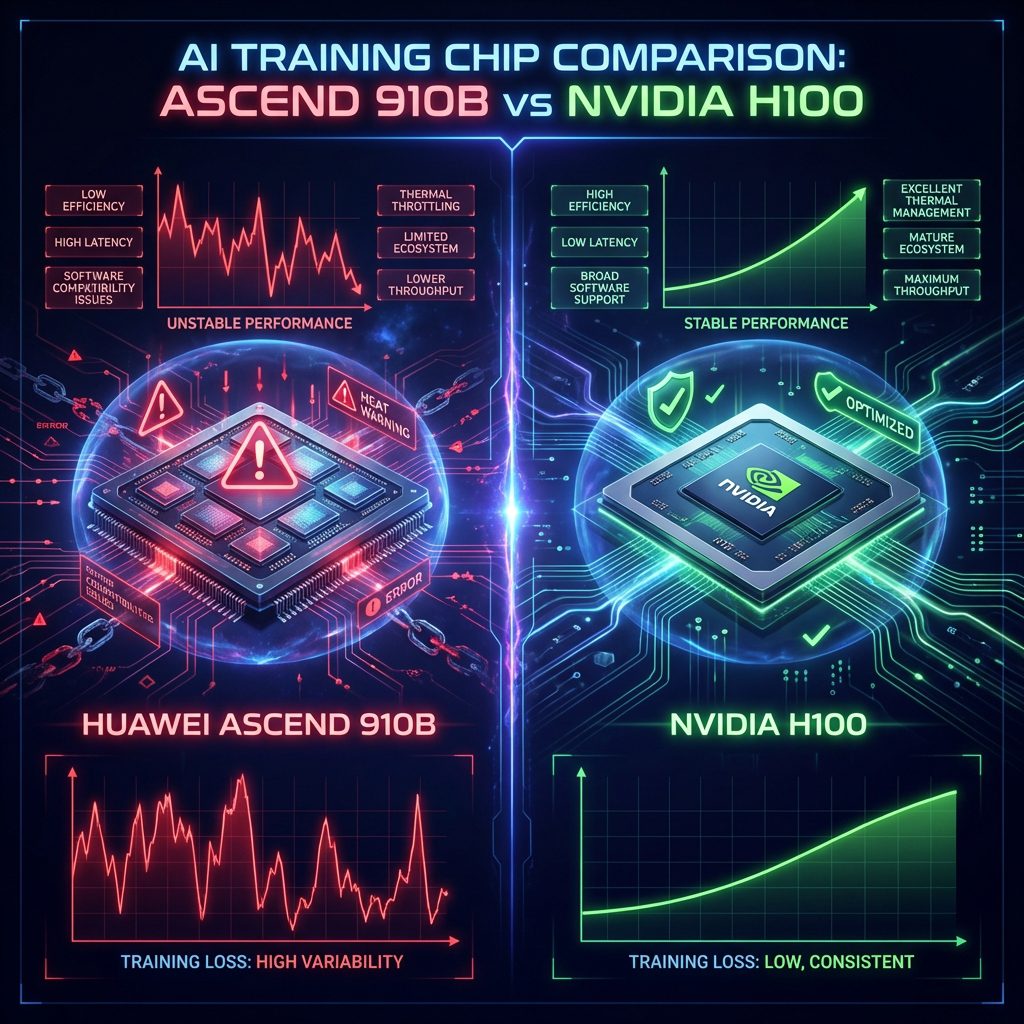
According to multiple sources, DeepSeek ran into serious stability and performance issues when trying to train R2 on Huawei’s Ascend 910B chips. The training runs were unstable. The convergence was unpredictable. The performance was subpar.
So what did they do?
They pivoted back to Nvidia hardware for the critical training phase.
This is a massive geopolitical statement disguised as a technical decision. Chinese authorities reportedly encouraged DeepSeek to use Huawei chips (likely as part of the broader “chip independence” strategy). But when push came to shove, DeepSeek chose performance over politics.
And honestly? That’s the right call. You can’t build the world’s best reasoning model on unstable hardware just to make a political point.
But it also reveals a harsh truth: China still needs Nvidia for frontier AI development. The Huawei Ascend chips aren’t ready for prime time — at least not for training trillion-parameter models.
The Architecture: 1.2T Parameters, 78B Active
Let’s talk specs.
Based on various leaks and reports, DeepSeek R2 is rumored to be a 1.2 trillion parameter Mixture-of-Experts (MoE) model. But here’s the clever part: it supposedly only uses about 78 billion parameters at a time.
This is the MoE magic trick. Instead of running all 1.2 trillion parameters for every token (which would be computationally insane), R2 uses a router network to select the most relevant “expert” sub-networks for each input.
The result:
– Inference speed comparable to a 78B dense model.
– Capacity and knowledge comparable to a 1.2T dense model.
– Memory requirements drastically lower than traditional trillion-parameter models.
This is the same design philosophy behind Mixtral 8x7B, GLM 4.7 Flash, and DeepSeek-V3 — but scaled to an entirely new level.
For comparison:
– DeepSeek R1: ~671B total parameters, ~37B active
– DeepSeek R2: ~1.2T total parameters, ~78B active
– GPT-5: Unknown (OpenAI doesn’t disclose architecture)
The jump from R1 to R2 is massive. We’re talking about a model that’s nearly 2x larger in total capacity, with 2x more active parameters per inference call.
The Technical Edge: Why DeepSeek’s MoE is Different
Here’s where it gets interesting for the technical crowd. DeepSeek’s MoE implementation isn’t just “more parameters” — it’s fundamentally different from how OpenAI, Google, or Meta approach mixture-of-experts.
Fine-Grained Expert Segmentation
Instead of using a few large experts (like Mixtral’s 8 experts), DeepSeek uses hundreds of smaller experts. R2 is rumored to have 256+ routed experts per layer.
Why does this matter? More experts = more precise routing. Instead of activating a “general coding expert,” R2 can activate a “Python async/await expert” or a “Rust memory safety expert.” This is surgical precision vs. a sledgehammer.
Shared Expert Isolation
This is the killer feature that most articles won’t mention.
DeepSeek designates certain experts as “Shared Experts” that are always active for every token. These handle general knowledge (grammar, common facts, basic reasoning). The routed experts focus exclusively on specialized, niche knowledge.
The result? No parameter waste. No routing instability. No experts sitting idle while others are overloaded.
Auxiliary Loss-Free Load Balancing
Traditional MoE models use an “auxiliary loss” to balance expert usage — but this degrades the primary objective (predicting the next token accurately).
DeepSeek’s innovation: dynamic bias. If an expert is overloaded, its routing score gets a negative bias. If it’s underutilized, it gets a positive bias. This maintains perfect load balancing without sacrificing prediction quality.
This is why DeepSeek models punch above their weight class. They’re not just bigger — they’re smarter about how they use their parameters.
The Pricing War: $0.07 Input, $0.27 Output
Here’s where DeepSeek is really going for the throat.
The reported pricing for R2 is:
– $0.07 per million input tokens
– $0.27 per million output tokens
Let’s put that in perspective.
DeepSeek R2 vs. GPT-5.2 vs. Claude Opus 4.5
| Model | Input (per 1M tokens) | Output (per 1M tokens) |
|---|---|---|
| DeepSeek R2 | $0.07 | $0.27 |
| GPT-5.2 | $1.4 | $14.00 |
| Claude Opus 4.5 | $5.00 | $25.00 |
| Gemini 3 Pro | $1.25 | $12.00 |
DeepSeek R2 is 35x cheaper than GPT-5.2 for output tokens.
This isn’t just competitive pricing. This is a pricing war.
And it’s working. We’re already seeing OpenAI and Google cutting their prices in response to DeepSeek’s earlier releases. If R2 delivers on these promises, we could see another major shakeup in the industry.
For developers building:
– AI-powered coding assistants (like Cursor or Antigravity)
– Long-context document analysis (legal, medical, research)
– Autonomous agents (like the ones we covered in AI Agents Explained)
This pricing makes DeepSeek R2 the default choice unless you absolutely need the brand-name models.
Multimodal Capabilities: Images and Video
One of the most exciting rumors about R2 is that it might handle multimodal inputs like images and video.
DeepSeek R1 was primarily text-only (with some basic image understanding). R2 is expected to be a native multimodal reasoning model, capable of complex chain-of-thought (CoT) processing across video, images, and audio.
This would put it in direct competition with:
– GPT-5.2 (which has advanced vision capabilities)
– Gemini 3 Pro (Google’s multimodal flagship)
– Claude Opus 4.5 (Anthropic’s latest)
If DeepSeek can deliver GPT-5-level multimodal reasoning at 1/35th the cost, that’s game over for the Western labs.
The Competition: ByteDance, Minimax, and Kimi
Here’s the other wrinkle: DeepSeek isn’t just competing with OpenAI and Anthropic anymore.
The Information report specifically mentions ByteDance (the company behind TikTok) as a major competitive threat. ByteDance has been making serious investments in AI, and they’re planning their own major model release around the same time as R2.
Then you have:
– Minimax (who dropped M2.1 and are potentially dropping M2.2)
– Kimi k2.5 (which we covered in our Kimi k2.5 analysis)
Both of these are backed by public investors now, which means they have serious capital to compete.
The AI race in China is getting fierce. And the competition is driving innovation at a pace that’s honestly terrifying for the Western labs.
The Geopolitical Angle: Why This Matters
DeepSeek R2 isn’t just a technical achievement. It’s a geopolitical statement.
The U.S. has tightened export controls on Nvidia H100 and A100 GPUs to China, cutting off access to the chips that power most frontier AI development.
China’s response? Build models that are so efficient they can run on older hardware — or build domestic alternatives like Huawei Ascend.
The fact that DeepSeek had to pivot back to Nvidia for R2 training shows that China still needs American chips for frontier AI. But the fact that they’re building models that can run inference on cheaper, more accessible hardware shows that they’re playing the long game.
This is a chip embargo workaround, disguised as a feature.
And it’s working.
Verdict: The Model to Watch in 2026
If DeepSeek R2 delivers on these promises, it’s going to be the most important AI release of 2026.
Here’s what we’re watching for:
– Actual performance vs. GPT-5.2 and Claude Opus 4.5 on reasoning benchmarks
– Multimodal capabilities (can it really handle video and images?)
– Real-world pricing (will they stick to $0.27/M output tokens?)
– Hardware requirements (can it run on consumer GPUs like RTX 4090s?)
The release is supposedly 2 weeks away (mid-February 2026). Mark your calendars.
If DeepSeek can deliver GPT-5-class reasoning at 1/35th the cost, the AI industry is about to get a lot more interesting.
And if they can do it while navigating the geopolitical minefield of chip embargoes and domestic hardware mandates? That’s a masterclass in strategic execution.
The future of AI might not be built in San Francisco. It might be built in Beijing — and it might cost 35x less than you think.
Har Har Mahadev 🔱, Jai Maa saraswati🌺


