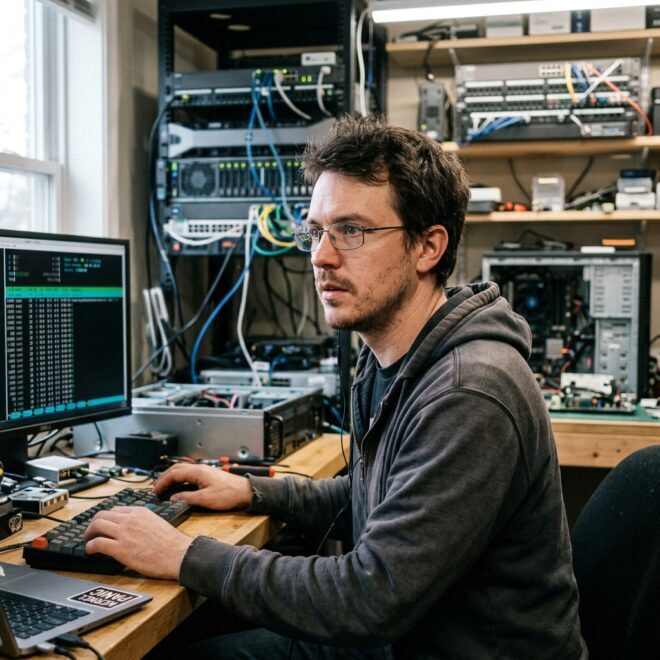



FLUX 3 Image Klein is Black Forest Labs’ 5.6B image generator for local generation and editing. That parameter count covers the image transformer, not every component used to make an image. For local setup, choose a complete workflow: transformer precision, text encoder, prompt upsampler, image autoencoder and the software that moves them through memory.
Black Forest Labs’ October 15 release includes base and distilled checkpoints. The advertised 8 GB route uses an INT8 build. It should not be read as a promise that every reference-code configuration, resolution and collection of reference images fits an 8 GB GPU.
The generator is only part of the memory budget
The model card identifies Qwen3-VL-4B-Instruct as a separate text encoder. The transformer’s size therefore cannot stand in for the complete pipeline’s weight storage, let alone its peak runtime allocation.
The reference implementation also loads a prompt upsampler. Its published B200 measurements at 1024×1024, with that upsampler off, report peak GPU memory of 31 GB in BF16, 26 GB in FP8 and 25 GB in NVFP4 for the distilled path. Those are measurements from the publisher’s implementation, not universal minimums.
Hugging Face’s Diffusers walkthrough uses a different measurement setup. Its memory table lists 20.72 GiB peak allocated after inference for BF16 on H100, while its separate end-to-end timing table lists 23.8 GiB for the workflows timed there. Neither is the same metric and configuration as BFL’s B200 nvidia-smi peak.
This is why a single “VRAM required” number needs a recipe attached. Allocated tensor memory, device-level usage and an offloaded workflow describe different things. Record which modules are resident at each stage before comparing reports.
Choose the implementation before choosing the precision
For an 8 GB card, start from the official ComfyUI model distribution and a current matching workflow. It packages the transformer, text encoder, upsampler and autoencoder separately. Check the actual files expected by each loader. Do not mix a FLUX.2 Klein template with the FLUX 3 release because the names look similar.
BFL’s reference repository says its own code has no INT8 path and directs RTX 30-series hardware to the ComfyUI INT8 files. Its NVFP4 path requires Blackwell. An INT8 success reported in ComfyUI is consequently not evidence that adding a precision flag to the reference Python CLI will reproduce it.
Diffusers provides another route, including quantized transformer loading and component offloading. The Hugging Face guide distinguishes fast quantized kernels on supported hardware from dequantization on other GPUs, which can reduce memory without delivering the same speedup. Use the guide’s actual single-file loading recipe rather than assuming that a smaller weight file guarantees faster execution.
Before downloading, identify the transformer checkpoint, text encoder and autoencoder, decide where prompt expansion will happen, and budget host RAM and storage as well as GPU memory.
Save the expanded prompt when judging quality
The model card asks users to supply a full scene caption through a prompt upsampler. The checked model card says its documented Diffusers examples do not automatically run the expansion approaches described there. BFL’s own CLI enables its upsampler by default and allows an external vision-language model to produce the caption instead.
This dependency changes how a fair comparison should be recorded. The short request typed by a person and the final caption consumed by the image model are different inputs. Save both, along with the image checkpoint, software revision, seed, resolution, steps and reference images. Otherwise an apparent improvement may come from different caption expansion rather than a better image checkpoint.
A useful proposed comparison would use two tracks: one fixes the final caption to compare image generation, and the other includes each workflow’s complete caption-expansion stage to compare the experience a user receives. Keep expansion time in the second track’s latency. No images were generated with FLUX 3 for this article, and no quality ranking is claimed.
Bounding boxes guide placement; they do not prove preservation
Layout control is another reason to evaluate Klein. The model card warns that boxes are not hard masks and that edits can alter content beyond the requested region. BFL’s release separately describes pixel restoration in its API. Do not assume every local pipeline inherits that service behavior.
The reference CLI’s box JSON uses y-first coordinates normalized from 0 to 1. The BFL bounding-box documentation uses a 0–1000 scale for inline caption boxes, also y first. For a synthetic top-left quarter, those representations are [0, 0, 0.5, 0.5] and [0, 0, 500, 500]. Follow the format expected by the selected entry point; copying coordinates between formats changes their meaning.
For a preservation check, compare the output with the reference outside the intended edit region as well as inside it. Define which changes are acceptable before inspecting the result. A visually plausible edit is not proof that surrounding pixels were preserved.
Check access and license before committing to deployment
The Hugging Face repository is gated. The weight license is FLUX Kommunity License v1.0, with commercial output generation for qualifying users below US$5 million in gross annualized revenue, including affiliates, subject to further terms. That is distinct from the reference code’s Apache 2.0 license. Read the linked weight license for the intended use; the release is not a blanket Apache-licensed model.
Klein’s local deployment question is practical: can the complete workflow produce the required images on the hardware available, with acceptable memory use, latency and editing behavior? An INT8 setup can be worth trying on a small GPU. The evidence needed is a recorded run of that exact setup, not the generator’s parameter count alone.
Reporting note: Prepared with AI assistance from primary sources. Publisher measurements are attributed; the comparisons above are proposed methods, not executed tests. Gated model files were not downloaded. The featured image is an original AI-generated editorial illustration, not a FLUX 3 sample.