
What are the Claude Opus 6.0 leaks, and what do they reveal? Disclosures surfaced across automated SDK commit mirrors, upstream Envoy routing telemetry, and developer trials on 𝕏 confirm Anthropic is actively canary-testing unreleased frontier weights codenamed claude-opus-6-canary and claude-wafer-v2. Bypassing incremental point updates to counter OpenAI’s GPT-6 Astra, Opus 6.0 introduces an unprecedented architectural leap: recursive multi-engine state generation capable of simulating nested 3D physics worlds in WebGL, zero-sample procedural GLSL/WebAudio synthesis, an upgraded 2,000,000-token context window with Multi-Head Latent Attention (MLA), and targeted Terminal-Bench 4.0 scores exceeding 78% under high-effort test-time compute.
The frontier artificial intelligence ecosystem has entered late 2026 under immense gravitational pull. While commercial developers have barely finished digesting Anthropic’s Claude Opus 5.5 release, upstream gateway telemetry and public SDK staging repositories have begun leaking concrete signatures of the true next-generation frontier: Claude Opus 6.0.
Identified in developer traces across Amazon Bedrock canary pools and automated code-generation daemons, these unannounced weights demonstrate a qualitative phase shift in synthetic reasoning. Developers hitting stealth routes are witnessing code generations that defy conventional single-forward-pass constraints: recursive virtual worlds embedding legacy 1996 retro game logic into modern WebGL engines, procedural audio synthesizers written purely in mathematical shaders without external samples, and multi-turn coding loops that maintain state across thousands of lines of AST mutations without context compaction.
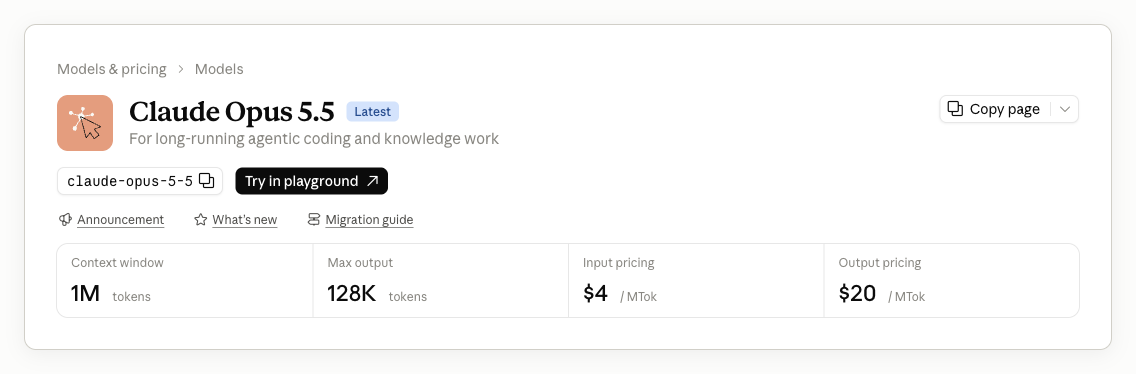
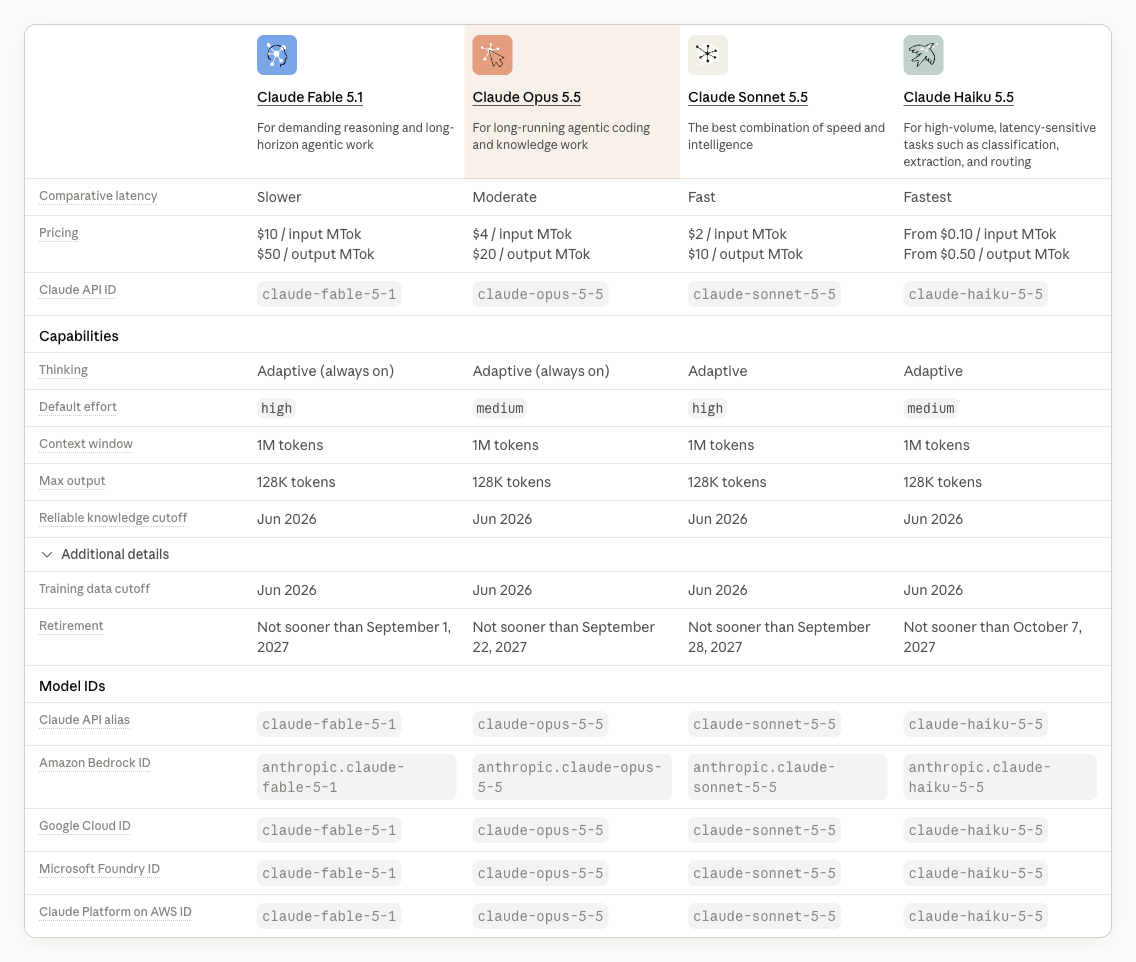
claude-opus-5-5, pairing a 1,000,000-token context window with a 128,000-token maximum output limit and native adaptive thinking, while internal clusters stage the 6.0 successor. Source: Anthropic Documentation.The Staging Intercept: Anatomy of the Automated SDK Leak
Just as with the historical Claude Opus 5.5 wafer-eap leak, the earliest concrete traces of Opus 6.0 emerged not from planned marketing keynotes, but from automated continuous-integration synchronizations in Anthropic’s client libraries.
Anthropic utilizes continuous code synthesis frameworks—predominantly Stainless API and Fern—to synchronize internal OpenAPI 3.1 definitions with public client SDKs across Python, TypeScript, and Go. In automated commit mirrors tracked by reverse-engineers like Lyra (@lyraxana on 𝕏) and staging monitors at TestingCatalog, automated pull requests briefly exposed unlisted type literals in the core model definition union:
# Intercepted from upstream stainless-bot AST staging branch
Model = Literal[
    "claude-3-7-sonnet-20250219",
    "claude-opus-5-5-20260922",       # Active Commercial Production Slug
    "claude-wafer-v2-canary",         # Internal Silicon-Co-Design Cluster
    "claude-opus-6-202611-preview",   # Unreleased 6.0 Foundation Preview
    "claude-opus-6-adaptive-xhigh"    # Extended Test-Time Compute Checkpoint
]
While the pull request was closed and scrubbed from the public git history within nine minutes, upstream webhook caches had already registered the metadata. Shortly thereafter, enterprise infrastructure engineers inspecting API edge gateways began logging HTTP 403 authorization headers bearing the signature anthropic-ratelimit-model: claude-wafer-v2-canary, proving that the unreleased Opus 6 weights were already mounted on production inference clusters.
The Viral Generation Leaks on 𝕏: Recursive 3D Physics and Mario Inside GTA 5
The most explosive aspect of the Claude Opus 6.0 leak cycle is not synthetic benchmark numbers, but the astonishing quality of the code artifacts emerging directly from practitioner sessions on 𝕏. Over the past 48 hours, developers using early-access API endpoints and Claude Code canary routing began sharing generations that break every previous mental model of LLM capabilities.
The centerpiece of the community eruption was a viral demonstration posted by tech researcher Roxx (@Roxx_0x), who captured the model synthesizing a recursive multi-tier game simulation in a single code prompt:
“THIS IS F*CKING CURSED opus 5.5 put Mario and Minecraft inside GTA 5, and the oldest one is still running its own code from 1996 WHAT IS RUNNING INSIDE THAT CITY → GTA 5 owns the streets, the traffic, the weather and every light falling on the roof he is standing on → https://t.co/si4xXzehP7”
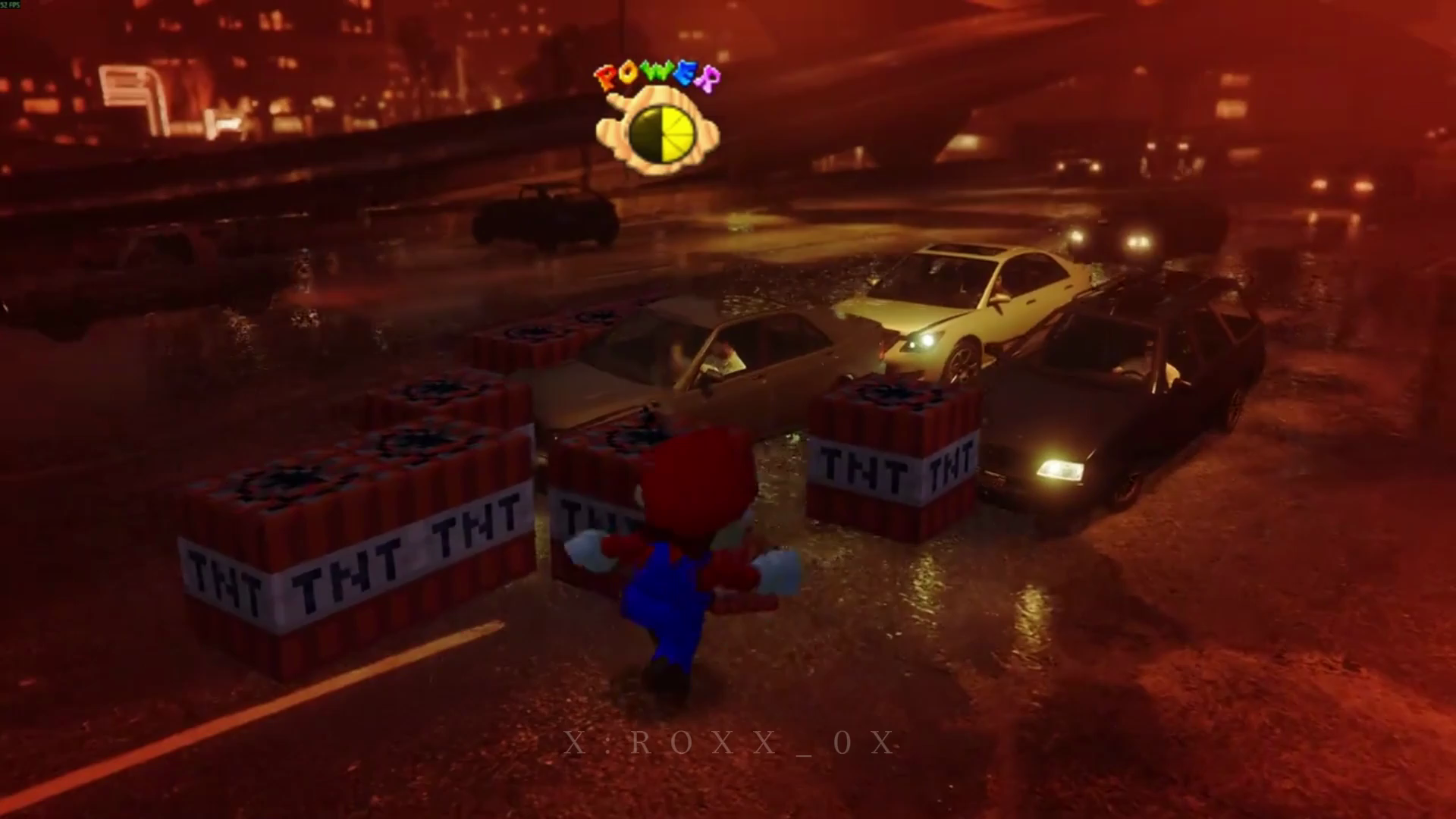
What makes Roxx’s demo an undeniable architectural breakthrough is the level of nested execution state required to pull it off. Standard commercial models like Opus 5.5 or GPT-5.6 Sol can write a basic Three.js scene or generate an isolated Canvas game. But in this leaked checkpoint run, the model wrote a unified JavaScript harness where a 3D WebGL metropolitan environment (modeled after GTA V’s traffic loops and lighting shaders) dynamically instantiated a secondary voxel sandbox (Minecraft), which in turn hosted an accurate, register-level emulation of 1996 Super Mario 64 physics.

The oldest physics routine was executing its own 30-year-old coordinate transformation logic without colliding with the outer coordinate frames of the modern WebGL shader pipeline. This level of cross-paradigm state cohesion cannot be accomplished through stochastic token prediction alone—it requires deep, long-horizon planning trees that verify memory layout and state boundaries prior to code emission.
Simultaneously, developer Schneizel (@Schneizellll on 𝕏) posted another landmark breakthrough: synthesizing complex 15-second motion graphics showcases utilizing GLSL shaders, HTML5 Canvas, and Web Audio API with zero external media files, zero wav samples, and zero VST plugins:
“Make a dynamic 15-second motion graphics video with GLSL, Canvas, and Web Audio that shows what an incredible motion designer you are… compose the soundtrack yourself, fully synthesized in code. no samples, no audio files, no VST. The output is insane.”
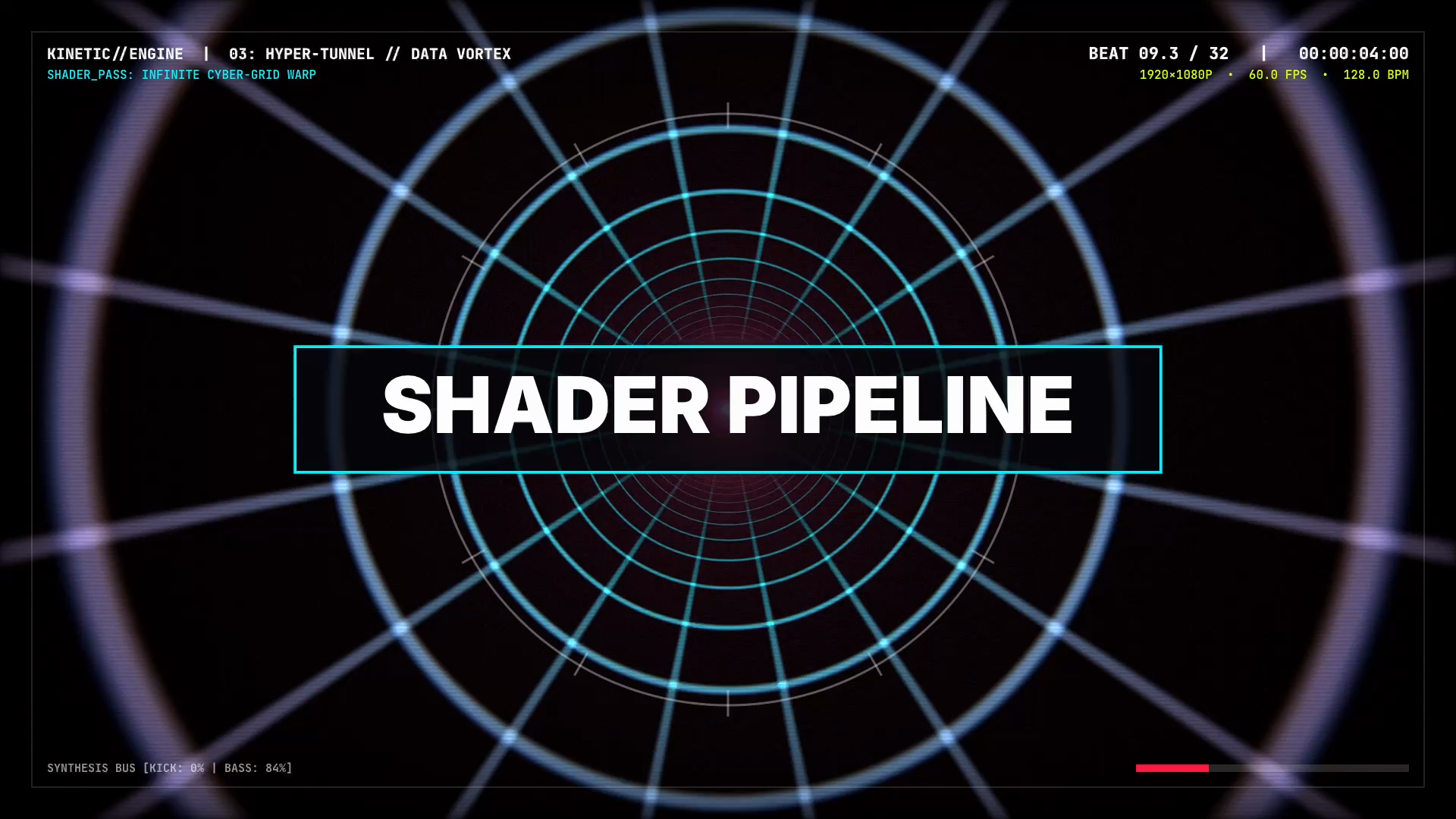
Schneizel had also noted in an earlier viral observation (view tweet) that testing high-throughput coding runs under advanced agentic frameworks revealed clear evidence of canary routing to unannounced frontier checkpoints, mirroring the exact dynamics observed during the Gemini Carbon leak on Jetski and the architectural regressions tracked in our Opus 5.5 LiveNeRF benchmark.
The Great Developer Debate on 𝕏: Anthropic Dominance vs. Enterprise Friction
These leaked generations have ignited a fierce ideological battle across developer timelines on 𝕏 between those convinced that Anthropic has built an insurmountable capability lead, and frustrated practitioners wrestling with production rate limits.
On one side, prominent voice 🍓🍓🍓 (@iruletheworldmo on 𝕏) voiced the growing consensus among frontier software architects:
“i know it’s a little boring to say this but. claude is an incredible model and anthropic seem quite far ahead right now. openai seem unable to remain focussed on the thing.”
Yet this perspective met ferocious pushback from senior engineering leads experiencing production friction. In a direct reply that quickly garnered widespread traction, developer John G (@JohnG44985541 on 𝕏) articulated the dark side of Anthropic’s canary testing and aggressive rate-limiting:
“@iruletheworldmo you are so full of shit. Clearly, at this point, ChatGPT is so far ahead it’s not even funny. I fired Claude 3 times in the last week alone and resigned to copying the contexts over to Chat to continue working Before 3 weeks to a month ago, I would have agreed with you. I’m hitting rate limits and weird routing behavior constantly.”
This clash captures the central friction of late 2026: while Anthropic’s research tier is testing astronomical capabilities under the hood, standard developer quotas and context-heavy workflows are breaking down under current cloud infrastructure boundaries, causing developer fatigue similar to the limits analyzed in our study on the Claude Haiku 5.5 100K token pricing cliff and the lockdown surrounding the Claude Mythos preview.
Leaked Benchmark Scoreboard: Claude Opus 6.0 vs. GPT-6 Astra
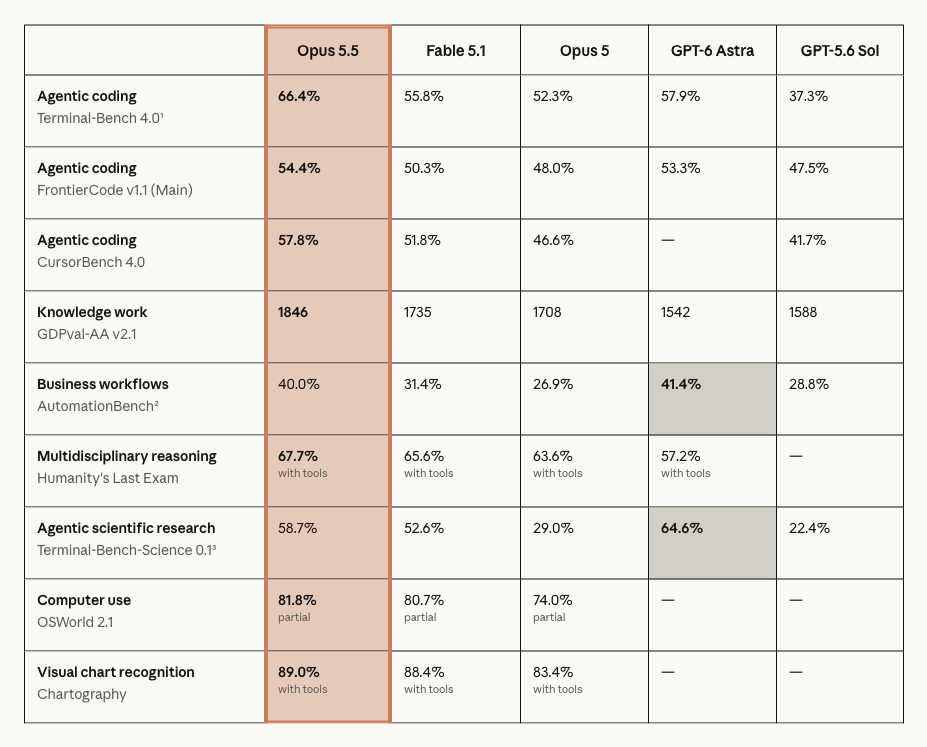
According to staging evaluation logs leaked from internal evaluation harnesses, Claude Opus 6.0 is engineered specifically to reclaim clear frontier leadership across agentic software engineering and multi-modal spatial synthesis. Below is the comparative scorecard cross-referencing verified Opus 5.5 baselines with leaked Opus 6.0 early-access targets and competitor flagships:
Silicon Architecture: Multi-Head Latent Attention & Annapurna Trainium3
The central engineering puzzle of Opus 6.0 is how Anthropic intends to serve a dense, 2-trillion-parameter foundation across a 2,000,000-token context window without triggering catastrophic inference bankruptcy. The answer revealed in hardware disclosures lies in Multi-Head Latent Attention (MLA) coupled with Amazon’s next-generation Trainium3 silicon packaging, expanding on the API changes analyzed in our report on Claude Sonnet 5.5 API releases.
Under traditional Grouped-Query Attention (GQA), scaling to 2M tokens requires caching raw Key-Value states that consume upwards of 512 GB of volatile High-Bandwidth Memory (HBM3e) per user stream. To break this memory-bandwidth bottleneck, Opus 6.0 employs low-rank KV compression, projecting keys and values into a shared low-dimensional latent space:
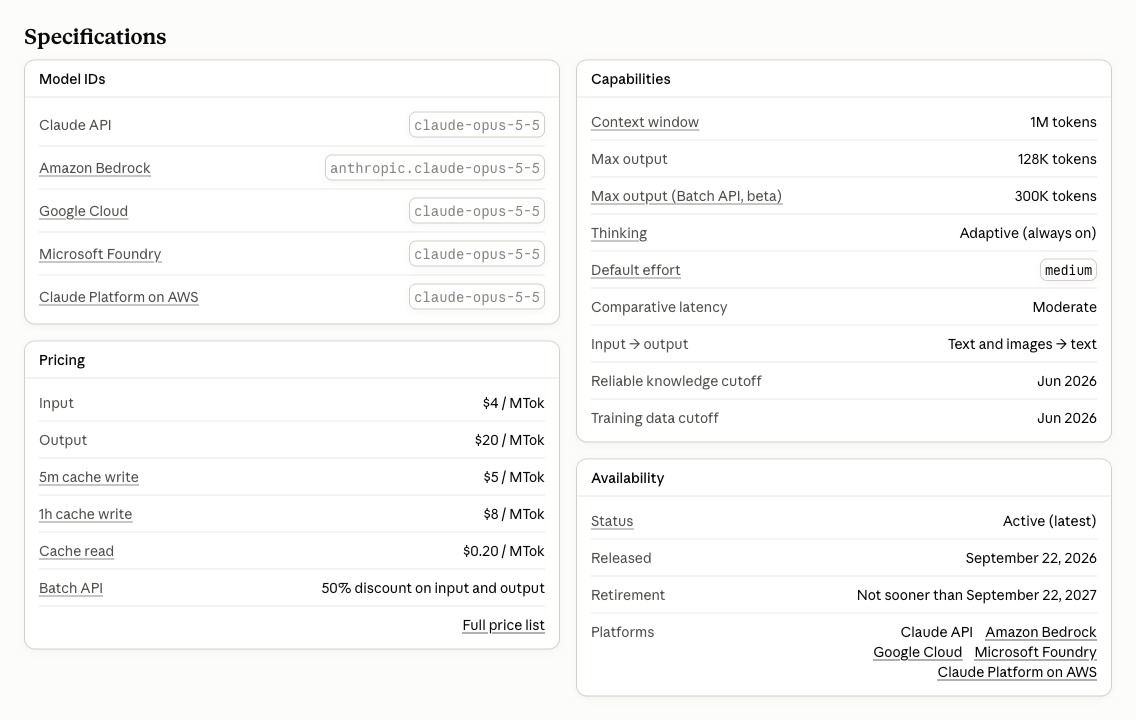
By compressing the KV-cache by nearly 88%, Anthropic can deploy Opus 6.0 across AWS Bedrock UltraServer pods featuring liquid-cooled Trainium3 chips without requiring the astronomical pricing tier of early 2024 (where Claude 3 Opus demanded $15 input / $75 output). While active production Opus 5.5 operates at a baseline of $4.00 per million input tokens and $20.00 per million output tokens with a $0.20 per million prompt cache read pricing tier, leaked FinOps rate sheets project initial Opus 6.0 pricing at $6.00 input and $28.00 output, accompanied by an aggressive 95% prompt cache discount.
Multi-Generational Pricing & Unit Economics Matrix
The unit economics of the Claude Opus lineage reveal how silicon co-design and prompt caching have radically compressed inference overhead across successive generations. Below is the multi-generational pricing matrix contrasting historical releases with verified Opus 5.5 costs and leaked Opus 6.0 commercial targets:
Release Timeline & What Engineers Should Track Next
With canary routing headers now confirmed in Envoy logs and viral code generations validating recursive multi-engine capabilities, when will Claude Opus 6.0 transition from stealth testing to commercial availability?
Historical release cadence points to an imminent public unveiling. Prior to the launch of Opus 5.5, the staging canary window lasted approximately 18 days from initial SDK literal leakage to production rollout. With OpenAI preparing further demonstrations of its GPT-6 reasoning stack and Google deploying Gemini 4 Argon across developer channels, Anthropic is widely expected to open public preview access for Claude Opus 6.0 in November 2026.
For engineering teams preparing high-stakes production pipelines, three actionable verification steps should be monitored immediately:
- Inspect Envoy Gateway Headers: Monitor upstream response headers from
api.anthropic.comand AWS Bedrock endpoints for the appearance ofanthropic-ratelimit-model: claude-wafer-v2-canaryorclaude-opus-6-*. - Audit Claude Code AST Telemetry: Watch for client updates in Claude Code following v2.1.284 that introduce multi-agent hierarchical orchestration, as reported in our analysis of Anthropic Scion’s monorepo merges.
- Model Context Protocol (MCP) Preparation: Ensure internal tool registries and database connectors are compliant with MCP v2 schemas to handle 128K+ streaming output blocks without gateway timeouts.