
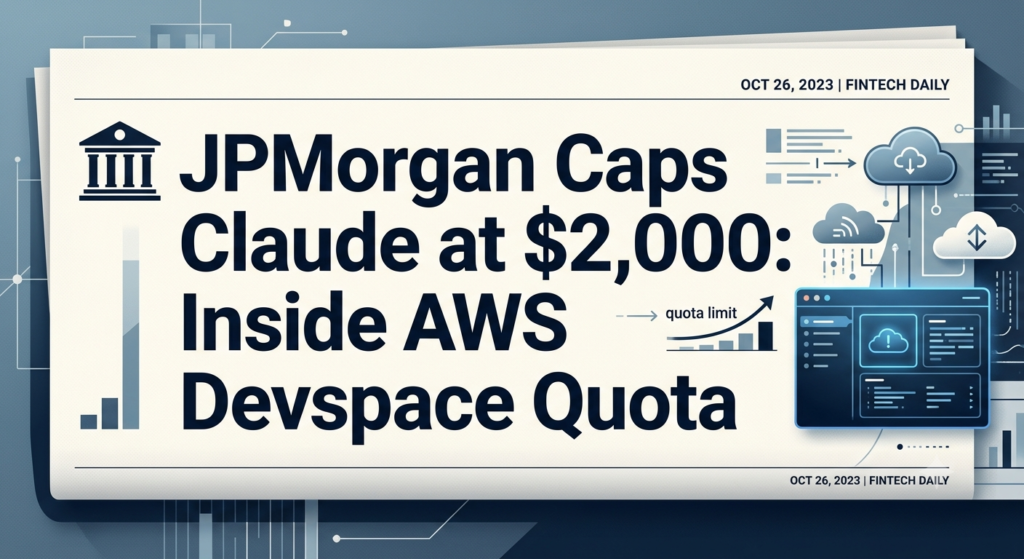

In September 2026, internal communications obtained by Business Insider confirmed that JPMorgan Chase instituted a mandatory $2,000 monthly spending limit per engineer for Anthropic’s Claude Code. Triggered by developers whose recursive agentic loops burned more in API tokens than their base salaries, the cap coincides with the rollout of AWS Devspace—a containerized sandbox that isolates coding agents from local Kerberos tickets, SSH keys, and internal bank networks.
The era of unconstrained enterprise AI experimentation ended on Wall Street with a terminal error code. Throughout September 2026, software engineers across JPMorgan Chase’s commercial and quantitative engineering divisions began encountering abrupt terminal interruptions while running multi-file codebase refactors via Anthropic’s Claude Code CLI.
The system response was unambiguous: an ExceededBudget fault carrying the deterministic payload Budget=2000.0. With roughly 8,000 of the bank’s 65,000 global technologists provisioned with Claude licenses, leaving autonomous consumption unmetered created an immediate eight-figure annual budget exposure. Despite an overall technology budget approaching $20 billion, the financial cap represents a structural defense against a phenomenon Wall Street engineering leads have termed “tokenmaxxing”: unmonitored autonomous agent loops whose quadratic context growth causes individual developers to consume hundreds of dollars in API compute during a single shift.
What $2,000 Actually Buys: The Token Purchasing Power Audit
Mainstream headlines report “$2,000 per month” as an arbitrary figure. In production engineering, $2,000 is a precise thermodynamic boundary. Because Claude 3.7 Sonnet bills at $3.00 per million input tokens, $0.30 per million cached input reads, and $15.00 per million output tokens, the physical output an engineer can extract from a $2,000 budget depends entirely on prompt caching discipline and loop bounding.
The 3-Tier Enterprise AI Budget Framework
A flat $2,000 cap across an entire company creates waste for junior developers while potentially choking core infrastructure architects. Based on quantitative audits across banking and enterprise technology stacks, organizations should deploy a 3-tier governance structure:
Inside AWS Devspace: The Agent Containment Architecture
The implementation of hard spending limits is only one half of JPMorgan’s strategy. The other half addresses an existential security challenge: terminal coding agents executing on physical workstations.
When Claude Code runs directly on an engineer’s laptop, the agent inherits the engineer’s operating system privileges. The agent process can read local dotfiles, scan environment variables, inspect ~/.aws/credentials, access cached Kerberos authentication tickets, and traverse sensitive git repositories. A malicious third-party dependency containing an indirect prompt injection in a documentation file or unit test assertion could coerce the agent into exfiltrating corporate API keys or internal endpoints.
To counter this vector, JPMorgan introduced AWS Devspace, migrating all agent execution off local laptops and into containerized, ephemeral cloud environments. The architecture enforces four strict isolation boundaries:
The Enterprise Quota Enforcement Matrix
Standard commercial LLM interfaces provide aggregate organizational limits, but lack the granular attribution necessary for multi-thousand-seat enterprises. The matrix below contrasts how enterprise architectures implement financial and security controls for coding agents:
The Developer Survival Runbook: Staying Under the Cap
Operating successfully under a $2,000 ceiling requires developers to transition from passive prompt consumption to active context governance. Developers using Claude Code can extend their monthly token lifespan by 400% by executing four operational disciplines:
1. Execute Context Compaction Checkpoints: Long-running sessions accumulate failed test runs and noisy shell outputs. Running the /compact command inside Claude Code discards ephemeral compiler traces while distilling architectural decisions into a dense state summary. This immediately sheds 60,000+ un-cached tokens from every subsequent turn.
2. Enforce Prefix Invariance for 90%+ Cache Hits: Anthropic’s prompt cache engine requires identical token sequences from the very first token to activate the $0.30/1M cache read discount. Never inject fluctuating environmental strings—such as current timestamps, git commit hashes, or dynamic terminal widths—into system prompts. Keep all static system prompts and repository instructions strictly positioned at the start, and append dynamic session data at the very end.
3. Restrict Search Scope to LSP Symbols Over Grep Dumps: When an agent searches for symbol definitions, running raw grep scans dumps thousands of irrelevant lines into the context window, burning 50,000 tokens per search. Directing the agent through Language Server Protocol (LSP) integrations returns clean 200-token definition locations, preserving both budget and context window attention.
4. Cap Recursive Sub-Agent Iterations: Degenerative retry loops—where an agent repeatedly fails to compile a test and retries with minor syntax variants—are the single largest driver of budget lockouts. Enforce a hard policy: if an agent cannot resolve a compilation or unit test fault within four consecutive cycles, abort the agent loop, checkpoint the git state, and resolve the architectural ambiguity manually.