



On September 10, 2026, exactly one week after launching its frontier reasoning model GPT-6 Astra, OpenAI quietly initiated an immediate intake freeze on its marquee consumer tier: new subscriptions and tier upgrades to the $200-per-month ChatGPT Pro plan (internally designated Pro 20X) were abruptly suspended. While existing subscribers remain grandfathered with an explicit caveat that any payment lapse permanently forfeits access, prospective users attempting to upgrade from the $20 Plus or $100 Pro plans are greeted with a notice that the tier is temporarily unavailable, with OpenAI confirming there is currently no active waitlist. While casual observers often assume AI plans are throttled by simple message counts, backend systems architects know the ground truth: inference limits are never strictly about messages—they are governed entirely by token compute budgets. And under GPT-6 Astra, those token budgets broke the bank.
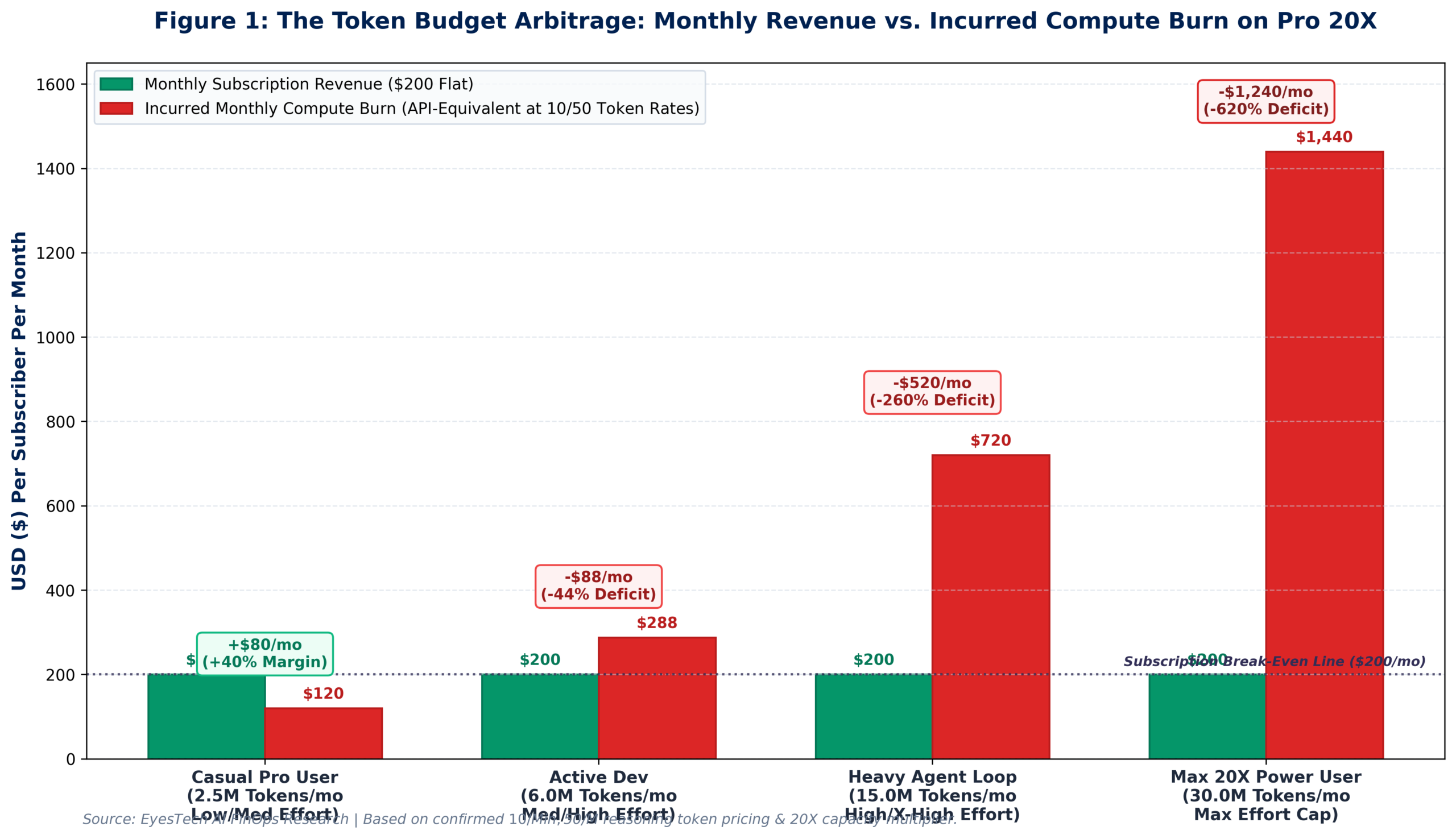
OpenAI structures its tiers around compute capacity multipliers: Plus ($20/mo) provides baseline 1X capacity, Pro 5X ($100/mo) provides 5X capacity, and Pro 20X ($200/mo) unlocks a massive 20X token throughput multiplier. Under traditional models like GPT-4o or GPT-5.6 Sol, outputs rarely exceeded 2,000 tokens. But GPT-6 Astra’s test-time reasoning engine generates 30,000 to 50,000 hidden reasoning tokens per prompt. At official Astra wholesale rates of $10/1M input and $50/1M reasoning tokens, an autonomous developer consuming a 30M token monthly allowance burns $1,440 in raw compute against a flat $200 subscription—forcing OpenAI to absorb a monthly deficit of -$1,240 per power seat (-620% gross margin deficit).
1. The Myth of the Message Counter: Why Limits Are Enforced on Tokens
A common misconception among non-engineers is that ChatGPT operates on a mechanical ‘message counter’—that users are simply permitted a fixed number of button presses. In production multi-tenant inference clusters running Triton, vLLM, or proprietary scheduling daemons, physical hardware does not allocate or meter ‘messages.’ Hardware allocates memory bandwidth, tensor cores, and high-bandwidth memory (HBM) strictly per token processed.
When OpenAI meters user quotas, the backend engine evaluates three concurrent token metrics:
2. Official Astra Pricing: Dissecting the 5 Reasoning Effort Levels
OpenAI’s official API rate card for GPT-6 Astra establishes standard rates at $10.00 per 1 million input tokens and $50.00 per 1 million output tokens (with prompt caching discounted to $1.00/1M). Crucially, all internal reasoning tokens generated during test-time search are billed directly as output tokens at the full $50/1M rate.
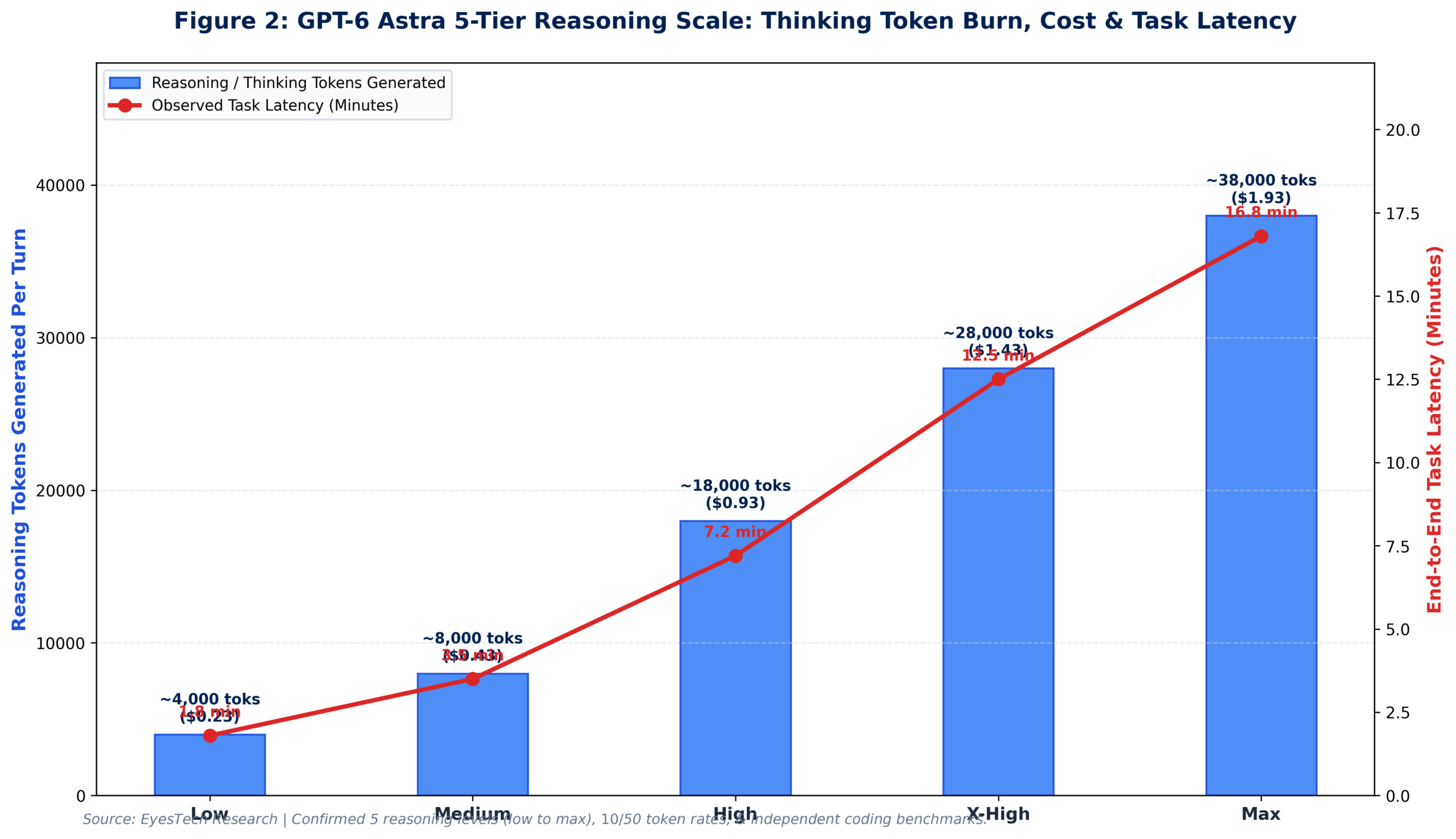
Astra introduces five confirmed reasoning effort levels: low, medium, high, xhigh, and max. The effort dial does not modify the price per token; it directly controls the model’s test-time compute allocation. The table below documents representative token volumes, latencies, and API cost equivalents across a standardized 3,000-token prompt:
| Astra Effort Level | Input Tokens | Reasoning Tokens | Total Tokens | Observed Task Latency | API Cost ($10 In / $50 Out) | Typical Use Case |
|---|---|---|---|---|---|---|
| Low | 3,000 | ~4,000 | ~7,000 | 1.8 min | $0.23 | Routine edits, mechanical refactoring |
| Medium (Default) | 3,000 | ~8,000 | ~11,000 | 3.5 min | $0.43 | Standard professional developer workflow |
| High | 3,000 | ~18,000 | ~21,000 | 7.2 min | $0.93 | Complex architecture & multi-file refactoring |
| X-High (Extra High) | 3,000 | ~28,000 | ~31,000 | 12.5 min | $1.43 | Formal proofs, cryptographic validations |
| Max (Peak Compute) | 3,000 | ~38,000 | ~41,000 | 16.8 min | $1.93 | Autonomous multi-step zero-day discovery |
3. The Mathematical Calculus of Flat-Rate Token Arbitrage
Traditional SaaS subscription economics rely on near-zero marginal costs: dormant users subsidize active ones. In frontier AI reasoning, however, marginal cost is strictly linear with physical token generation. When users are granted a 20X token capacity bucket, the monthly balance sheet diverges radically:
Where Rsub is the flat monthly fee ($200.00), Vin is total monthly prompt tokens, Vreason is total monthly reasoning tokens, and Pin/Pout are official API rates ($10/1M input, $50/1M output).
When evaluated across real-world token consumption cohorts on the Pro 20X plan, the unit economics explain why OpenAI had to halt new sign-ups immediately:
- Monthly Subscription Revenue: $200.00 per month
- Monthly Token Consumption (Max 20X Capacity): 30,000,000 tokens (3M prompt + 27M reasoning tokens)
- Wholesale Prompt Token Cost: (3,000,000 / 1,000,000) × $10.00 = $30.00
- Wholesale Reasoning Token Cost: (27,000,000 / 1,000,000) × $50.00 = $1,350.00
- Total Incurred Monthly Compute Burn: $30.00 + $1,350.00 + HBM Pinning = ~$1,440.00 per month
- Net Operating Deficit: $200.00 − $1,440.00 = -$1,240.00 per seat/month
- Negative Gross Margin: -620.0%
4. The Memory Bottleneck: KV Cache Pinning and 355-Second TTFT
The crisis facing OpenAI’s clusters is not merely financial—it is physical. Independent benchmarks published by Artificial Analysis and OpenRouter report that when Astra operates at maximum reasoning effort, its time-to-first-token (TTFT) can reach approximately 355 seconds (nearly 6 minutes), during which multi-GPU clusters execute extensive Monte Carlo tree searches and reward verification passes before generating visible output.
During these extended reasoning passes, intermediate key-value (KV) projections must remain pinned in high-bandwidth memory across H100 and H200 clusters. This pins tens of gigabytes of SRAM and HBM per active query stream, preventing dynamic batching and starving co-located enterprise API tenants who pay full price for commercial token throughput.
5. The Future of Frontier Pricing: The Transition to Credit Wallets
The pause on new $200 Pro subscriptions signals the end of flat-rate reasoning models across the AI industry. With Anthropic pricing Claude Fable 5.1 at $10/$50 and OpenAI aligning Astra at the identical price point, the cost structure of frontier AI is converging around consumption-metered tokens rather than all-you-can-eat monthly tiers.
Engineering teams and enterprise leaders should prepare for three structural evolutions in commercial AI packaging:
6. Enterprise Strategic Directives
- Preserve Active $200 Pro Seats: Ensure corporate billing cards remain active. A single failed renewal forfeits the 20X token capacity allowance permanently during the intake freeze.
- Standardize on Medium Effort Defaults: In IDE configurations and internal agent scripts, set default reasoning effort to
medium. Reservehighandmaxexclusively for tasks that fail initial verification. - Leverage Prompt Caching: Structure prompts to maximize static prefixes. With Astra caching discounted to $1.00/1M, high prefix hit rates drastically reduce per-query costs.
- Model CI/CD Spend on Metered Tokens: Audit internal automated workflows to ensure tooling does not depend on flat-rate unlimited reasoning subscriptions ahead of upcoming pricing transitions.