
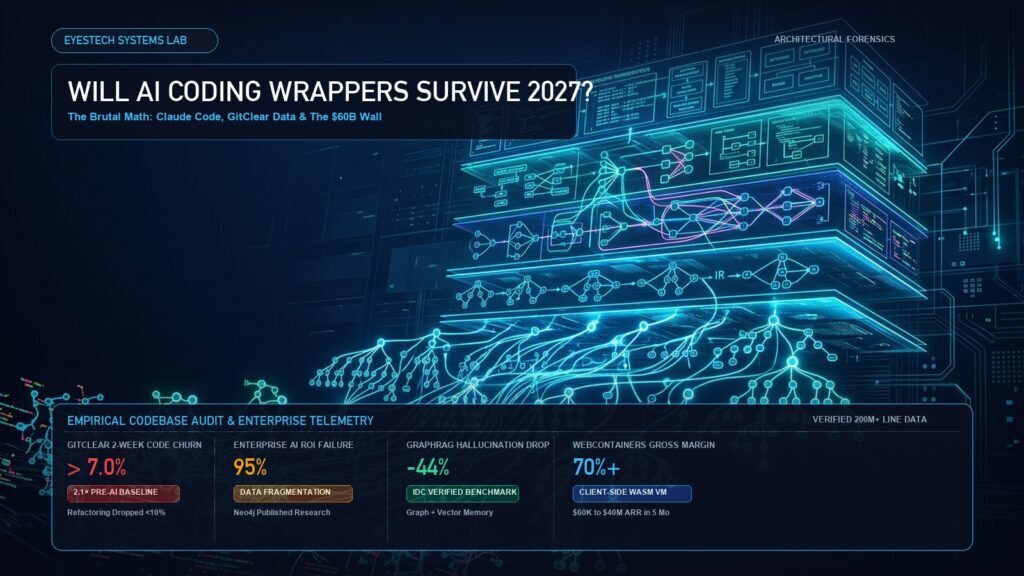

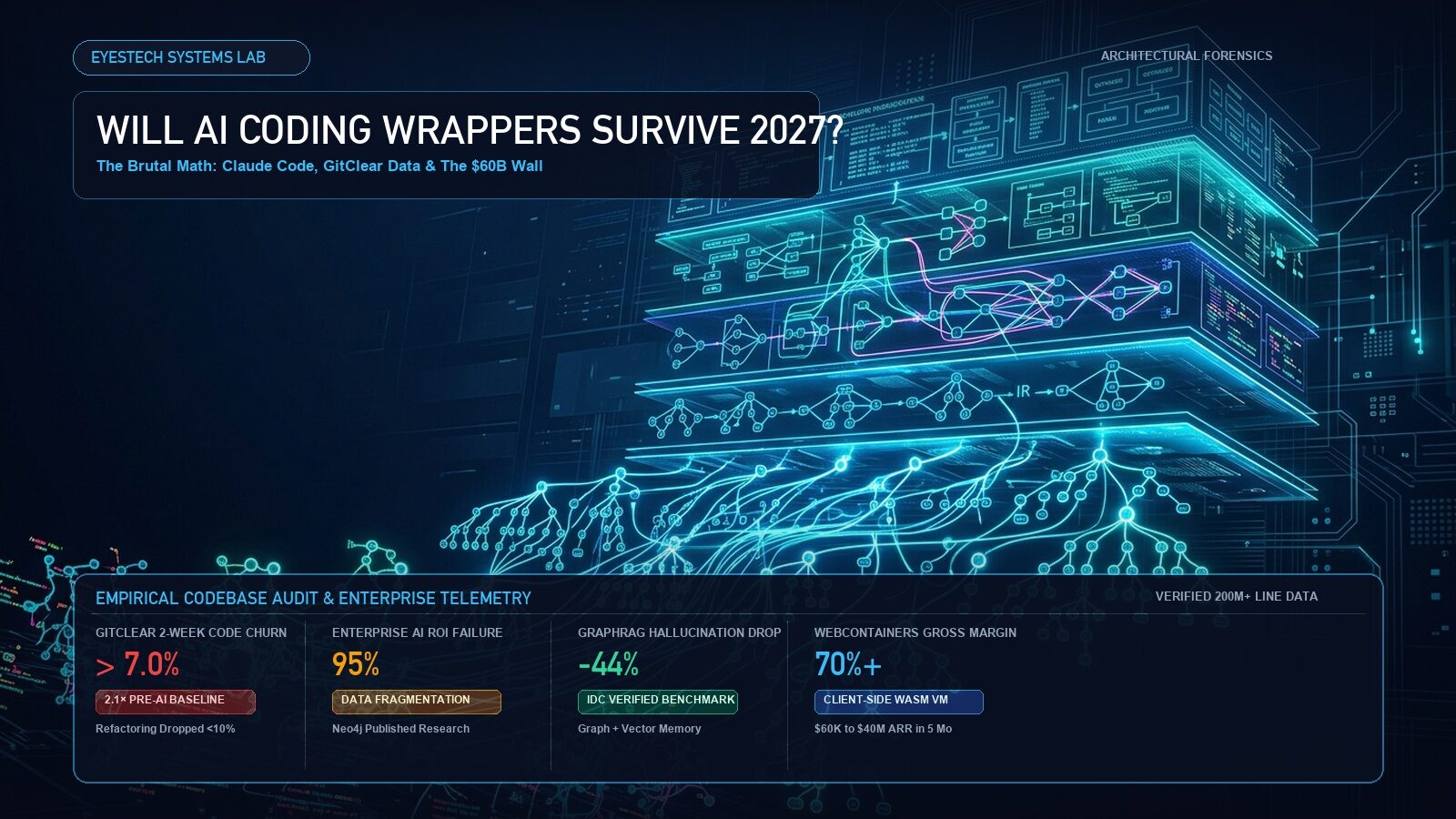
Will AI coding wrappers survive 2027? Thin prompt wrappers will be extinct. Tools that merely send user prompts to OpenAI or Anthropic APIs are already being dismantled by first-party terminal agents like Claude Code and native Codex integrations. However, thick platforms (such as Builder.io, Bolt.new, Lovable, and Emergent) are anchored to defensible engineering moats: deterministic AST compilers, client-side WebAssembly runtimes (WebContainers), and design-system token bridges. With GitClear’s 200M-line study confirming that AI code has doubled churn to over 7%, and enterprise data revealing that 95% of AI projects stall due to data fragmentation rather than model intelligence, the survivors of 2027 will not be vibe-coding prompt boxes—they will be autonomous software supervisory studios.
The $60 Billion Illusion and the Approaching Wall
Between late 2024 and 2026, generative development platforms experienced one of the most violent capital influxes in enterprise software history:
After grinding through seven years on ~$80,000 ARR building WebContainers, CEO Eric Simons paired their in-browser WebAssembly runtime with Claude 3.5 Sonnet, securing a $700M valuation and millions of active builders.
Spun out of Anton Osika’s open-source GPT Engineer, Lovable scaled by transforming natural-language intents into full-stack web applications, capturing non-technical founders and indie creators alike.
Scaled its AI-native editor across 64% of the Fortune 500, generating over 100 million lines of enterprise code daily before its landmark $60B acquisition.
Yet beneath these headline valuations lies an unforgiving market reality: frontier model labs are aggressively expanding downward into the developer interface.
Anthropic’s release of Claude Code—an autonomous agent operating natively inside the terminal with direct access to bash, git, file systems, and test runners—proves that frontier labs will not remain passive API providers. When the model itself can inspect your repo, run tests, and commit diffs from the command line, the foundational question shifts: what defensible value remains for third-party platforms when raw code generation is commoditized?
The Three Thermodynamic and Economic Pressures
Three structural pressures are compressing third-party margins and exposing the physical limits of token-driven development:
The “Write-Only” Codebase Crisis (GitClear Data)
The marketing pitch that natural-language prompting replaces software engineering collapses under production workloads. In longitudinal research analyzing over 200 million lines of code, software analytics firm GitClear uncovered a sharp maintainability decay across codebases built with AI assistants:
- Code Churn More Than Doubled: Two-week code churn (code rewritten or deleted shortly after commit) surged from a pre-AI baseline of 3.3% to over 7.0%.
- The Collapse of Refactoring: The percentage of “moved” (refactored or reused) code plummeted from ~25% in 2021 to under 10%.
- Duplication Explosion: Commits containing copy-pasted or duplicated logic blocks increased by 81%, while cross-file function calls dropped by 35%.
Large language models are probabilistic token sequencers, not systems architects. When tasked with a feature modification, an LLM defaults to generating net-new, redundant boilerplate rather than modifying existing inheritance trees or modular abstractions. Once a vibe-coded application crosses ~5,000 lines, it hits a maintainability wall: circular state loops, conflicting schema revisions, and untracked side effects that force engineering teams to abandon the codebase and rewrite it from scratch.
The Token Burn and Margin Squeeze
An autonomous coding agent does not execute a single prompt; it operates across a recursive tree: planning subagents, file indexers, AST parsers, TypeScript compiler sweeps, and unit-test runners. A single user session can burn through tens of millions of tokens.
In enterprise rollouts, this leads directly to the token budget exhaustion crisis—where companies piloting unconstrained coding agents report exhausting an entire four-month token budget in under four weeks. Frontier labs can cross-subsidize their own developer interfaces (Claude Code, GitHub Copilot) at flat rates ($20–$30/month) as loss leaders to lock developers into their ecosystem. Third-party platforms paying wholesale API token rates to Anthropic and OpenAI face an unforgiving margin squeeze: either impose aggressive usage throttles, or bleed venture capital on inference overhead.
Why 95% of Enterprise AI Fails: The Context Chasm
The belief that frontier models will effortlessly eliminate all developer tooling stems from a fundamental misunderstanding of the engineering discipline: assuming that software development is merely a syntax generation problem.
In production engineering, writing code is the final 20% of the workflow. The preceding 80% is a state, context, and relational topology problem.
Roughly 95% of enterprise AI projects worldwide have failed to produce measurable financial benefit. The root cause is not model intelligence—frontier reasoning models score at human olympiad levels. The failure is semantic data fragmentation.
In an enterprise codebase (banking, insurance, healthcare, telecommunications), code is inextricably tied to decades of fragmented organizational context: 30 years of HR and policy files scattered across SQL databases, PDFs, and Excel spreadsheets; internal microservice endpoints with undocumented rate limits; and strict regulatory mandates (e.g., mule account detection or HIPAA isolation). When an agent is dropped into this environment with only standard vector search (RAG), it fails because vector similarity treats documents as flat, isolated chunks without relational context.
According to an IDC study, grounding an AI model in a native knowledge graph with vector search (GraphRAG) reduces hallucinations by 44% compared to vector databases alone. A terminal agent like Claude Code cannot solve enterprise software problems until an underlying semantic knowledge layer maps these multi-hop relationships.
The Anatomy of Survival: Who Outlasts 2027?
The platforms that survive and scale past 2027 are those that stopped acting as “wrappers” and evolved into deterministic execution engines and software factories.
The Deterministic AST Moat: Builder.io
Under CEO Steve Sewell, Builder.io built a defensive moat that foundation models cannot easily disrupt:
Instead of prompting an LLM with a raw Figma image (which causes the model to guess layout and vomit redundant Tailwind classes), Builder.io’s Visual Copilot compiles Figma vector trees into an Abstract Syntax Tree (AST) using deterministic mathematical layout algorithms. It then maps visual components directly to the customer’s live design tokens (e.g., <Button variant="brand">) rather than generating generic HTML.
Furthermore, Builder.io’s Micro-Agents operate on a constrained, test-driven feedback loop: the agent writes unit tests first, executes them silently against the code in a background runner, and self-heals in a tight loop until compiler passes are achieved before the code ever reaches human review.
The Zero-Cost Runtime Moat: Bolt.new
Bolt.new’s defensive moat is rooted in infrastructure engineering: WebContainers.
StackBlitz spent seven years compiling Node.js and an entire virtual operating system into the browser via WebAssembly. While traditional coding platforms must spin up expensive remote cloud microVMs on AWS or GCP for every single user session, Bolt.new runs the entire development server inside the user’s browser tab. This architectural moat allows StackBlitz to maintain 70%+ gross margins while delivering sub-second Hot Module Replacement (HMR) previews that terminal agents cannot replicate.
Full-Stack Production Guardrails: Emergent
Emergent (emergent.sh) directly addresses the GitClear maintainability crisis by abandoning freeform, un-architected code generation. It enforces a strict multi-agent division of labor: an Architect Agent establishes database schemas and typed API contracts, a Design Agent configures component state, and a Backend Agent generates structured FastAPI and PostgreSQL implementations.
By syncing clean, containerized repositories directly to GitHub, Emergent ensures users own their code rather than being locked into an unmaintainable proprietary sandbox.
The 2027 Survival Matrix
Auditing the commercial developer ecosystem reveals clear dividing lines between commoditized prompt layers and durable systems infrastructure:
| Architectural Tier | Representative Tools | 2027 Survival Status | Decisive Defensive Moat |
|---|---|---|---|
| Thin Prompt Wrappers | Generic chat-to-code sites, single-file code generators | EXTINCT (100% Failure) | Zero moat. Cannibalized by Claude Code, ChatGPT Canvas, and GitHub Copilot. |
| Toy Vibe-Coders | Unconstrained web app generators without tests or export tooling | HIGH RISK (~80% Churn) | Severely damaged by GitClear code quality cliff and inability to refactor past 5K lines. |
| AI-Native IDEs | Cursor, Windsurf | DURABLE (High Survivability) | Deep developer muscle memory, multi-file AST indexing, local LSP caching, git integration. |
| Deterministic Design Bridges | Builder.io (Visual Copilot, Mitosis) | DOMINANT (Extremely High Moat) | Figma vector math to AST compilation, enterprise design tokens, test-driven micro-agents. |
| WASM Runtime Platforms | Bolt.new (StackBlitz) | DURABLE (Structural Advantage) | WebContainers running client-side in WebAssembly, 70%+ gross margins, instant HMR. |
| Enterprise Software Studios | Emergent, Replit Agent, Lovable | PIVOTING TO WIN | Evolving from 0-to-1 demo builders into full-lifecycle environments with CI/CD and DB migrations. |
The “Switzerland” Moat: Anti-Vendor Lock-In
The final structural barrier preventing Anthropic, OpenAI, or Microsoft from monopolizing software development is enterprise vendor neutrality.
Frontier AI labs are locked in an escalating, zero-sum war: Anthropic will never route a deep architectural reasoning step to OpenAI’s o3; OpenAI will never incorporate Anthropic’s Claude 3.7 Sonnet for front-end visual tasks; Google will always favor its own Gemini silicon.
Enterprise organizations vehemently reject single-vendor dependency. Independent platforms act as the neutral routing layer (“Switzerland”):
By arbitrating latency, reasoning capabilities, and token economics across model providers, independent software studios turn foundational AI breakthroughs into an immediate competitive tailwind for their own products.
The Forensic Verdict: Autonomous Studios vs. Token Commodities
The debate over whether “AI wrappers” have a future is rooted in an obsolete 2023 mental model. By 2027, the word “wrapper” will be as outdated as calling Salesforce a “wrapper around an Oracle database” or Snowflake a “wrapper around AWS S3.”
The platforms that succumb to extinction will be those that treated software development as a shallow text-generation parlor trick. They will be wiped out by terminal agents like Claude Code and built-in foundation tools.
The platforms that survive and command billion-dollar enterprises will be Autonomous Software Studios. They will treat foundation models as an interchangeable, commoditized reasoning engine, while anchoring their enterprise value in what models cannot do: deterministic AST compilation, client-side WebAssembly execution, relational knowledge graphs, and rigorous supervisory engineering.
Frequently Asked Questions (FAQ)
Will AI coding wrappers survive against Claude Code and OpenAI?
Thin prompt wrappers will be completely obsolete by 2027. However, “thick” platforms like Builder.io, Bolt.new, and Lovable survive because they provide deterministic AST transformation, client-side WebAssembly runtimes, and enterprise design-system integration that foundation model APIs do not supply.
Why do 95% of enterprise AI projects fail?
According to research published by Neo4j, 95% of enterprise AI failures are caused by semantic data fragmentation rather than model intelligence deficits. Enterprises possess decades of siloed, relational data that isolated vector databases fail to contextualize without knowledge graph topologies.
What is the maintainability gap in AI-generated code?
GitClear’s empirical analysis of 200+ million lines of code found that AI-assisted code causes two-week code churn to double from 3.3% to over 7%, reduces refactoring activity by 60%, and increases code duplication by 81%, creating write-only codebases that hit a scalability wall past 5,000 lines.