



While popular defense commentary remains fixated on cinematic high-energy lasers burning pinholes through flying munitions, modern electronic warfare officers have recognized an unavoidable tactical truth: directed photons cannot solve the mathematics of a saturation swarm. In the contested border airspaces of 2026, where adversary quadcopters attack not in isolated pairs but in synchronized waves of forty to sixty autonomous airframes, traditional air defense has encountered an economic and thermodynamic dead end.
Under its Technology Development Fund, India’s Defence Research and Development Organisation (DRDO) has formally invited industry proposals to design and build the SHIELD Program—an indigenous S-band High-Power Microwave Integrated Evaluation System for Lethality and Damage. Mandating Gallium Nitride (GaN) solid-state architecture capable of generating field strengths exceeding 3 kV/m in the far field, SHIELD represents a decisive strategic pivot from single-target optical beams to wide-aperture silicon destruction.
To understand why DRDO has committed substantial resources to an S-band microwave evaluation complex, one must examine the operational collapse of existing Counter-Unmanned Aerial Systems (C-UAS). Over the past eighteen months, military operations in Eastern Europe, the Red Sea, and northern border skirmishes have invalidated two decades of counter-drone doctrine. Firing a $120,000 surface-to-air missile at a $650 commercial FPV drone is an arithmetic formula for national bankruptcy. Meanwhile, conventional radio-frequency (RF) jammers—built to sever 2.4 GHz and 5.8 GHz control links—have been rendered useless by autonomous onboard edge AI navigation and spooling optical fiber lines.
The only physics-compliant solution remaining on the modern battlefield is non-kinetic electromagnetic destruction: projecting a conical wavefront of multi-gigawatt pulsed microwave energy that transforms the internal circuitry of every drone in the sky into its own incinerator.
The Core Parameters of DRDO’s Project SHIELD
- Operational Designation: S-Band High-Power Microwave Integrated Evaluation System for Lethality and Damage (SHIELD).
- Transmitter Core: Solid-State Power Amplifier (SSPA) utilizing high-density Gallium Nitride (GaN) semiconductor technology.
- Lethal Threshold Mandate: Minimum peak electric field strength of ≥ 3.0 kV/m (3,000 Volts per meter) delivered in the far field.
- Mission Target: High-density saturation drone swarms, loitering munition flight controllers (MCU/ESC), GNSS antennas, and contested tactical communications.
- Architectural Predecessors: Transitioning military directed-energy away from legacy vacuum tubes (Relativistic Magnetrons and Vircators) into electronically steered Active Electronically Scanned Arrays (AESA).
1. The Optical Fallacy: Why High-Energy Lasers Fail Against Swarms
For the past decade, defense procurement agencies from Whitehall to the Pentagon have hailed High-Energy Lasers (HEL)—such as the UK’s DragonFire and the US Army’s DE M-SHORAD—as the definitive answer to low-cost aerial threats. The sales pitch was undeniably attractive: an essentially bottomless magazine operating at a dollar-per-shot electrical cost.
However, when tested against realistic tactical saturation tactics, optical directed-energy weapons collide with three immutable physical barriers: thermal dwell time, atmospheric extinction, and beam geometry.
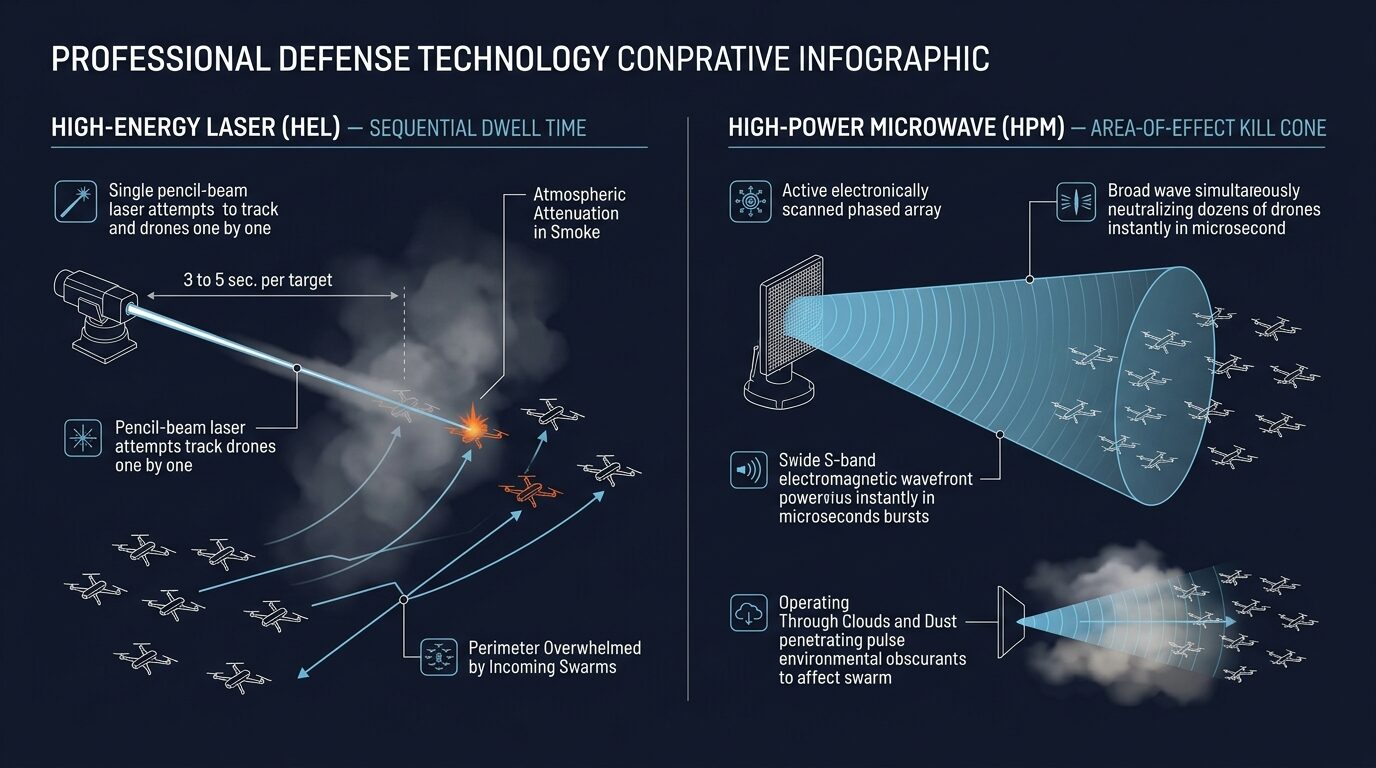
Figure 1: Comparative kill mechanics of High-Energy Lasers (HEL) versus High-Power Microwave (HPM) systems. Lasers suffer from sequential single-target lock queues and environmental beam scattering, whereas HPM arrays project a broad conical wavefront that destroys swarms simultaneously.
The Dwell-Time Bottleneck
A High-Energy Laser does not destroy an aerial target instantly upon contact. A laser weapon works by concentrating photons onto a tiny, diffraction-limited optical spot (typically 1.5 cm to 3 cm in diameter) to heat, melt, or ablate the target’s structural skin through pure thermal conduction:
Where P is laser output power, τ is steady-state optical lock duration, and η is material absorptivity coefficient.
Even with a high-end 50-kilowatt fiber laser, burning through a resin-reinforced carbon fiber airframe or melting an aluminum motor casing requires between 2.5 and 5.0 seconds of uninterrupted optical lock (τdwell) on the exact same surface coordinates. During this window, the laser’s gimbaled mirror beam director must track a high-agility quadcopter executing erratic 40G evasive maneuvers in three-dimensional space.
Consider a coordinated saturation attack: thirty commercially available FPV kamikaze drones approaching a command post at 120 km/h (33.3 m/s) from dispersed azimuths:
- At a maximum effective thermal engagement range of 1,200 meters, the defending laser system has approximately 36 seconds before the swarm impacts the perimeter.
- Allocating an optimistic 4 seconds per target (3 seconds dwell time + 1 second target re-acquisition and mirror realignment), a multi-million-dollar laser system can engage a maximum of 8 to 9 drones.
- The remaining 21 drones penetrate the defense shield entirely unscathed.
Atmospheric Bloom and Aerosol Extinction
Worse still, laser wavelengths operate within the optical and near-infrared spectra (typically 1.06 μm for ytterbium fiber lasers). These microscopic wavelengths are catastrophically vulnerable to atmospheric particulate matter. In dusty desert environments (such as Rajasthan or Ladakh), coastal sea-spray fog, or battlefield smoke screens generated by burning fuel and artillery aerosols, optical scattering coefficients skyrocket.
A 50 kW laser beam propagating through light battlefield smoke can experience up to 75% power extinction over 1,000 meters. The energy is dispersed into the atmosphere, causing “thermal blooming”—where heated air acts as a defocusing lens—preventing the beam from ever reaching the power density required to ablate drone composites.
2. The Physics of 3 kV/m: How Microwaves Shred Sub-Micron Silicon
High-Power Microwave weapons completely discard thermal ablation. An HPM system does not attempt to melt the physical shell of a drone; it treats the atmosphere as an electromagnetic waveguide and weaponizes the physics of semiconductor junctions.
DRDO’s SHIELD mandate explicitly specifies a peak electric field strength of ≥ 3.0 kV/m (3,000 Volts per meter) in the far field. To non-engineers, 3 kV/m sounds like an arbitrary military threshold. To a semiconductor verification engineer, 3 kV/m represents the guaranteed death of modern integrated circuits.
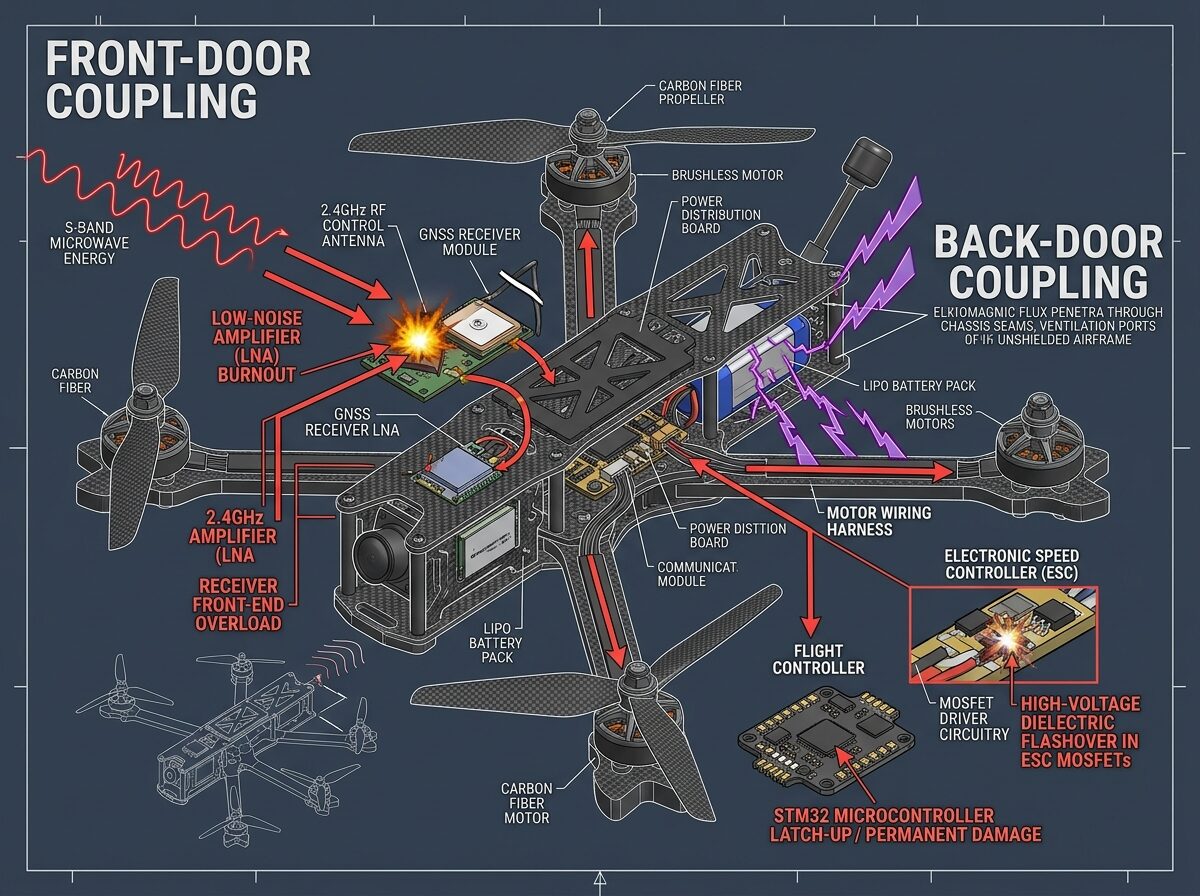
Figure 2: Technical cross-section illustrating Front-Door (antenna-impedance funneling) and Back-Door (aperture and harness resonance) microwave coupling into drone avionics.
The Semiconductor Breakdown Threshold
Commercial and military loitering munitions rely on off-the-shelf microcontrollers (such as STMicroelectronics STM32F4/F7/H7 processors based on ARM Cortex-M cores) to run their flight stabilization loops, inertial measurement unit (IMU) fusion algorithms, and motor telemetry.
These microprocessors are fabricated on sub-micron CMOS silicon nodes. In modern silicon, the silicon dioxide or hafnium-based gate dielectric separating the transistor gate from the conduction channel is measured in nanometers:
- Standard operating logic levels for these microcontrollers range between 0.8V, 1.8V, and 3.3V.
- The physical dielectric breakdown voltage (Vbr) of these microscopic gate oxides is typically between 8V and 15V.
- Any induced transient voltage spike that exceeds 15V causes irreversible dielectric puncture, forming permanent low-resistance conductive filament shorts across the gate, locking the processor in permanent hardware failure.
How does an electromagnetic wave in the air create a 100V spike inside a sealed silicon chip? Through two devastating physical mechanisms: Front-Door Coupling and Back-Door Coupling.
Front-Door Coupling: The Impedance Funnel
Every combat drone must transmit and receive radio frequency signals to communicate with satellite constellations (GPS/GLONASS/NavIC at 1.1–1.6 GHz) and ground control stations (ExpressLRS or proprietary telemetry at 2.4 GHz and 5.8 GHz).
Because DRDO’s SHIELD program operates specifically in the S-Band (2.0 GHz to 4.0 GHz), its emitted electromagnetic waves overlap perfectly with the resonant tuning of the drone’s external antennas. When an S-band microwave wavefront hits a drone, its tuned 2.4 GHz antenna does not reflect the pulse—it acts as an impedance-matched funnel, gathering the electromagnetic energy and dumping hundreds of volts directly down the coaxial lead into the receiver’s Low-Noise Amplifier (LNA) and RF front-end mixer.
The sensitive gallium-arsenide or silicon-germanium diodes inside the LNA, designed to detect microscopic signals measured in microvolts (μV), are instantly subjected to hundreds of watts of raw electrical power. The semiconductor junctions vaporize in less than 50 nanoseconds.
Back-Door Coupling: Parasitic Harness Resonators
Even if an adversary deploys a fiber-optic tethered drone or an autonomous edge-AI drone with zero external antennas, it remains defenseless against Back-Door Coupling.
Microwave radiation at S-band frequencies has wavelengths between 7.5 cm and 15 cm. These dimensions match the exact physical geometry of quadcopter internal structures:
- Carbon-fiber fuselage slots, battery ventilation holes, and camera lens apertures act as resonant cavity slots, allowing microwave flux to penetrate directly into the avionics bay.
- The copper motor power wires running through the drone’s four arms (typically 10 cm to 15 cm in length) act as half-wavelength dipole antennas.
- Under a 3 kV/m incident field, an unshielded 12 cm motor harness wire induces an internal peak voltage of:
A 360-volt transient surging backward into the Electronic Speed Controller (ESC) instantly blows through the gate insulation of the power MOSFET bridges. The brushless DC motors lose commutation timing, seize violently mid-air, and the drone enters a fatal ballistic flat-spin toward the terrain.
| DRONE SUBSYSTEM | CORE SILICON | OPERATING VOLTAGE | DIELECTRIC LIMIT (Vbr) | 3 kV/m FAILURE MODE |
|---|---|---|---|---|
| GNSS Receiver | MAX2769 / SiGe LNA | 1.8V – 2.8V | 5.0V – 7.0V | Thermal diode junction burnout; permanent loss of satellite positioning. |
| Flight Controller (MCU) | STM32H743 / ARM Cortex-M7 | 3.3V Core / 1.2V Logic | 12.0V – 15.0V | CMOS latch-up, flash memory corruption, CPU lockup, loss of stabilization. |
| Motor ESC Bridges | Infineon / N-Channel MOSFETs | 24V – 48V (Bus) | 60.0V (Vds) | Gate-oxide puncture from harness back-EMF spikes; motor phase short-circuit. |
| Edge AI Module | Nvidia Jetson Orin Nano / NPU | 0.8V – 1.1V Core | 3.5V – 5.0V | Memory bus cross-talk, tensor core halt, camera MIPI transceiver latch-up. |
3. The GaN Revolution: From Soviet Vacuum Tubes to Solid-State AESA
The concept of using microwave pulses to disable electronics is not new. During the late Cold War, Soviet defense scientists deployed systems like the Ranets-E, and US labs experimented with explosive-driven Flux Compression Generators (FCGs).
However, those early microwave weapons were massive, single-shot behemoths. They relied on vacuum-tube physics: Relativistic Magnetrons, Vircators (Virtual Cathode Oscillators), and high-voltage spark-gap switches. These systems suffered from catastrophic operational flaws:
- They required bulky liquid-nitrogen cryo-cooling and capacitor banks that weighed tens of tons.
- They could only fire one pulse every 20 to 45 seconds, making them entirely useless against high-speed sequential waves.
- Their vacuum tubes suffered from rapid electrode erosion and catastrophic thermal degradation after just a few dozen discharges.
The Solid-State Power Amplifier (SSPA) Breakthrough
The defining technological leap of DRDO’s SHIELD program is its mandate for Solid-State Power Amplifier (SSPA) technology powered by Gallium Nitride on Silicon Carbide (GaN-on-SiC) semiconductors.
Unlike legacy silicon LDMOS or vacuum klystrons, GaN semiconductors possess an ultra-wide electronic bandgap (3.4 eV vs 1.1 eV for silicon). This wide bandgap allows GaN transceivers to operate at significantly higher breakdown voltages, extreme temperatures (>225°C), and deliver power densities exceeding 8 to 10 Watts per millimeter of gate width at multi-gigahertz S-band frequencies.
Why GaN AESA Changes Directed Energy Warfare
Microsecond Pulse Repetition
GaN switches in nanoseconds, enabling pulse repetition rates of thousands of bursts per second (kHz PRF), maintaining a continuous microwave “wall” against incoming munitions.
Zero Mechanical Moving Parts
By assembling thousands of GaN transmit/receive modules into an Active Electronically Scanned Array (AESA), the beam is steered phase-electronically across azimuth and elevation in microseconds.
Software-Defined Beamforming
The array can instantaneously dynamically morph from a 45° wide-angle “floodlight” that knocks down 50 drones simultaneously to a knife-edge 2° pencil beam that snipes high-altitude reconnaissance UAVs.
4. Global Kill-Grid Comparison: Where DRDO SHIELD Stands
India’s SHIELD program joins an elite cohort of tier-1 defense projects racing to operationalize solid-state microwave weapons. The primary global benchmark in this domain is the US Army’s Epirus Leonidas, which was integrated into the Indirect Fire Protection Capability – High-Power Microwave (IFPC-HPM) program.
| SYSTEM | ORIGIN & DEVELOPER | RF ARCHITECTURE | TARGET ENGAGEMENT | MOBILITY CLASS |
|---|---|---|---|---|
| DRDO SHIELD | India (DRDO / TDF Consortium) | S-Band (≥3 kV/m Far-Field) GaN SSPA | Simultaneous Area-Effect Swarm Kill | Trailer / 8×8 Truck-Mounted Tactical |
| Epirus Leonidas | United States (Epirus / US Army) | Software-Defined S-Band GaN Phased Array | Multi-Target Conical / Single-Target Pencil | Stryker A1 8×8 Vehicle / Joint Base Pod |
| AFRL THOR | United States (Air Force Research Lab) | Magnetron / Cavity Resonator (Narrowband) | Base Perimeter Swarm Defense | 20-Foot ISO Shipping Container (Static) |
| China FK-3000 HPM | China (CASIC) | Combined HPM + Autocannon + SAM | Multi-Tier Air Defense Mesh | Heavy Armored 8×8 Wheeled Chassis |
5. Tactical Economics: Breaking the Attrition Curve
Beyond the raw electromagnetics, the fundamental argument for Project SHIELD is economic. Modern air defense is suffering an untenable cost-exchange asymmetry:
The Ruinous Math of Kinetic Interception
A military battery utilizing medium-range surface-to-air missiles (such as an Akash-NG or Barak-8) incurs an ammunition expenditure of approximately $150,000 to $450,000 per interceptor. In a saturation raid where an adversary deploys 40 suicide drones assembled for under $1,000 each ($40,000 total inventory), firing kinetic missiles results in a negative exchange ratio of nearly 200 to 1. Depleting high-end missile stocks to kill commercial plastic airframes exhausts national munitions reserves in days.
In contrast, an S-band GaN microwave system operating off a standard 150 kW diesel generator or vehicle power-takeoff consumes approximately 0.25 kilowatt-hours of electrical energy per high-power discharge burst. At tactical fuel generation rates, the marginal cost to project a 3 kV/m electromagnetic kill cone across an entire incoming drone formation is under $0.15 per engagement.
Furthermore, microwave directed energy removes the logistics footprint of ammunition resupply convoys. So long as the generator has diesel, or the base is tied to a hardened power grid, the system cannot be Winchestered (run out of ammo).
Related Investigations on Eyestech:
- Dr. Marcus Vance’s semiconductor analysis: Beyond CoWoS: Why Nvidia Killed the 4-Die Rubin Ultra and Scrambled a 17% Fan-Tax Air Rack.
- Local edge compute economics: The $999 Inference King: Can the 24GB M4 Pro Mac Mini Really Kill the RTX 4090 Homelab?
- Model compute efficiency: Calculate datacenter deployment costs with the Eyestech AI Coding Cost Calculator.
6. The Verdict: The Transition to Electronic Sovereignty
The launch of DRDO’s SHIELD program signals that India’s military planners have recognized the shifting geometry of future conflict. As autonomous loitering munitions become cheaper, faster, and immune to electronic radio jammers through on-device vision models, defense systems must transition from shooting down airframes to denying the electromagnetic viability of silicon itself.
By focusing on Gallium Nitride solid-state power amplification at S-band frequencies, SHIELD provides the technological foundation for mobile, vehicle-mounted, and base-defense directed-energy shields. The nation that controls high-power microwave phased arrays will not need to burn millions of dollars shooting at individual drones; it will simply flip a switch and watch adversary swarms fall like dead birds from the sky.