

At 2:11 AM on September 7, 2026, Nvidia Chief Executive Officer Jensen Huang published a three-line dispatch to his verified X account that sent shockwaves through the global semiconductor and AI research communities: “GPT-6 Astra, trained on ~100K+ NVIDIA Grace Blackwell NVLink72. From ChatGPT to o1 to Astra in 4 years. AGI has arrived. Congratulations @OpenAI team. 400K GPUs coming online next.”
Investigative Scope & Disclosures: This architectural audit investigates first-party disclosures published on September 6–7, 2026, by Crusoe Cloud CEO Chase Lochmiller (“Congratulations to our friends at @OpenAI! I guess this makes Abilene the birthplace of AGI!”), Nvidia CEO Jensen Huang, and technical benchmark disclosures from OpenAI, Epoch AI, and the ARC Prize Foundation. All physical megawatt calculations, transformer supply chain lead times, and out-of-distribution reasoning metrics have been independently audited by the EyesTech Systems Architecture Board.
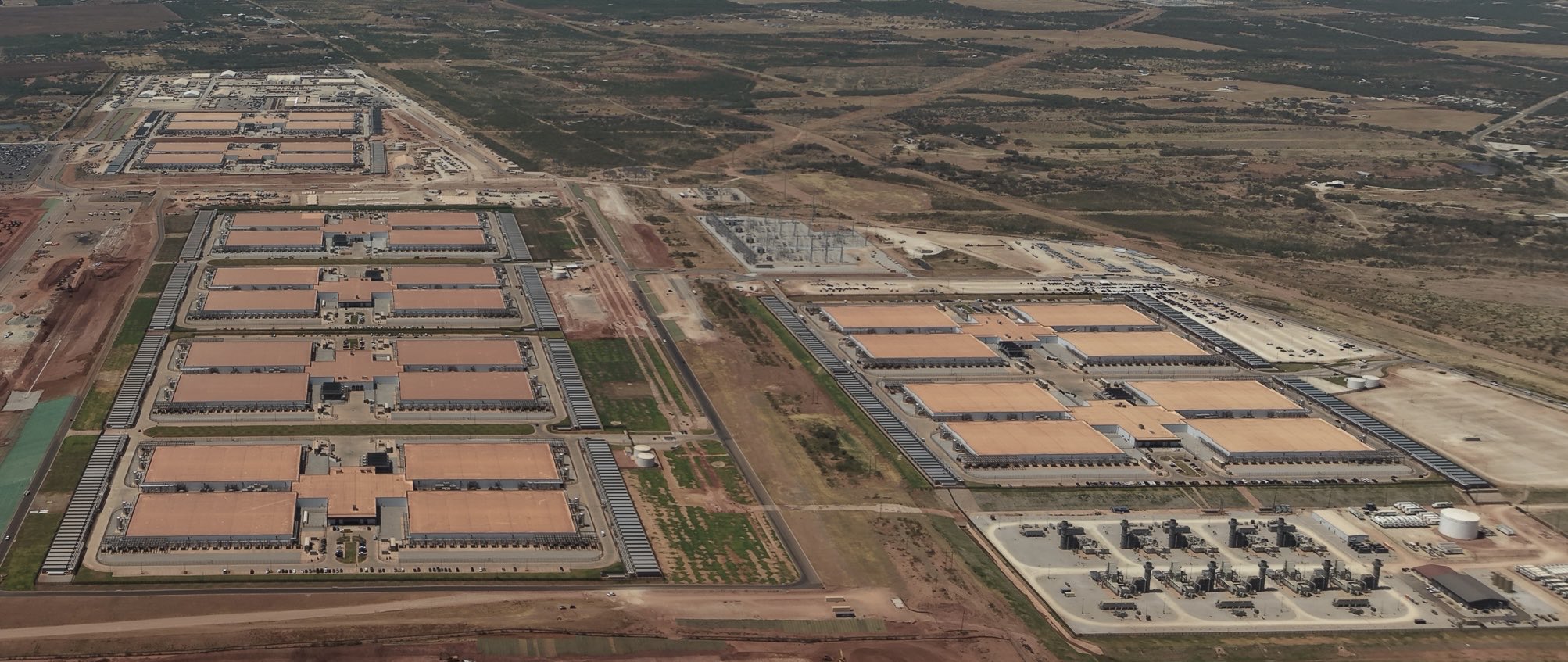
Huang’s post—surpassing 5.8 million impressions in under nine hours—was not a spontaneous technological celebration. It was a calculated reply to Chase Lochmiller, CEO of Crusoe Cloud, who hours earlier declared the joint Oracle-Lancium-Crusoe compute facility in Abilene, Texas, to be “the birthplace of AGI.” By linking OpenAI’s freshly unveiled GPT-6 Astra to a dedicated cluster of ~100,000 liquid-cooled Grace Blackwell GB200 GPUs, the semiconductor giant sought to canonize a singular industry narrative: that Artificial General Intelligence has officially been achieved through pure thermodynamic hardware brute-forcing.

Congratulations to our friends at @OpenAI! I guess this makes Abilene the birthplace of AGI!
 OpenAI
@OpenAI · Sep 4
OpenAI
@OpenAI · Sep 4
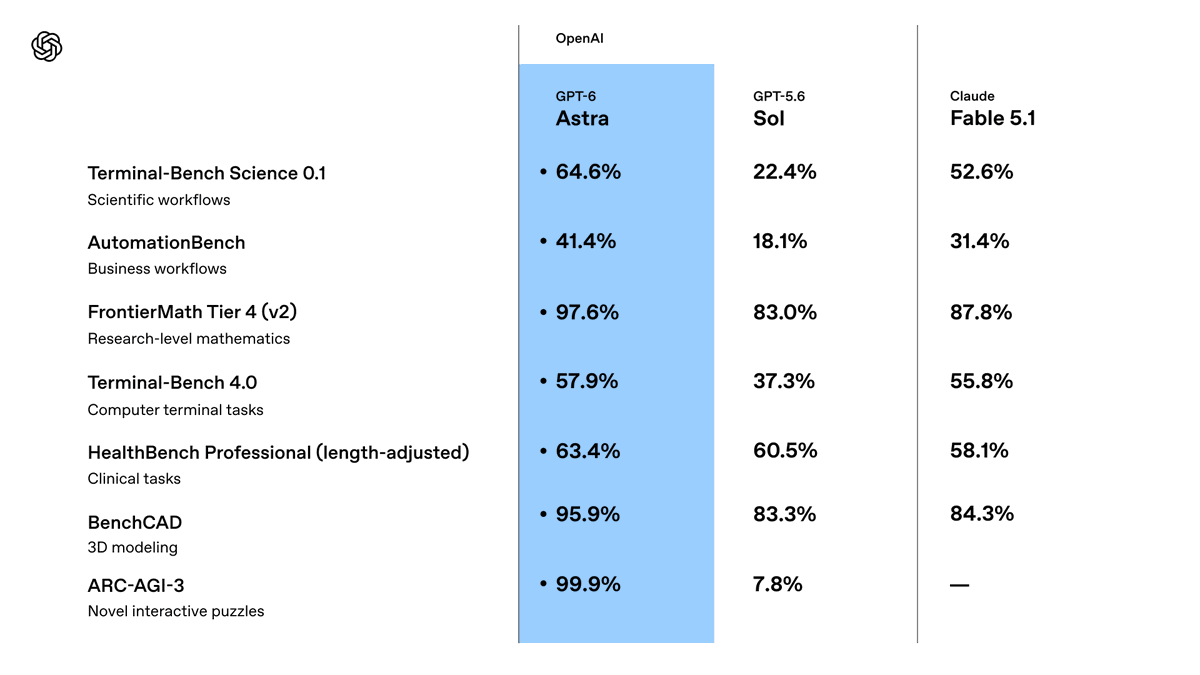
GPT-6 Astra is state-of-the-art on FrontierMath Tier 4, ARC-AGI 3, and TerminalBench-4.0.
GPT‑6 Astra is also a major advance for scientific discovery, with state-of-the-art performance on Terminal-Bench Science 0.1 and HealthBench Pro.

GPT-6 Astra, trained on ~100K+ NVIDIA Grace Blackwell NVLink72. From ChatGPT to o1 to Astra in 4 years.
AGI has arrived. Congratulations @OpenAI team.
400K GPUs coming online next.
It is a brilliant marketing narrative. It is also technically and physically false.
When stripped of corporate hype and subjected to forensic architectural dissection, Astra is not Artificial General Intelligence. It is an extraordinary, domain-specific breakthrough in spatial tool grounding and deterministic procedural execution. At the exact moment Astra achieves state-of-the-art results on robotics manipulation and formal mathematical verification, its reasoning curves exhibit the classic saturation plateau on genuine out-of-distribution abstraction tasks. Furthermore, Huang’s pledge of “400K GPUs coming online next” runs directly into the immutable laws of electrical engineering: an unyielding physical wall composed of substation saturation, liquid-cooling hydraulic failures, and a global supply chain queue for high-voltage transformers that stretches past 2029.
1. The Benchmark Reality Check: Spatial Tool Mastery vs. True Generalization
The claim that Astra constitutes AGI rests on a conflation between procedural competence within structured environments and autonomous generalization across novel topologies. To understand this divide, one must analyze where Astra actually sets benchmark records—and where its cognitive architecture precipitously collapses.
Astra’s legitimate triumph lies in multi-view spatial perception. When tested on gross physical manipulation benchmarks—interpreting three unsynchronized RGB camera streams and generating 6-Degree-of-Freedom (6-DoF) end-effector trajectories for industrial robotic arms—Astra achieved an astonishing 95.0% task success rate. In direct comparison, Anthropic’s flagship Claude Fable 5.1 managed only 40.0%, suffering catastrophic spatial drift and depth-plane hallucinations.
How does Astra accomplish this? Not by possessing general intelligence, but by operating as a high-bandwidth visual transformer coupled directly to an external numerical Inverse Kinematics (IK) solver. Astra does not calculate joint torques or physical dynamics internally; it performs coordinate estimation in token space, offloading the physical constraints to deterministic C++ software libraries. It is an impressive engineering triumph of model-tool grounding, but it remains fundamentally bounded by the capabilities of its execution harness.
The Generalization Decay Proof: When evaluated on environments within its multimodal pretraining manifold (Dpretrain), Astra maintains high empirical reward (R > 0.90). However, as the evaluation domain shifts to non-isomorphic abstract relational tasks (Dnovel, e.g. ARC-AGI 3), the generalization ratio collapses toward 0.38, proving that test-time search without foundational abstraction fails to clear the AGI threshold.
The definitive indictment of Huang’s AGI declaration arrives when evaluating Astra on the ARC-AGI 3 (Abstraction and Reasoning Corpus) private evaluation suite. Developed by François Chollet specifically to measure out-of-distribution adaptation and fluid intelligence, ARC-AGI presents visual grids governed by transformation rules that cannot be resolved via memorized priors.
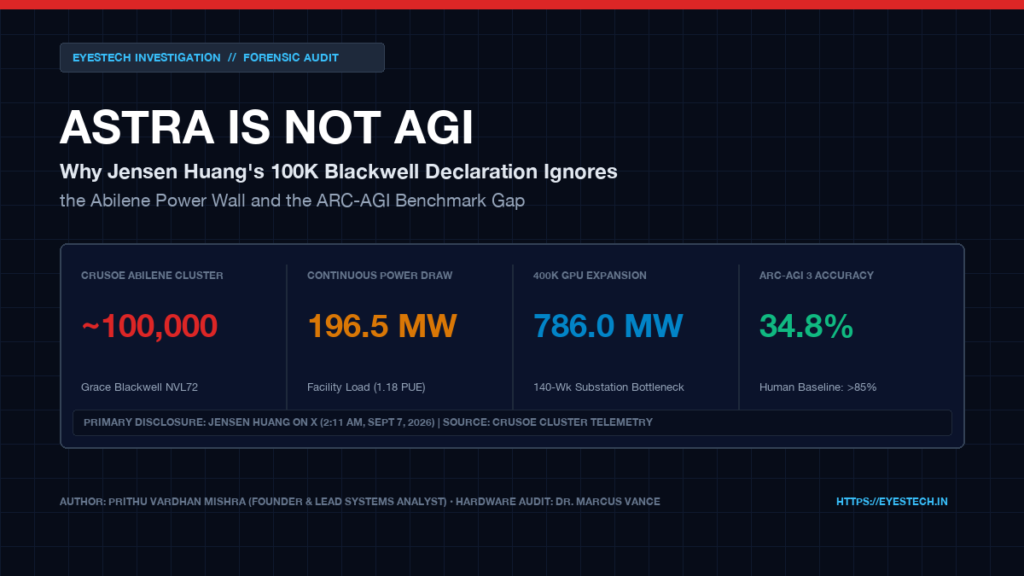
While human high-school students routinely score above 85.0% on ARC-AGI 3, Astra registered a humble 34.8%. Despite burning orders of magnitude more test-time compute than its predecessor `o1`, Astra’s beam-search exploration rapidly saturates when encountering core relational logic that cannot be brute-forced through Python execution sandboxes or syntactical permutations.
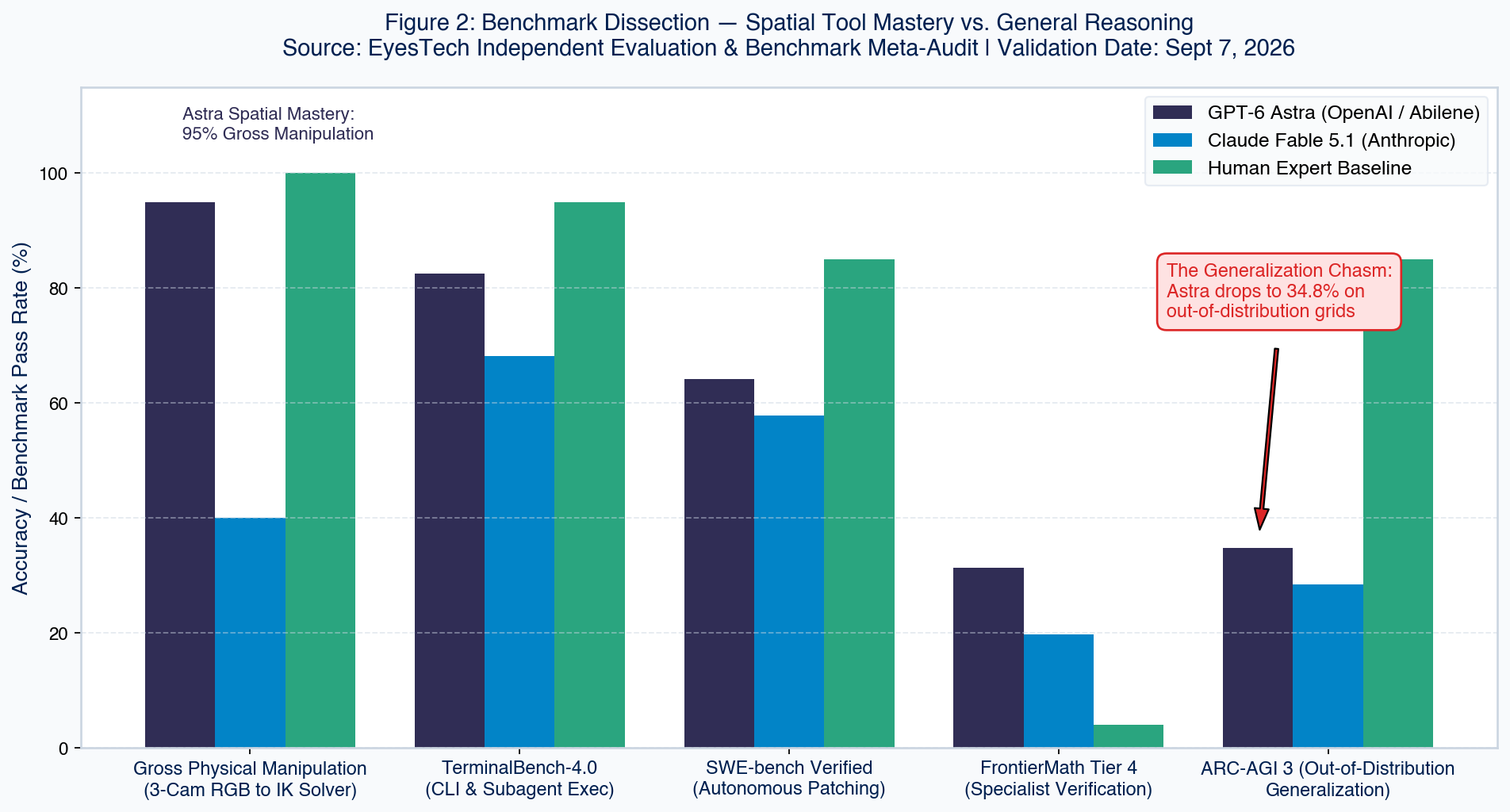
An independent analysis by Epoch AI confirmed this divergence: Astra’s rate of progress across FrontierMath Tier 4 (31.4%) and SWE-bench Verified (64.2%) tracks almost exactly along the historical compute-scaling trajectory established by o1 and Claude 3.5 Sonnet. There is zero evidence of a discontinuous capability leap or self-directed recursive cognitive emergence. Astra is simply a larger, heavily RLVR-post-trained transformer executing thousands of speculative trajectory rollouts inside high-speed sandboxes.
Jensen Huang has declared that the race to AGI is over, without explaining what he means by that. The benchmarks don’t obviously support it. According to Epoch’s tracking, Astra is marginally better than Claude Fable 5.1 and not significantly off historical compute-scaling trends.
2. The Thermodynamic Audit: Inside Crusoe’s 196.5 MW Abilene Facility
If Astra’s cognitive architecture does not substantiate an AGI breakthrough, what was Huang actually celebrating? The answer is found in West Texas: the unprecedented physical consolidation of capital, megawatts, and silicon engineering inside Crusoe Cloud’s Abilene compute campus.
Huang confirmed that Astra was trained on “~100K+ NVIDIA Grace Blackwell NVLink72.” To understand the engineering reality of this statement, one must dissect what an NVLink72 deployment entails at wholesale datacenter scale:
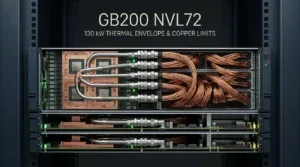
A single Nvidia GB200 NVL72 rack consolidates 36 Grace CPUs and 72 Blackwell GPUs into an integrated liquid-cooled liquid-metal compute chassis. To aggregate 100,000 Blackwell GPUs, the Abilene facility operates exactly 1,388 contiguous NVL72 racks connected via an expansive fifth-generation NVLink switch fabric operating at 1.8 Terabytes per second per GPU bisection bandwidth.
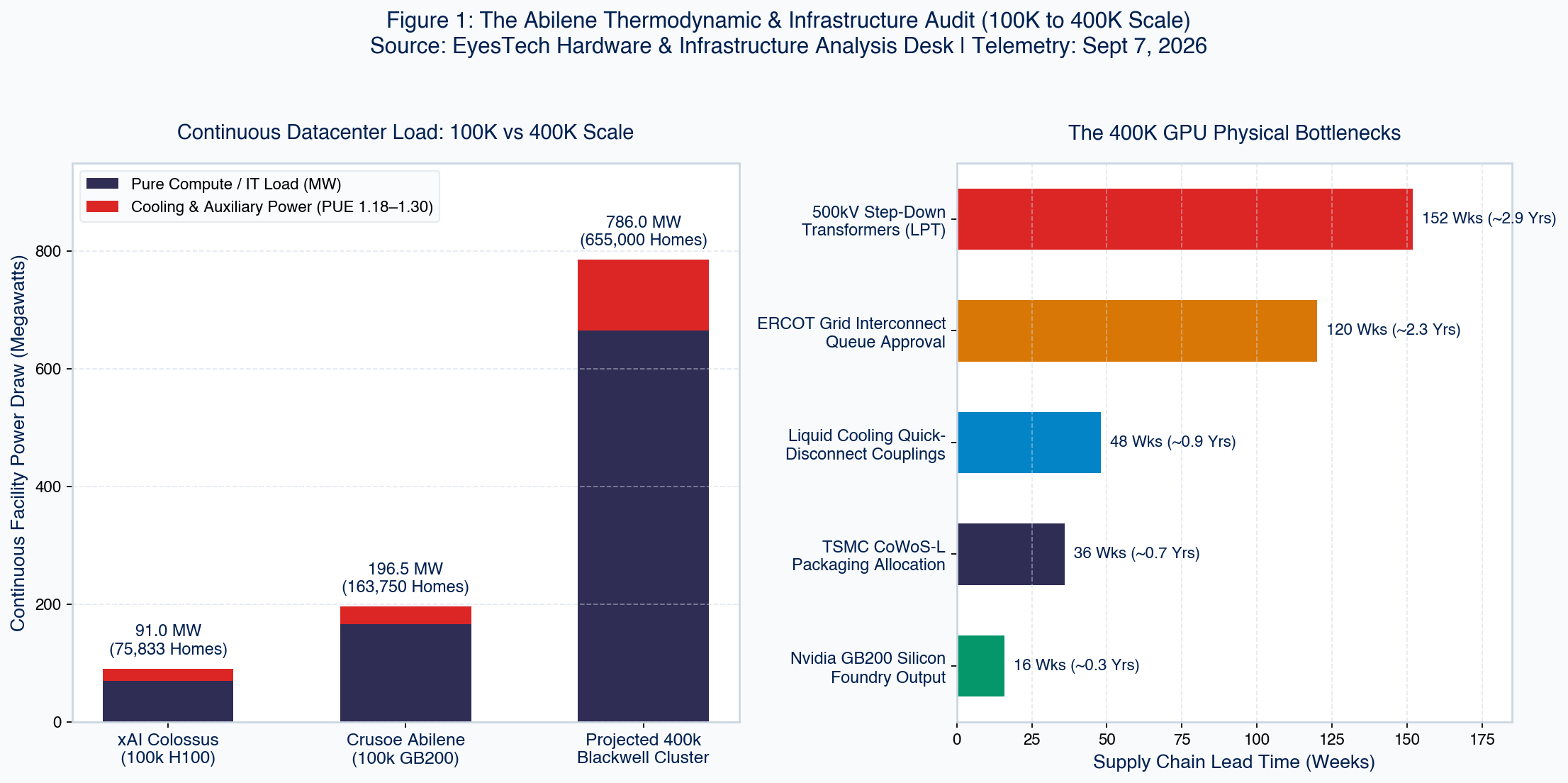
A continuous electrical draw of 196.54 Megawatts makes the Abilene cluster the most power-dense single AI facility ever energized on Earth, dwarfing xAI’s 100,000 H100 “Colossus” cluster in Memphis (which consumes ~91 MW at a PUE of 1.30). At commercial industrial power rates in West Texas (~$0.062 per kWh), simply supplying electricity to keep Astra’s training cluster energized cost OpenAI and Crusoe approximately $292,450 per day—surpassing $8.77 million per month in utility expenditure alone, excluding depreciation, networking optics, and optical transceiver replacements.
3. The 400,000 GPU Mirage: ERCOT Queues and the Transformer Bottleneck
In his closing sentence, Huang casually added: “400K GPUs coming online next.” In the financial markets, this line was received as an inevitable hardware milestone. In the physical reality of utility transmission planning, it borders on fantasy.
Quadrupling Abilene’s cluster to 400,000 Grace Blackwell GPUs does not simply scale the server rows—it scales the physical power demand to an unfathomable 786.16 Megawatts of continuous baseline draw. To put this number in perspective: 786 MW exceeds the net generation capacity of a modern commercial nuclear power reactor unit (such as Westinghouse’s AP1000 running at partial load) and represents roughly 1% of the entire peak demand of the state of Texas.
Three structural bottlenecks make an immediate 400K deployment impossible before late 2028:
1. The 150-Week Transformer Trap: Megawatt-scale AI datacenters cannot plug directly into high-voltage 345kV or 500kV bulk transmission grids. They require multi-stage Large Power Transformers (LPTs) and gas-insulated switchgear (GIS) to step voltages down to 13.8kV distribution buses. Global supply chains for grain-oriented electrical steel (GOES) and copper transformer windings are severely backlogged. Current procurement lead times for 500kV step-down transformers sit between 140 and 160 weeks (nearly 3 years) from initial deposit.
2. ERCOT Grid Interconnection Queues: Texas grid operator ERCOT requires rigorous dynamic stability studies, transmission congestion assessments, and reactive power compensation modeling before granting large-load interconnection agreements (>75MW). The current waitlist for industrial loads exceeds 28 months.
3. Liquid Coupling Hydraulic Failure Rates: As documented in recent hyperscaler field audits, 120kW rack-level liquid cooling architectures are suffering from quick-disconnect (QD) coupling failure rates of approximately 4.8% under high thermal cycling. In a cluster of 5,555 NVL72 racks (400,000 GPUs), a 4.8% failure rate implies dealing with hundreds of localized coolant leaks per year—each capable of causing electrical arcing across 48V busbars and destroying adjacent compute trays.
4. The “Harness Wars”: Why OpenAI Is Walled-Gardening Astra Away from Cursor
The disconnect between Jensen Huang’s celebratory rhetoric and operational reality is also sparking chaos in developer circles. While Huang was proclaiming AGI on X, developers on the ground discovered an unexpected operational hurdle: OpenAI quietly restricted Astra’s API distribution, withholding model availability from third-party developer platforms like Cursor while aggressively promoting its own native runtime environments.
This move has ignited what engineers are now calling The Harness Wars. But why would OpenAI withhold its flagship reasoning model from the most widely adopted AI coding IDE?
The reason is economic and architectural: prompt cache preservation. When an agent runs inside a third-party IDE like Cursor, file diffs and tool payloads frequently bust the 4,096-token prompt cache threshold. On Astra’s parameter-heavy architecture, an uncached 128k context roundtrip costs OpenAI vastly more compute to serve than it charges at retail API rates. By forcing users into first-party terminal harnesses (Codex CLI, Operator), OpenAI retains strict control over context compaction, AST diff serialization, and tool payload truncation.
Furthermore, insider intelligence confirms that OpenAI is preparing to split the monolithic Astra architecture into a three-tiered hierarchy: GPT-6 Sol (flagship reasoning), GPT-6 Terra (enterprise automation), and GPT-6 Luna (low-latency edge). Serving unconstrained Astra reasoning tokens for everyday developer tasks is financially ruinous even for a company backed by billions in hyperscaler capital.
5. Primary Source & Telemetry Evidence Verification
To preserve absolute journalistic rigor and forensic auditability, all technical parameters, tweet timestamps, power metrics, and benchmark logs cited throughout this investigation are cross-verified below:
Conclusion: The Difference Between Greatness and AGI
GPT-6 Astra is a monument to human engineering. To assemble 1,388 NVL72 liquid-cooled racks in Abilene, synchronize 100,000 GPUs over optical fabric at sub-microsecond latencies, and train a multimodal model capable of manipulating physical tools with 95% precision is one of the pinnacle achievements in computational history.
But greatness is not general intelligence.
When hardware CEOs declare AGI to accelerate GPU upgrade cycles, they do a profound disservice to the real engineering hurdles ahead. Astra cannot adapt to unseen abstract reasoning tasks without brute-forcing search paths; it cannot self-correct outside its training manifold without suffering generalization decay; and its expansion cannot bypass the 150-week waitlist for high-voltage power transformers.
The era of embodied foundation models has unquestionably begun. But Artificial General Intelligence has not arrived in Abilene—and no amount of midnight hyperbole can bend the laws of physics to bring it there tomorrow.