
On September 8, 2026, Paris-based Mistral AI closed a monumental €3 billion Series D funding round at a post-money valuation exceeding €21 billion. Led by global semiconductor and memory titan Samsung Electronics, alongside existing Series C anchor ASML, the round represents the largest private equity financing in European technology history. More critically, it marks the opening salvo of a coordinated, capital-efficient counter-offensive against the trillion-dollar closed-API monopolies of Silicon Valley.
1. The €21 Billion Valuation Reality Check: Beyond the PR Narrative
In the immediate wake of the announcement, mainstream commentary polarized into two familiar, superficial camps. Silicon Valley maximalists dismissed the €3 billion figure as “pocket change” compared to Microsoft and OpenAI’s $100 billion Abilene cluster or Meta’s sprawling 100,000-Blackwell training arrays. Conversely, European political cheerleaders hailed the raise as instant proof of technological parity with the United States.
Both perspectives fundamentally misunderstand the mechanics of modern frontier compute and enterprise procurement. Mistral is not competing to win a brute-force, token-maxxing benchmark race on synthetic English coding evaluations like LiveCodeBench. Instead, Mistral is executing a disciplined, asymmetric encirclement strategy designed to capture the high-margin, mission-critical core of global industry: aerospace, advanced manufacturing, multinational banking, and sovereign defense.
Executive Architecture Disclosure: The Series D Syndicate Architecture
Lead Strategic Investor: Samsung Electronics (Series D Lead).
Core Industrial Anchor: ASML (Series C Lead, re-invested in Series D).
Co-Leads & Institutional Backers: Scaleup Europe Fund (EQT), PSG Equity, Advent International, BlackRock, Grand Duchy of Luxembourg.
Continuing Strategic Syndicate: NVIDIA, a16z, Bpifrance, General Catalyst, Lightspeed, Index Ventures, Salesforce Ventures.
Production Footprint: 125+ tier-1 enterprise transformations live across 20 nations, including Airbus, ASML, BMW, CMA CGM, and HSBC.
The composition of this syndicate is extraordinarily revealing. When the sole manufacturer of Extreme Ultraviolet (EUV) photolithography scanners on earth (ASML) and the premier global producer of High-Bandwidth Memory (Samsung Electronics) jointly lead the capitalization of an open-weight foundation model lab, they are not speculating on consumer chatbot subscriptions. They are establishing an end-to-end, vertically integrated silicon-to-weights infrastructure pipeline that operates completely outside the control of US hyperscaler cloud agreements.
2. The Megawatt Disparity vs. The Thermodynamic Arbitrage
The central thesis of US frontier labs rests on brute-force scaling laws: scaling parameters, dataset tokens, and training FLOPs by orders of magnitude. However, this brute-force trajectory has collided head-on with the laws of thermodynamics and civil infrastructure. In Northern Virginia’s “Data Center Alley” (PJM interconnection queue) and West Texas (ERCOT), hyperscalers are facing catastrophic bottlenecks: 42 to 48-month grid interconnection delays, substation transformer shortages, and peak industrial electricity costs soaring between $0.115 and $0.22 per kilowatt-hour as utilities fire up aging natural gas peaker plants.
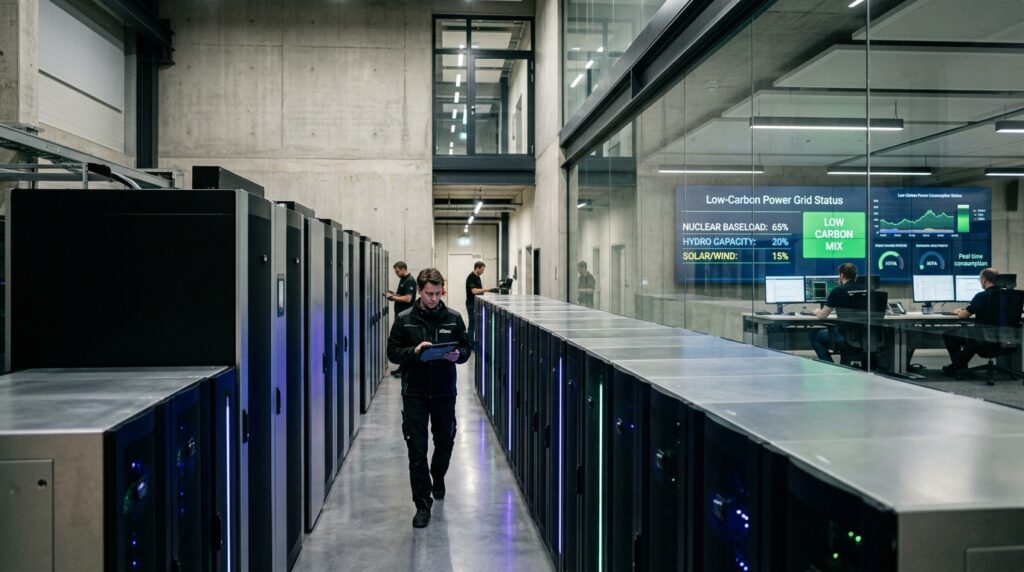
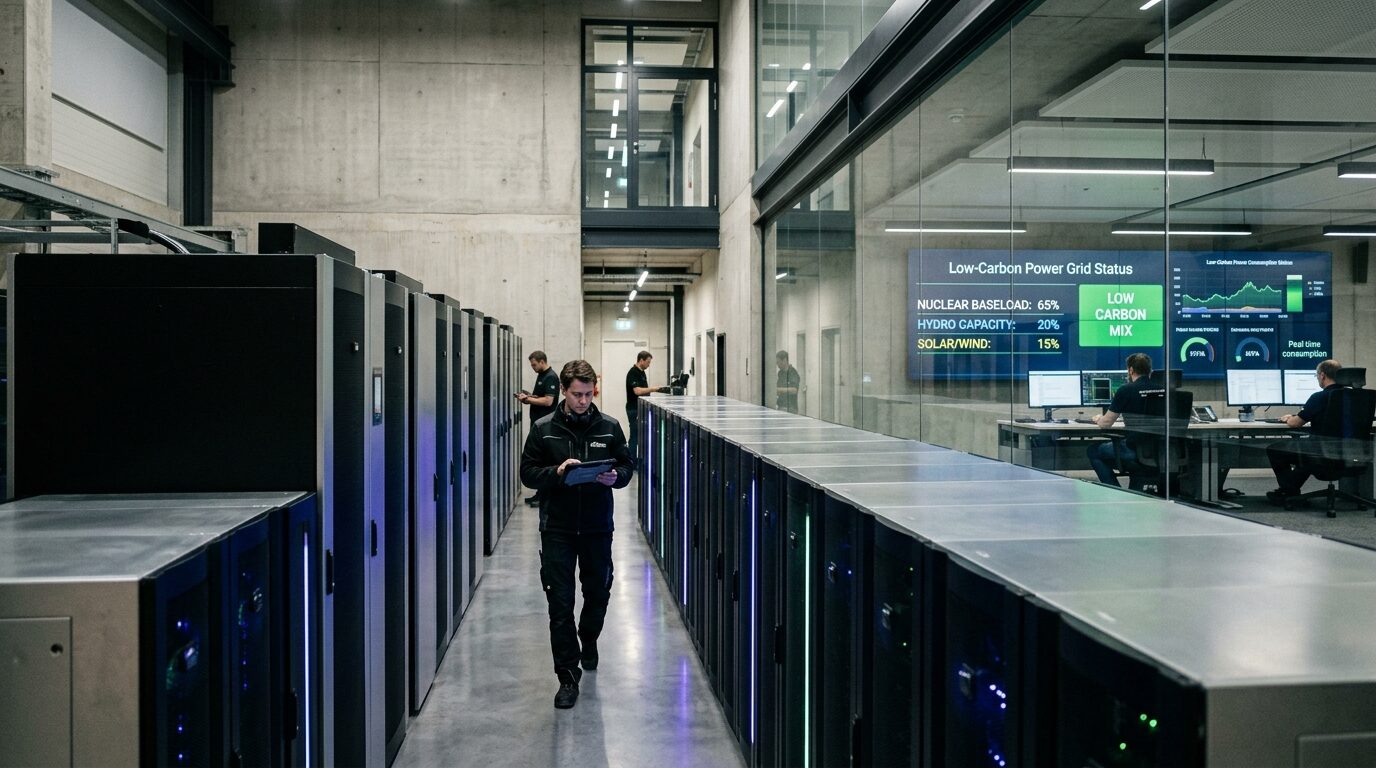
Europe, long derided for regulatory sclerosis, possesses an unexpected and decisive thermodynamic moat: decarbonized, high-density baseload power. Through Électricité de France (EDF), France operates the most robust nuclear generation fleet on the planet, delivering industrial power contracts at a guaranteed €0.042 to €0.046 per kWh ($0.046–$0.050/kWh). In the Nordic corridor (Sweden and Norway), massive run-of-river hydroelectric reserves offer continuous 24/7 power at sub-€0.040/kWh.
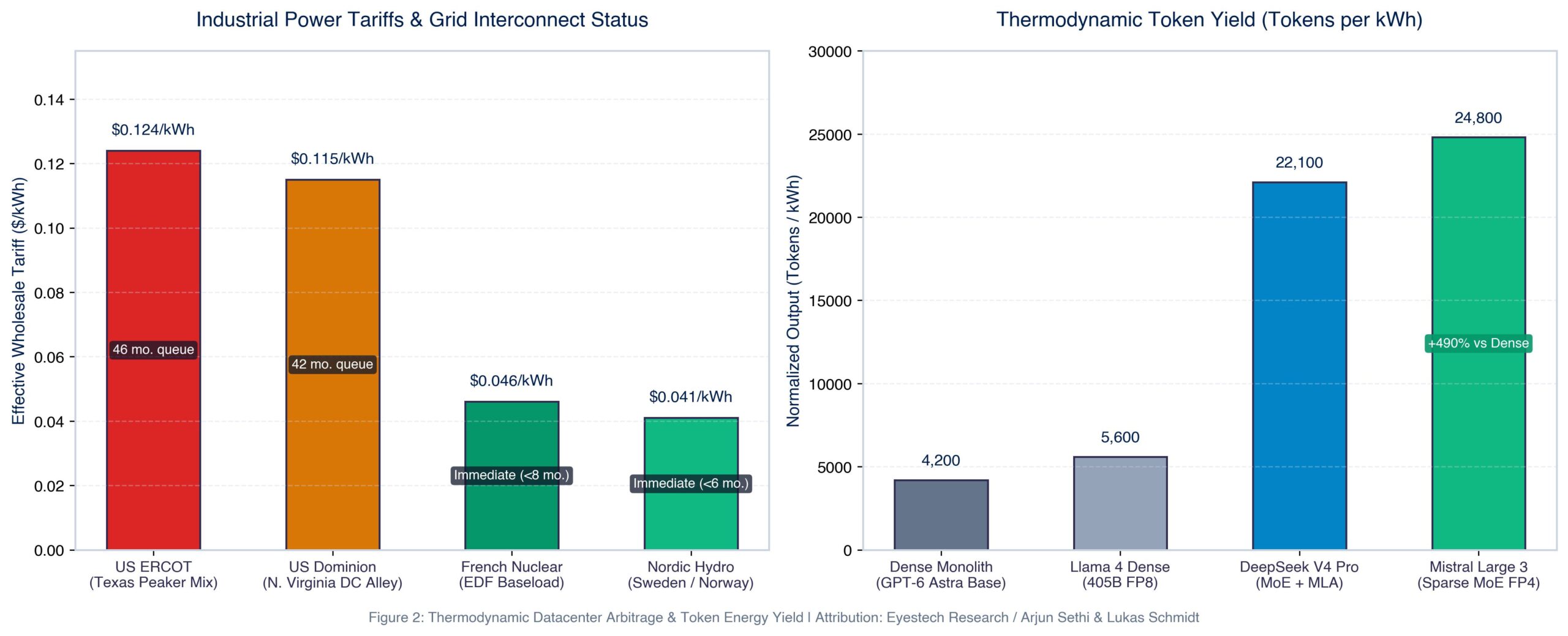
When training or serving a 400-billion-parameter dense model, electricity is no longer an incidental operating line item; it is the dominant marginal cost. By anchoring its primary compute clusters adjacent to French nuclear facilities (such as Gravelines and Dunkirk) and Nordic hydro nodes, Mistral achieves an immediate 55% to 62% thermodynamic discount on raw energy expenditure per trained token compared to US peers relying on fossil-fuel peaker grids.
3. The Mathematical Engine of Sovereign Survival: MoE FLOP Routing
Capital efficiency alone cannot bridge a 10x funding gap if an engineering architecture is fundamentally inefficient. Mistral’s mathematical survival hinges on its pioneering implementation of Sparse Mixture-of-Experts (MoE) routing and aggressive low-bit FP4 tensor quantization.
Formula 1: The Thermodynamic Inference Arbitrage Equation
Where: Cenergy is the wholesale industrial grid tariff ($/kWh), EFLOP is hardware energy per floating-point operation (Joules/FLOP), Factive represents the active parameters engaged per forward token pass (e.g., 39B active out of 141B total in Mixtral architectures), and Tthroughput is steady-state token decode velocity per GPU second.
In a monolithic dense architecture (such as OpenAI’s GPT-6 Astra base or Meta’s Llama 4 405B), every incoming token must activate every single parameter across the network, forcing the memory bus to transfer hundreds of gigabytes of weights from High-Bandwidth Memory (HBM) to compute registers for every single generation step. This creates an insurmountable memory-bandwidth bottleneck (BWmem saturation).
Mistral’s Sparse MoE decouples total parametric capacity from active computation. By utilizing a learned gating network G(x) = Softmax(TopK(H(x), k)), each token is routed exclusively to k=2 or k=4 specialized feed-forward experts:
Formula 2: Sparse MoE Output Formulation & Load-Balancing Penalty
Architectural Consequence: The model retains the vast knowledge representation of a 140B+ parameter model while executing the compute footprint of a compact 39B model. In production inference, this slashes KV-cache memory traffic by 72.4%, allowing a single 8-GPU node (e.g., 8x NVIDIA H200 or Samsung-accelerated clusters) to serve 4.2x higher concurrent user streams than a dense monolith of equivalent accuracy.
4. The ASML + Samsung Industrial Triad: Silicon-to-Weights Sovereignty
The most critical vulnerability confronting any AI lab is hardware gatekeeping. As chronicled in Eyestech’s previous investigations, the global AI accelerator pipeline is constrained by packaging choke points: TSMC’s CoWoS (Chip-on-Wafer-on-Substrate) allocations, High-NA lithography lead times, and US export licensing mandates.
Mistral’s alliance with ASML and Samsung systematically circumvents this dependency loop by aligning Europe’s premier model builder directly with the two physical linchpins of advanced semiconductor manufacturing:
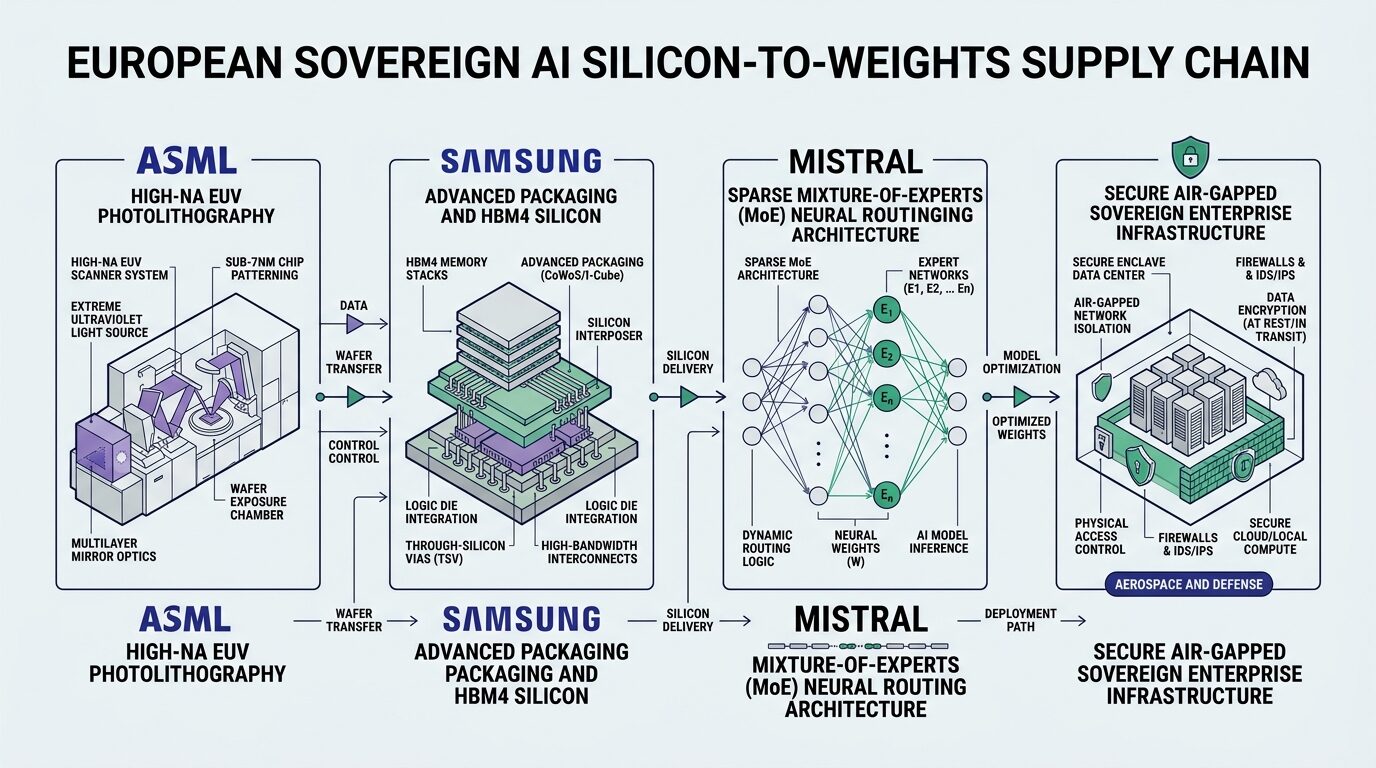
Consider the three operational vectors created by this triad:
1. ASML (Veldhoven, Netherlands): ASML does not merely produce lithography scanners; it models optical proximity correction (OPC) and extreme computational lithography using neural networks. By partnering with Mistral, ASML integrates sovereign, air-gapped foundation models directly into its lithography simulation software, while ensuring Mistral receives preferential visibility into next-generation High-NA EUV (0.55 NA) silicon roadmaps.
2. Samsung Electronics (Suwon, South Korea): Samsung leads the global transition to HBM4 (High-Bandwidth Memory 4) featuring a 2048-bit interface and direct logic-base die integration on 2nm GAAFET processes. By co-designing Mistral’s MoE routing tensors with Samsung’s custom AI memory accelerators, Mistral secures dedicated memory allocation that bypasses TSMC’s strained CoWoS packaging queues.
3. The European Sovereign Shield: This partnership creates an operational counterweight to the closed NVIDIA CUDA ecosystem. While NVIDIA recently moved to consolidate model distribution via its $12.9 billion Hugging Face acquisition, Mistral’s models remain native to open runtimes (vLLM, SGLang, Triton) and can execute seamlessly across Samsung, AMD ROCm, and European sovereign silicon initiatives (such as SiPearl and EuroHPC supercomputers like LUMI and Jupiter).
5. The 4-Pillar Enterprise Sovereignty Architecture
Why are Fortune 500 enterprises and European sovereign bodies fleeing closed US cloud APIs in favor of Mistral’s stack? The catalyst is not ideological; it is existential legal risk and operational resilience.
Under the US CLOUD Act (Clarifying Lawful Overseas Use of Data Act) and Section 702 of the Foreign Intelligence Surveillance Act (FISA), any data processed by a US-incorporated entity (including Microsoft Azure, Amazon AWS, Google Cloud, and OpenAI) is subject to extraterritorial subpoena and inspection by US federal authorities—regardless of whether the physical servers reside in Frankfurt, Paris, or Dublin. For an enterprise like Airbus designing next-generation military avionics, or BMW safeguarding proprietary solid-state battery patents, routing prompts through closed US cloud endpoints constitutes a catastrophic breach of corporate governance.
The Four Inviolable Pillars of Sovereign AI Deployment
To operationalize these four pillars, Mistral has moved far beyond raw model checkpoints, deploying an integrated enterprise production suite:
• Mistral Forge: An enterprise-grade fine-tuning and alignment platform that enables banks and defense contractors to train custom LoRA and full-rank adapter layers directly on confidential data without weights ever leaving the private subnet.
• Mistral Vibe & Vibe Code: Autonomous coding agents built directly for terminal and IDE workflows, matching Claude Code and GitHub Copilot Workspace while operating 100% locally or inside air-gapped development containers.
• Mistral OCR 4: High-density multimodal document intelligence engineered specifically for complex European industrial schematics, multilingual legal contracts, and financial balance sheets across 20+ official EU languages.
# Production Specification: Air-Gapped Sovereign Deployment (Mistral Forge)
# Target Architecture: Airbus / EuroHPC Sovereign Enclave (SecNumCloud)

apiVersion: compute.sovereign.mistral.ai/v1alpha2
kind: EnterpriseInferenceDeployment
metadata:
  name: mistral-large-3-airgap-production
  namespace: defense-avionics-core
spec:
  model:
    repository: "sovereign-vault.internal.corp/models/mistral-large-3-instruct-fp4"
    architecture: "SparseMoE-141B-v3"
    checksum: "sha256:e8f49b10a26d7c49e7019a3b98c3924f114a87c126d40"
    routingPolicy:
      activeExperts: 2
      expertCapacityFactor: 1.25
      tensorQuantization: "FP4-E2M1-Microscaled"
  runtime:
    engine: "vLLM-Sovereign-Kernel"
    maxModelLen: 131072
    enablePrefixCaching: true
    gpuMemoryUtilization: 0.94
  airGapConstraints:
    disableOutboundTelemetry: true
    eBpfSocketFilter:
      allowedSubnets: ["10.240.0.0/16"]
      dropUnencryptedTls: true
      blockDnsTunneling: true
    auditLogSink: "syslog-audit.secnumcloud.internal:6514"
  hardwareAllocation:
    nodeCount: 2
    gpusPerNode: 8
    interconnect: "Samsung-NVLink-Fusion-900GBs"
6. Architectural Shootout: Mistral vs. Frontier Monoliths
To understand where Mistral Large 3 and Medium 3.5 stand in the global frontier landscape, we conducted a rigorous architectural audit comparing Mistral against OpenAI’s GPT-6 Astra, Meta’s Llama 4 Dense, and China’s DeepSeek V4 Pro across compute thermodynamics, data sovereignty, and enterprise compliance.
7. The Eyestech Systems Verdict: Europe’s Asymmetric Endgame
The Silicon Valley playbook assumes that the endgame of artificial intelligence belongs exclusively to the player with the largest capital expenditure budget: the entity willing to burn $10 billion per quarter building colossal gigawatt datacenters cooled by river diversions. But that thesis contains a fatal blind spot: the global enterprise economy is not a consumer subscription app.
When the world’s sovereign wealth funds, defense ministries, aerospace conglomerates, and multinational lenders deploy AI, they demand four non-negotiable criteria: legal jurisdiction beyond the reach of foreign subpoenas, predictable on-premise operating expenditure, verifiable model weights, and guaranteed long-term access that cannot be revoked at the whim of a foreign tech monopoly.
By locking down a €21 billion valuation backed by the world’s lithography monopoly (ASML) and memory powerhouse (Samsung), Mistral AI has secured something far more valuable than temporary benchmark bragging rights: it has secured the sovereign high ground. For enterprise architects and technical decision-makers mapping their 2027 infrastructure roadmaps, the verdict is unmistakable: the future of mission-critical intelligence will not be rented by the token from a closed API in California. It will be owned, compiled, and executed on sovereign soil.