
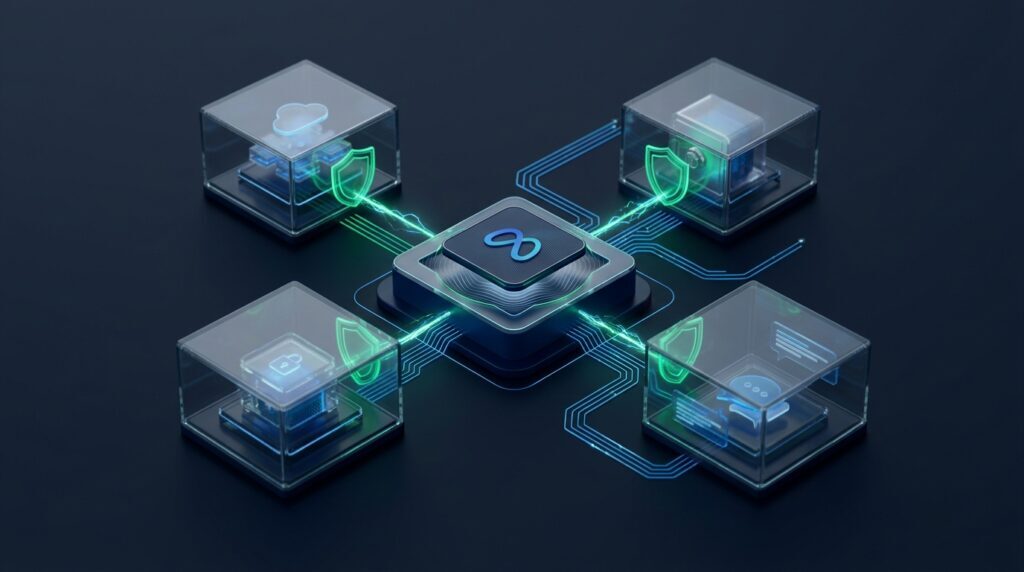

On September 8–9, 2026, Meta officially launched Muse, marking an aggressive industry departure from passive conversational chatbots toward asynchronous, long-horizon task execution. Built by the consolidated Meta Superintelligence Labs (MSL) under Chief AI Officer Alexandr Wang and Nat Friedman, Muse represents two monumental inflections: the tactical closure of Meta’s frontier model weights (keeping Muse Spark 1.3 proprietary), and the deployment of an OS-level defense-in-depth harness—the Hatch daemon, systemd-nspawn container cells, and an out-of-band Sentinel eBPF watchdog—engineered to neutralize the “Lethal Trifecta” of agentic prompt injection. Leveraging direct integration across 2 billion WhatsApp users, Meta has opened a new front in the AI platform war.
1. The Transition: From Narration to Autonomous Web Action
For three years, consumer artificial intelligence has remained stranded in a conversational cul-de-sac. Users queried frontier large language models, received articulate paragraphs detailing how a complex workflow could be accomplished, and were then forced to manually open a dozen browser tabs to execute the advice themselves. If an engineer asked an LLM to plan a multi-city travel itinerary, the model hallucinated flight numbers; it did not compare real-time seat inventories, redeem airline credits, hold a boutique hotel room on a credit card, or resolve calendar collisions across an enterprise inbox.
On September 8, 2026, Mark Zuckerberg announced the public rollout of Muse, Meta’s autonomous personal agent platform. Positioning the release as Meta’s inaugural milestone toward “Personal Superintelligence,” Zuckerberg framed Muse not as an advisory chatbot, but as an always-on digital executive officer operating continuously in the background.
[Traditional Conversational Paradigm]
User Prompt ──► LLM Inference ──► Text Output (Passive Advice) ──► User Executes Manually

[The Muse Agentic Paradigm]
User Prompt (WhatsApp/App) ──► MSL Cloud Planner ──► Dedicated Cloud Linux VM (Hatch)
                                                            │
                                        ┌───────────────────┴───────────────────┐
                                        ▼                                       ▼
                              Headless Chromium Browser              API Connectors (Gmail/Cal)
                              (eBPF Tainted Egress Guard)           (Privsep Token Surrogation)
                                        │                                       │
                                        └───────────────────┬───────────────────┘
                                                            ▼
                                              Autonomous Web Action (24/7)
                                                            │
                                            [Sentinel High-Risk Gate?]
                                             ├── Yes ──► Biometric HITL Approval
                                             └── No  ──► Task Resolved in Background
Early production traces emerging across social channels demonstrate the practical reality of this execution model. Early tester Marshall Haas (@marshal) shared verified workflows where Muse operated across external websites autonomously: it traversed municipal utility portals to clear outstanding invoices, navigated third-party floral storefronts to buy get-well arrangements using virtual payment credentials, and reserved dining reservations through OpenTable interfaces.
While critics immediately ignited a philosophical debate—arguing that delegating personal gestures to autonomous software “stops us being human”—systems architects recognized the technical milestone: the agent parsed dynamic, unstructured DOM trees without crashing, leaking authentication cookies, or triggering anti-bot bot-detection firewalls.
2. The Cognitive Core: Muse Spark 1.3 and the Closed-Weights Schism
The cognitive engine behind Muse is Muse Spark 1.3, deployed on September 2, 2026, by the newly consolidated Meta Superintelligence Labs (MSL). Formed in mid-2025 by consolidating Fundamental AI Research (FAIR), core LLM pre-training infrastructure, and applied product engineering, MSL is led by Chief AI Officer Alexandr Wang (founder of Scale AI) alongside Nat Friedman (former CEO of GitHub).
The release of Muse Spark crystallizes the end of Meta’s pure open-source evangelism. Following the muted commercial performance of Llama 4 against OpenAI and Google reasoning models in late 2025, Meta restructured its model release cadence into a hybrid “straddle” strategy:
1. The Proprietary Cloud Tier: Muse Spark 1.3 is strictly closed-source. Its weights remain locked inside Meta datacenters, accessible only via the Meta Model API and consumer apps.
2. The Edge Open-Weight Flank: To prevent the developer exodus to open-weight models from DeepSeek and Qwen, Meta deployed Muse Glimmer—a 30-billion-parameter open-weight model optimized for local consumer silicon—while promising delayed open releases of older checkpoints.
| Benchmark / Metric | Muse Spark 1.3 Score | Industry Baseline | Architectural Significance |
|---|---|---|---|
| DeepSWE (Autonomous SWE) | 75.4% | 65.2% (Frontier Baseline) | Multi-file Git repository navigation, bug localization, and automated regression testing. |
| Tool-Call Volume Efficiency | −20% Tool Calls | Baseline (Muse Spark 1.2) | Eliminates redundant exploratory polling, directly compressing runtime latency. |
| Inference Token Consumption | −25% Tokens Consumed | Baseline (Muse Spark 1.2) | Dramatically lowers inference GPU thermodynamics during long-horizon loops. |
| Active Context Window | 1,000,000 Tokens (1M) | 128k – 200k (Typical) | Ingests thousands of scraped accessibility nodes, full email archives, and terms of service. |
3. Systems Anatomy: The Hatch Daemon and Systemd-Nspawn Cells
The fatal failure mode of early agentic systems (such as AutoGPT or local shell wrappers) was execution locus: running an untrusted, probabilistic neural network with elevated permissions on a user’s physical hardware. A single adversarial injection on a malicious website could execute destructive filesystem operations or exfiltrate private SSH keys.
As documented in Meta AI Research’s architectural paper authored by Tarek Sheasha (VP of Engineering at MSL), Muse rejects local execution entirely. Every active user is provisioned a dedicated, isolated cloud container known as the Muse Secure VM.
┌─────────────────────────────────────────────────────────────────────────────────┐
│                           MUSE SECURE VM (LINUX KVM)                            │
│                                                                                 │
│   HOST ENVIRONMENT (Privileged Security Domain)                                 │
│   ├── hatch-safety     (Out-of-band classifier inspecting inference streams)    │
│   ├── hatch-authd      (Credential store & surrogate token minter)               │
│   ├── privsep workers  (Sandboxed systemd units executing connector logic)       │
│   └── SENTINEL         (eBPF Layer-4/7 Firewall & Human-in-the-Loop Authority)  │
│                                │                                                │
│         Unix Domain Sockets    │ eBPF Network Interception & Taint Tracking      │
│         (SO_PEERCRED ACLs)     │                                                │
│                                ▼                                                │
│   ┌─────────────────────────────────────────────────────────────────────────┐   │
│   │ RUNTIME CELL (systemd-nspawn Container)                                 │   │
│   │                                                                         │   │
│   │  • Core Daemon: Hatch (Agentic harness & tool orchestrator)             │   │
│   │  • Unprivileged Root: Mapped to unprivileged host UID (UID != 0)         │   │
│   │  • Blocked Syscalls: No io_uring, no CAP_SYS_PTRACE, no CAP_NET_ADMIN  │   │
│   │  • Browser Agent: Headless Chromium via A11y Tree Broker (No Raw DOM)   │   │
│   │  • Workspace: Ephemeral scratch filesystem & code compiler               │   │
│   └─────────────────────────────────────────────────────────────────────────┘   │
└─────────────────────────────────────────────────────────────────────────────────┘
                                         │
                                         ▼ Network Egress
                                  [ THE OPEN WEB ]
The virtual machine is partitioned into two mutually suspicious security domains:
1. The Runtime Cell (systemd-nspawn): The core agent daemon, codenamed Hatch, runs within a containerized Debian image. Root inside the container is mapped to an unprivileged host UID via Linux user namespaces (userns). Crucially, high-risk kernel interfaces are blocked at the seccomp layer: io_uring (a common vector for zero-day privilege escalations) is disabled, alongside CAP_SYS_PTRACE (preventing process memory inspection) and CAP_NET_ADMIN (preventing network routing tampering).
2. The Host Safety Plane: Out-of-band systemd units manage security boundaries. hatch-authd securely stores OAuth tokens locally in the VM (never in centralized Meta databases). privsep background workers execute connector logic outside the runtime cell. Inter-process communication occurs strictly over Unix domain sockets validated with kernel-level SO_PEERCRED credentials.
4. Neutralizing the “Lethal Trifecta”: Sentinel, eBPF, and Tainted Egress
In June 2025, security researcher Simon Willison coined the term “The Lethal Trifecta” to define the prerequisite conditions for catastrophic agentic exploitation:
Forensic Vulnerability: When an agent combines access to private personal data (Dprivate), exposure to untrusted web content (Cuntrusted), and an unconstrained outbound network egress channel (Eegress), prompt injection can systematically coerce the model into exfiltrating private records to an attacker endpoint.
Meta’s counter-architecture is Sentinel, an out-of-band supervisory agent that governs all network egress and third-party connector invocations:
1. Kernel-Level “Tainted Egress” Tracking: To prevent user alert fatigue while safeguarding against exfiltration, Muse utilizes eBPF attached to Linux Security Module (LSM) hooks. Processes begin in a clean state. The moment a tool reads private user records (such as emails or calendar entries), the kernel flags the cgroup as tainted. Tainted processes immediately forfeit network auto-allow permissions; any subsequent HTTP egress freezes until Sentinel issues a biometric Human-in-the-Loop (HITL) prompt.
2. Zero-Knowledge Credential Surrogation: When Muse interacts with authenticated services, hatch-authd mints a synthetic surrogate token. The model context only ever sees this surrogate string. When the outbound HTTP request hits the VM network boundary, Sentinel validates the destination URL, method, and decoded payload. Only after validation does Sentinel swap the surrogate for the genuine credential at the network wire. Prompt injection attacks attempting to force the model to print its API keys produce useless surrogate tokens.
5. The Headless Web: Accessibility Trees Over Raw DOM
Conventional browser agents parse raw HTML and CSS stylesheets, leaving them acutely vulnerable to DOM poisoning (e.g., invisible text nodes containing adversarial instructions or clickjacking buttons). Meta’s browser broker isolates Chromium via three architectural constraints:
Accessibility Tree Snapshots: The browser agent does not view raw DOM. Instead, it reads a sanitized accessibility tree (a11y) snapshot—the structured semantic format utilized by screen readers. Malicious styling tricks (like zero-opacity text or CSS-based prompt injection) are stripped entirely.
Execution Quarantine: The agent has zero permission to execute arbitrary in-page JavaScript. Chrome DevTools Protocol access is restricted to an external broker, preventing the model from hijacking browser sessions.
The Anti-Account-Takeover Filter: Because primary email inboxes hold account recovery keys, Muse’s email connector integrates deterministic regex filters and dedicated classifier models that automatically redact and quarantine One-Time Passwords (OTPs), 2FA codes, magic links, and password-reset URLs before text enters the prompt context.
Single-Use Virtual Cards: E-commerce checkouts are powered by Stripe Link (with Shop Pay scheduled for Q4 2026). Muse generates an ephemeral single-use card number bound specifically to the merchant, the exact dollar total, and an expiring time window. Even if captured by an adversarial storefront, the credentials cannot be reused.
6. The Competitive Matrix: Meta Muse vs. Grok 4.6 vs. Gemini Spark
The agent landscape has consolidated around three competing paradigms, each targeting distinct technical and commercial moats:
| Architectural Dimension | Meta Muse (Muse Spark 1.3) | xAI Grok Bot (Grok 4.6) | Google Gemini Spark (Gemini 3.8) |
|---|---|---|---|
| Primary Focus | Lifestyle administration, cross-web bookings, bill settlement, and personal coordination. | Frontier software development, codebase refactoring, and real-time news synthesis. | Productivity and automation inside Google Workspace (Docs, Sheets, Drive, Android). |
| Execution Architecture | Dedicated Cloud Linux VM (systemd-nspawn container + Chromium). | Client-side IDE (Cursor, Copilot, Terminal). No consumer cloud VM. | Google Cloud multi-tenant serverless infrastructure. |
| Security & Sandboxing | Sentinel watchdog + eBPF kernel data taint tracking + zero-knowledge vault. | Standard API safety layers; user manages local terminal privileges. | Google IAM, enterprise OAuth scopes, and Google Safe Browsing. |
| Distribution Moat | WhatsApp (2B+ users), iOS/Android apps, muse.ai, Ray-Ban Meta glasses. | X platform integration, xAI API, developer IDE plugins, Tesla OS. | Android native OS, Chrome browser extension, Google Workspace sidebar. |
| Pricing Model | Free (100M tokens/wk) • Power ($20/mo) • Max ($100/mo). | Included in X Premium+ ($16/mo) / Usage-based API pricing. | Bundled with Google One AI Premium ($19.99/mo). |
7. Inference Economics: The 100-Million-Token Subsidy
To accelerate mainstream adoption, Meta has introduced an extraordinary compute subsidy: up to 100 million tokens per week completely free of charge for US adults.
The monetization structure scales across three tiers:
Free Tier ($0/month): Standard execution queues across WhatsApp, iOS, Android, and web. Supports daily web navigation, calendar management, and basic transaction flows.
Power Tier ($20/month): Prioritized VM warm-pools (eliminating spin-up latency), higher token throughput, and parallel browser execution threads.
Maximum Tier (Up to $100/month): Grants unconstrained access to Muse Spark Max (deep reasoning mode), multi-agent subagent swarms, persistent background crons, and the capability to compile code and host micro-tools inside the user’s dedicated VM.
By leveraging its internal MTIA (Meta Training and Inference Accelerator) custom silicon, private global fiber networks, and advertising cash flows, Meta is executing a thermodynamic price squeeze. By pricing agentic inference far below cloud hosting cost, Meta aims to starve venture-backed agent startups before they establish distribution moats.
8. The Trust Paradox & The Confidential VM Horizon
Despite its defense-in-depth engineering, Muse faces a profound societal challenge: can consumers trust an advertising conglomerate with the intimate keys to their digital lives?
In response to regulatory scrutiny under the EU AI Act and public skepticism regarding data harvesting, Meta has enacted three defensive policies:
Ad System Quarantine: Meta contractually guarantees that VM storage, private files, and conversation trajectories are strictly quarantined from its advertising bidding engines.
Public $300,000 Bug Bounty: Opening its agentic infrastructure to external penetration testers, Meta is offering bounties of up to $130,000 for a single verified prompt-injection exploit that breaches container boundaries.
The Confidential VM Roadmap: Scheduled for deployment in late 2026, Meta is engineering Muse Confidential VM using AMD SEV-SNP and Intel TDX hardware enclaves. This architecture cryptographically encrypts VM memory at the silicon level, guaranteeing that even Meta hypervisor administrators cannot inspect user data without explicit private keys.
9. The Verdict: The Dawn of the Action Economy
The launch of Meta Muse signals the definitive arrival of the Action Economy.
While the broader AI industry spent years debating conversational nuance and parameter scaling, Meta Superintelligence Labs has re-anchored the battleground around systems isolation, kernel sandboxing, and messaging distribution leverage.
By routing the entire agentic loop through WhatsApp, Meta has eliminated the friction that stalled rival agents: users do not need to install complex browser plugins or configure API tokens. They simply message an assistant that is always awake, sandboxed in the cloud, and guarded by kernel-level watchdogs. If Meta successfully defends the Sentinel boundary against real-world adversarial attacks, Muse will define the operational fabric through which the next generation of digital commerce is transacted.