

We got data centres running on gas before GTA 6 because waiting five to seven years for regional electrical grid interconnection burns more capital in idle GPU depreciation than environmental regulators can legally penalize. When New Jersey environmental inspectors deployed thermal drones to uncover 62 secretly installed natural gas engines powering Microsoft Copilot workloads, the resulting $1.07 million fine was celebrated as a victory for municipal air quality zoning. In enterprise infrastructure FinOps ledgers, it registered as an 18.3-to-1 positive financial arbitrage.
The arithmetic governing modern AI compute clusters has broken away from traditional utility planning. When a cloud provider takes delivery of 20,000 state-of-the-art accelerators, the clock starts ticking against an unforgiving 36-to-48 month linear silicon amortization window. Every single hour those servers sit un-energized in an empty shell, capital evaporates without generating a single inference token. The emerging “Idle FLOP Tax” is forcing hyper-growth cloud providers into radical off-grid energy architectures, pitting behind-the-meter Solid Oxide Fuel Cells (SOFC) and clandestine reciprocating gas engines against a hopelessly congested power grid.
The Vineland Thermal Sting: 123 Megawatts Behind Sound Berms
In September 2026, the New Jersey Department of Environmental Protection (NJDEP) levied a historic $1.07 million administrative penalty against DataOne, an infrastructure operator running a 2.6-million-square-foot facility in Vineland, New Jersey. The site was developed for Nebius Group under an umbrella infrastructure deployment valued at $17 billion, contracted to supply dedicated compute capacity for Microsoft Copilot workloads.
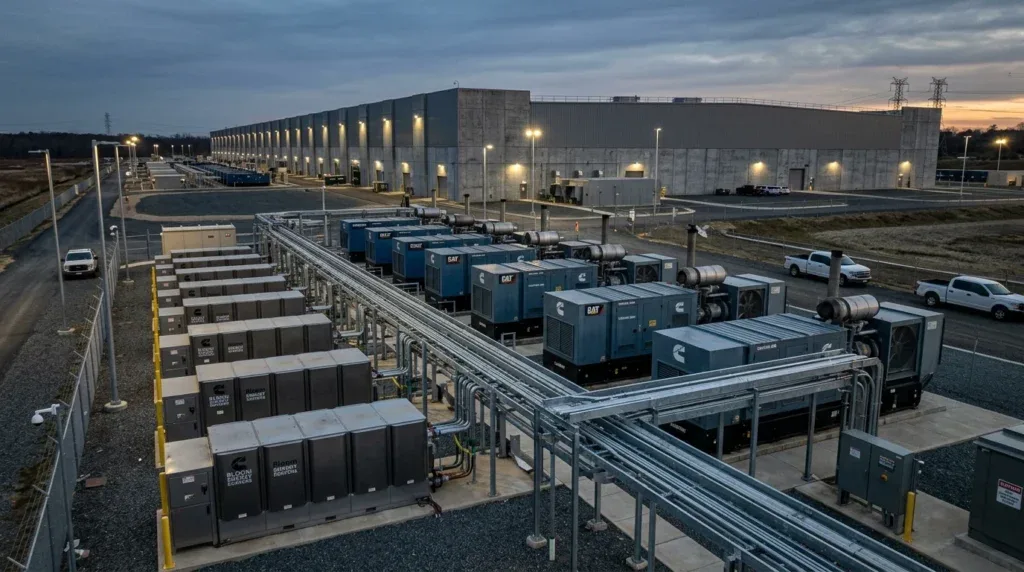
During a targeted site audit, state air quality inspectors uncovered 62 large-bore natural gas reciprocating generator sets installed outdoors in continuous operation behind high sound-dampening acoustic berms. Each generator was rated at 1,982 kilowatts—yielding an unpermitted on-site generating capacity of 122.88 megawatts. Under New Jersey state air safety regulations, any stationary internal combustion equipment exceeding 37 kilowatts requires pre-construction reviews and Title V air operating permits due to emissions of nitrogen oxides (NOx), carbon monoxide, volatile organic compounds (VOCs), and particulate matter (PM2.5).
“`htmlDiscovered Assets: 62 × 1,982 kW Natural Gas Reciprocating Generator Units (122.88 MW Total Continuous Prime Rating)
Statutory Violation: Operation of stationary combustion equipment exceeding 37 kW threshold without Pre-Construction Permits & Operating Certificates (N.J.A.C. 7:27-8)
Administrative Fine: $1,070,000 with a 45-day operational grace period to submit retrospective Title V air permit applications while maintaining cluster energization.
Mainstream coverage characterized the enforcement action as a warning shot to reckless Silicon Valley operators. Yet the operational remedy told the opposite story: the DEP granted DataOne a 45-day remediation window to assemble and file retroactive permit paperwork, allowing the 62 natural gas units to continue combusting fuel and generating electrons while the application is reviewed. The facility did not go dark for an hour. Why? Because shutting down 123 MW of live compute would cause immediate regional outages for Microsoft Copilot.
Deriving the FinOps Calculus: The Idle FLOP Depreciation Math
To understand why an operator willingly risks state enforcement, one must look at the balance sheet mechanics of high-density AI infrastructure. Enterprise server racks hosting modern 8-way accelerator architectures (such as NVIDIA HGX H100 or Blackwell B200 nodes) represent an upfront capital investment of $300,000 to $380,000 per chassis. In high-performance compute accounting, these assets are depreciated linearly over 36 to 48 months.
“`htmlDhourly, server = $350,000 ÷ 35,040 ≈ $9.988 per server-hour (≈ $1.248 per GPU-hour).
At pure baseline hardware carrying cost excluding fabric overhead, an idle accelerator unit decays at $0.40 to $0.70 per hour.
When scaled to an enterprise training or inference deployment of 20,000 accelerators, the cumulative depreciation velocity becomes staggering:
“`htmlThe Cold Financial Reality: Over eight months of unpermitted operation, the facility sustained an accumulated idle capital protection benefit of $20,160,000 against a state penalty of $1,100,000. Operating in violation of the Clean Air Act generated a net capital savings exceeding $19 million.
This calculation does not even incorporate downstream commercial liabilities. Missing delivery milestones on enterprise compute contracts triggers contractual SLA penalties ranging from $100,000 to $500,000 daily. If a frontier model training run is delayed by two quarters, the market window slams shut. For an infrastructure fund or cloud provider, a $1.1 million environmental fine is not a deterrent; it is a negligible rounding error on the balance sheet.
Take-or-Pay Leases and the PJM Interconnection Quagmire
The underlying catalyst driving data center developers into regulatory conflict is the total breakdown of electrical grid interconnection timelines. In the PJM Interconnection territory—the regional transmission organization covering 13 Eastern states including New Jersey, Pennsylvania, and Virginia’s Data Center Alley—the gap between IT hardware readiness and transmission energization has reached a historic disconnect.
While PJM reformed its administrative study process to review interconnection queues within one to two years, downstream physical energization has deteriorated. Lead times for high-voltage 500 kV autotransformers and gas-insulated switchgear (GIS) now extend beyond four to five years. Engineering analyses of data centers commissioned in 2025 and 2026 reveal an average duration of seven or more years from initial grid application to commercial power delivery.
In parallel, developers and hyperscalers are constrained by aggressive contractual frameworks. As revealed in Financial Times disclosures detailing Oracle’s cloud infrastructure expansion, major operators frequently sign take-or-pay leases with real estate developers. Under these agreements, the tenant commits to pay millions of dollars each month in base facility rent and contracted capacity charges starting on a predetermined date, regardless of whether the local utility has energized the substation.
When an operator faces $5 million in monthly lease obligations on a dark building, coupled with $2.5 million in monthly hardware depreciation on rack-mounted servers sitting in shipping crates, waiting seven years for a utility interconnect is an existential non-starter. They must source their own electrons immediately.
Oracle’s 2.8 GW Bloom Energy Deal: The Fuel Cell Clean-Air Escape Hatch
While DataOne in New Jersey opted for the raw brute-force approach of reciprocating diesel-gas generators, Oracle pioneered a sophisticated alternative: behind-the-meter Solid Oxide Fuel Cells (SOFC). Under an unprecedented Master Services Agreement (MSA), Oracle partnered with Bloom Energy to procure up to 2.8 gigawatts of fuel cell generation capacity for its global AI data center footprint, with 1.2 gigawatts already contracted into active engineering deployment.
The strategic genius of Bloom’s solid oxide fuel cell architecture lies in its electrochemical physics. Unlike internal combustion reciprocating engines or open-cycle gas turbines, fuel cells do not combust fuel. They reform natural gas into hydrogen and carbon monoxide, passing it across a solid ceramic electrolyte to generate electricity via electrochemical oxidation.
“`htmlCathode Reaction: O2 + 4e− → 2O2−
Electrical Efficiency: 60% to 65% LHV (Lower Heating Value) at point of generation, compared to 38% to 42% for reciprocating gas engines.
Permitting Exemption: Because combustion flame temperatures exceed 1,500°C, reciprocating engines bond atmospheric nitrogen and oxygen into virulent NOx. SOFCs operate at electrochemical boundary temperatures without flame combustion, producing virtually zero criteria air pollutants (NOx < 0.01 lbs/MWh).
Because Bloom Energy Server units emit virtually zero NOx, SOx, or particulate matter, they routinely qualify for minor-source air exemptions or categorical general permits. An operator deploying a 50 MW Bloom Energy microgrid can obtain air clearance in 60 to 90 days, completely circumventing the multi-year Clean Air Act Title V major source permitting review that triggered DataOne’s $1.1M fine in New Jersey.
Furthermore, because Bloom’s units connect directly to natural gas utility distribution mains, the data center bypasses the electrical transmission grid entirely. The operator “brings their own power” directly into the facility’s 480V/13.8kV electrical distribution bus.
Architectural Teardown: On-Site Power Generation Technologies
Every behind-the-meter generation technology introduces distinct thermodynamic, acoustic, and transient load trade-offs. The table below provides a forensic engineering comparison of the primary power solutions hyperscalers deploy to beat the grid queue:
“`html| Metric / Architecture | Reciprocating Gas Engine (CAT G3520 / Jenbacher) | Solid Oxide Fuel Cell (Bloom Energy Server) | Aeroderivative Turbine (GE Vernova LM2500XPRESS) | Utility Interconnection (PJM 500kV Substation) |
|---|---|---|---|---|
| Deployment Lead Time | 3 to 6 months (modular skids) | 6 to 12 months | 12 to 18 months | 5 to 7+ years (PJM backlog) |
| Title V Permitting Risk | Severe (Major source NOx/VOC) | Exempt / Minor Source | High (requires SCR/catalyst) | None (utility owns generation) |
| Electrical Efficiency (LHV) | 38% – 44% | 60% – 65% | 37% – 41% | Grid average (~35% – 40%) |
| di/dt Transient Response | Fast (< 2-3 sec ramp) | Extremely Slow (Requires BESS) | Moderate (rotational inertia) | Instantaneous (infinite bus) |
| Acoustic Footprint | High (75–85 dBA @ 10m) | Ultra-Low (< 65 dBA @ 10m) | High (requires silencers) | Silent (substation hum) |
The Thermal Shock Problem: Why Fuel Cells Require Battery Buffers
While solid oxide fuel cells eliminate emissions violations and bypass the grid queue, they introduce a severe electrical engineering hurdle: thermal inertia. In our prior forensic audit of Oracle’s force majeure on the Stargate mega-cluster, we analyzed how synchronized all-reduce collective communication across 100,000 GPUs creates brutal di/dt power transients—surging power consumption by 40 to 80 megawatts in tens of microseconds, followed by immediate load collapse upon completion.
Natural gas reciprocating engines handle sudden load changes through aggressive mechanical throttles and spinning rotor mass. Fuel cells cannot. Because SOFC stacks maintain internal ceramic operating temperatures between 600°C and 800°C, attempting to ramp electrical output faster than 1% per second induces catastrophic thermal shock, cracking the ceramic electrolyte membranes.
Consequently, deploying Bloom Energy servers for AI clusters mandates a hybrid architecture: the fuel cells provide steady-state baseload power, while containerized Battery Energy Storage Systems (BESS) featuring high-rate Lithium Iron Phosphate (LFP) cells absorb the explosive sub-second di/dt spikes.
Production Dispatch Logic: Coordinating SOFC Baseload and BESS Injection
The Python implementation below demonstrates the microgrid dispatch controller responsible for dampening GPU di/dt steps across a 100 MW behind-the-meter fuel cell cluster, shedding or injecting power via fast-response battery inverters to keep the ceramic fuel cell stack within thermal stress tolerances:
# microgrid_power_dispatch.py
# Real-time behind-the-meter governor for Bloom SOFC + BESS AI Cluster
import time
from dataclasses import dataclass

@dataclass
class MicrogridState:
    cluster_load_mw: float       # Real-time IT load (GPUs + Cooling)
    sofc_output_mw: float        # Current steady-state fuel cell output
    bess_soc_percent: float      # Battery Energy Storage State of Charge
    bess_max_discharge_mw: float # Inverter discharge limit

class SOFCPowerGovernor:
    def __init__(self, sofc_max_ramp_mw_per_sec: float = 0.5):
        self.max_ramp = sofc_max_ramp_mw_per_sec
        self.target_sofc_mw = 0.0

    def dispatch(self, state: MicrogridState, dt_sec: float) -> dict:
        delta_p = state.cluster_load_mw - state.sofc_output_mw

        # Calculate maximum permissible ramp to protect ceramic electrolyte
        allowed_ramp = self.max_ramp * dt_sec
        if abs(delta_p) <= allowed_ramp:
            new_sofc = state.cluster_load_mw
            bess_cmd_mw = 0.0
        elif delta_p > 0:
            # Positive transient: GPU batch step up
            new_sofc = state.sofc_output_mw + allowed_ramp
            # Instantaneous deficit is bridged by high-rate BESS inverter
            bess_cmd_mw = min(delta_p - allowed_ramp, state.bess_max_discharge_mw)
        else:
            # Negative transient: GPU collective sync barrier / idle collapse
            new_sofc = state.sofc_output_mw - allowed_ramp
            # Excess fuel cell energy diverted to recharge BESS
            bess_cmd_mw = max(delta_p + allowed_ramp, -state.bess_max_discharge_mw)

        return {
            "sofc_setpoint_mw": round(new_sofc, 3),
            "bess_dispatch_mw": round(bess_cmd_mw, 3),
            "grid_import_mw": 0.0, # Zero grid interconnection dependence
            "thermal_shock_mitigated": True
        }

if __name__ == "__main__":
    governor = SOFCPowerGovernor(sofc_max_ramp_mw_per_sec=0.4)
    # Simulating a 45 MW sudden collective all-reduce surge in 100 milliseconds
    curr_state = MicrogridState(
        cluster_load_mw=85.0,
        sofc_output_mw=40.0,
        bess_soc_percent=88.5,
        bess_max_discharge_mw=60.0
    )
    result = governor.dispatch(curr_state, dt_sec=0.1)
    print(f"[DISPATCH EVENT] SOFC Setpoint: {result['sofc_setpoint_mw']} MW | "
          f"BESS Injection: {result['bess_dispatch_mw']} MW | Shock Mitigated: {result['thermal_shock_mitigated']}")
The Regulatory Future: From Zoning Enforcement to Grid Secession
The juxtaposition of New Jersey’s $1.1M fine and Oracle’s 2.8 GW Bloom Energy procurement outlines the new reality of AI hyperscale expansion. As regional grid operators like PJM enforce Interim Resource Adequacy Service (IRAS) standards and mandate that large loads bring their own generation, the traditional utility-customer relationship is decomposing.
Hyperscalers are not waiting for centralized transmission planning. In regions where state environmental regulators enforce aggressive emission standards, operators with deep capital will follow Oracle’s blueprint: underwriting massive solid oxide fuel cell microgrids that consume pipeline gas without triggering Clean Air Act combustion thresholds. In secondary markets with lax oversight or emergency economic development zones, developers will continue quietly hauling reciprocating gas engines onto concrete pads, factoring state fines directly into their capital expenditure budgets.
So long as an idle accelerator cluster bleeds tens of thousands of dollars each day in stranded depreciation, regulatory fines will remain nothing more than an entry fee for private power generation.