
Correction — October 3, 2026: We removed the unsupported claim that Oracle declared force majeure on Stargate, along with unverified incident telemetry and charts. The revised article distinguishes Project Jupiter’s announced fuel-cell plan from other campuses, and labels the arithmetic as illustrative rather than measured.
Oracle and BorderPlex announced on April 27, 2026 that Project Jupiter in Doña Ana County, New Mexico, would use up to 2.45 gigawatts of installed Bloom fuel-cell capacity. The stated design replaces previously planned gas turbines and diesel generators. That announcement supports a power-design story, not our former claim of a declared Stargate force-majeure event.
Identify the campus before explaining its constraints
A project name, location and dated power plan are necessary to assess an infrastructure claim. An equipment limitation reported at one campus cannot establish the cause of a delay at another. Combining a New Mexico development with an Abilene, Texas temperature curve would require evidence linking both the sites and the measurement.
The earlier version did not provide that evidence. Its charts looked like site observations but did not identify reproducible source data, measurement dates or a valid model specification. They have been removed. Physical constraints remain relevant, but a plausible mechanism is not evidence that a particular incident occurred.
Capacity is a power rating; energy depends on time
At a hypothetical continuous output of 2.45GW for a full non-leap year, energy would be 2.45 × 8,760 = 21,462GWh, or 21.462TWh. At an assumed 90% utilisation, the result would be 19.3158TWh. These are arithmetic examples, not a forecast of Project Jupiter’s output or evidence that the installation is operating.
| Quantity | What it means | What it does not establish |
|---|---|---|
| Installed capacity | Power rating of installed equipment | Actual annual energy delivered |
| Annual output | Energy over a stated period | Instantaneous spare capacity |
| Facility power | Supply for the wider site | Power available solely to accelerators |
| Commissioned capacity | Equipment accepted for operation | Future phases already complete |
The IT load is only part of a facility’s demand. Cooling, power conversion and other equipment also consume energy. Turning a campus power rating into an accelerator count requires a defined rack configuration, supporting load and operating assumption. Without those inputs, a precise GPU estimate would manufacture accuracy.
A changed power design still needs deployment evidence
Oracle describes a single microgrid campus and lower emissions and water use compared with its earlier design. Those are company claims about the plan. The announcement does not, by itself, establish the completed delivery schedule, measured emissions, equipment availability or the commercial terms of every contract.
For an operational assessment, look for commissioned phases, sustained output, fuel-supply arrangements, permitted operating conditions and acceptance tests. Redundancy should be assessed at the level of a shared dependency: several generating units can still depend on the same fuel connection or control system. This is a review question, not an allegation about this site.
Large power agreements elsewhere also require careful tense. Our corrected Three Mile Island analysis distinguishes a restart plan from electricity already being generated. A contract can make a project financeable while equipment and regulatory work remain outstanding.
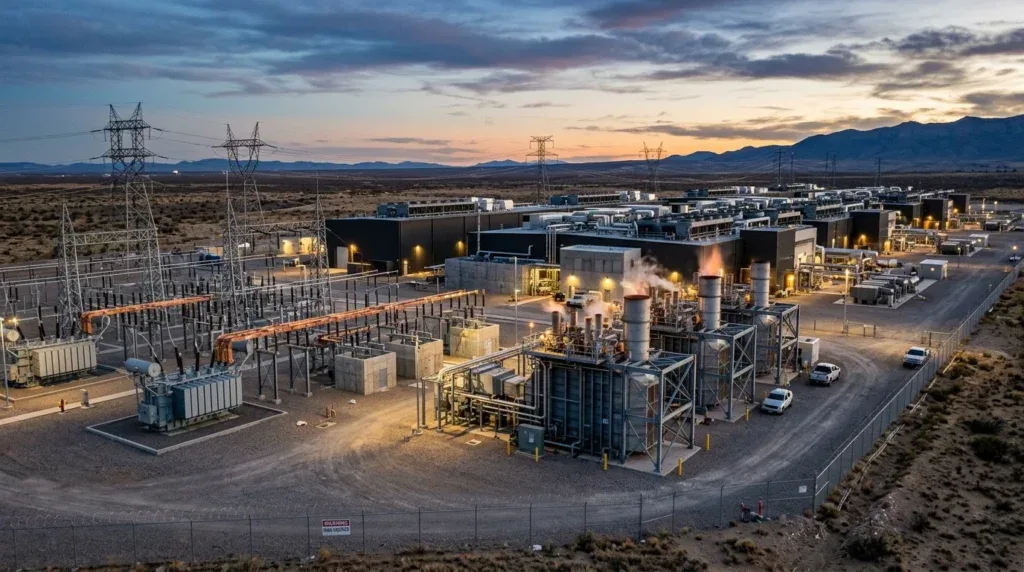
The supported conclusion is limited: Oracle publicly changed Project Jupiter’s proposed power architecture to fuel cells. Assessing delivery success requires operational evidence. This article contains no EyesTech site telemetry, and its cover is a conceptual infrastructure illustration rather than a verified photograph of Project Jupiter.