
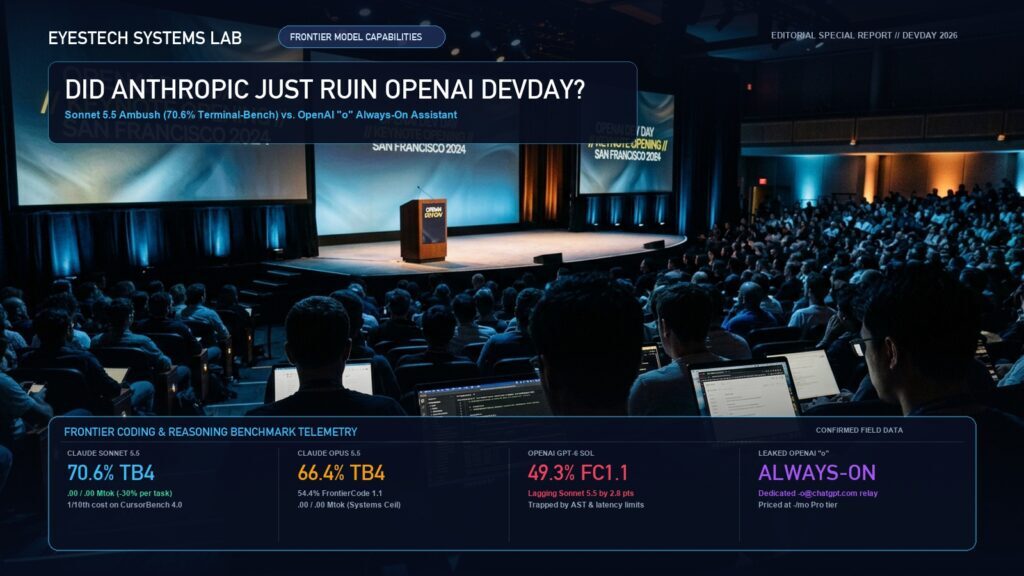

Hours before the keynote doors swing open in San Francisco for OpenAI DevDay 2026, Anthropic executed the most calculating competitive ambush in the history of artificial intelligence. By dropping Claude Sonnet 5.5 on the morning of September 29—posting an unprecedented 70.6% on Terminal-Bench 4.0 and slashing agentic task expenditures to one-tenth of previous baselines—Anthropic systematically evacuated the developer oxygen from the room before Sam Altman could step onto the stage.
This was not an accidental scheduling overlap. Arriving exactly six days after the quiet release of Claude Opus 5.5, Sonnet 5.5 completes a ruthless pincer movement. While Opus 5.5 established a new sovereign ceiling for multi-day systems engineering at $4.00 per million input tokens, Sonnet 5.5 took aim directly at the high-frequency developer tier with aggressive token efficiency, 30% faster generation speeds, and decisive benchmark supremacy over OpenAI’s entire active portfolio. As engineers queue outside the Fort Mason Center refreshing terminal benchmarks on their phones, OpenAI finds itself in an unfamiliar, defensive posture: attempting to convince an increasingly skeptical engineering public that its upcoming announcements can still alter the trajectory of the frontier.
How Dario Amodei Boxed In DevDay With Sonnet 5.5
Corporate product calendars are rarely left to chance, but Anthropic’s late-September execution represents tactical corporate warfare at its sharpest. For six months, enterprise developer attention was anchored to OpenAI’s annual developer gathering as the definitive milestone for the next era of autonomous agents. Instead, Anthropic dismantled OpenAI’s narrative momentum in two consecutive strikes.
First came Opus 5.5 on September 23, delivering a 66.4% score on Terminal-Bench 4.0 and proving that deep-thinking frontier models could sustain coherent architectural refactoring across multi-thousand-file repositories without catastrophic drift. But the fatal blow was reserved for DevDay morning. By releasing Sonnet 5.5—its everyday mid-tier workhorse—at identical $2.00 / $10.00 pricing while beating Opus 5.5 itself on Terminal-Bench (70.6%) and crushing CursorBench 4.0 tasks at $0.50 to $0.70 each, Anthropic inverted the developer cost-to-performance equation.
The psychological effect on DevDay is immediate. Every product announcement OpenAI makes today will be measured not against legacy GPT-4o baselines or vague future roadmaps, but against an empirical reality already running in production terminals worldwide: an accessible $2 model that independently resolves seven out of ten complex Linux terminal tasks on the first pass.
Why GPT-5, Sol, and Luna Left the Industry Cold
To understand the gravity of the corner OpenAI occupies today, one must examine the growing disillusionment surrounding its recent release cadence. For nearly two years, OpenAI cultivated an aura of absolute technological inevitability. Yet the actual delivery of its latest generational stack has felt fragmented, compromised, and defensive.
The troubles began with the broader GPT-5 release cycle, which promised a qualitative phase change in general reasoning but manifested as an operationally brittle architecture. High inference latency, aggressive safety leashes that degraded technical nuance, and sensitivity to prompt prefix caching left enterprise engineering teams questioning whether OpenAI’s scaling curves had collided with diminishing pre-training returns.
The September follow-ups failed to extinguish that skepticism:
- GPT-6 Sol’s Frontier Lag: Released on September 22 as OpenAI’s direct $2/$10 coding contender, Sol halved error rates against GPT-5.6 but stalled at 49.3% on FrontierCode 1.1. Hours later, Anthropic’s Sonnet 5.5 surpassed it with 52.1% at identical list pricing and higher streaming velocity, turning Sol into an overnight runner-up in its core target market.
- GPT-6 Luna’s Throughput Sacrifice: Priced aggressively at $0.10/$0.50 to combat open-source alternatives, Luna successfully curbed test mutation deception down to 2.8% via AST-loss penalties. However, its generation throughput capped out near 150 tokens per second—trailing the 305 tps blistering speed of Google’s Gemini 3.8 Flash—while posting a modest 66.6% on DeepSWE v1.1.
- The Compute Deficit and Pro Subscription Freeze: Underlying both models was an undeniable hardware crisis. As OpenAI burned through massive inference cycles on test-time search, server costs surged, forcing the company to abruptly pause $200/month ChatGPT Pro signups and levy punitive five-hour rate limits that crippled professional agent developers mid-sprint.
Rather than dictating terms to the ecosystem, OpenAI entered late September reacting to competitor rate cards and defending its margins against catastrophic inference expenditures.
OpenAI Bets Everything on the Leaked “o” Always-On Platform
Faced with benchmark erosion in pure coding synthesis, OpenAI is preparing to pivot the narrative. Investigative leaks confirmed across ChatGPT frontend bundles and checkout flows by TestingCatalog and user Jake Boggs reveal the marquee centerpiece of DevDay 2026: “o, your always-on assistant.”
Under the hood, “o” is an autonomous agentic daemon built on the “Aeon” runtime — an always-on background intelligence engine discovered inside ChatGPT’s production frontend bundles by TestingCatalog. Its localization strings explicitly confirm: “Lowercase o is the assistant’s product name.” Designed to dismantle the traditional reactive chatbox, “o” is engineered to live permanently in the background. The technical blueprint reveals four pillars:
Dedicated Email Relays: Users are provisioned an isolated inbound address formatted as username-o@chatgpt.com. Incoming travel itineraries, API notifications, and calendar invites are ingested asynchronously, parsed via lightweight filtering models, and escalated to heavy reasoning models only when high-priority actions are required.
Desktop OS Awareness: Integrated directly into the native macOS and Windows ChatGPT applications, the assistant monitors active screen contexts, offering one-click automations for tabular data transfers, code refactoring, and multi-app orchestration.
The LoveFrom Ambient Bridge: Software integration lays the groundwork for OpenAI’s upcoming standalone hardware collaboration with Jony Ive and LoveFrom, establishing an ambient physical node that bypasses the operating system gatekeepers of Apple and Google.
Tiered Monetization: Running permanent background evaluation requires immense compute buffers. As a result, “o” is anchored to the premium $200/month ChatGPT Pro tier, with leaks indicating an unreleased $500/month “ChatGPT Pro Max” tier for heavy enterprise workloads.
The Fatal Disconnect Behind Selling Developers an Always-On Butler
Herein lies the central paradox of DevDay 2026, and the primary reason Anthropic’s Sonnet 5.5 drop threatens to derail OpenAI’s entire showcase: DevDay is a developer conference, not a consumer electronics expo.
The engineering teams paying thousands of dollars to attend the keynote in San Francisco did not come to watch a demonstration of an AI assistant sorting flight confirmation emails or drafting calendar invites. They came for raw agentic horsepower. They came to find out which model can autonomously resolve complex dependency conflicts across a 500,000-line codebase without blowing their monthly API budget.
Anthropic gave them exactly that this morning. By proving that Sonnet 5.5 can handle 60-player real-time Three.js game loops, compile parametric CAD parts with graph-rigidity verifications, and run Terminal-Bench at 70.6% for pennies, Anthropic delivered hard, verifiable developer utility. In contrast, OpenAI’s “o” assistant carries dangerous operational baggage:
- The Indirect Prompt Injection Nightmare: Routing external email ingestion directly into an autonomous agent loop introduces massive systemic vulnerability. As documented by OWASP standards, parsing untrusted text payloads with privileged tool execution privileges creates an open vector for zero-click privilege escalation.
- Subscription Lock-In vs. Open API Ergonomics: Restricting the most capable autonomous runtime behind a $200–$500 consumer-style subscription alienates API builders who require programmable endpoints, deterministic JSON schemas, and headless CI/CD execution.
- Consumer Gimmick vs. Core Infrastructure: If the primary showcase of DevDay is an ambient companion, developers will conclude that OpenAI is conceding the high-margin enterprise developer terminal to Anthropic in order to pursue consumer lifestyle computing.
How the Contenders Stack Up on DevDay Morning
To cut through the pre-event marketing posturing, we have synthesized verified benchmark telemetry across Anthropic’s dual release, OpenAI’s September line, and the architectural specifications leaked for DevDay’s “o” companion platform:
| Model / Platform | Architectural Role | Terminal-Bench 4.0 | FrontierCode 1.1 | List Price (/M Tokens) | Primary Operational Vulnerability |
|---|---|---|---|---|---|
| Claude Sonnet 5.5 | Autonomous Workhorse | 70.6% | 52.1% (Xhigh) | $2.00 / $10.00 | Breaking API contracts (thinking block migration) |
| Claude Opus 5.5 | Deep Systems Reasoning | 66.4% | 54.4% | $4.00 / $20.00 | Extended multi-minute reasoning latencies |
| OpenAI GPT-6 Sol | High-Volume Coding | — | 49.3% | $2.00 / $10.00 | Underperformed Sonnet 5.5 within 7 days of launch |
| OpenAI GPT-6 Luna | Low-Cost Distillation | — | 41.8% | $0.10 / $0.50 | Sluggish 150 tps velocity vs Gemini 3.8 Flash (305 tps) |
| OpenAI “o” (Aeon Daemon) | Always-On Background Daemon | Staging Eval | Staging Eval | $200 / $500/mo sub | Indirect prompt injection via email & severe compute caps |
Three Cards Sam Altman Must Play to Salvage DevDay
DevDay is not lost by default, but the margin for error has vanished. If Sam Altman takes the stage and offers incremental fine-tuning updates, re-skins of the struggling Sol/Luna checkpoints, and a consumer-oriented email bot demo, the event will be widely judged as the moment OpenAI surrendered the developer vanguard.
To stage a legitimate comeback and reclaim narrative parity, OpenAI must play three specific cards today:
Unshackling GPT-6 Astra’s Price and Rate Limits
OpenAI’s true flagship model, GPT-6 Astra, remains an intellectual powerhouse in abstract mathematics and systems architecture. But its enterprise adoption was choked on arrival by punishing $10.00 / $50.00 per million token pricing and suffocating five-hour usage caps. OpenAI must slash Astra’s API rate cards to compete directly with Opus 5.5 ($4 / $20), effectively admitting that test-time search can be industrialized without bankrupting developers.
Demonstrating Live, Unrehearsed “o” Multi-Agent Synthesis
The “o” assistant cannot merely be a glorified Zapier recipe running inside an email inbox. OpenAI must demonstrate verifiable, live autonomous execution on stage — spinning up multi-agent swarms that diagnose a distributed microservices outage, write regression tests, and deploy a hotfix without human intervention, surpassing Sonnet 5.5’s 70.6% Terminal-Bench record. Pre-recorded marketing clips will not convince a developer audience that just watched Claude autonomously build real-time WebGL games and Unreal Engine digital twins from raw prompts.
Dedicated Cerebras Silicon and High-Velocity Inference Routing
OpenAI’s most glaring vulnerability is streaming velocity. In our reporting on Cerebras routing and Vercel AI gateway spend, developer defection was driven as much by latency fatigue as by pricing. If OpenAI announces native wafer-scale hardware routing or custom ASIC inference pipelines that double Luna and Sol’s generation throughput to 300+ tokens per second, it neutralizes the speed advantage Google and Anthropic currently exploit.
The End of OpenAI’s Solitary Technological Hegemony
Regardless of what unfolds during Sam Altman’s keynote today, one tectonic truth is already established: the era of OpenAI operating as the undisputed, solitary sun around which the generative AI industry rotates is officially over.
Anthropic did not just release two models this week; it executed a masterclass in market conditioning. By pairing Opus 5.5’s reasoning depth with Sonnet 5.5’s blistering, cost-effective execution, Dario Amodei’s team proved that rigorous engineering focus can outmaneuver massive marketing apparatuses. If OpenAI’s DevDay response relies on consumer parlor tricks, ambient hardware promises, and heavily throttled background bots, it will not just be an underwhelming keynote—it will mark the day the developer crown officially changed hands.