

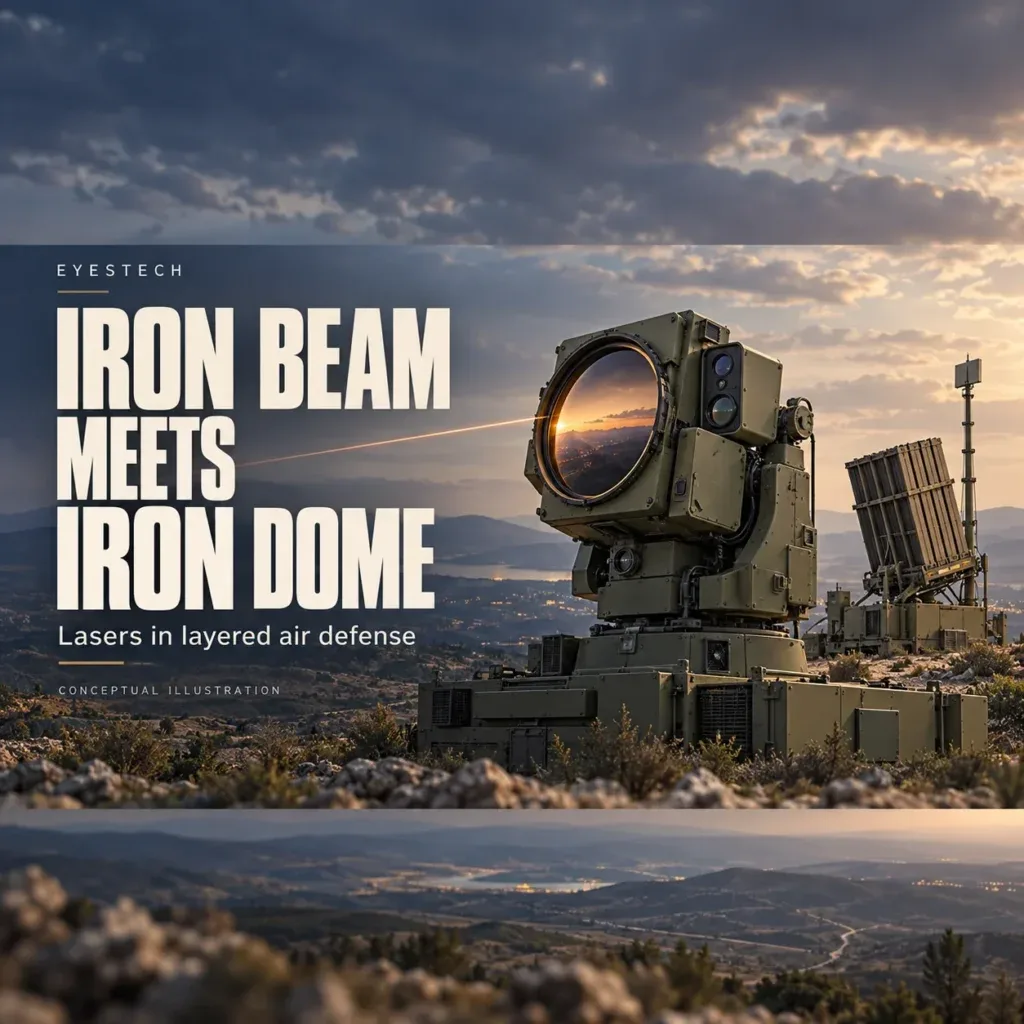

A cheap shot is only useful when it finishes in time. The real promise of laser defense is preserving interceptor stocks without sacrificing the next opportunity to stop a threat.
Iron Beam adds a laser option to Israel’s layered air defense. Its value depends on which threats it can stop, under which conditions, and how many missile launches it avoids. The first system was delivered in December 2025; joint testing through Iron Dome’s battle management center was announced in June 2026.
That last development deserves more attention than another headline about pennies per interception. In its June 30 test announcement, Israel’s Ministry of Defense described joint Iron Beam scenarios integrated within Iron Dome’s battle management center. This establishes a reported integration milestone. It does not establish an independently measured interception rate, nationwide coverage, or performance in every weather condition.
The useful question is how adding a laser changes the work of the whole defense network. A successful laser engagement can leave an interceptor available for a later threat. An unsuccessful attempt can consume time that the missile layer needs. The difference between those outcomes is where the engineering story begins.
What has actually been demonstrated?
Three milestones are often compressed into one claim about combat readiness:
- May 28, 2025: the ministry reported that fielded high-power laser prototypes had intercepted scores of threats during the war. Its announcement distinguished those systems from the more powerful Iron Beam then under development.
- December 28, 2025: the ministry announced delivery of the first operational Iron Beam system. It described successful tests against rockets, mortars and UAVs, with Rafael as the principal contractor and Elbit responsible for the laser source.
- June 30, 2026: the Iron Dome upgrade trials included joint scenarios using the laser through the battle management center.
These support a progression from prototype use to system delivery and integration testing. They should remain separate in any assessment of maturity. Earlier combat footage cannot, by itself, establish the performance of the delivered configuration.
The ministry’s December 28, 2025 handover post is historical evidence of delivery. It is not a performance dataset.

The layers overlap because threats behave differently
Layered air defense is more complicated than concentric circles on a map. Threat trajectories, sensing, geography and weapon suitability shape each engagement. The Iron Dome manufacturer brochure describes a system combining detection and tracking, battle management and missile interception, including discrimination between threatening projectiles and those expected to land outside defended areas.
| System | Broad role in the architecture | What the laser addition changes |
|---|---|---|
| Iron Beam | Laser engagements against suitable nearby aerial threats | Adds an option when the optical path, target and available time permit |
| Iron Dome | Missile interception of threatening short-range projectiles and other supported aerial targets | May retain interceptors when a laser completes the engagement |
| David’s Sling | Another missile-defense layer for threats beyond Iron Dome’s usual role | Remains a distinct capability; laser delivery does not establish equivalence |
| Arrow | The ballistic-missile defense portion of the layered system | Does not become redundant because a short-range laser is available |
The ministry’s delivery announcement explicitly places Iron Beam alongside all three missile systems. It does not describe a laser replacing the entire stack.
The first economy in a defense network is deciding which objects require interception. Adding a cheaper effector does not remove the need for that judgment. Track quality, predicted consequences and confidence in classification still matter.
EyesTech’s explanation of fiber-optic FPV drones illustrates why different effects belong in one architecture: moving a control link into glass changes what an RF jammer can disrupt. A laser acts on the physical aircraft, so it does not need that aircraft to maintain a vulnerable radio command link. That observation does not establish an Iron Beam test result against fiber-controlled FPVs; it explains why complementary mechanisms matter.
Light arrives quickly. Damage takes time.
Rafael describes Iron Beam as a 100 kW class system, with coherent beam combination and adaptive optics. Those features address beam delivery and stability. A headline power rating does not tell us how much useful energy reaches a vulnerable part of a moving target.
The Government Accountability Office’s directed-energy overview identifies time on target, distance and the location illuminated as factors that affect the outcome. A laser must maintain sufficient energy on the relevant area long enough to produce damage. Acquiring the track, stabilizing the beam and confirming the effect also consume time.
A simplified energy accounting: absorbed energy = optical output power × atmospheric transmission × fraction landing on the relevant area × absorption fraction × illumination time.
This is a conceptual relationship, not an Iron Beam damage model. Real targets conduct heat, move and present changing surfaces; the required energy is not a universal constant. The relationship explains why nominal output power alone cannot determine effectiveness.
For example, a hypothetical 100 kW beam operating for four seconds emits 400 kJ. If we assume 50% atmospheric transmission and a combined 25% factor for relevant-area delivery and absorption, the accounting yields 50 kJ absorbed there. Every percentage and the four-second duration in this example is an illustrative assumption. None is a published Iron Beam measurement, and 50 kJ is not a claimed destruction threshold.
The reader can see the implication without accepting a secret specification: reducing useful delivery increases the time required to reach the same assumed energy. A system that succeeds against one target in one optical environment may need a different engagement window elsewhere.
Weather changes both availability and capacity
The Congressional Research Service’s review of directed-energy weapons distinguishes line-of-sight limits, atmospheric absorption and scattering, and turbulence. It also explains why adaptive optics can mitigate turbulence without making a laser an all-weather weapon.
That distinction matters. A distorted beam and an obscured path are different problems. A clearer image at the sensor also does not automatically establish enough energy delivery for interception.
There are two consequences for the rest of the network. Some conditions may make a laser engagement unavailable altogether. Other conditions may leave it possible but slower. In the second case, the laser remains usable while completing fewer engagements in the same period. Describing weather as a simple on/off switch misses that middle ground.
GAO also identifies cooling requirements as a constraint. A deep energy supply does not establish continuous firing at a fixed rate. Sustained operation depends on the complete power and thermal system, not just the laser source.
For a purchaser or analyst, an important metric is therefore availability during the periods when defended threats actually arrive. Annual average clear-weather hours are a weak substitute. This is an evaluation principle, not a claim about when an adversary will attack or a disclosed Iron Beam operating limit.
A deep magazine can still have a short queue
Consider an explicitly hypothetical engagement window of 60 seconds. Assume one independent laser engagement channel and an average six-second cycle covering acquisition, illumination, effect assessment and switching. The arithmetic permits ten completed cycles.
If that average becomes ten seconds, the same channel permits six cycles. It can have ample electrical energy remaining and still lack time to service every threat in the window.
| Illustrative input | Case A | Case B |
|---|---|---|
| Available window | 60 seconds | 60 seconds |
| Average complete engagement cycle | 6 seconds | 10 seconds |
| Independent channels assumed | 1 | 1 |
| Idealized completed cycles | 10 | 6 |
These are assumptions for explaining capacity, not Iron Beam specifications. The calculation assumes usable tracks and suitable targets are continuously available, with no overlapping work or interruptions. It excludes geometry, cooling pauses, retries and other constraints.
More independent channels could increase capacity, but that requires compatible coverage, sensing, power and coordination. Combining several laser sources into one beam should not be counted as several independently serviceable targets.
This is one reason “unlimited ammunition” needs qualification: energy availability, engagement capacity and defensive success describe different things. The arithmetic above lets readers test that distinction without inventing an operational firing rate.
The handoff matters as much as the successful shot
The central integration problem is retaining another credible interception opportunity when a laser attempt does not finish as expected.
As an analytical requirement, a laser-first decision should leave enough time for effect assessment, reassignment and a feasible missile engagement. The precise allowance depends on the threat, geometry and system; the June announcement does not disclose the allocation logic or timing thresholds.
A laser attempt that is inexpensive but consumes that allowance can be a poor choice. Conversely, using a missile immediately when the laser could safely finish may surrender the inventory benefit. Evaluating the controller therefore requires both successful laser engagements and the outcomes after incomplete or abandoned attempts.
The broader sensing and coordination problem also appears in EyesTech’s NATO Drone Wall analysis. Its relevance here is the chain connecting a track to an appropriate effector. The laser cannot recover time already lost before a usable track reaches it.

Count avoided missile launches before counting dollars
The ministry describes Iron Beam’s marginal engagement cost as negligible. That is a claim about an additional engagement, not a published lifecycle cost per successful defense. Equipment, personnel, maintenance, power infrastructure and supporting sensors still belong in an economic assessment.
A useful first model avoids choosing a disputed dollar figure:
Expected missile launches avoided = N × a × e × s × m.
- N: threats that would otherwise receive missile engagements.
- a: fraction occurring when the laser is available.
- e: fraction of those threats eligible for a laser engagement under the model’s timing and other constraints.
- s: fraction of eligible attempts that successfully remove the need for missile engagement.
- m: average missile launches displaced by each such success.
Take 100 otherwise missile-engaged threats, 60% laser availability, 50% conditional eligibility, 80% conditional success and one displaced launch per success. The result is 24 expected missile launches avoided. Fractional expected values are statistical averages, not partial missiles fired during a single event.
If availability falls to 30% while the other assumptions remain unchanged, the result falls to 12. If availability stays at 60% and eligibility rises to 75%, it becomes 36. These are sensitivities, not forecasts for Israel’s defense network.
This decomposition offers a more useful question than the electrical price of one shot: which constraint most limits the share of missile engagements that the laser can actually displace?
To estimate net financial savings, multiply avoided launches by an appropriate marginal interceptor cost, then subtract incremental laser operating and ownership costs over the same period. Procurement totals should not be silently substituted for marginal launch costs. The scope must also say whether new sensors and infrastructure are included.
There is a second potential benefit that the cash calculation misses. An interceptor retained today remains available for another engagement before resupply. That benefit depends on future demand and stocks, but it explains why magazine preservation can matter even before a laser pays back its capital cost.
What evidence would change the assessment?
The public releases establish milestones. They do not provide the complete dataset needed to estimate the model above. A credible evaluation would report:
- Eligible threats and attempted engagements, alongside successes and abandoned attempts.
- Target categories, test conditions and configuration, with sensitive details appropriately withheld.
- Laser availability during relevant threat windows.
- Distributions of complete engagement time, rather than one best result.
- Outcomes after failed attempts, including successful missile fallback and lost opportunities.
- Missile consumption in comparable scenarios with and without laser participation.
- Sustainment demands and cost boundaries over a stated period.
A success percentage without its denominator cannot establish what share of the network’s burden the laser removes. Demonstrations selected for suitable targets and clear conditions can establish capability while leaving availability and sustained capacity unresolved.
My assessment would become more favorable with documented missile savings under representative conditions and reliable fallback after unsuccessful attempts. It would become less favorable if the additional layer repeatedly consumed time without reducing missile demand, or if sustainment made it unavailable during relevant windows.
Iron Beam’s strongest promise is helping the missile layers retain capacity. The June integration tests are a meaningful step toward that role. The next judgment should turn on timely engagements, preserved interceptors and sustained availability—the quantities that determine whether a cheaper shot improves the defense as a whole.
Common questions
Does Iron Beam replace Iron Dome?
The official delivery and integration announcements describe a complementary laser capability. Missile layers remain necessary for threats and conditions outside its usable engagement envelope.
Does a laser destroy a target instantly?
Light travels quickly, but achieving damage requires sufficient energy on target. Tracking, illumination and effect assessment contribute to the complete engagement time.
What does a low cost per shot leave out?
Ownership and sustainment costs, availability, unsuccessful attempts and the fraction of missile launches actually displaced. Those determine the cost and benefit of adding the system.