

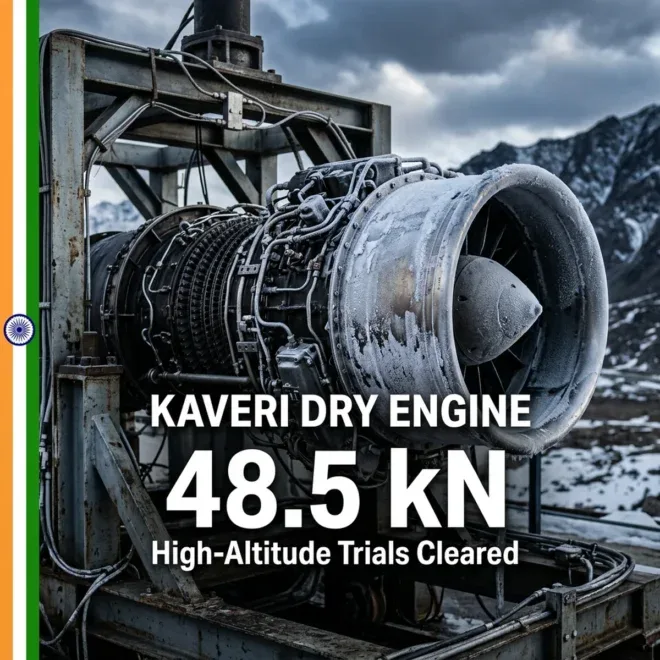

The Gas Turbine Research Establishment’s (GTRE) decades-long pursuit of an indigenous military jet engine reached a concrete operational milestone this week. In dual-facility testing concluded across Russia’s premier aviation test institutions—the Central Institute of Aviation Motors (CIAM) and the Gromov Flight Research Institute—the Kaveri Derivative Engine (KDE), also designated the Kaveri Dry Engine, logged a peak unaugmented thrust of 48.5 kilonewtons (kN).
The recorded figure surpasses GTRE’s baseline design requirement of 46 kN by roughly 5.4%, clearing the operational flight envelope up to a simulated ceiling of 13,000 meters (42,650 feet). Tested both in CIAM’s altitude test cells and mounted on Gromov’s modified Ilyushin Il-76LL flying testbed, the powerplant is now en route back to India. There, its high-altitude telemetry and vibration spectra will undergo formal audit by the Centre for Military Airworthiness and Certification (CEMILAC) in Bengaluru—the final gatekeeper before the core is integrated into the prototype airframe of India’s Ghatak stealth Unmanned Combat Aerial Vehicle (UCAV).
For a propulsion initiative often shadowed by the original GTX-35VS’s inability to meet the high reheat requirements of the manned LCA Tejas fighter, the Russian test campaign marks a clear architectural vindication: stripping the afterburner transforms an overstretched fighter engine into an optimized, survivable turbofan for a tailless stealth strike platform.
| Parameter | Baseline GTRE Target | Achieved Trial Performance | Operational Significance |
|---|---|---|---|
| Peak Dry Thrust | 46.0 kN (~4,690 kgf) | 48.5 kN (~4,945 kgf) | +5.4% thrust margin at sea-level static conditions; eases MTOW growth limits |
| Simulated Altitude Envelope | 11,000 m (FL360) | 13,000 m (FL426) | Validates combustion stability and relight capability in the thin lower stratosphere |
| Test Platforms | Altitude Chamber & Flying Testbed | CIAM Test Cell + Il-76LL FTB | Evaluates steady-state aerothermal behavior followed by real aerodynamic inlet distortion |
| Architecture | 2-Spool Low-Bypass Turbofan | Non-Afterburning (Dry) | Eliminates reheat weight and thermal bloom for all-aspect low observability |
| Primary Target Airframe | Ghatak Strike UCAV | Stealth Flying Wing (est. 13-tonne class) | Provides dry thrust-to-weight ratio of ~0.35–0.38 for sustained subsonic cruise |
| Certification Authority | CEMILAC (Bengaluru) | Telemetry Review Pending | Prerequisite for taxi trials and initial flight clearance on flight-test vehicles |
The Crucible at 13,000 Meters: Why Altitude Chambers Matter
A gas turbine’s sea-level bench figures tell only a fraction of its operational story. Ground runs at sea level benefit from dense ambient air (1.225 kg/m³ at standard temperature and pressure), where compressor stages operate far from their aerodynamic stall limits and combustor pressure remains well above atmospheric.
At 13,000 meters, the physical environment shifts radically. Air density plummets to roughly 0.27 kg/m³—approximately 22% of sea-level density. Ambient temperature stabilizes near −56.5 °C (216.65 K), characteristic of the lower stratosphere above the 11 km tropopause. Combustion pressure drops sharply inside the annular combustion chamber, significantly narrowing the fuel-air flammability limits.
Under these conditions, low Reynolds numbers over high-pressure compressor blades cause aerodynamic boundary layers to thicken, increasing skin friction and inducing aerodynamic separation. The compressor’s surge margin shrinks; if the engine encounters inlet distortion or an aggressive throttle transient, the airflow can stall, extinguishing the flame.
At CIAM’s high-altitude test cells outside Moscow, technicians subject the Kaveri core to forced conditioned air that mirrors these altitude density gradients, sub-zero inlet temperatures, and varying Mach numbers. The tests specifically audit:
Ignition and in-flight relight envelopes — the ability of the dual-channel Full Authority Digital Engine Control (FADEC) to detect a flameout and reignite the fuel-air mixture in rarefied, freezing air without causing catastrophic thermal shock or compressor backfire.
Transient fuel metering — rapid throttle sweeps from idle to maximum continuous rating without triggering aerodynamic compressor stalls.
Core cooling efficiency — ensuring internal cooling air directed through high-pressure turbine nozzle guide vanes maintains thermal margins across turbine inlet temperatures exceeding 1,400 K.
Subsequent trials on Gromov’s Il-76LL flying testbed—where the Kaveri derivative was installed on an inboard pylon in place of one of the transport aircraft’s standard Aviadvigatel D-30KP-2 turbofans—tested these characteristics against genuine flight dynamics, structural vibration, and turbulent boundary layers.
Why “Dry” Is the Right Choice for Ghatak
The original GTX-35VS Kaveri programme was conceived to deliver 51 kN dry thrust and 81 kN with afterburning to power the Tejas Light Combat Aircraft. It fell short primarily in reheat efficiency: combustion instability, excessive dry core weight, turbine blade metallurgy bottlenecks, and thermal dissipation issues prevented it from meeting the stringent power-to-weight demands of a single-engine dogfighter. The IAF subsequently chose the General Electric F404-GE-IN20 for Tejas Mk1 and Mk1A, and later the F414-GE-INS6 for the heavier Tejas Mk2.
However, the operational requirements of a stealth strike drone like Ghatak—developed under DRDO’s Aeronautical Development Agency (ADA) alongside testing of the subscale SWiFT (Stealth Wing Flying Testbed)—are fundamentally different from those of an agile dogfighter.
| Requirement | Air Superiority Fighter (Tejas / AMCA) | Stealth Strike Flying Wing (Ghatak) |
|---|---|---|
| Speed Regime | Requires afterburner for transonic dash, intercept, and climb rates | Operates strictly in high-subsonic regime (Mach 0.75–0.85); afterburner useless |
| Thrust-to-Weight | High TWR (>1.0) for aggressive sustained turns | Moderate TWR (~0.35) optimized for cruise and loiter endurance |
| Intake / Exhaust | Variable-geometry circular nozzle | Expected: serpentine (S-duct) radar-obscured inlet and flattened 2D exhaust nozzle |
| IR Signature | Afterburner bloom visible to IRST sensors beyond 100 km | Suppressed IR footprint across MWIR/LWIR wavebands to defeat ground/air detectors |
Thermal Signature Elimination
An active afterburner injects raw fuel into the exhaust duct behind the turbine, generating an incandescent exhaust plume exceeding 1,700 °C. For a low-observable aircraft, this turns the platform into a beacon for mid-wave (MWIR) and long-wave infrared (LWIR) search-and-track systems.
By removing the reheat diffuser, flame rings, fuel spray bars, and variable nozzle actuators, the Kaveri Dry Engine drops exhaust gas temperatures substantially. This allows airframe designers to pair the engine with a flattened exhaust geometry that mixes cool bypass air with core exhaust, deflecting heat away from ground-based infrared seekers.
S-Duct Intake Compatibility
Stealth flying wings avoid straight inlet ducts, which would expose highly reflective compressor face blades to enemy radar pulses. Instead, they typically employ an aggressive serpentine (S-duct) intake that bends the airflow out of direct line of sight.
S-ducts inherently introduce pressure distortion and uneven swirl across the compressor face. The 48.5 kN dry Kaveri demonstrated in Russia that its compressor stages possess the necessary aerodynamic surge margins to ingest distorted airflow without choking or stalling—a critical prerequisite for installation on any stealth airframe.
Fuel Economics and Combat Radius
Without an afterburner, specific fuel consumption (SFC) remains in the dry cruise regime, estimated at 0.78 to 0.88 lb/lbf·hr for this class of low-bypass military turbofan. For an unmanned penetration platform intended to fly unrefueled deep-strike missions or loiter for hours in contested airspace, fuel economy dictates operational viability far more than sprint speed.
Matching Thrust to Airframe: The Ghatak Power Budget
A dry thrust output of 48.5 kN translates directly into actionable airframe design parameters. For a tailless flying wing operating at subsonic cruise, a clean aerodynamic configuration typically yields a lift-to-drag ratio (L/D) between 14:1 and 18:1.
For an estimated 13-tonne airframe at an L/D of 15, sustained cruise requires roughly 8.5 kN—well within the continuous rating of a 48.5 kN dry engine. Maximum thrust is reserved for takeoff, climb, and maneuvering.
Takeoff thrust margin: Conventional runway takeoff without catapult assistance requires a static thrust-to-weight ratio between 0.34 and 0.38 for a subsonic UCAV with adequate runway length. At 48.5 kN (~4,945 kgf), the engine supports an all-up takeoff weight of roughly 13,000 to 14,500 kg with appropriate safety margins on hot-and-high Indian runways.
This power budget can accommodate an internal weapons bay carrying precision-guided munitions—from lightweight 120 kg class weapons such as the DRDO SAAW to heavier 500 kg class glide bombs—alongside internal avionics, SATCOM datalinks, and extensive fuel fractions.
The Road to Bengaluru and Chitradurga
While exceeding 48 kN in Russian altitude cells is a substantial technical achievement, the propulsion system must navigate several domestic development gates before taking to the air on a full-scale airframe:
CEMILAC airworthiness audit — the full instrumentation logs from CIAM and Gromov—covering cyclic stress, high-cycle fatigue (HCF), turbine disc thermal gradients, and FADEC error-handling routines—must be audited in Bengaluru. CEMILAC will determine whether the engine requires localized blade damping or control-law tuning.
Ground integration with stealth exhaust and intake — prior trials tested the core with standard circular testbed nacelles. The next critical engineering milestone is ground-test coupling at GTRE Bengaluru with the full intake duct and exhaust assembly designed for the Ghatak airframe.
Taxi and high-speed ground runs — once installed in a full-scale Ghatak technology demonstrator, the engine will progress from low-speed ground runs to high-speed abort and rotation tests at the Aeronautical Test Range (ATR) in Chitradurga, Karnataka.
Domestic industrialization — manufacturing partners, notably Godrej Aerospace and private precision machining vendors who contributed to the fabrication of the dry Kaveri prototypes, will need to establish serial production lines with standardized metallurgy, including single-crystal turbine blades and nickel-based superalloys developed by DRDO’s Defence Metallurgical Research Laboratory.
Defence sources have indicated that if CEMILAC clearance proceeds without major structural redesigns, integration trials on a Ghatak prototype could begin within the next two to three years. For India’s defence aerospace ecosystem, proving a reliable 48.5 kN core closes one of its most persistent strategic vulnerabilities—an indigenous, sanction-proof propulsion backbone for the coming generation of unmanned combat aviation.