

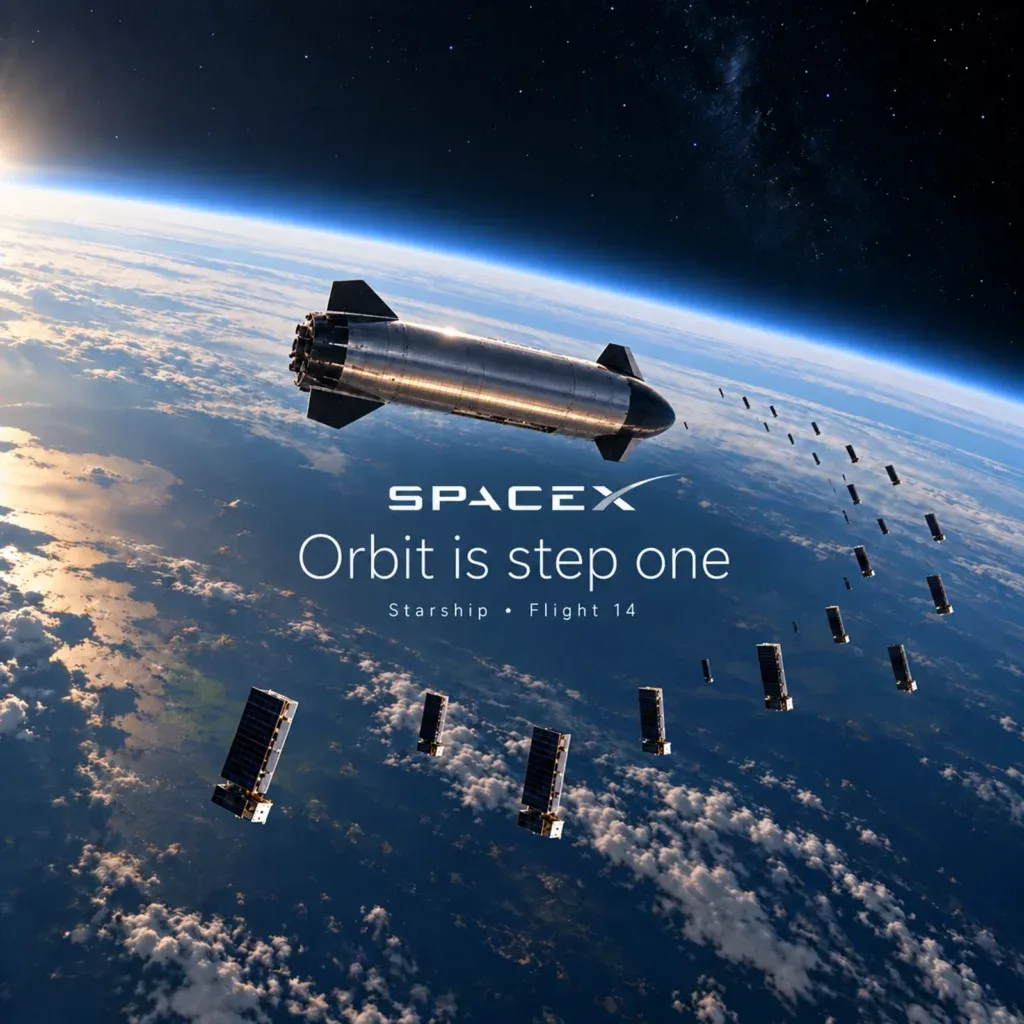

SpaceX reports that Starship reached Earth orbit on September 28 and deployed 26 Starlink V3 satellites during Flight 14. The company says the satellites made contact and must complete checks and raise their orbits before serving customers. The flight demonstrated orbital delivery; customer performance and full vehicle reuse remain separate questions.
The launch matters because it connects a new deployment capability with larger communications payloads. Understanding that connection requires keeping three milestones separate: release into orbit, successful commissioning, and useful service on the ground.
The flight required a separate insertion decision
SpaceX says a vacuum engine stopped early during ascent, with the remaining engines compensating. Controllers assessed the engines needed for later maneuvers before approving orbital insertion. After deployment, they shortened the orbital phase and performed a deorbit burn leading to a controlled northern-Pacific splashdown. These are the operator’s reported outcomes, not an independent reconstruction of telemetry.
An orbit is a continuing trajectory around Earth. The speed and direction needed to sustain it differ from simply reaching a high altitude. A vehicle can reach space on a suborbital path and still return without completing a revolution. A separate insertion maneuver therefore changes the mission’s consequences as well as its headline.
A deployment is not instant network service
SpaceX’s post-flight report explicitly separates satellite contact from on-orbit checks and orbit raising. A successful radio contact is an early sign that a spacecraft is functioning. It does not show that every communications subsystem has met its operational target or that the spacecraft is in its service position.
For a broadband customer, the outcome depends on the complete route: terminal, satellite link, onward transport and the network serving the destination. More available satellite capacity can help, but demand in a particular region and the rest of that route still affect an individual connection.
That is also why a satellite-level capacity figure should not be advertised as a subscriber’s download speed. Capacity is shared and scheduled. A user-level claim needs a measured service condition, including location, congestion and the terminal used.
The useful network metric arrives after deployment
Starship achieved orbit on its first attempt and successfully delivered Starlink V3 satellites to space for the first time → https://t.co/LwJ4g6dNZ3 pic.twitter.com/pnd3k8x6E0
— SpaceX (@SpaceX) September 28, 2026
The official post shows the delivery milestone and includes mission footage. For a customer, the evidence to watch next is commissioning status and measured service under stated conditions. A launch video cannot supply those results.
A simple capacity model explains why. Suppose a particular route has 100 units of available radio capacity, 60 units of onward transport and 80 units at a ground-network constraint. In this deliberately simplified serial example, usable throughput cannot exceed the smallest term: 60 units. Doubling radio capacity to 200 leaves that bound at 60. These are hypothetical units, not V3 specifications or a prediction of Starlink performance.
Real networks add scheduling, competing demand, changing coverage and multiple routes. Still, the model identifies the missing question in a satellite-only headline: which segment currently limits the service? A meaningful comparison should report the terminal, location, time window, congestion and complete route rather than equate a spacecraft’s advertised capacity with an individual download.
The same distinction appears in Marcus Vance’s examination of orbital computing: placing hardware in orbit starts an operating problem involving communications and the environment. Flight 14 answers a delivery question. Reliable service needs observations after delivery.
Reuse economics need a repeated-flight denominator
For a future cost comparison, count successfully commissioned payload as well as launched payload, and record how many vehicles returned to fly again. Then include turnaround time and the work required between flights. These are proposed operating metrics, not values established by this mission.
A rocket could improve the amount delivered per launch while still requiring expensive replacement hardware. Another could return hardware but take too long to sustain the required cadence. The practical outcome depends on both delivered service and repeatable operations. Flight 14 provides a clear milestone to follow with those measurements; it does not fill in their values.
Splashdown is distinct from reuse
The company reports a controlled end to this mission in the ocean. Returning a vehicle for another launch would require a different chain of outcomes: recovery, inspection, refurbishment if needed, and another flight. An orbital success cannot stand in for evidence that this complete reuse cycle has been achieved.
For launch economics, the eventual question is how often the complete system can deliver useful payload and fly again. A single mission cannot provide a reliable operating-cost or cadence estimate. Engine behavior, maintenance workload and turnaround are all relevant evidence to collect over repeated flights.
Flight 14 crossed an important delivery threshold. The next useful observations are satellite entry into service and repeatable flight operations. Those will show how the launch milestone translates into a working communications system.