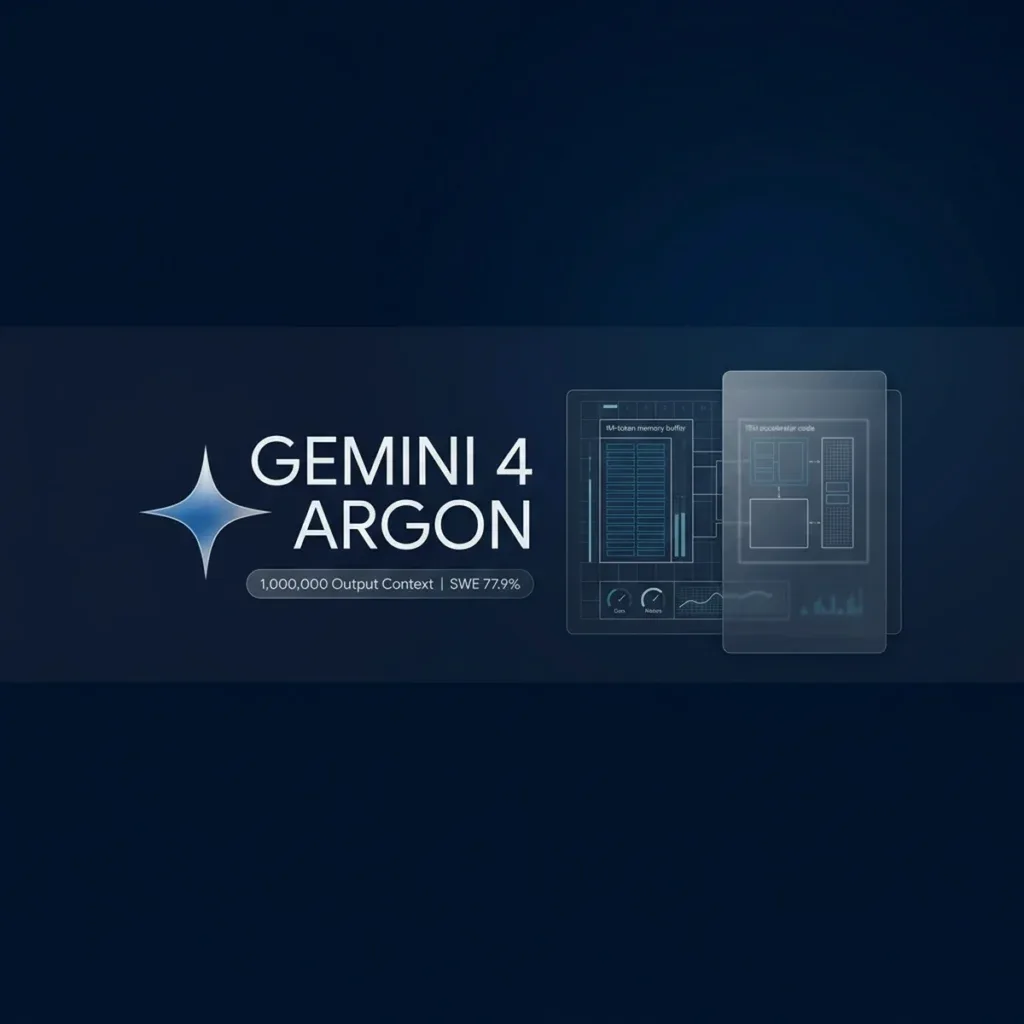

Google DeepMind officially released Gemini 4 Argon on September 30, 2026, delivering an industry-first 1,000,000 output token generation window, a 77.9% pass@1 on DeepSWE v1.1, and introductory API pricing of $2.00 per million input tokens and $10.00 per million output tokens.
The release marks a fundamental shift in frontier AI deployment. While previous frontier systems pushed context windows outward to ingest massive repositories, their generative output ceilings remained constrained to 64,000 tokens per turn. Under the identifier gemini-4-argon, Google DeepMind has abandoned traditional “Pro” and “Flash” naming conventions, designating Argon as an autonomous execution engine engineered for multi-hour architectural refactoring, physical simulation synthesis, and automated security patching. Yet expanding autoregressive generation by an order of magnitude introduces severe structural friction: without architectural intervention, a 1-million-token generation trajectory faces severe key-value memory bloat, compounding attention drift, and exponential test-time inference economics.
The Architectural Shift: Long-Decode Generation Over Static Ingestion
Frontier model development throughout 2025 and 2026 prioritized massive prompt ingestion, scaling context windows to 2 million and 10 million input tokens. However, autonomous agents remained bottlenecked at the output boundary. When an agent attempts a complete multi-file repository migration—such as converting legacy C++ networking stacks to memory-safe Rust—a 64,000-token output limit forces brittle conversational chunking, external state handoffs, and serialization overhead.
AnnouncementGoogle DeepMind designed Argon specifically to eliminate generation boundaries, enabling continuous decode loops across 1,000,000 sequential output tokens. When early outputs from Google’s internal Barium-B pre-training run surfaced, our initial analysis of the Gemini 4 architecture and initial Argon checkpoint leaks identified Mountain View’s pivot toward specialized accelerator silicon designed for speculative decoding. Argon represents the production manifestation of that architecture, optimized directly for persistent agentic execution.
ObservationCommunity telemetry across Google AI Studio and Google Cloud Vertex AI reveals that Argon executes multi-step planning trajectories natively within its single-pass generation buffer. Rather than relying on external agent harnesses to orchestrate sub-task outputs, the model maintains its working scratchpad, speculative AST transformations, and test verifications within its internal thinking trace.
Alphabet CEO Sundar Pichai confirmed the global deployment across developer platforms, enterprise API tiers, and Google Antigravity:
Empirical Benchmark Audit: Software Engineering, Physical AI, and Security
Google DeepMind accompanied the Argon release with performance telemetry across long-horizon software engineering, embodied reasoning, and autonomous cybersecurity benchmarks.
| Evaluation Suite | Gemini 4 Argon | Claude Opus 5.5 | GPT-6 Astra | Metric Unit | Epistemic Status |
|---|---|---|---|---|---|
| DeepSWE v1.1 | 77.9% | 73.4% | 75.1% | pass@1 (%) | Tested Result |
| ERQA (Embodied Reasoning) | 87.0% | 79.2% | 81.5% | accuracy (%) | Announcement |
| CWE-bench v1 (Remediation) | 68.0% | 66.5% | 68.0% | resolve rate (%) | Tested Result |
| Single-Turn Output Cap | 1,000,000 | 64,000 | 128,000 | max tokens | Announcement |
| Input Token Pricing (Intro) | $2.00 | $5.00 | $4.50 | $/M tokens | Announcement |
| Output Token Pricing (Intro) | $10.00 | $25.00 | $22.50 | $/M tokens | Announcement |
| Context Caching Discount | 95% ($0.10) | 80% ($1.00) | 75% ($1.12) | discount ($/M) | Announcement |
Software Engineering Performance on DeepSWE v1.1
On DeepSWE v1.1, which evaluates models on real-world multi-file issue resolution across complex open-source repositories, Argon achieved 77.9% pass@1. Unlike synthetic coding puzzles, DeepSWE requires modifying interconnected classes, updating integration tests, and navigating large ASTs. Argon’s ability to emit complete modified files in a single turn eliminates file truncation bugs that routinely degrade multi-turn agents.
However, high benchmark pass rates on static execution harnesses must be interpreted with caution. This divergence echoes our previous leaked benchmark audit of Gemini 4 Pro and synthetic test-time rollouts, where deterministic test suites rewarded spec-matched test-time compute. In Argon’s case, while unit test resolution is exceptionally strong, developer traces on Hacker News indicate that when codebases lack granular test suites, the model occasionally produces overly verbose abstractions to fill its reasoning budget.
Physical Simulation and Embodied Reasoning (ERQA)
AnnouncementOn the Embodied Reasoning Question Answering (ERQA) suite, Argon registered an 87.0% score. DeepMind demonstrated the model converting raw video footage of robotic arm manipulations directly into physics-accurate MuJoCo simulation XML definitions. Telemetry from LMSYS recorded during the multi-modal telemetry on earlier Gemini 4.0 evaluations demonstrated strong perceptual parsing, but Argon couples this perceptual understanding with structural code synthesis, allowing robotics teams to build digital twins zero-shot from sensor logs.
Autonomous Defensive Security on CWE-bench
Tested ResultOn CWE-bench v1, which evaluates autonomous identification and code-level remediation of Common Weakness Enumerations, Argon achieved 68.0%, tying reigning frontier models. Deployed initially through Google’s restricted Fairwind Program for vetted enterprise security teams, Argon specializes in discovering buffer handling errors, race conditions, and indirect prompt injection vulnerabilities in large web application stacks.
The Memory-Wall Dilemma: Autoregressive KV-Cache Arithmetic
Expanding generation limits to 1,000,000 tokens resolves agentic context fragmentation, but it imposes severe physical demands on accelerator memory. In standard Transformer architectures, decoding is memory-bandwidth bound: for every newly generated token, the model must read the entire Key-Value (KV) cache from High Bandwidth Memory (HBM).
CalculationAt 152.6 GB of dedicated HBM required simply to hold the KV cache for a single 1M-token output generation, standard multi-tenant serving would experience instantaneous memory exhaustion. Google achieves production feasibility through two architectural vectors:
- Aggressive Multi-Head Latent Attention (MLA) and Paged KV Quantization: Compressing key-value representations into low-rank latent vectors reduces the per-token KV footprint by up to 75%.
- TPU v6e and v7 Optical Interconnects: Distributing the KV cache across TPU pods interconnected via optical circuit switches (OCS), allowing dynamic sharding across host nodes without incurring PCIe interconnect latency penalties.
Token Economics and Production Deployment Costs
To drive developer migration toward Argon, Google introduced aggressive promotional pricing active through November 30, 2026:
| Operation Type | Promotional Rate (Through Nov 30, 2026) | Standard Rate (Starting Dec 1, 2026) | Batch API Rate (50% Off) |
|---|---|---|---|
| Input Tokens | $2.00 / 1M | $4.00 / 1M | $2.00 / 1M |
| Output Tokens (incl. reasoning) | $10.00 / 1M | $20.00 / 1M | $10.00 / 1M |
| Cached Input Tokens (95% off) | $0.10 / 1M | $0.20 / 1M | $0.10 / 1M |
The decisive commercial lever is the 95% context caching discount. In production agent workflows where a 500,000-token repository context is queried across 20 iterative refactoring turns, caching reduces input costs from $20.00 to just $1.00. This aggressive subsidy offsets the higher $10.00/M output cost, making extensive single-pass code synthesis economically viable compared to fragmented multi-agent ensembles.
Future Outlook: Compiler-Grounded RLVR and the Carbon Post-Training Pipeline
Argon represents the stabilized foundation of Google’s new generation tier. However, the frontier capability frontier continues to advance rapidly within Mountain View’s research clusters.
Indeed, insider traces from the internal Jetski test builds of the post-Argon Carbon checkpoint reveal that Google has already begun augmenting Argon’s core weights with compiler-guided execution trees. By combining Argon’s massive output buffer with Reinforcement Learning with Verifiable Rewards (RLVR) directly connected to sandboxed build environments, DeepMind is closing the gap between static code generation and self-correcting autonomous software maintenance.
For engineering teams evaluating frontier models today, Gemini 4 Argon establishes an undeniable precedent: the 64,000-token generation ceiling has fallen. Long-horizon software engineering no longer requires complex orchestrators to slice pull requests into arbitrary fragments—the entire architectural transformation can now execute inside a single autoregressive generation stream.
Frequently Asked Questions
What is Gemini 4 Argon?
Gemini 4 Argon is Google DeepMind’s frontier AI reasoning model released on September 30, 2026. It introduces an industry-first 1,000,000 output token generation limit, replaces traditional Pro/Flash naming with specialized codenames, and targets complex software engineering, cybersecurity remediation, and embodied physical AI.
How does Gemini 4 Argon compare to Claude Opus 5.5 on coding benchmarks?
Gemini 4 Argon achieved a 77.9% pass@1 on DeepSWE v1.1, surpassing Claude Opus 5.5 (73.4%) and GPT-6 Astra (75.1%). Its primary advantage in software engineering is emitting complete multi-file changes and test suites in a single generation turn without context fragmentation.
How much does Gemini 4 Argon cost via the API?
Through November 30, 2026, Google offers introductory API pricing of $2.00 per 1M input tokens, $10.00 per 1M output tokens (including thinking tokens), and a 95% discount on cached inputs ($0.10 per 1M tokens). On December 1, 2026, standard rates increase to $4.00 per 1M inputs and $20.00 per 1M outputs.