
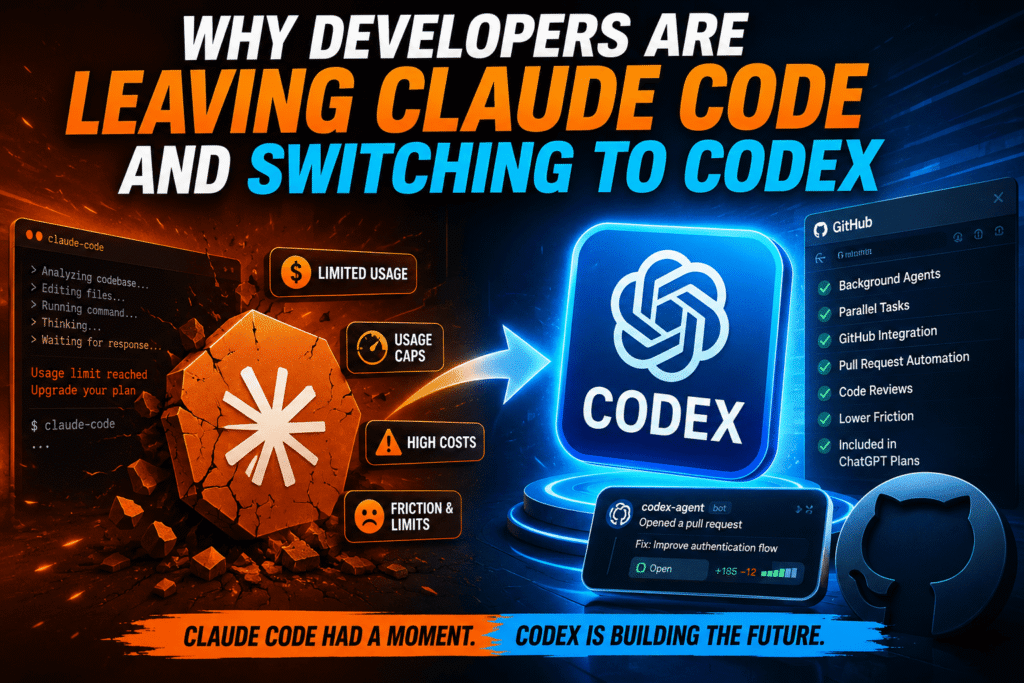

Developers switching from Claude Code to Codex is not just another AI hype cycle. It is a real shift in how software teams want to build now.
Claude Code had the early crown. It made agentic coding feel real. It sat in the terminal, understood big codebases, edited files, ran commands, and helped developers ship faster. Anthropic still describes Claude Code as an agentic coding tool that can read a codebase, edit files, run commands, and work across terminal, IDE, desktop app, and browser.
But the market has moved.
Developers do not only want a smart terminal buddy anymore. They want an AI agent that can work inside GitHub, create pull requests, review code, fix CI failures, run in the background, handle parallel tasks, and fit into team workflows without constant babysitting.
That is where Codex is winning.
OpenAI describes Codex as a coding agent that can read, edit, and run code. More importantly, Codex cloud can work on background tasks, including parallel tasks, inside its own cloud environment. It can connect to GitHub and create pull requests from its work.
That one difference explains the whole battle.
Claude Code feels like a powerful assistant inside your development environment. Codex feels like an agent that can move through the full software workflow.
And in 2026, the full workflow wins.
Quick Answer: Why Are Developers Switching From Claude Code to Codex?
Developers are switching from Claude Code to Codex because Codex is becoming the stronger workflow tool. It has better GitHub-native features, background task execution, parallel agent support, pull request automation, easier migration, and stronger momentum inside the developer ecosystem.
Claude Code is still strong for terminal-first developers. But Codex is winning the bigger race because software development is moving from “AI helps me code” to “AI agents complete work across GitHub, IDEs, branches, reviews, and pull requests.”
The Real Reason Codex Is Winning: GitHub Is Changing the Game
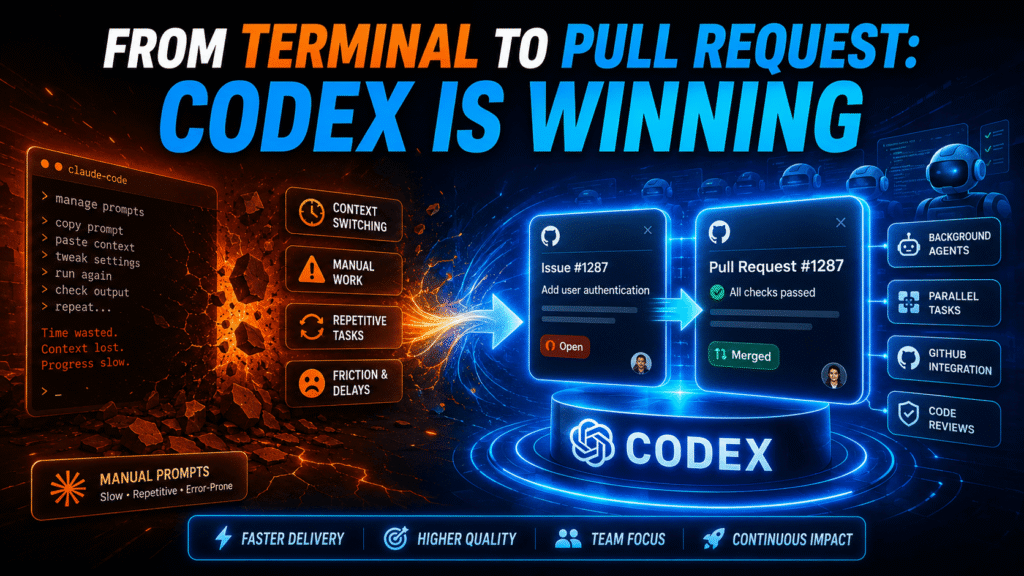
The biggest reason developers are switching from Claude Code to Codex is not only model quality. It is GitHub.
GitHub is no longer just a place to store code. It is becoming the control room for AI agents.
GitHub announced Agent HQ as its vision for bringing coding agents directly into the GitHub flow. GitHub says agents should not be bolted on. They should work the way developers already work.
Then GitHub made the story even bigger. Claude by Anthropic and OpenAI Codex became available in public preview on GitHub and VS Code for Copilot Pro+ and Copilot Enterprise users.
That is huge.
It means GitHub is turning the coding-agent market into a platform battle. The winner is not just the model with the best benchmark score. The winner is the agent that works where developers already live.
And developers live in:
- GitHub Issues
- Pull requests
- Code reviews
- CI failures
- Branches
- Repository instructions
- VS Code
- GitHub Actions
- Team workflows
Claude Code can do serious development work. No doubt. But Codex is positioning itself directly inside the GitHub loop.
That is why Codex is dangerous for Anthropic.
Anthropic built a great terminal experience. OpenAI is building a workflow machine.
Codex Is Not Just Coding. It Is Pull Request Automation.
OpenAI’s Codex GitHub integration lets developers request reviews with @codex review, turn on automatic reviews, customize review guidelines, and ask Codex to fix problems in the same pull request.
OpenAI says Codex reviews the pull request diff, follows repository guidance, and posts a standard GitHub code review focused on serious issues.
This is where Codex starts firing shots at Claude Code.
Claude Code asks: “What do you want to do in your terminal?”
Codex asks: “What do you want shipped?”
That difference matters.
A developer using Claude Code may still need to:
- Ask Claude Code to inspect the issue
- Approve edits
- Run tests
- Review local diffs
- Create a branch
- Push changes
- Open a pull request
- Ask for review
With Codex, the workflow can become:
- Tag Codex
- Let it work
- Review the pull request
- Ask it to fix the issue
- Merge when ready
That is not a small feature gap. That is a workflow gap.
And workflow gaps are how developer tools win.
GitHub’s Agent Future Makes Claude Code Look Less Central
GitHub’s own Copilot coding agent is now built around background work, planning, branches, pull requests, and review loops.
GitHub says Copilot coding agent can research a repository, create an implementation plan, make code changes on a branch, improve test coverage, update docs, resolve merge conflicts, and optionally open a pull request.
This is the direction of the entire industry.
The new software workflow is not:
Open terminal. Ask AI. Copy code. Fix manually.
The new workflow is: Assign agent. Let it work in the background. Review the diff. Merge the pull request. Codex fits this shift better than Claude Code.
That is why developers switching from Claude Code to Codex are not just changing tools. They are changing the way they build.
Claude Code is still excellent when you want deep local control. But GitHub is making local-only workflows feel smaller. The center of gravity is moving from the terminal to the pull request.
And Codex is sitting exactly where that gravity is moving.
Codex Has the Background Agent Advantage
OpenAI says Codex cloud can work on tasks in the background, including in parallel, using its own cloud environment.
That is a major advantage. The future is not one chat window. It is not one terminal session. It is not one prompt at a time.
The future is multiple agents running in parallel.
A real developer does not have one task. A real developer has ten:
- Fix this bug
- Write this test
- Review this PR
- Update this dependency
- Refactor this module
- Investigate this flaky test
- Build this small feature
- Clean this documentation
- Check this security risk
- Prepare this release note
Claude Code can help with these tasks. But Codex is building the command center for them.
That is why Codex feels like the winner.
Anthropic’s Big Problem: Claude Code Plans and Limits Feel Painful
Now let us talk about the part Anthropic fans do not like.
Claude Code is powerful, but its plan and usage story has become a pain point.
Anthropic says Pro and Max usage limits are shared across Claude and Claude Code. That means your activity in both tools counts against the same usage limits. When users hit limits, Anthropic suggests upgrading, enabling extra usage, switching to pay-as-you-go usage, or waiting for limits to reset.
That is not the developer dream.
The developer dream is: “I am in flow. Do not interrupt me.”
The Claude Code plan reality can feel like: “You are in flow. Now think about limits.”
That is a bad place to put a developer. Anthropic’s own Claude Code cost page says costs vary based on model choice, codebase size, automation, and usage patterns. It also says enterprise deployments average around $13 per developer per active day and $150 to $250 per developer per month.
To be fair, good engineering tools cost money. A serious AI coding agent can save hours. If Claude Code saves a developer one hour per day, many teams will gladly pay.
But OpenAI is attacking the same market with a simpler message: Codex is included in ChatGPT Plus, Pro, Business, Edu, and Enterprise plans.
That is why this pricing fight matters.
Anthropic is saying: “Manage your limits carefully.”
OpenAI is saying: “Codex is already in your ChatGPT plan.” That is a brutal contrast.
OpenAI Is Making Switching Easier
OpenAI is not waiting for developers to casually discover Codex. It is actively lowering the friction to switch.
OpenAI’s “Switch to Codex” page tells users to download the Codex app, sign in with ChatGPT, migrate their setup through onboarding or Settings, and resume work in Codex.
That is a direct shot at Claude Code.
Because migration is usually where tools lose users. Developers hate rebuilding configuration, instructions, plugins, skills, and project setup.
OpenAI is saying: “Bring your setup. Keep moving.”
That is smart. Very smart.
It means OpenAI is not only competing on model quality. It is competing on switching cost. And in software, the product with lower switching friction often grows faster.
AGENTS.md Is Quietly Becoming a Big Deal
Codex also benefits from the growing importance of portable agent instructions.
OpenAI’s Codex GitHub review docs say Codex can follow repository-specific guidance. These instructions can customize review behavior, such as checking for security regressions or avoiding PII logging.
This matters because teams need agents to understand their rules.
A good AGENTS.md file can tell Codex:
- How to run tests
- How to build the app
- What files to avoid
- How to name branches
- What security risks to check
- What coding style to follow
- What counts as a good pull request
- What not to change without approval
Claude Code has its own configuration world, including Claude-specific memory and project files. That is useful if you are fully inside Claude’s ecosystem.
But the wider agent market is moving toward portable instructions and shared workflows.
Codex is riding that wave. Claude Code feels like Anthropic’s kingdom.
Codex feels like it wants to work everywhere. That is why developers switching from Claude Code to Codex often feel like they are moving from a single tool to an agent platform.
Codex Also Has the Open-Source and CLI Angle
OpenAI also has an official Codex GitHub repository for its lightweight coding agent that runs in the terminal.
That matters because developers trust tools they can inspect, install, discuss, and track in public.
The Codex ecosystem now has multiple surfaces:
- Codex cloud
- Codex in ChatGPT
- Codex GitHub integration
- Codex CLI
- Codex app
- Codex inside GitHub Agent HQ
This creates a bigger product surface than a simple coding assistant.
Claude Code may still be loved by terminal power users. But Codex is becoming a full-stack coding-agent platform.
That is the real threat.
Claude Code Had a Trust Problem, and Anthropic Admitted It
This is where the shot gets sharper. Anthropic published a postmortem about Claude Code quality reports. Anthropic said it investigated reports of degradation, found issues, and resolved them as of April 20, 2026 in version 2.1.116. The company said the API and inference layer were unaffected, but it acknowledged product-level problems around Claude Code, Claude Agent SDK, and Claude Cowork.
That admission matters.
Developers can forgive bugs. Developers cannot forgive silent quality drops during paid work.
If an AI coding tool gets worse, developers waste time. They blame themselves. They rewrite prompts. They rerun sessions. They burn usage. They lose trust.
That is the real damage.
Claude Code did not lose because it became useless. It lost momentum because developers started asking a dangerous question:
“Can I trust this tool to stay consistent tomorrow?”
Once that question enters the room, competitors get a chance.
Codex walked in at the right time.
Codex Is Winning Momentum Because It Feels Like the Future
The reason developers switching from Claude Code to Codex feels like a trend is simple: Codex is aligned with where software work is going.
Software work is becoming:
- More asynchronous
- More agent-driven
- More GitHub-native
- More PR-centered
- More parallel
- More team-managed
- More review-heavy
- More automated
Claude Code is still strongest when a developer wants to sit in the driver’s seat.
That is valuable. But Codex is stronger when a developer wants to become a manager of agents.
That is the future.
A senior engineer does not want to spend the whole day manually prompting one assistant. A senior engineer wants to delegate five tasks, compare outputs, review diffs, and move faster.
OpenAI understands this.
The Codex app is not just another coding UI. It is a statement: “The developer is becoming an agent manager.”
Claude Code helped create the agentic coding wave. Codex is productizing the next phase.
Claude Code Still Has Strengths
Let us be honest. Claude Code is not dead.
Claude Code is still one of the best tools for terminal-first developers. It is strong when you want tight local control, deep codebase understanding, step-by-step edits, and direct command execution.
Claude Code is still great for:
- Debugging strange local issues
- Understanding legacy code
- Running terminal-heavy workflows
- Working inside unusual repositories
- Pairing closely with the agent
- Reviewing every action before it happens
- Doing exploratory architecture work
If your work style is “sit with the agent and steer it,” Claude Code can still be excellent.
But if your work style is “assign the agent and review the result,” Codex is becoming harder to ignore.
That is the key difference.
Claude Code is a great coding companion.
Codex is becoming a coding workforce.
Codex vs Claude Code: Who Wins?
| Category | Winner | Why |
|---|---|---|
| Terminal-first coding | Claude Code | Better for interactive local workflows |
| GitHub pull requests | Codex | Built around PR review, fixes, and GitHub tasks |
| Background work | Codex | Codex cloud runs tasks in the background and in parallel |
| Parallel agents | Codex | Codex is designed for delegated and parallel coding work |
| Plan simplicity | Codex | Codex is included in eligible ChatGPT plans |
| Deep local control | Claude Code | Strong CLI and developer-controlled workflow |
| Team workflow | Codex | Better aligned with GitHub, branches, reviews, and PRs |
| Momentum | Codex | OpenAI, GitHub, migration tools, and agent workflows are all pushing forward |
Final winner: Codex.
Not because Claude Code is weak.
Codex wins because the battlefield changed.
The New Developer Workflow: From Pair Programmer to Agent Manager
Old AI coding workflow: “Ask AI to help write code.”
New AI coding workflow: “Assign AI agents to ship work.”
This is why GitHub matters so much. GitHub says Copilot coding agent can work independently in the background, create plans, make code changes, and help with tasks like bugs, features, test coverage, documentation, technical debt, and merge conflicts.
That means GitHub itself is training developers to think in agent tasks.
Once developers get used to assigning work from issues, pull requests, and agent panels, terminal-only tools feel less central.
Claude Code may still be the better pair programmer for some people.
But Codex is closer to the new job description:
“AI agent that takes work from the software system and returns a reviewable pull request.” That is the future of coding.
Why Anthropic Should Be Worried
Anthropic should be worried for five reasons.
First, Claude Code’s limits story is weaker. Shared Claude and Claude Code usage limits create friction for developers who use AI heavily.
Second, Claude Code’s enterprise cost story is not light. Anthropic says average enterprise usage is around $13 per developer per active day and $150 to $250 per developer per month.
Third, Claude Code had a public trust hit after Anthropic had to explain recent quality issues.
Fourth, GitHub is turning agents into a platform layer, and Codex is already deeply tied into that direction.
Fifth, OpenAI is actively making it easier to switch into Codex.
That is a nasty combination. Anthropic may still have excellent models. Claude may still feel brilliant in many coding sessions. But this market is not only about intelligence.
It is about distribution, workflow, pricing, trust, and habit. OpenAI is attacking all five.
Why Codex Is the Winner Right Now
Codex is winning because it is not trying to be only a better coding chatbot.
It is trying to become the operating layer for software agents.
Codex has:
- Cloud background tasks
- Parallel execution
- GitHub pull request workflows
- Code review automation
@codexGitHub actions- App-based multi-agent management
- Setup migration
- ChatGPT plan bundling
- CLI and GitHub ecosystem presence
- Strong alignment with GitHub’s agent future
That is the full stack. Claude Code still has the respect of developers. But Codex has the stronger strategic position.
Developers switching from Claude Code to Codex are not saying Claude cannot code. They are saying Codex fits how modern software teams want to work.
And that is the shot Anthropic needs to answer.
People Also Ask
Why are developers switching from Claude Code to Codex?
Developers are switching from Claude Code to Codex because Codex is stronger for GitHub workflows, pull requests, background tasks, parallel agents, migration, and team-based development.
Is Codex better than Claude Code?
Codex is better for GitHub-native workflows and background agent work. Claude Code is better for terminal-first, interactive, local development.
Is Claude Code still worth using?
Yes. Claude Code is still worth using if you want deep local control, strong terminal workflows, and close collaboration with an AI coding assistant.
Does Codex work with GitHub?
Yes. Codex can connect to GitHub, work with repositories, create pull requests, review PRs, and respond to @codex mentions in GitHub comments.
Is Codex included in ChatGPT?
Yes. OpenAI says Plus, Pro, Business, Edu, and Enterprise plans include Codex, though usage depends on plan limits and task complexity.
What is the biggest weakness of Claude Code?
The biggest weakness of Claude Code is not coding ability. It is friction: usage limits, cost management, plan complexity, and the fact that its strongest experience is still more terminal-centered than GitHub-centered.
Final Verdict
Developers switching from Claude Code to Codex are following the future of software development.
Claude Code won the first round of agentic coding by proving that an AI coding assistant could work seriously inside a real codebase.
But Codex is winning the next round.
Why? Because Codex is not only helping developers write code. It is helping developers manage coding agents across GitHub, pull requests, background tasks, parallel workflows, and team review systems.
That is the bigger prize. Anthropic still has great models. Claude Code still has loyal users. But OpenAI is playing a more aggressive game. It is bundling Codex into ChatGPT plans, pushing GitHub workflows, adding migration tools, building around parallel coding tasks, and turning Codex into a serious agent platform.
Claude Code is a great tool. Codex is becoming the new workflow. And in developer tools, the workflow always wins.