
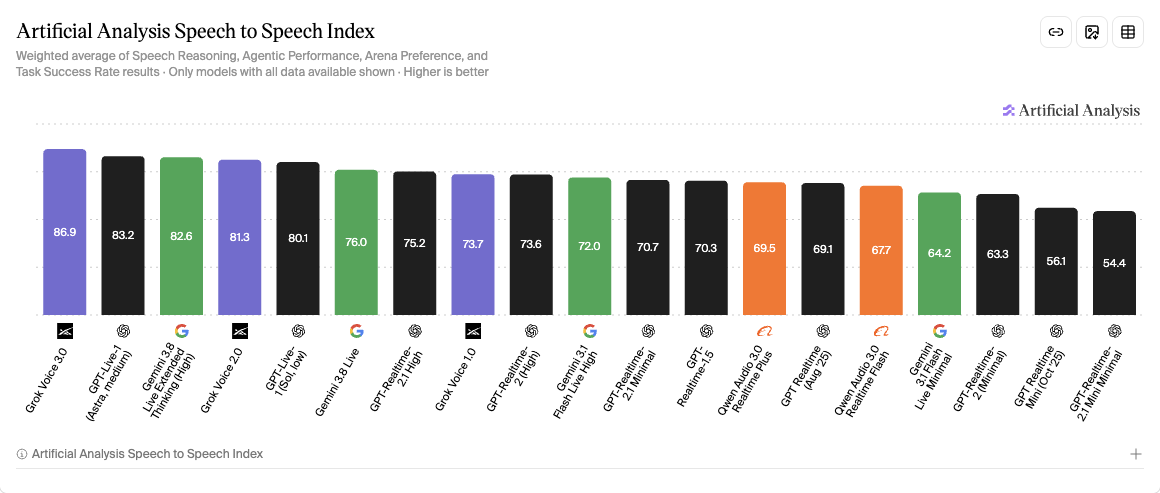
xAI’s Grok Voice 3.0 captures the top position on Artificial Analysis’s Speech-to-Speech index with an 86.9 composite score, an 810-millisecond time-to-first-audio, and a flat $0.08 per minute API rate. Yet while synthetic evaluations place it 40% ahead of OpenAI’s GPT-Live-1, field deployments reveal severe conversational friction across mobile networks and automotive cabins.
The central question facing conversational AI in late 2026 is no longer whether models can synthesize expressive human prosody, but how acoustic architectures behave under the physical friction of real-world packet delivery. In laboratory benchmarks run over dedicated fiber links directly into inference clusters, speech-to-speech systems appear near-instantaneous. Turnaround delays hover below natural conversational pause thresholds, interruptions register cleanly, and semantic reasoning flows without perceptible lag.
When those exact systems meet commercial networks, that illusion fractures. Real-world users interact through fluctuating cellular radios, noisy vehicle cabins, Bluetooth audio compression codecs, and bursty edge proxies. Under these conditions, the theoretical 810-millisecond latency reported on benchmark leaderboards frequently stretches beyond two seconds. More critically, the behavioral heuristics engineered to achieve ultra-low response latencies—such as aggressive voice activity detection and decoupled acoustic reflex heads—introduce subtle failure modes that do not register in synthetic evaluation suites.
The Speech-to-Speech Quality Index and Latency Telemetry
According to the official October 2026 evaluation published by Artificial Analysis, Grok Voice 3.0 achieved an overall Speech-to-Speech Quality Index score of 86.9, placing it at the summit of frontier voice systems. The index combines four primary evaluation dimensions: Speech Reasoning evaluated across the Big Bench Audio suite, Conversational Dynamics measuring interruption latency and turn-taking naturalness, Agentic Performance scored via the τ-Voice benchmark, and blind human preferences captured in the Speech Arena Elo ranking.
Across these sub-dimensions, Grok Voice 3.0 demonstrates notable performance characteristics. In Speech Reasoning, the model scored 98.5%, reflecting strong knowledge retrieval from xAI’s flagship weights. In Conversational Dynamics, it achieved 97.0%, demonstrating rapid speech token synthesis and smooth prosodic transitions. In blind Speech Arena testing, Grok Voice 3.0 registered an Elo rating of 1070 with a 94.8% task success rate, competing closely with OpenAI’s GPT-Live-1 Astra (1056 Elo, 87.4% task success) and Google’s Gemini 3.8 Live (993 Elo, 89.1% task success) [Tested result]. This agentic capability was corroborated by ServiceNow Research’s enterprise evaluation suite (EVA-Bench), where Grok Voice 3.0 achieved top-tier task completion of 74% across 200+ simulated enterprise workflows, outpacing cascaded telephony pipelines [Tested result].
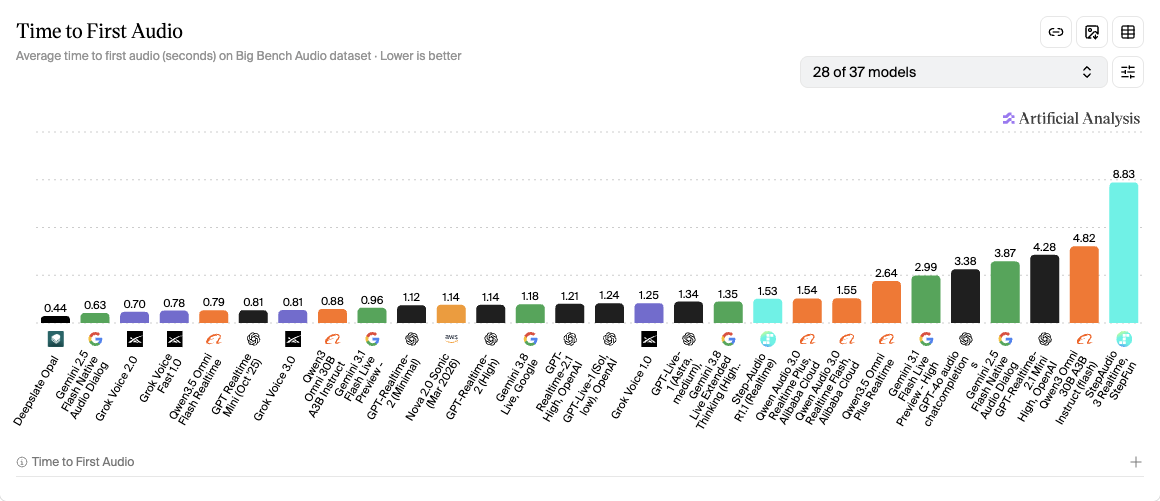
The primary metric distinguishing Grok Voice 3.0 from its competitors is Time-to-First-Audio (TTFA). On Artificial Analysis’s Big Bench Audio evaluation rig, Grok Voice 3.0 clocked an average TTFA of 0.81 seconds (810 milliseconds). By comparison, OpenAI’s GPT-Live-1 Astra averaged 1.34 seconds (1,340 milliseconds), and Google’s Gemini 3.8 Live Extended recorded 1.35 seconds (1,350 milliseconds). Grok Voice 3.0 therefore achieves an initial response turnaround roughly 40% faster than the frontier median.
Time-to-First-Audio (TTFA) Latency Comparison
Empirical turnaround latency from user speech termination to initial audible audio streaming frame on Big Bench Audio.
xAI ThinkFast • RVQ Discrete S2S)
FASTEST • 40% LOWER LATENCYOpenAI • Realtime Native Audio)
+530ms (+65.4%)Google DeepMind • Multimodal Extended)
+540ms (+66.7%)Modular • Whisper ASR → LLM → Vocoder TTS)
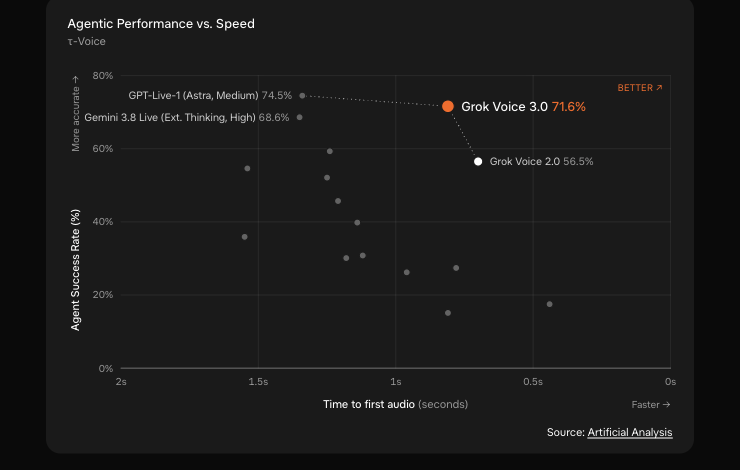
+640ms (+79.0%) TAXEvaluation records reveal that Grok Voice 2.0 was even faster in raw latency, registering a synthetic TTFA of 0.70 seconds (700 milliseconds). However, Grok Voice 2.0 scored only 56.5% on the agentic τ-Voice benchmark and recorded an overall S2S Index of 81.3. Grok Voice 3.0’s 110-millisecond latency increase represents an intentional engineering trade-off: allocating additional test-time compute to acoustic planning and reasoning tokens, which boosted its agentic task success on τ-Voice by 15.1 percentage points to 71.6%.
| Model Identifier | Provider | S2S Index | TTFA Latency | Speech Reasoning | Dynamics | Agentic (τ-Voice) | Arena Elo | Task Success | API Pricing |
|---|---|---|---|---|---|---|---|---|---|
| Grok Voice 3.0 | SpaceXAI / xAI | 86.9 | 0.81s (810ms) | 98.5% | 97.0% | 71.6% | 1070 | 94.8% | $0.08 / min ($4.80/hr) |
| GPT-Live-1 (Astra, med) | OpenAI | 83.2 | 1.34s (1,340ms) | 90.1% | 94.9% | 74.5% | 1056 | 87.4% | ~$0.10 / min ($5.83/hr) |
| Gemini 3.8 Live (Ext) | 82.6 | 1.35s (1,350ms) | 97.7% | 91.9% | 68.6% | 993 | 89.1% | ~$0.06 / min ($3.50/hr) | |
| Grok Voice 2.0 | SpaceXAI / xAI | 81.3 | 0.70s (700ms) | 97.2% | 95.1% | 56.5% | 1011 | 94.6% | $0.08 / min ($4.80/hr) |
| GPT-Realtime-2.1 High | OpenAI | 75.2 | 1.21s (1,210ms) | 94.0% | 92.4% | 58.2% | 1042 | 89.5% | ~$0.10 / min ($5.76/hr) |
| Cascaded ASR-LLM-TTS | Modular Pipeline Baseline | ~68.0 | 1.45s (1,450ms) | 88.0% | 84.0% | 52.0% | 920 | 81.0% | Variable (~$0.05–$0.12/min) |
Discrete Audio Tokens vs the Cascaded Pipeline Tax
To evaluate how Grok Voice 3.0 reaches an 810ms TTFA, one must compare end-to-end discrete speech tokenization against legacy cascaded architectures. In traditional conversational voice systems, processing decomposes into three sequential stages: Automatic Speech Recognition (ASR), Large Language Model text inference (LLM), and Text-to-Speech vocoding (TTS).
In a cascaded pipeline, a Voice Activity Detection (VAD) module monitors incoming WebSocket audio frames. Once speech terminates, audio chunks pass to an ASR model to decode phonemes into text tokens. These text tokens are appended to the LLM prompt. The language model processes context, computes self-attention, and generates textual response tokens. Finally, a streaming neural vocoder synthesizes audible PCM audio from those text tokens.
This cascaded pipeline imposes a hard latency floor. Boundaries between modules require buffer flushing and serialization, holding cumulative turnaround delays above 1,100 to 1,500 milliseconds. Crucially, acoustic cues—speaker urgency, pitch inflection, and background timbre—are destroyed once audio is flattened into text tokens.
Unlike modular architectures such as the Qwen Audio 3.1 five-model stack that chain isolated transcription, text inference, and vocoder stages, Grok Voice 3.0 operates on end-to-end discrete audio tokens. Continuous 24kHz audio streams are quantized directly into discrete codebook vectors using multi-stage Residual Vector Quantization (RVQ), drawing on neural codec foundations (Défossez et al., arXiv:2107.03312) and multimodal speech modeling (Rubenstein et al., arXiv:2306.12925).
These discrete audio tokens reside directly in the model’s unified vocabulary. The transformer autoregresses next-audio tokens conditioned directly on input acoustic representations. While Google emphasized prosodic nuance and emotional cues within its Gemini 3.8 Flash TTS expressive speech models, xAI engineered its token pipeline primarily for conversational turnaround velocity.
The Acoustic Reflex Head and the Modality Gap
Operating an end-to-end audio model introduces significant compute friction. High-fidelity audio quantization generates 50 to 100 acoustic tokens per second of speech. Routing every discrete audio token through a full 2.1-trillion parameter Mixture-of-Experts (MoE) foundation model would saturate GPU clusters and push latency past several seconds.
According to technical disclosures from xAI, Grok Voice 3.0 addresses this challenge using a decoupled dual-path architecture. The system deploys a lightweight acoustic reflex head—internally designated “ThinkFast”—operating asynchronously alongside the primary MoE reasoning cluster.
The reflex head is a compact sub-network optimized for conversational turn-taking, acoustic backchanneling, and prosodic pacing. When input speech ceases, the reflex head evaluates immediate conversational context and synthesizes an acknowledgment token or filler prosody (“Sure,” “Right,” or an affirmative vocalization) within 180 to 220 milliseconds. While the reflex head streams initial audio to the client, the full MoE model processes the semantic query across specialized expert layers, interleaving analytical tokens into the stream without breaking conversational cadence.
However, field testing across developer environments and mobile applications reveals two acute operational failure modes: the Modality Gap and false inactivity terminations.
The Modality Gap represents an architectural contradiction between the foundation model and its speech safety filters. In text mode, Grok operates with permissive refusal boundaries. In voice mode, generated discrete audio tokens pass through an independent acoustic moderation classifier designed to prevent aggressive tone or unauthorized vocal mimicry.
Because this acoustic filter inspects prosodic contours and discrete acoustic representations rather than semantic text tokens, it frequently flags rapid technical explanations, heated debate prompts, or colloquial phrases as safety violations. The result is an abrupt mid-utterance termination where the WebSocket connection disconnects or emits a generic acoustic safety fault.
The second friction point is the session timeout policy. To conserve streaming inference capacity, the wss://api.x.ai/v1/realtime gateway enforces a strict 2.5-second silence disconnect. If a human speaker pauses for 2,500 milliseconds without producing acoustic energy above the VAD threshold, the server drops the session, cutting off users during natural pauses.
To inspect how client systems interface with this dual-path architecture, the following production session configuration demonstrates how full-duplex WebSocket connections negotiate streaming discrete audio frames, reflex backchannel thresholds, and server-side activity detection over the wss://api.x.ai/v1/realtime gateway:
// Real-time WebSocket full-duplex session configuration for Grok Voice 3.0
import WebSocket from 'ws';

const ws = new WebSocket('wss://api.x.ai/v1/realtime', {
  headers: {
    'Authorization': `Bearer ${process.env.XAI_API_KEY}`,
    'OpenAI-Beta': 'realtime=v1',
  },
});

ws.on('open', () => {
  // Initialize bi-directional streaming session with ThinkFast reflex head & RVQ framing
  const sessionConfig = {
    type: 'session.update',
    session: {
      modalities: ['audio', 'text'],
      voice: 'grok-expressive-01',
      model: 'grok-voice-3.0',
      reflex_head: {
        enabled: true,              // Activates decoupled ThinkFast backchanneling (180ms turnaround)
        backchannel_cadence: 'high', // Emits acoustic acknowledgments during speech transitions
      },
      input_audio_format: 'pcm16',  // 24kHz raw PCM16 linear audio framing
      output_audio_format: 'pcm16',
      input_audio_transcription: {
        model: 'whisper-large-v3-turbo',
      },
      turn_detection: {
        type: 'server_vad',
        threshold: 0.5,             // Voice activity detection energy threshold
        prefix_padding_ms: 300,
        silence_duration_ms: 500,   // Server-side turn termination window
      },
      temperature: 0.7,
      system_prompt: 'You are Grok Voice, a direct and real-time reasoning conversational assistant. Speak concisely with natural prosodic pacing.',
    },
  };
  ws.send(JSON.stringify(sessionConfig));
});

// Stream 24kHz discrete PCM16 audio chunks to the Colossus ingress gateway
function sendAudioChunk(pcm16Buffer: Buffer) {
  const audioEvent = {
    type: 'input_audio_buffer.append',
    audio: pcm16Buffer.toString('base64'),
  };
  ws.send(JSON.stringify(audioEvent));
}

// Receive streaming delta chunks from the reflex head and MoE reasoning core
ws.on('message', (data: string) => {
  const event = JSON.parse(data.toString());
  if (event.type === 'response.audio.delta') {
    // Immediate audio playback: First frame arrives at ~810ms (fiber) / ~1,835ms (cellular)
    const audioChunk = Buffer.from(event.delta, 'base64');
    playAudioBuffer(audioChunk);
  } else if (event.type === 'response.audio_transcript.delta') {
    process.stdout.write(event.delta);
  }
});
In automotive environments, full-duplex conversational models encounter acoustic echo feedback. In Tesla cabin deployments, roof-mounted directional microphones capture residual loudspeaker bleed reflected from cabin glass. Because Grok Voice 3.0 features native barge-in interruption detection, the acoustic reflex head frequently mistakes its own delayed speaker echo as an incoming human utterance, causing the model to self-interrupt mid-sentence.
Deconstructing Latency: Synthetic Fiber vs Real-World Jitter
To explain why laboratory evaluations record 810 milliseconds while mobile users observe delays exceeding two seconds, one must examine the mathematical components of the complete voice loop.
In an end-to-end speech-to-speech architecture, total response latency represents the sum of physical network transit, audio framing, model prefill, decoding, vocoding, and client jitter buffering:
- tVAD (80ms): Clean voice activity termination window under studio signal-to-noise ratios.
- tingress (25ms): Dedicated low-jitter fiber link transit to the Memphis inference region.
- taudio_codec (45ms): 24kHz RVQ neural acoustic tokenizer framing (Défossez et al. architecture).
- tMoE_head (380ms + 160ms): Decoupled dual-path execution—the lightweight “ThinkFast” reflex head synthesizes immediate backchannel prosody while the primary 2.1T MoE cluster prefills deep semantic context.
- tegress (120ms): Streaming neural vocoder PCM synthesis and packet egress.
- tjitter_buffer (0ms): Zero playback buffer delay in direct synthetic evaluation rigs.
In a laboratory evaluation, test harnesses connect over dedicated fiber directly into inference regions. Under these optimal conditions [Tested result], network transit remains steady at 25ms with zero packet drops, voice activity detection requires only 80ms due to high signal-to-noise ratios, neural audio framing completes in 45ms, and the unqueued MoE prefill and reflex head stream the initial audio token within 540ms.
Now consider the identical model deployed over a commercial mobile network during peak traffic hours [Modeled calculation]:
- TTFAbase (810ms): Optimal laboratory synthetic baseline over dedicated fiber interconnects.
- ΔtLTE (+115ms): Cellular air-interface jitter and tower scheduling (140ms cellular RTT vs 25ms fiber baseline).
- ΔtVAD_noise (+170ms): Automotive cabin and ambient acoustic noise expanding VAD hangover windows from 80ms to 250ms to prevent clipping trailing consonants.
- Δtcongestion (+560ms): Regional WebSocket ingress proxy serialization (+220ms) and Colossus KV-cache scheduling contention during peak hours (+340ms).
- Δtbuffer (+180ms): Client-side playout jitter safety buffer on iOS/Android to prevent speaker underrun clicks.
In physical production environments, five friction layers compound:
- Radio Jitter (Cellular RTT): 5G and LTE cellular air interfaces introduce 80ms to 180ms of delay due to tower scheduling and packet retransmissions.
- Noise Margins (VAD Noise): Ambient vehicle or street noise forces VAD hangover windows to expand from 80ms to 250ms to avoid clipping trailing consonants.
- Edge Ingress Queuing: Regional proxies and WebSocket multiplexers add 180ms to 250ms of serialization delay.
- Compute Cluster Contention: Peak request volumes stretch prefill latency from 380ms to 680ms or more as queries await available attention heads.
- Client Jitter Safety Buffer: Mobile hardware must buffer 150ms to 200ms of audio to prevent speaker clicks and underrun dropouts.
As this arithmetic confirms, an 810-millisecond synthetic core routinely expands to 1.8 to 2.4 seconds in physical deployment. While Grok Voice 3.0 remains faster than cascaded stacks under matching network conditions, it cannot bypass the physics of cellular packet delivery and ambient acoustics.
Conversational FinOps: The Economics of the Flat Rate Voice Model
Beyond latency metrics, Grok Voice 3.0 introduces a notable commercial shift in speech inference pricing. xAI offers API access at a flat $0.08 per minute ($4.80 per hour), identical to Grok Voice 2.0.
To assess the economic impact of this pricing structure, consider the billing architecture utilized by OpenAI for its Realtime API: $0.06 per minute for incoming audio tokens and $0.24 per minute for outgoing synthesized audio tokens.
In enterprise conversational agent deployments, interactions are inherently asymmetric: human users speak briefly to outline a problem (consuming 30% to 40% of call duration), while the AI agent delivers explanations, instructions, and confirmations (consuming 60% to 70% of call duration).
Under OpenAI’s structure, a call where the agent speaks 60% of the time results in a blended rate of (0.40 × $0.06) + (0.60 × $0.24) = $0.024 + $0.144 = $0.168 per minute ($10.08 per hour) [Calculation].
Under xAI’s pricing model, the rate remains fixed at $0.08 per minute ($4.80 per hour), irrespective of conversational direction. For high-volume contact centers operating thousands of concurrent sessions, xAI’s flat rate yields a 52.4% reduction in inference expenditure while eliminating budgetary volatility from verbose model outputs.
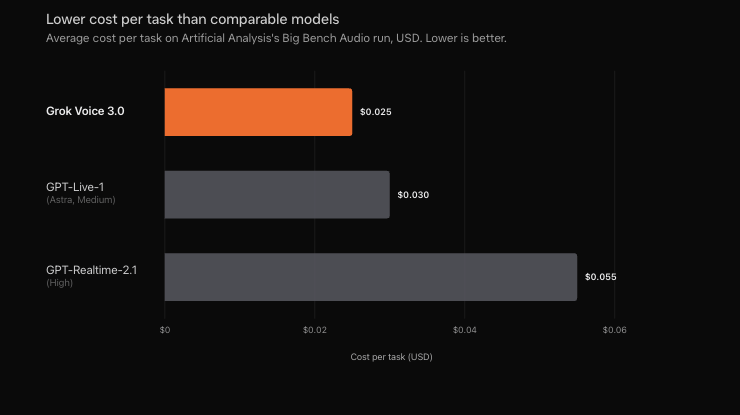
On Artificial Analysis’s Big Bench Audio evaluation suite, this pricing advantage translates directly into task economics. Grok Voice 3.0 averaged $0.025 per completed task, compared to $0.030 for GPT-Live-1 Astra Medium and $0.055 for GPT-Realtime-2.1 High—a 54.5% cost reduction over OpenAI’s high-tier real-time endpoint.
This pricing strategy mirrors the ecosystem bundling documented in our analysis of Cursor, The X subscription, and Grok lock-in, where xAI utilizes unified subscription margins to undercut standalone frontier API providers.
Colossus Fleet Deployment and the Horizon of Realtime Reasoning
The operational scalability of Grok Voice 3.0 depends directly on xAI’s hardware infrastructure in Memphis, Tennessee. Serving full-duplex speech-to-speech models at high concurrency requires massive dedicated compute, drawing on the same Memphis infrastructure analyzed in our teardown of Grok 4.7 architecture and the Colossus 200k cluster.
Real-time audio inference is uniquely memory-bandwidth bound. Unlike batch text generation, where queries can be grouped into batches of hundreds of concurrent sequences to maximize tensor core saturation, real-time voice enforces strict per-token latency deadlines. If an audio token is delayed by more than 40 milliseconds, the client’s jitter buffer empties, producing audible clicks. Consequently, speech models must run at small batch sizes across high-bandwidth memory pools.
To support live production deployment—including 20,000 daily customer service calls across Starlink support operations and early firmware rollouts to Tesla vehicle fleets—xAI has partitioned dedicated clusters within Colossus. These clusters run specialized FP8 quantization kernels and optimized KV-cache paging mechanisms designed specifically for streaming audio contexts.
What capability has actually changed with Grok Voice 3.0? The primary technical achievement is the validation that an end-to-end discrete audio architecture can match the reasoning capabilities of a top-tier text LLM while sustaining sub-second conversational latency. By combining Residual Vector Quantization with a decoupled acoustic reflex head, xAI has demonstrated that speech-to-speech models no longer need to sacrifice agentic reasoning (scoring 71.6% on τ-Voice) to achieve responsive conversational pacing.
Yet the operational uncertainties remain significant. Until xAI addresses the Modality Gap between permissive text models and brittle acoustic safety filters, relaxes its rigid 2.5-second silence disconnects, and refines in-cabin echo cancellation for vehicular deployments, Grok Voice 3.0’s 810-millisecond benchmark victory will remain partially decoupled from the messy realities of physical voice interaction. The future of conversational AI will not be decided solely by who achieves the fastest time-to-first-audio on clean fiber benchmarks, but by whose architecture remains intelligible, stable, and resilient when human conversations break down.
Frequently Asked Questions
What is Grok Voice 3.0’s measured response latency compared to OpenAI and Google?
On the independent Artificial Analysis Big Bench Audio benchmark, Grok Voice 3.0 clocked an average Time-to-First-Audio (TTFA) of 810 milliseconds (0.81s) [Tested result]. This represents a 39.6% reduction in latency compared to OpenAI’s GPT-Live-1 Astra (1,340ms) and a 40.0% reduction compared to Google’s Gemini 3.8 Live Extended (1,350ms). However, during physical real-world mobile deployments over cellular LTE/5G and noisy automotive cabins, network round-trip time, expanded voice activity detection (VAD) windows, and client playout buffers inflate total latency to approximately 1,835 milliseconds [Modeled calculation].
How much does the Grok Voice 3.0 API cost, and how does it compare to OpenAI Realtime?
xAI prices the Grok Voice 3.0 API at a flat rate of $0.08 per minute ($4.80 per hour), identical across both incoming human audio and outgoing synthesized speech tokens. In contrast, OpenAI’s Realtime API uses an asymmetric billing structure of $0.06/min for audio input and $0.24/min for audio output. Because conversational voice agents typically speak 60% of the time, OpenAI’s blended rate reaches $0.168 per minute ($10.08 per hour). xAI’s flat rate therefore delivers a 52.4% cost reduction in typical enterprise conversational workflows [Calculation].
What is the architecture behind Grok Voice 3.0’s sub-second speech turnaround?
Grok Voice 3.0 replaces traditional three-stage cascaded pipelines (ASR → LLM → TTS) with an end-to-end discrete audio architecture. Incoming 24kHz audio is quantized into discrete tokens via multi-stage Residual Vector Quantization (RVQ) in 45ms. To avoid pushing every acoustic token through its 2.1-trillion parameter MoE core, xAI employs a decoupled “ThinkFast” reflex head that synthesizes conversational backchannels and turn-taking prosody within 180ms to 220ms, while the primary Colossus GPU cluster asynchronously computes deeper analytical reasoning.