

MiniMax’s code points to M3.1. A tokenizer fingerprint points Space Bunny toward the MiniMax family. Real SVG and Minecraft demos show why those clues are only the beginning of the story.
MiniMax M3.1 appears in MiniMax’s public Code tests. Space Bunny Alpha, an anonymous model on OpenRouter, shares the token-count fingerprint of MiniMax models. Neither fact proves that Space Bunny is M3.1. Public SVG and Minecraft demos are mixed: some show broken geometry, while a polished game needed several follow-up prompts. The interesting question is how reliably a candidate model completes the whole task.
MiniMax M3.1: What MiniMax’s own code shows
The clearest public evidence of MiniMax M3.1 work is MiniMax’s model-selection test. At the inspected commit, it creates a managed MiniMax-M3.1 entry with 512,000 and 1,000,000 token context options, a 128,000 token output limit, forced-on thinking, and low, high, and max effort values. A second test file also contains medium and xhigh examples. These are integration fixtures, not a final API specification.
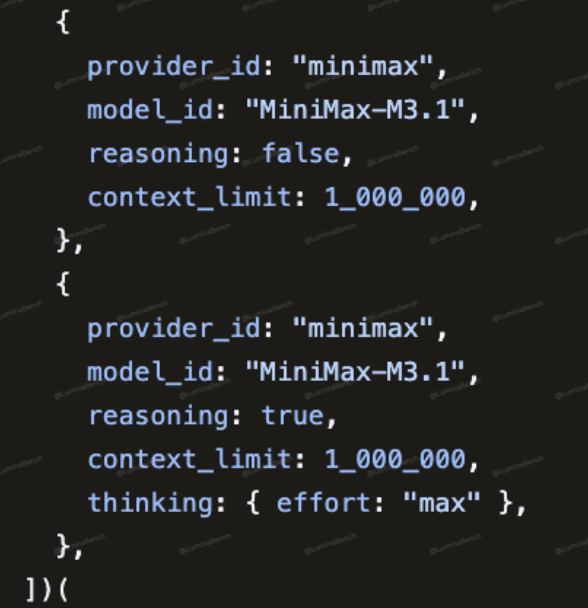
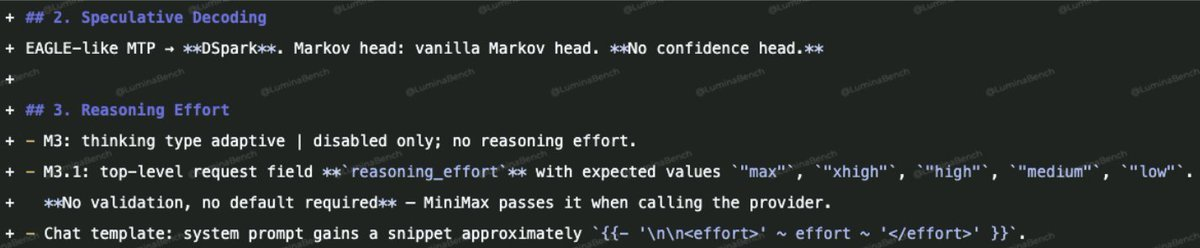
Three screenshots supplied to EyesTech add a less verifiable trail. One shows a MiniMaxAI/MiniMax-M3.1-preview-private checkpoint. Another lists reasoning-on and reasoning-off M3.1 configurations with one million token limits. The third describes request-level reasoning effort and DSpark speculative decoding. We could not establish the original file or commit for those screenshots. The reasoning-off entry also differs from the forced-on thinking in MiniMax Code’s managed-model test. Different serving paths or an unfinished implementation could explain the difference; a universal behavior cannot be inferred.

There is also a baseline problem with the headline numbers. MiniMax M3 already advertises a one million token window and text, image, and video input. NVIDIA’s public M3 DSpark card shows that a DSpark draft head is not, by itself, a new M3.1 feature. The supplied M3.1 screenshot says there is no confidence head, whereas NVIDIA’s M3 card describes one. That may be an implementation change, but there is no public M3.1 throughput measurement to establish a speed gain.
The tokenizer match is a family clue, not an identity card
OpenRouter’s Space Bunny Alpha listing describes an anonymous, free model with a one million token context window, text/image/video input, tool calling, and adjustable reasoning. Those properties resemble the M3.1 clues, but they overlap with capabilities MiniMax has already described for M3. OpenRouter is the router here; it has not named the model developer.
The better clue is YFarmX’s 50-string token-count test. It reports a 50-of-50 match between Space Bunny and each of eight tested MiniMax models, repeated in two passes. A smaller seven-string community comparison also found matching token-count differences after fixed overhead was accounted for. Repeating the same tokenizer pattern across varied strings is more informative than asking a model what it is: self-identification can be generated or mistaken.
But a tokenizer is shared infrastructure. The 50-string study associates Space Bunny with the MiniMax tokenizer family; it cannot distinguish M2, M3, M3.1, or another checkpoint using that tokenizer. “Space Bunny is probably MiniMax-family” is better supported than “Space Bunny is M3.1.” Neither MiniMax nor OpenRouter has confirmed the exact checkpoint.
| Question | Evidence | Conclusion |
|---|---|---|
| M3.1 preparation? | MiniMax Code test entries | Integration work is visible. |
| Private preview serving? | Supplied screenshots without original source | Not independently verified. |
| MiniMax-family tokenizer? | Repeated 50-string match | Strong family clue. |
| Exactly M3.1? | Timing and feature overlap | Unconfirmed. |
| Better coding than M3? | Selected public demos | No controlled answer yet. |
An SVG peacock exposes the geometry problem
Indie builder Sahil Panhotra posted a peacock-on-a-bike SVG animation generated with Space Bunny. His verdict was “okayish”: the feathers looked decent, but their placement was odd, the bicycle geometry drifted, and the pedaling was janky. He said GLM 5.3 Flash Max did better on the same test. The original video is embedded below so readers can inspect the movement.
Sahil Panhotra’s Space Bunny SVG animation
A reply in that thread identifies why this is a useful stress test: an SVG animation has to preserve spatial relationships and coordinate them over time. The wheels, pedals, feet, and body must remain attached through every frame. A handsome still frame can hide a broken motion system. Sahil also pushed back on the model-identification rumor, saying Space Bunny could be another MiniMax model rather than M3.1. His criticism of this output should not be converted into a verdict on a version nobody has confirmed.
The Minecraft demos disagree for a reason
Atomic Chat compared two one-file Minecraft-style builds. Its posted video says DeepSeek V4.1 Flash made a walkable, diggable forest while Space Bunny left holes in the ground that showed the sky. A terrain gap is a functional failure: world generation, mesh continuity, camera view, and collision behavior have to agree. The post comes from a company promoting its own model product, and it does not provide a full public harness, code artifacts, or repeated runs. Treat it as a documented example, not a ranked benchmark.
Atomic Chat’s Minecraft-style comparison
The replies show the perception gap. One commenter took the flawed terrain as a warning about MiniMax M3.1 if Space Bunny is indeed that model. That “if” matters; a poor anonymous-model clip cannot establish the identity or quality of an unreleased model. The visible video tells us little about prompt wording, effort settings, retries, or how the two outputs were selected.
Then Israfil posted a playable Space Bunny survival game with exploration, block placement and removal, and a hotbar. The follow-up supplied the prompt: create a browser Minecraft game in one HTML file with advanced shaders. This is a reported positive example, but it was not a one-shot success. When a commenter questioned the result, the creator clarified that the game was refined with four more prompts.
Israfil’s iterative Space Bunny survival game
These clips need not cancel one another. They show different runs with incomplete test records. A model may produce a weak first draft yet respond well to correction. A polished fifth iteration demonstrates iterative usefulness, while the number of prompts is part of the cost. A fair comparison would publish each prompt, model setting, generated file, elapsed time, token use, and number of human interventions; then repeat the task across several runs. None of those three X posts supplies that full record.
Long context is another claim users are testing
In a firsthand OpenCode report, one user praised Space Bunny’s speed, vision, and short-task tool use, but said it sometimes lost track of earlier issues as a session grew and gave up after failed tool calls. Another discussion about verbosity described high context consumption; one informal comparison cited roughly 500,000 tokens against 160,000 for similar work elsewhere. These are user accounts, with unknown agent configuration and task equivalence.
The one million token limit describes how much input a service can accept. It does not measure whether the model retrieves a buried constraint, avoids rereading files, or finishes an agent task efficiently. A fast token stream can still produce a slow task if it loops or spends too many tokens on irrelevant steps. Conversely, a model that needs several prompts may be valuable if those iterations are quick and the final code works. Those are measurements M3.1 will need, whichever checkpoint Space Bunny turns out to be.
What would settle the story
MiniMax’s M3 page establishes the baseline for multimodal support and long context. To judge MiniMax M3.1, we need a named model card, a public API specification, and repeated M3-versus-M3.1 tasks with fixed prompts and agent settings. For the SVG test, save the generated code and inspect geometry through the animation. For the voxel game, run the produced file and test terrain continuity, movement, digging, and block placement. For long coding work, track tokens, elapsed time, tool failures, late-instruction recall, and final patch quality.
A Wednesday, September 30, 2026, release remains a community prediction. The public code, Space Bunny listing, and supplied screenshots do not contain a launch commitment. M3.1 integration is visible; Space Bunny’s family is strongly suggested by token counts; its exact identity and M3.1’s release date remain unconfirmed.
Reader questions
Is Space Bunny Alpha confirmed as MiniMax M3.1? No. Its token-count fingerprint matches tested MiniMax models, but that does not identify the specific version.
Did Space Bunny build the playable Minecraft game in one try? No. The creator said the posted result was refined with four additional prompts.
Do the bad SVG and Minecraft clips prove M3.1 is weak? No. They show reported failures from an anonymous model under incompletely documented conditions. They identify sensible tasks for a repeatable M3.1 evaluation.
Has MiniMax announced M3.1’s price or launch date? No public M3.1 price or dated launch commitment was found in the sources checked for this article.
How this was reported: EyesTech inspected the cited MiniMax Code commit, the public model listings and tokenizer study, and the original X posts and visible replies linked above. We did not run Space Bunny or independently reproduce the three creators’ outputs. Three reader-supplied screenshots are labeled separately because their source files were unavailable. This article will be updated if MiniMax or OpenRouter identifies Space Bunny or publishes M3.1 specifications.
Featured image: AI-generated editorial illustration by EyesTech, using MiniMax’s logo as a brand reference. The bunny is a visual metaphor; the image does not establish Space Bunny’s identity.