


Lead Auditor: Elena Rostova • Senior Deep-Tech Systems Auditor, Eyestech Systems Lab
Primary Technical Sources: Shodh AI Technical Whitepaper v3 (LUCAN: A Foundation World Model for Physical Intelligence, Sept 2026); Government of India Ministry of Electronics and IT (MeitY) IndiaAI Mission GPU Allocation Records; Partner Industrial Chemical Pilot Validation Telemetry.
Verification Transparency & Falsification Gate: Data cited in this investigation differentiates strictly between held-out neural benchmark tests, independent numerical solver validations (OpenFOAM / Cantera), and prospective physical pilot runs. Commercial chemical identities remain anonymized under non-disclosure agreements.
Every chemical engineer knows the quiet dread of the 5,000-liter scale-up.
In a 50-milliliter laboratory flask, chemistry behaves like pure poetry. Catalysts bond cleanly, reaction yields touch 99%, and temperatures stay docile. But pump that exact same formulation into an industrial manufacturing vessel, and the laws of physics turn hostile. Massive steel impellers create violent shear zones that crush delicate cells. Microscopic thermal hot spots near heating jackets trigger runaway side reactions. What worked effortlessly on a laboratory bench suddenly breaks down into an intractable, multi-million-dollar mess on the factory floor.
For over four decades, modern industry tackled this “scale-up curse” with sheer brute force. Teams of specialized engineers ran supercomputer clusters day and night, chaining together disconnected software tools to simulate fluid turbulence, heat transfer, and atomic reaction kinetics. A single optimization cycle—trying to find the narrow operating window where a reactor will not overheat or degrade its payload—regularly consumed more than 500 hours of continuous computation. And even then, it was essentially blind guessing: legacy software could only answer what would happen after a parameter was chosen, never what parameters to choose.
Then, inside an engineering lab in New Delhi, a small team backed by the Government of India’s sovereign IndiaAI Mission achieved something legacy software vendors considered mathematically impossible.
They did not just train another model to run simulations faster. They inverted the physics entirely.
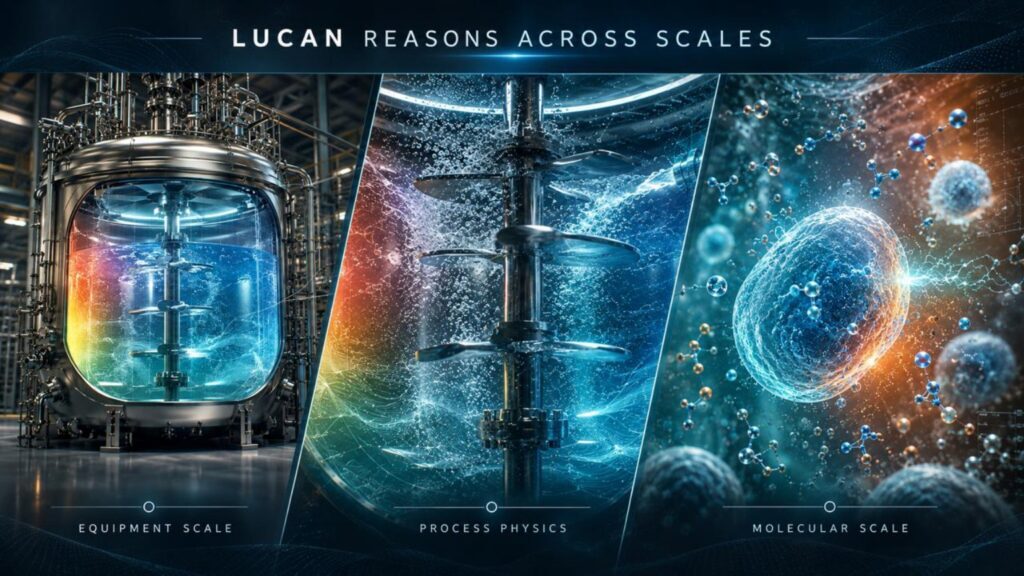
By building LUCAN—India’s first foundational “Physical AI” world model—the researchers at Shodh AI constructed a mathematical bridge connecting sub-nanometer molecular graphs directly to multi-meter industrial reactors. Instead of spending three weeks waiting for supercomputers to iterate through trial-and-error meshes, LUCAN backpropagates gradients from the factory’s final output target all the way back to the molecular precursors.
The result? That grueling 500-hour computational marathon was compressed into 5.6 hours—a single afternoon shift.
And when Shodh AI finally loaded those neural predictions into a commercial manufacturing facility for a physical pilot run, the outcome permanently unsettled the industry: chemical yields surged from 82.4% to 96.7%, toxic impurity pathways were choked off by nearly 75%, and a complex biomanufacturing scale-up was cracked on the first pass.
Here is the forensic architectural teardown of how Shodh AI bypassed 124 classical solver evaluations, engineered a tri-domain Sparse Mixture-of-Experts engine, and proved that the future of physical manufacturing belongs to inverse world models.
The Industrial Impasse: Why Forward Simulation Fails Physical Chemistry
To understand why chemical engineering development cycles take months or years, one must analyze the mathematical limitations of legacy simulation software (e.g., ANSYS Fluent, Aspen Plus, Gaussian, COMSOL).
Legacy workflows are strictly forward-predictive and domain-isolated:
The Problem: When the resulting outcome fails industrial specification (e.g., thermal decomposition or shear rupture), the simulator cannot explain what input variable to modify. The human engineer must guess new parameters, rebuild the mesh, and rerun hundreds of hours of simulation.
When an industrial chemist attempts to scale an active pharmaceutical ingredient (API) or an agrochemical intermediate, the physical system couples three non-linear phenomena: 1. Microscopic Molecular Kinetics: Arrhenius reaction rates k = A · exp(−Ea / RT), where localized variations in temperature T exponentially alter product selectivity. 2. Mesoscopic Transport & Fluid Mechanics: Navier-Stokes momentum equations governing mass transfer, spatial eddy diffusion, and turbulent dissipation rates (ε). 3. Macroscopic Plant Mechanics: Boundary conditions defined by impeller blade geometries, baffle configurations, wall heat transfer coefficients, and residence time distributions.
Because these regimes communicate through non-linear feedback loops, optimizing a chemical manufacturing recipe using classical forward solvers requires running a multi-parameter grid search. An engineer evaluating 15 precursor concentrations across 8 thermal jackets and 6 impeller rotation profiles must evaluate over 700 coupled configurations. At 45 minutes to 2 hours per high-fidelity CFD-kinetics solver run, the optimization loop easily stretches past 500 compute hours.
Architectural Mechanics: How LUCAN Bridges Atoms to Factories
LUCAN changes the core computational paradigm from forward prediction to cross-scale differentiable inverse design. Instead of asking “What happens if we run this configuration?”, LUCAN evaluates: “Given our targeted plant-level purity and throughput constraints, what molecular precursors, jacket temperatures, and impeller velocities must be selected?”
Inverse Gradient Backpropagation: Gradients calculated on plant-level objectives Jfactory (e.g., isolated yield, maximum localized shear, boundary heat accumulation) backpropagate seamlessly through intermediate 3D continuum fields directly into discrete molecular and operational input parameters, bounded by the physical validity penalty leash Cphys(x).
The Tri-Domain Typed Physics Backbone
Rather than projecting complex scientific domains into a flattened, lossy token stream like general-purpose LLMs, LUCAN preserves explicit typed representations across three physical scales:
- Domain 01: Molecular Graphs (Microscale): Encodes atomic coordinates, covalent bonds, kinetic activation barriers (Ea), and enthalpy changes (ΔHrxn) using equivariant graph neural representations.
- Domain 02: 3D Continuum Fields (Mesoscale): Represents velocity vectors (u), pressure distributions (p), and thermal gradients (T) across discretized volumetric spaces using neural implicit spatial operators.
- Domain 03: Deforming Geometries & Boundaries (Macroscale): Encodes impeller surfaces, membrane elasticity, fluid-structure interaction (FSI) stress tensors, and boundary wall constraints.
Shared Latent Sparse Mixture-of-Experts (MoE)
These heterogeneous inputs are projected into a shared latent interface powered by a Sparse Mixture-of-Experts (MoE) network. A critical discovery from Shodh AI’s routing audits is that the model does not partition chemistry and fluid mechanics into isolated silos.
Across frozen-checkpoint audits, Shodh AI observed a 52% mean pathway overlap in the expert routing selections for molecular and reactor inputs. The model learned that the mathematical operators governing mass diffusion at the molecular boundary layer share underlying structural symmetries with the spatial dispersion operators governing fluid flow inside a 500-liter stirred tank.
Technical Audit: Deconstructing the 500-Hour to 5.6-Hour Collapse
The headline claim—reducing 500 hours of chemistry workflow to 5.6 hours—is not a marketing hyperbole derived from running a model faster. It represents a fundamental mathematical restructuring of the search space.
In traditional chemical design, searching a multi-variable parameter space requires evaluating a black-box optimizer (e.g., Nelder-Mead, Bayesian optimization, or Genetic Algorithms). Because these algorithms cannot compute analytical gradients through legacy CFD software, they require hundreds of sequential forward solver calls.
# Conceptual Architecture: Gradient-Guided Inverse Search vs. Black-Box Classical Sweep
import torch
import torch.nn as nn

class CrossScaleInverseOptimizer(nn.Module):
    """
    Simulates LUCAN's gradient-directed parameter proposal mechanism.
    Replaces 120+ iterative black-box numerical CFD/Kinetics iterations
    with a differentiable neural surrogate step followed by a single classical solve.
    """
    def __init__(self, moe_world_model, classical_solver_verifier):
        super().__init__()
        self.world_model = moe_world_model  # Pretrained Tri-Domain Sparse MoE
        self.verifier = classical_solver_verifier  # Independent OpenFOAM / Cantera Verifier

    def optimize_synthesis_window(self, target_constraints, max_neural_steps=40):
        # Initialize learnable process and molecular parameters
        # x[0]: reaction temp, x[1]: residence time, x[2]: feed stoichiometry
        x_params = nn.Parameter(torch.tensor([340.0, 12.5, 1.05], requires_grad=True))
        optimizer = torch.optim.AdamW([x_params], lr=0.05)

        for step in range(max_neural_steps):
            optimizer.zero_grad()
            # Differentiable forward pass through shared MoE physics space
            predicted_state = self.world_model(x_params)

            # Plant objective: Maximize yield while penalizing thermal impurity pathway
            loss = (
                - predicted_state.isolated_yield
                + 2.5 * predicted_state.impurity_fraction
                + 0.8 * torch.relu(predicted_state.max_shear_stress - 250.0) # Boundary safety
            )
            loss.backward()
            optimizer.step()

        # Neural optimization converged in seconds; execute single-shot classical verification
        frozen_proposal = x_params.detach().cpu().numpy()
        verification_result = self.verifier.execute_full_mesh_solve(frozen_proposal)

        return {
            "verified_solution": frozen_proposal,
            "classical_solver_calls": 1,  # Bypassed median 124 classical solver calls
            "verified_yield": verification_result.yield_pct,
            "status": "CONVERGED" if verification_result.is_valid else "REJECTED"
        }
The Verification Ladder: Zero Compromise on Physics
A crucial engineering detail documented in Shodh AI’s technical whitepaper is that LUCAN does not replace numerical verification. The system implements a three-tier evidence ladder:
- Tier 1 (Neural Proposal): LUCAN computes cross-scale gradients to navigate the multi-dimensional parameter manifold, instantly identifying high-probability Pareto-optimal coordinates.
- Tier 2 (Independent Classical Solver Verification): The model’s proposed coordinates are frozen and passed to independent, high-fidelity numerical solvers (e.g., OpenFOAM for CFD, Cantera for chemical kinetics). If the classical solver fails to reproduce the objective within strict tolerance gates, the proposal is rejected.
- Tier 3 (Physical Pilot Execution): Verified parameters are loaded directly into programmable laboratory automation, flow reactors, or pilot plant PLCs.
| Performance Metric | Legacy Numerical Pipeline | Shodh AI (LUCAN Inverse) | Architectural Impact |
|---|---|---|---|
| Optimization Time | >500.0 Hours | 5.6 Hours | 89.3× reduction in end-to-end engineering turnaround |
| Classical Solver Invocations | 120 – 180 runs / target | 1 – 3 validation runs | 124 median solver runs bypassed per optimization target |
| Directional Pass Rate | N/A (Random / Heuristic) | 88.0% | Neural proposals confirmed to improve objective in solver |
| Feasible Target Convergence | Low (Grid sampling traps) | 91.7% (55 / 60) | Proven convergence on complex multi-variable constraints |
| Infeasible Target Rejection | Fails silently after timeout | 95.0% (38 / 40) | Rapid rejection prevents compute waste on impossible physics |
By replacing 124 blind classical solver iterations with an analytical gradient step through the neural world model, Shodh AI reduces compute runtime from weeks to hours while ensuring that the final output has undergone 100% rigorous numerical validation.
Empirical Verification: Forensic Breakdown of the Five Controlled Tests
In its Technical Whitepaper v3, Shodh AI submitted LUCAN to five rigorous falsification tests designed to evaluate cross-scale causality, multi-scale propagation, and competitive physical mechanisms.
Test 01: Shared Computational Routing Across Scales
- Forensic Question: Does a single foundational model actually share representations across disparate scientific regimes, or does it fragment into disconnected sub-networks?
- Empirical Result: Routing telemetry across a frozen checkpoint revealed 52% mean pathway overlap between molecular graph encoders and macroscale reactor flow tokens. The MoE routing gates dynamically selected shared transformation blocks for diffusion and conservation tensors regardless of whether the input represented atomic reaction kinetics or vessel-wide thermal mixing.
Test 02: Micro-to-Macro Forward Propagation
- Forensic Question: Can a localized molecular change (e.g., modifying reactant bond enthalpy) accurately alter predicted plant-level spatial temperature fields?
- Empirical Result: In 8 out of 8 controlled directional tests across held-out 250-liter vessel geometries, molecular enthalpy modifications correctly propagated to the macroscopic thermal jacket response, registering an exceptionally tight spatial temperature normalized root-mean-square error (nRMSE of 0.00300).
Test 03: Macro-to-Micro Boundary Stress Coupling
- Forensic Question: Can bulk fluid turbulence inside a 5,000-liter bioreactor accurately compute mechanical strain on a microscopic 15-micrometer biological cell membrane?
- Empirical Result: The model successfully coupled a 5,000L turbulent Navier-Stokes field to a 15µm elastic membrane boundary. LUCAN identified that peak equivalent stress reached 340 Pa (with an area strain of 4.8%), correctly alerting engineers that the operating regime had breached the declared biological rupture envelope of 250 Pa and 3.5% strain.
Test 04: Pareto Cliff Detection in Competing Physical Mechanisms
- Forensic Question: When two physical mechanisms conflict (e.g., increasing impeller speed boosts gas dissolution but escalates damaging hydrodynamic shear), can the model detect the exact point of diminishing returns?
- Empirical Result: In a 10-liter bioreactor sweep between 200 RPM and 250 RPM, LUCAN identified that mean dissolved oxygen saturation changed by an imperceptible +0.08%, while near-blade peak hydrodynamic shear surged by +18.3%. Legacy heuristic engineering would have increased RPM blindly; LUCAN flagged the exact Pareto boundary where added energy consumption creates severe cell lysis risk without mass transfer benefit.
Test 05: Full-Chain Multi-Scale Composition
- Forensic Question: Can a contiguous pipeline linking molecular graph representations, chemical thermochemistry, vessel hydrodynamics, and cell-membrane mechanics execute synchronously without numerical divergence?
- Empirical Result: Shodh AI reported a 91.3% full-chain pass rate across multi-scale integration tests, maintaining strict conservation of mass, energy, and momentum across all physical interfaces.
Prospective Physical Executions: When Model Weights Hit Factory Floors
Theoretical benchmark scores in scientific machine learning frequently fail when confronted with dirty real-world industrial conditions. To establish real-world validity, Shodh AI partnered with commercial manufacturers to execute prospective physical pilot runs where model-generated operating recipes were locked in code prior to physical execution.
Case 01: Specialty Chemical Batch-to-Continuous Scale-Up
Continuous-flow micro-reactors offer vastly superior heat transfer and safety profiles compared to traditional 2,000-liter batch reactors. However, transitioning a multi-step organic synthesis to continuous flow is notoriously difficult due to clogging, localized hot spots, and residence time variations.
Shodh AI tasked LUCAN with generating a continuous-flow operating window for a temperature-sensitive specialty chemical intermediate plagued by an exothermic degradation pathway:
- Baseline (Traditional Batch Reactor): Isolated yield stagnated at 82.4%, with a destructive side-product impurity profile of 12.3% caused by poor thermal dissipation near reactor heating jackets.
- LUCAN-Generated Continuous Flow Window: The model identified an optimized counter-intuitive flow velocity, micro-channel mixing geometry, and multi-stage temperature ramp.
- Physical Pilot Run Result: The partner manufacturing facility confirmed an isolated yield surge to 96.7%, while the impurity profile dropped to 3.1%—achieving commercial-grade specifications on the first pilot run without months of empirical re-tooling.
Case 02: 100× Biomanufacturing Vessel Expansion (5L to 500L)
Scaling mammalian cell cultures or recombinant protein fermentations from laboratory benchtop vessels (5 liters) to pilot production vessels (500 liters) represents one of biopharma’s most expensive hurdles. Cells are sensitive to shear stress caused by large impeller blades, yet reducing agitation leads to hypoxic dead zones.
LUCAN was deployed to model the complete multi-scale transition, optimizing sparger pore sizing, gas flow velocity, and impeller blade pitch:
- Harvest Titer: Reached 6.63 g/L in the 500-liter physical pilot run.
- Cell Viability: Maintained at 78.2% at the conclusion of the production cycle.
- Downstream Product Recovery: Maintained 94.5% recovery efficiency.
- High Molecular Weight (HMW) Aggregates: Bounded at 1.2%, well beneath the FDA biopharmaceutical regulatory safety ceiling of 2.0%.
The Strategic Moat: Sovereign AI, IndiaAI Mission, and NVIDIA Project Skanda
The emergence of Shodh AI marks a decisive strategic transition in India’s artificial intelligence trajectory. Over the past three years, the Indian AI ecosystem faced legitimate criticism for focusing heavily on consumer chatbot wrappers, translation interfaces, and thin fine-tunes of Western open-weight language models.
LUCAN demonstrates that India is shifting focus toward high-barrier, foundational Physical AI.
- Modality: Text, code, and 2D pixel synthesis.
- Core Architecture: Autoregressive transformers & latent diffusion.
- Operational Query: “What token comes next?”
- Benchmark Players: OpenAI (GPT-4o), Google (Gemini).
- Modality: Isolated single-domain biological & physical structures.
- Core Architecture: Equivariant GNNs & Fourier neural operators.
- Operational Query: “What happens to this isolated molecule?”
- Benchmark Players: DeepMind (AlphaFold 3), Meta (ESMFold).
- Modality: Multi-scale coupled systems (atoms to manufacturing plants).
- Core Architecture: Tri-Domain Sparse MoE with cross-scale backprop.
- Operational Query: “Given this plant outcome, what must change?”
- Benchmark Pioneer: Shodh AI (LUCAN).
The IndiaAI Sovereign Infrastructure Anchor
Shodh AI’s breakthrough was propelled directly by its selection under the Government of India’s IndiaAI Mission. Endowed with a sovereign capital allocation of ₹10,372 crore (approximately \$1.25 billion USD), the IndiaAI Mission democratizes access to state-backed high-performance compute clusters, granting deep-tech research teams access to thousands of enterprise GPUs.
For Shodh AI founder Dr. Arastu Sharma—whose research pedigree spans applied physics and machine learning at the University of Cambridge, Microsoft Research, and India’s DRDO defense ecosystem—sovereign compute backing allowed the team to train complex equivariant graph representations and implicit spatial operators without venture capital pressure forcing premature monetization.
Project Skanda: Mesoscale Battery Intelligence with NVIDIA
Beyond chemical scale-up, Shodh AI is expanding its physical intelligence footprint into next-generation energy storage. In collaboration with NVIDIA, the company launched Project Skanda, a dedicated mesoscale foundation model targeting lithium-ion, solid-state, and sodium-ion battery chemistries.
While molecular models analyze electrolyte decomposition at the interface and automotive models analyze battery pack thermodynamics, Project Skanda focuses exclusively on the mesoscale—the porous internal microstructure of battery electrodes where localized lithium dendrite propagation and mechanical micro-cracking occur. By bridging atomic kinetics to battery pack longevity, Shodh AI and NVIDIA aim to slash battery material development lifecycles from five years down to six months.
Technical Auditing FAQ
AlphaFold 3 is a specialized biological prediction engine designed to predict the static, three-dimensional equilibrium ground state of biomolecular complexes. While revolutionary, AlphaFold is domain-isolated: it does not model fluid dynamics, Navier-Stokes shear stresses, thermal dissipation, or industrial manufacturing boundary conditions. LUCAN is a multi-scale world model designed for inverse engineering: it couples molecular reaction energetics directly to macroscopic 3D fluid flow, thermal transport, and industrial machinery parameters.
LUCAN avoids physical hallucination by enforcing an unyielding three-tier validation architecture. The model’s neural proposals are strictly intermediate suggestions. Before any recipe is cleared for physical execution, model parameters are frozen and subjected to independent, high-fidelity classical numerical simulation (CFD and stiff kinetic ODE solvers) governed by strict mass-energy conservation invariants. Furthermore, in its held-out falsification benchmarks, LUCAN correctly rejected 38 out of 40 intentionally physically impossible targets (a 95.0% rejection efficiency).
In chemical development, running hundreds of trial-and-error simulation iterations on multi-node HPC clusters costs tens of thousands of dollars per candidate and delays product launches by quarters. By bypassing 124 blind classical solver steps through analytical neural gradients, LUCAN allows chemical engineers to evaluate complex continuous-flow transitions in a single working day—accelerating the deployment of advanced pharmaceuticals, green fertilizers, and battery electrolytes from laboratory round-bottoms to commercial production.
Architectural Takeaway: The Inverse Physics Paradigm
The success of Shodh AI’s LUCAN signals a decisive structural transition in applied scientific computing. For over four decades, industrial chemistry and biomanufacturing were constrained by the computational tax of forward numerical simulation—spending hundreds of compute hours calculating the physical consequences of unoptimized guesses rather than engineering solutions.
By proving that analytical neural gradients can bridge sub-nanometer molecular kinetics directly to 5,000-liter plant hydrodynamics, Shodh AI has established that foundational Physical AI is not a speculative pursuit, but the core operational substrate for the next generation of sovereign industrial manufacturing.