

For three decades, Indian technology operated on a single, non-negotiable rule: if you were building software, you had to be in Bengaluru. You fought the gridlock of the Outer Ring Road, paid commercial leases exceeding ₹140 per square foot, and factored 25% annual engineer churn into your business model.
The artificial intelligence boom broke that monopoly. Frontier AI systems do not just consume engineering hours; they require continuous thermodynamic compute, low-latency cooling, and unambiguous legal protection. When an autonomous agent executes a flawed trade, misreads medical telemetry, or leaks customer records—a vulnerability class recently exposed in Meta Muse’s privilege inversion flaw in OS agents—who goes to court? The startup founder, the API wrapper, or the foundation model lab in San Francisco?
While New Delhi remained stalled in consultative debates over the Digital India Act, Karnataka made a sudden, calculated maneuver. It did not take place in the boardrooms of Whitefield or Koramangala.
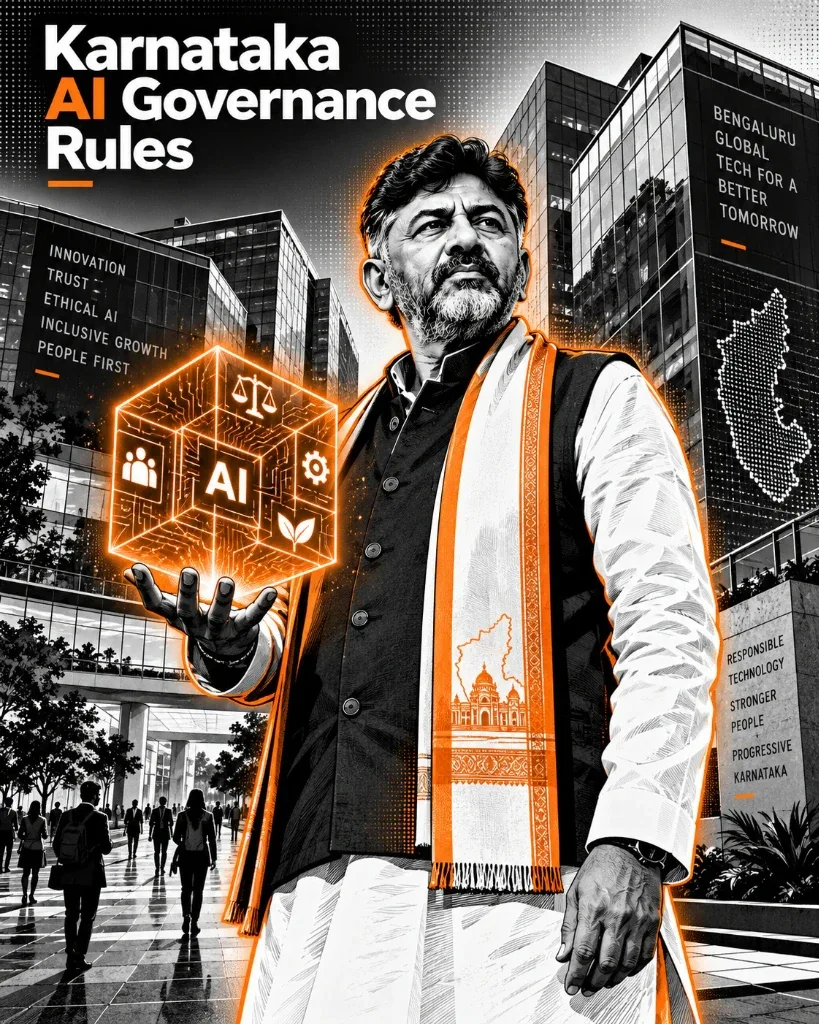
On September 23, 2026, 350 kilometers west on the Arabian Sea, the state dropped two simultaneous structural announcements at the Dr. T.M.A. Pai Convention Centre in Mangaluru. It officially launched India’s first state-level regulatory doctrine—“AI Governance for Indian Startups – A Set of Principles”, crafted with law firm Shardul Amarchand Mangaldas to dismantle the legal black box of model liability. Simultaneously, officials confirmed that over 1,000,000 square feet of Grade-A office space is under construction along the coast.
Why did India’s premier tech state choose a coastal port city famous for banking and medical colleges to launch its most consequential legal shield? And how did a 20-mile shoreline absorb 60 enterprise tech firms and 13,000 engineers before the rest of the industry noticed?
The Sub-National Sprint: How Karnataka AI Governance Rules Fill India’s Policy Void
India’s national AI posture has operated primarily through reactive executive advisories from the Ministry of Electronics and Information Technology (MeitY). Mandates requiring platforms to label synthetic media and seek government clearance before deploying “untested” algorithms sparked sharp industry pushback for threatening startup agility.
With the Digital India Act still navigating consultative drafts, early-stage AI ventures faced severe legal ambiguity under the Digital Personal Data Protection (DPDP) Act 2023 and the Consumer Protection Act. As explored in our analysis of the India-EU AI Chip and 6G Alliance, sub-national states are increasingly forced to architect their own operational corridors while federal frameworks deliberate. Karnataka—generating over 40% of India’s software exports—opted not to wait. Developed with Shardul Amarchand Mangaldas & Co. (SAM) and the Karnataka Digital Economy Mission (KDEM), the new principles establish a model of continuous governance rather than bureaucratic licensing gates.
Tri-Tier AI Liability Rules: Protecting Startups from Foundation Model Faults
Under classical Indian product liability doctrine, assigning fault for an autonomous system failure is virtually impossible due to non-deterministic inference. The Karnataka-SAM framework solves this by partitioning the supply chain into three accountable tiers:
- 1. Model Designers: Upstream foundation labs (e.g., Llama, Mistral, OpenAI) responsible for base pre-training documentation, alignment boundaries, and the rigorous red-teaming demanded by third-party safety audits and gray-box assessments.
- 2. Application Developers: Teams fine-tuning weights, configuring RAG pipelines, and writing prompt templates. Liable for adapter drift and retrieval corpus contamination.
- 3. System Deployers: Operational vendors providing runtime user access and autonomous tool privileges. Liable for execution permissions, rate limits, and human overrides.
This partition shields Indian startups. If a developer queries a third-party foundation model via API, and the base model hallucinates due to pre-training flaws, the deployer cannot be held strictly liable—provided they maintained verified sandboxing, audit logs, and operational disclaimers.
Core Governance Sutras: Data Provenance, DPDP Harmonization & Agent Sandboxes
The framework codifies seven operational mandates (“Sutras”) startups must integrate into production:
| SUTRA | ENGINEERING MANDATE | STATUTORY ALIGNMENT |
|---|---|---|
| 1. Fairness | Slice-based bias audits across demographic and dialectal vectors. | Article 14 & Consumer Protection Act. |
| 2. Privacy | Strict isolation between customer PII vectors and fine-tuning caches. | DPDP Act 2023. |
| 3. Provenance | Cryptographic manifests for web data; attribution for open weights. | Copyright Act 1957. |
| 4. Sandboxing | Enforced eBPF socket filters and microVM isolation for agent tools. | CERT-In Directives. |
| 5. Efficiency | Token-per-watt telemetry; prioritizing renewable-powered compute. | State Data Centre Policy 2026–2031. |
| 6. HITL | Programmatic human sign-off on critical financial/clinical outputs. | RBI, SEBI & NMC regulations. |
| 7. Skills | Accredited retraining paths for roles affected by generative automation. | KSDSC Accreditation. |
Mangaluru Tech Hub Emergence: Auditing the 1M Sq. Ft. Grade-A Silicon Beach Boom
Launching the governance framework in Mangaluru marks the physical activation of Karnataka’s “Beyond Bengaluru” program. At the summit, KDEM CEO Sanjeev Kumar Gupta confirmed that more than one million square feet of Grade-A commercial office space is currently under active construction across the Mangaluru cluster.
The coastal corridor has added 60+ new technology enterprises and 13,000 engineers over the past 36 months. The state’s decadal targets for the cluster include:
- 200,000 Technology Jobs: Absorbing graduates from 22 regional engineering colleges and NITK Surathkal.
- ₹40,000 Crore ($4.8 Billion USD) Annual Exports: Decentralizing software revenue outside the capital.
- 4,000+ Startups & 80+ GCCs: Anchored by specialized capability centers, state incubation funds, and domestic deep-tech innovators mirroring breakthroughs like Shodh AI’s indigenous foundation modeling.
In addition, Financial Advisor to the Chief Minister L.K. Atheeq announced government approval for a ₹60 crore Centre of Excellence in Marine Studies and Bio-economy at the College of Fisheries, backed by the newly formed Mangaluru Design Council to oversee urban planning.
Bengaluru vs. Mangaluru Tech Hub Operating Economics: 60% Cost Arbitrage
For engineering executives, Mangaluru’s draw is pure operational efficiency. This decentralized development thesis directly echoes Zoho’s rural and Tier-2 R&D expansion, proving that advanced computing clusters can scale outside congested tier-1 capitals. Bengaluru’s infrastructure strain creates steep cost premiums:
| METRIC | BENGALURU | MANGALURU | ARBITRAGE |
|---|---|---|---|
| Grade-A Lease | ₹85 – ₹150 / sq. ft. | ₹32 – ₹55 / sq. ft. | 60% Cost Reduction |
| Engineer CTC | ₹16L – ₹28L | ₹9L – ₹16L | 40% Payroll Advantage |
| Annual Churn | 18% – 28% | 6% – 9% | 67% Lower Turnover |
| Daily Commute | 65 – 110 mins | 15 – 30 mins | 72% Transit Compression |
| Talent Feeder | Pan-India migration | NITK + 22 Colleges | Direct Coastal STEM |
Four Strategic Growth Engines: GCCs, MedTech, Coastal Datacenters & Marine Biotech
Mangaluru is building specialized technical depth across four targeted sectors:
- 1. Global Capability Centres (GCCs): 60+ GCC leaders attended Technovanza 2026. Banking, insurance, and maritime logistics majors are establishing core risk and cybersecurity units where attrition is under 10%.
- 2. MedTech & Clinical AI: Dense hospital networks (Kasturba Medical College, Yenepoya, Father Muller) enable engineers to co-locate with clinicians on diagnostic vision and surgical robotics.
- 3. Coastal Green Datacenters: Under Karnataka’s Sustainable Data Centre Policy 2026–2031, the city leverages direct subsea fiber landings and seawater cooling to achieve a Power Usage Effectiveness (PUE) below 1.25.
- 4. Marine Studies & Bio-Economy: The ₹60 crore Centre of Excellence at the College of Fisheries accelerates coastal genomic sequencing, marine bioinformatics, and synthetic biology.
The Founder and CTO Checklist: Implementing Karnataka AI Governance Rules
To comply with the new doctrine, engineering leaders must implement four baseline technical controls:
- Upstream Liability Disclaimers: Update enterprise MSAs to adopt the Tri-Tier model, specifying that foundation model hallucinations do not constitute application-level breach of warranty.
- DPDP Consent Tokenization: Deploy cryptographic tokenization middleware between databases and LLM context windows to scrub personal data before inference.
- Agent Sandboxing: Implement eBPF socket filters and container barriers around agents with shell execution, database mutation, or API privileges.
- Power Telemetry Tracking: Log watt-hours per million tokens using OpenTelemetry to prepare for state sustainable compute reporting.
Frequently Asked Questions: Karnataka AI Rules & Mangaluru Tech Hub
Launched on September 23, 2026, during Mangaluru Technovanza by the Government of Karnataka, KDEM, and Shardul Amarchand Mangaldas (SAM), it is India’s first state-level governance framework for AI startups. It defines clear boundaries for algorithmic liability, DPDP Act 2023 compliance, agentic sandboxing, and IP protection across the AI lifecycle.
The framework establishes a Tri-Tier Liability Architecture dividing fault among Model Designers (foundation pre-training safety), Model Developers (fine-tuning and RAG pipelines), and System Deployers (runtime tool execution and human overrides). This protects application builders from strict liability for upstream base model failures.
Under Karnataka’s “Beyond Bengaluru” initiative, Mangaluru offers over 1,000,000 sq. ft. of Grade-A office space under construction, 60% lower commercial rents, annual engineer churn under 10%, and a strong collegiate feeder from NITK Surathkal and 22 engineering colleges. Growth is driven by GCCs, MedTech AI, coastal green data centers, and a ₹60 crore Marine Bio-Economy CoE.