

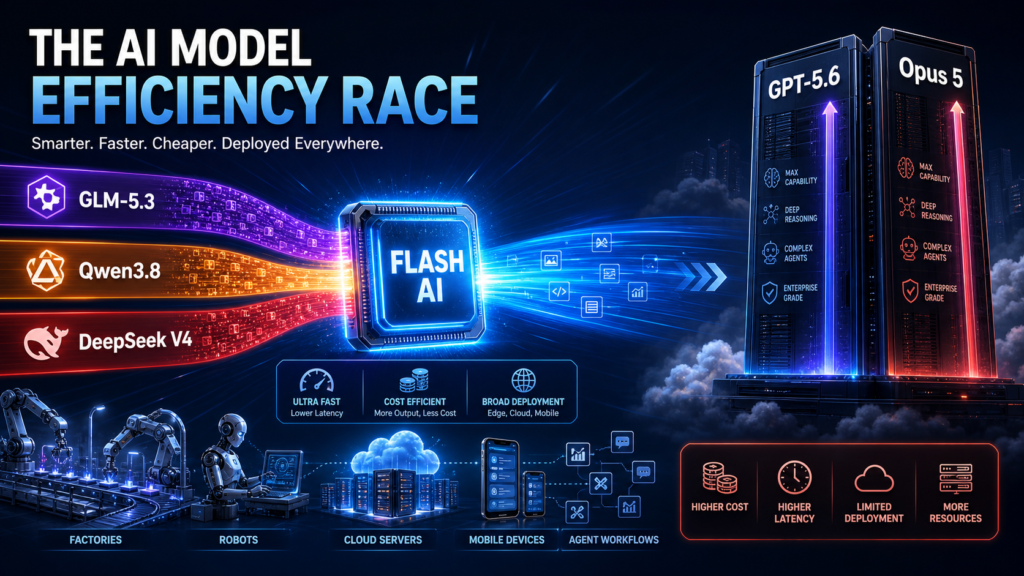

China’s rush toward “Flash” AI models is not a retreat from the frontier. It is a change in what the frontier means. DeepSeek-V4-Flash, GLM-5.3-Flash and Qwen3.8-Flash-Next are being designed around a harder commercial question than “How high is the benchmark score?” The question is: how many useful actions can a country deliver per yuan, watt and minute?

That distinction matters because China is trying to put agents into factories, phones, government services, logistics, science and robotics—not merely win a leaderboard. A premium model that answers brilliantly but costs too much to call thousands of times a day is a research trophy. A Flash model that is slightly less capable but fast, cheap and deployable across domestic hardware can become infrastructure.
Our thesis: China is optimizing for the deployment frontier
In the United States, the public AI race is still narrated through the largest training clusters and the most impressive general-purpose model. China’s model releases point to a different scorecard:
- cost per million input and output tokens;
- tokens per watt on available accelerators;
- latency under sustained, high-concurrency agent traffic;
- how well the model runs across domestic and heterogeneous chips;
- how many factories, apps, devices and developers can adopt it.
This is why the name “Flash” keeps returning. It is a product promise: enough intelligence to complete a real task, delivered at a price and speed that makes repetition affordable.
1. China’s AI demand is becoming a token-volume problem
China’s official Digital China publication reported in June 2026 that average daily token usage in the country had increased more than 1,400-fold in two years. It also described roughly 1,000 AI companies driving demand, most of them concentrated in eastern China, while five of the country’s eight national computing hubs sit in the western region where renewable power can reduce operating costs. The report is an unusually direct signal that China is building an AI utility, not just a chatbot market.
Agents make this volume problem much larger. One request can trigger a planning pass, several tool calls, code execution, retries, a visual check and a final answer. A five-dollar premium call is tolerable for a demonstration. It is not tolerable when an enterprise agent runs continuously across millions of transactions.
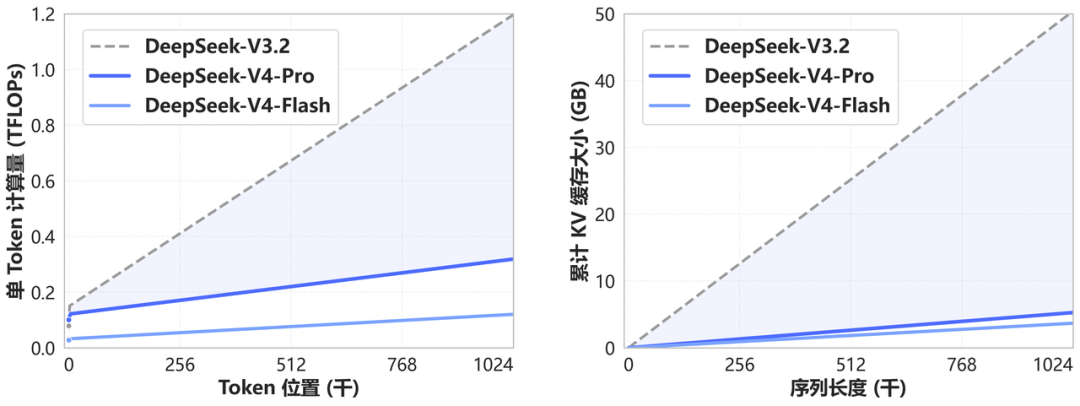
Chinese companies are therefore exposing the economics in their product names and pricing. DeepSeek describes V4-Flash as 284B total parameters with 13B active, one-million-token context and lower compute and memory cost. Z.ai’s official price table lists GLM-5.3-Flash at $0.075 per million input tokens and $0.25 per million output tokens during a September 2026 promotion, compared with $1.40 and $4.40 for GLM-5.3. Moonshot’s Kimi K3 announcement even highlights a 90%+ coding cache-hit rate and a $0.30 per million cached-input price. DeepSeek, Z.ai and Moonshot are making marginal inference cost part of the competition.
2. Flash models stretch a constrained hardware ecosystem
The hardware story is not simply “China has no GPUs.” China has substantial computing capacity, but access, supply, software compatibility, memory bandwidth and power are all constraints. The U.S. Bureau of Industry and Security says its controls cover advanced computing semiconductors, manufacturing equipment, HBM and related software because those technologies support AI and military applications. That policy context increases the value of every optimization that reduces memory traffic or active computation.
Flash architectures attack different parts of the bottleneck. Mixture-of-experts models activate only a subset of weights for each token. Linear or recurrent attention reduces the cost of carrying long histories. Sparse attention retrieves selected regions instead of reading the whole context. Quantization cuts weight and activation bandwidth. Prefix caching avoids recomputing the same instructions for every agent turn.
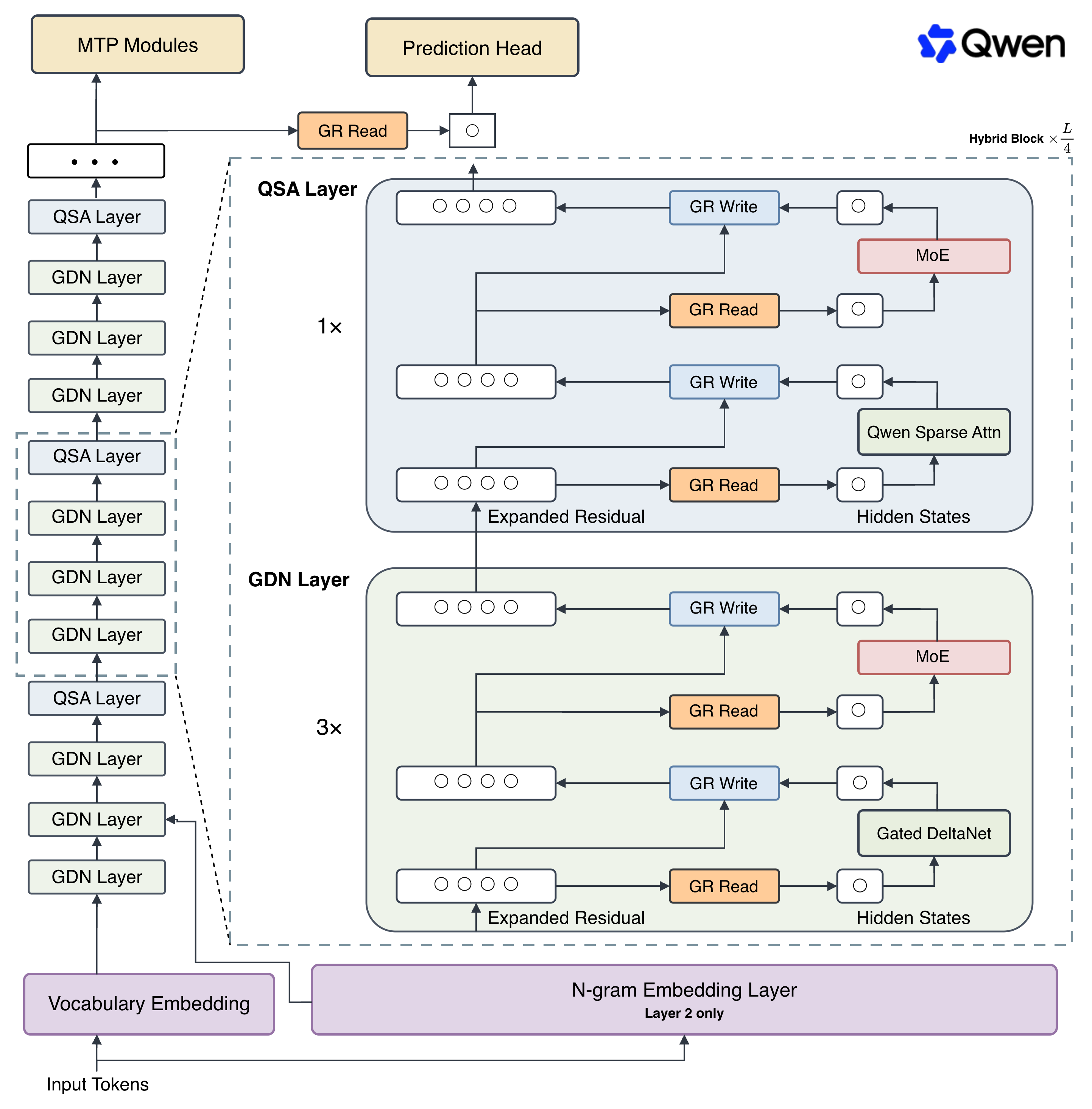
Alibaba’s latest Qwen3.8-Flash-Next preview shows how far this design philosophy is moving. Qwen combines Gated DeltaNet recurrent layers with a sparse global-attention layer, adds a 51B n-gram embedding memory and activates roughly 6B parameters per token in a 125B main model. The company calls the release an early Qwen4 architecture preview aimed at “ultimate cost-efficiency,” not a conventional size race. Read Qwen’s technical announcement.
Qwen3.8-Flash-Next is a Qwen4 architecture laboratory
Qwen3.8-Flash-Next is more important than its name suggests. Alibaba describes it as an open-weight multimodal mixture-of-experts model and an early preview of the architecture planned for Qwen4—not simply a cheaper Qwen3.8. The main model has 125B parameters, a separate 51B N-gram embedding table and only 6B parameters activated per token. It supports 262,144 tokens natively and can be extended to one million with YaRN. Qwen also lists a production Qwen3.8-Flash service at $0.16 per million input tokens and $0.47 per million output tokens. Qwen’s technical announcement presents the model as an architectural experiment that developers can inspect before the full Qwen4 family arrives.
The key design is a three-to-one hybrid of Gated DeltaNet and Qwen Sparse Attention. Three out of every four layers compress history into a fixed-size recurrent state; the remaining layer uses a lightweight micro-block indexer to retrieve important regions from the full context. In plain language, GDN remembers cheaply and QSA retrieves precisely. Qwen reports up to 7.6× faster attention prefill and 4.9× faster decoding at one-million-token context, plus 8.6× the prefill throughput of Qwen3.7-Plus in a cache-heavy test with a 90% prefix-cache hit rate. Those are vendor benchmarks, so they should be reproduced under the same context, cache, quantization and serving conditions.
Qwen also says Flash-Next required about one-ninth the training cost of Qwen3.7-Plus while producing stronger coding and office-task results. Whether that ratio survives independent testing is still open, but the strategic message is clear: Qwen is optimising the entire training-and-serving curve, not merely pruning a finished model. That makes Flash-Next a plausible base for cheap domain fine-tuning, high-volume agent rollouts and future RL experiments.
GLM-5.3-Flash co-designs the model with the serving stack
GLM-5.3-Flash shows a different route to the same destination. Z.ai calls it the first natively multimodal model in the GLM-5 family and says it was trained from a new base with a 30-trillion-token multimodal corpus. It contains 320B total parameters but activates 18B per token, compared with 32B active parameters and 92 layers in the similarly sized GLM-4.5 generation. The reduction is not just a marketing “Flash” label: Z.ai redesigned the layer count, attention path and serving system around lower latency and memory traffic. Read Z.ai’s GLM-5.3-Flash release.
Its long-context stack combines linear attention for local state with sparse attention for global retrieval. Z.ai adds IndexPool, which compresses four indexer key vectors into one through weighted pooling at one-million-token context. The company reports approximately 3× lower attention compute and 4.4× smaller KV-cache size than GLM-5.3. Again, these are vendor comparisons, but they reveal the engineering priority: memory bandwidth and cache capacity are being treated as first-class model-design variables.
GLM-5.3-Flash is also a case study in hardware sovereignty. Z.ai says it tested the model anonymously as “Ox Alpha” under real-world traffic, with that traffic served on Chinese AI accelerators. Its production stack separates multimodal encoding, prompt prefill and token decoding into independently scheduled worker pools, and combines quantisation, cache compression and layer splitting. Z.ai reports a 3× end-to-end serving improvement over its initial baseline on the same domestic hardware. That number is a vendor result, but the co-design principle matters: the model is being shaped around the chips China can actually deploy, not only the chips used in Western benchmark labs.
The native vision path is strategically important too. Z.ai describes visual self-verification for coding and computer-use tasks: the model can inspect a rendered interface, compare it with the intended result and iterate. This moves Flash beyond text completion toward agents that operate browsers, desktops, documents and industrial interfaces. In other words, GLM-5.3-Flash is not merely trying to answer faster; it is trying to close the loop between perception, action and verification at a price that supports continuous use.
What Qwen and GLM reveal about China’s Flash strategy
| Model | Core design | Strategic signal |
|---|---|---|
| Qwen3.8-Flash-Next | 125B main model + 51B N-gram embeddings; 6B active; GDN + QSA hybrid | Use an open architecture preview to reduce long-context and training cost before Qwen4. |
| GLM-5.3-Flash | 320B total; 18B active; sparse + linear attention; IndexPool; native multimodal | Co-design model, runtime and Chinese accelerator stack for production agent traffic. |
| DeepSeek-V4-Flash | 284B total; 13B active; 1M context; DSA and token compression | Make frontier-adjacent reasoning available as a high-volume, economical API. |
Qwen and GLM therefore represent complementary versions of the same strategy. Qwen is using Flash-Next as a public architectural laboratory for the next model generation. GLM is presenting Flash as a production system in which multimodality, agent tooling, domestic accelerators and the serving stack are optimised together. DeepSeek’s Flash release supplies the third reference point: a large sparse model whose small active path is positioned for economical, million-token service.
China’s own policy documents use similar language. The State Council’s 2025 AI+ opinion calls for more efficient training and inference methods, domestic AI-chip innovation, shared compute, and intelligent-compute supply that is accessible, economical, green and secure. The Ministry of Industry and Information Technology’s Compute Interconnectivity Action Plan calls for heterogeneous computing, cross-region scheduling and public compute that can be found and used like a utility. State Council AI+ plan · MIIT compute plan.
Our reading: Flash is a portability strategy. A model that needs the very newest accelerator is exposed to one supply chain. A model built around low active parameters, cache reuse and efficient kernels has more ways to run on Ascend, local NPUs, cloud accelerators and mixed clusters.
3. Beijing’s policy target is diffusion across six sectors
The State Council’s AI+ plan sets a target for intelligent terminals and agents to exceed 70% penetration across six priority areas by 2027, rising above 90% by 2030. The document names science, industry, consumption, public services, governance and global cooperation, and specifically calls for AI phones and computers, robots, industrial software, agriculture, healthcare and public administration.
This is a fundamentally different demand curve from a small number of premium research users. If AI is expected to assist an industrial inspection line, a rural clinic, a municipal service desk and a consumer handset, model cost and latency become adoption gates. A model that is 5% better but 10× more expensive can lose the deployment decision.
China’s May 2026 guidelines on AI agents, issued by the Cyberspace Administration of China, NDRC and MIIT, reinforce that direction by seeking standardized and innovative agent development. The official summary is less about a single chatbot and more about making agents a normal product category.
4. Open weights turn cheap inference into a distribution weapon
Price is only half the strategy. Open weights let developers, universities, cloud providers and manufacturers adapt a model without waiting for a foreign API to approve access or keep serving a region. China’s AI+ plan calls AI an international public good, promotes open-source communities and supports global-South capacity building.

The U.S.–China Economic and Security Review Commission describes this as a “deployment loop”: open models lower the cost of putting AI into manufacturing, logistics and robotics; those deployments generate specialized real-world data; the data improves future systems. The Commission’s analysis does not prove that China will win, but it explains why distribution can matter as much as a small benchmark lead.
This is where Flash models are strategically useful. An open 1T-parameter model that nobody can afford to serve has limited ecosystem reach. An open model with a smaller active path, permissive tooling and a reasonable token bill can become the default layer inside thousands of products.
5. The domestic price war makes “good enough and fast” rational
Baidu CEO Robin Li offered the bluntest explanation in a 2026 TIME interview: China has less buying power and steeper competition, so its companies have to push inference costs down; smaller models also reduce energy use. That is a business argument, not a patriotic slogan. In a crowded market, a vendor that can deliver comparable routine coding or research at a fraction of the price can buy distribution quickly. Read the TIME interview.
MiniMax’s filing shows the same logic in numbers. Its M2 model activates about 10B parameters out of 230B total, prices API output at approximately $1.20 per million tokens, and reported a 770.7% rise in monthly text-token consumption after launch. The filing says reducing marginal cost per token is central to improving affordability and margins. See pages 312–314 of the filing.
There is a catch: cheap models can trigger a capacity crisis. AP reported that Moonshot temporarily stopped new Kimi K3 subscriptions after demand overwhelmed capacity. A low price is not a moat if the provider cannot supply the tokens. Flash therefore increases the importance of scheduling, caching, networking, power and capacity planning.
6. The hidden battlefield is the software stack
Here is the part of the story that price charts often hide: a Flash model is only as efficient as its runtime. Huawei and China Mobile reported up to a 372% token-throughput improvement in a live-network validation using hierarchical KV-cache management for long sequences. That result is meaningful, but it is a vendor test.
An independent July 2026 field study paints a more difficult picture. Serving DeepSeek-V4-Flash and multimodal workloads on 16 Huawei Ascend 910 devices required 12 source-level patches, disabling some high-throughput features and adding safeguards for device failures. The study identifies incomplete operators, fragile parallelism, numerical faults, immature compilation, limited scalability and ecosystem fragmentation.
Our opinion: China’s Flash strategy will be judged less by whether a model can run on domestic silicon once, and more by whether thousands of developers can run it without a research team attached. Model architecture, compiler maturity, kernels, observability and procurement must improve together.
7. Distillation is not just compression — it is an RL strategy
The usual explanation for distillation is smaller memory and faster inference. The deeper benefit is that it gives a student model a better starting policy for reinforcement learning. A small model that begins with no reliable reasoning pattern may spend its rollout budget generating malformed chains of thought, weak tool calls or reward-hacking behavior. A distilled student starts closer to useful behavior, so later RL can spend more of its budget exploring improvements.
DeepSeek’s R1 release is unusually direct about this result. R1-Zero discovered reasoning through large-scale RL, but the team reported repetition, poor readability and language mixing. The final R1 pipeline added cold-start data, two RL stages and two supervised fine-tuning stages. DeepSeek then distilled the larger model’s reasoning patterns into Qwen and Llama checkpoints from 1.5B to 70B parameters, arguing that these patterns performed better than those discovered by applying RL directly to small models. Its published table shows the 32B distilled Qwen at 72.6 AIME 2024 pass@1 and the 70B distilled Llama at 70.0. Read the DeepSeek-R1 technical release.
This is why a Flash model can matter even when it is not the final frontier model. The large teacher pays the expensive discovery cost once; the smaller student becomes the cheap policy used for thousands of domain-specific rollouts, evaluations and production experiments. NVIDIA’s NeMo RL measurements show why the economics are compelling: rollout generation represented 65–72% of RL step time in its 8B tests, while speculative decoding produced 1.5–1.8× faster rollouts and up to 1.4× faster end-to-end RL steps. NVIDIA’s rollout study also projects larger gains at frontier scale.
The qualification is important: distillation does not make a weak model magically intelligent. It transfers a teacher’s patterns, which can narrow the student’s exploration space and preserve the teacher’s blind spots. The financial win appears only when the student is reused often enough to amortize teacher-generation costs, and the correct metric is cost per verified task—not cost per token.
8. “80–90% as good” is a routing strategy, not a benchmark claim
China does not need every Flash model to beat the best frontier system on every difficult benchmark. It needs a model that is good enough for the largest share of real requests, predictable under concurrency and cheap enough to call repeatedly. The difficult tail can be escalated to a premium model.
The market evidence supports this portfolio logic. A 2026 Journal of Economic Perspectives study using OpenRouter data found that open-source models cost about 90% less than comparable closed models, while no single model dominates across all use cases. Microsoft’s Switchcraft router achieved 82.9% accuracy on tool-calling benchmarks while reducing inference cost by 84%; it also found that larger models do not consistently outperform smaller ones on tool-use tasks. AEA market study · Microsoft Switchcraft research.
That changes the meaning of “surpass.” A Chinese Flash model can surpass a frontier model in daily calls, developer integrations, device deployments and completed tasks per dollar while still losing on the hardest research questions. In this scenario, the frontier model becomes an exception service. Flash becomes the default path that captures the developer ecosystem, cache prefixes, tool schemas and application data.
There is also a hidden accounting trap. Microsoft found that a nominally cheaper model can become more expensive when it uses token-intensive reasoning. Flash models therefore need to prove lower cost per successful action after retries, tool calls, latency and human review are included.
9. The deeper reason: deployment itself becomes a training asset
Our strongest new interpretation is that Flash models allow China to turn its physical economy into a training advantage. When inference is cheap enough, agents can be placed inside factories, warehouses, logistics systems, vehicles, phones and robots. Every deployment can produce proprietary trajectories: sensor readings, failed plans, operator corrections, tool calls, maintenance events and measurable task outcomes.
That creates a compounding loop:
- lower-cost models make more deployments financially viable;
- deployments generate operational and physical-world data;
- that data improves specialised models and evaluation sets;
- better specialised models make further deployments cheaper and safer.
The U.S.–China Economic and Security Review Commission describes this as two linked loops: an open-model loop in which derivatives and integrations accelerate iteration, and a physical loop in which manufacturing, logistics and robotics deployments generate real-world data. The Commission identifies small specialised models as the mechanism joining those loops and argues that export controls aimed at frontier training do not directly stop deployment-driven data accumulation. Read the USCC analysis.
Chinese policy is beginning to formalise the same idea. The 2026 “model–data resonance” action calls for a positive “data–model–scenario application” cycle, cross-entity model training and “agent factories.” The AI-plus-manufacturing plan targets 1,000 industrial agents, 100 high-quality datasets and 500 application scenarios by 2027, while explicitly supporting small models, cloud-edge-end deployment and model lightening. Model–data resonance notice · AI+ manufacturing action.
Official MIIT figures add scale to the argument: China reported 2,185 EFLOPS of intelligent-computing capacity, 52 facilities with more than 10,000 accelerator cards, AI adoption by more than 30% of large manufacturing enterprises and over 10 billion global downloads of Chinese open-source models by mid-2026. These figures do not prove superior model quality, but they show why China values deployment volume as a strategic resource. Digital China report.
This is the deeper strategic bet: the model is not only an AI product. It is a sensor, a policy, an industrial interface and a data-collection point. A country that deploys millions of affordable agents may eventually gain a better world model for specific physical tasks, even if another country still owns the strongest general-purpose benchmark model.
What China is actually optimizing
| Metric | Why it matters in China’s strategy | What to measure |
|---|---|---|
| Cost per useful action | Agents may call a model many times for one task. | Completed task cost, not token price alone. |
| Tokens per watt | Power and cooling limit national-scale deployment. | Throughput at a fixed quality and power envelope. |
| Hardware portability | Domestic and mixed accelerators need viable software. | Time to port, operator coverage, failure rate and observability. |
| Cache efficiency | Long agent sessions repeat system prompts and files. | Cold versus warm latency, cache-hit rate and memory overhead. |
| Distribution | Open weights can seed developers and industrial data loops. | Downloads, integrations, fine-tunes and production deployments. |
Where the Flash thesis can fail
- Quality gaps: a model that is cheap but requires repeated retries may cost more per completed task than a premium model.
- Software friction: a domestic accelerator ecosystem can erase model-level efficiency if compilers and kernels remain fragile.
- Capacity shocks: viral low prices can overwhelm infrastructure, as the Kimi subscription pause demonstrated.
- License and compliance risk: open weights do not automatically mean unrestricted commercial use, and Chinese deployments still face local data and content rules.
- Benchmark tunnel vision: Flash models may look excellent on coding or agent scores while remaining unreliable on long-tail reasoning, GUI control or safety-critical tasks.
Our final view: the next AI race is infrastructure economics
China is looking toward Flash models because its strategic goal is not simply to own the smartest model in a laboratory. It wants capable intelligence embedded in the physical economy: factories, logistics networks, public services, phones, vehicles and robots. That requires models that are cheap enough to call, efficient enough to power and flexible enough to run across an imperfect hardware stack.
The United States may still lead in the race to build the absolute frontier. China is trying to win the race to make frontier-adjacent intelligence ordinary. If the software ecosystem catches up, Flash models could become the “Linux of inference”: not always the most glamorous, but present everywhere because developers can afford to build on them.
Our warning is equally important. A low token price is not the same as low total cost. The real winner will be the model that delivers the lowest cost per successful action at stable quality, under real concurrency, on hardware that can actually be purchased. That is the metric EyesTech will use when we test the next generation of Chinese Flash models.
Frequently asked questions
Does “Flash” mean a small model?
No. DeepSeek-V4-Flash and Qwen3.8-Flash-Next can have very large total parameter counts while activating a smaller subset for each token. Flash describes the inference target—speed and cost efficiency—not necessarily a tiny checkpoint.
Is China choosing Flash because it cannot build frontier models?
That is too simple. Chinese labs are still releasing frontier-scale systems, but they are optimizing those systems for deployment, domestic hardware and price. Compute constraints are one factor; policy targets, energy, competition and demand are equally important.
What should developers compare?
Compare completed-task cost, latency, cache behavior, quality after retries, software support on your hardware and license terms. A tokens-per-second screenshot without prompt length, cache state, quantization and runtime version is not a serious benchmark.
Sources and disclosure
This opinion is based on official releases and policy documents from DeepSeek, Alibaba, Z.ai, Moonshot AI, China’s State Council/CAC, MIIT, Huawei and China Mobile; a MiniMax regulatory filing; the U.S. BIS export-control announcement; an independent Ascend field study; and AP, TIME and USCC analysis. Vendor prices and throughput figures are identified as vendor claims or promotions. Policy targets are presented as targets, not proof of outcomes. The argument that deployment economics—not only benchmark leadership—will shape the next phase is our analysis of those sources.