


Reasoning token cost decides whether test-time AI is an upgrade or an expensive reliability problem. This audit gives engineering teams a repeatable way to compare a fast baseline, a bounded reasoning model and a hybrid escalation route using cost per validated task—the unit that connects model quality to production economics.
- Whether extra reasoning lowers cost per accepted result.
- When to use an API, an open model or a hybrid router.
- Which token, latency, cache, retry and validation metrics to log.
- How to run a comparison another engineer can reproduce.
What changed with reasoning models?
Conventional inference usually exposes input and output tokens. Reasoning models add an internal compute phase or configurable reasoning effort. The provider may expose that work as reasoning tokens, completion details or a higher-level effort setting; telemetry and billing depend on the API and model. An internal trace should therefore not be treated as a universally visible or universally billed field.
The systems consequence is measurable: more generated work increases service time and, for self-hosted models, increases the live sequence state held in the key-value cache. The engineering question is whether the incremental accuracy or task completion rate justifies the incremental dollars, seconds and GPU memory.
Calculate reasoning token cost from measured usage
Use this as a budgeting model and reconcile it against the provider invoice. Do not infer hidden token counts from elapsed time or copy a historical price into a current comparison without recording the price date and model identifier. OpenAI and Anthropic publish model-specific pricing and usage semantics, and those documents change as model families are retired or replaced. For workload-level estimates, use the EyesTech AI cost calculator and replace every default with your measured usage.
| Measure | Purpose |
|---|---|
| Model ID and price date | Prevents stale rate-card comparisons. |
| Input, cached input, output and reasoning usage | Separates prompt reuse from newly generated work. |
| TTFT, TTLT and timeout rate | Connects spend to user experience and gateways. |
| Validation and retry outcome | Measures useful work instead of raw generation. |
Why latency becomes an architecture problem
Reasoning is sequential work. If a request produces 4,000 additional tokens at a measured 75 tokens per second, that phase alone takes about 53 seconds. This is a capacity-planning example, not a universal latency claim. Queueing, batching, provider load and streaming behavior change the result.
AWS documents a 29-second integration timeout for REST API Gateway configurations; streaming and other API types have different limits. Long jobs should return a job identifier, while short requests should set an application deadline below the gateway deadline, propagate cancellation and use idempotency keys before retrying.
KV cache pressure: the part you can calculate
For a decoder-only transformer, KV memory grows approximately linearly with sequence length and batch size. A simplified FP16 estimate is:
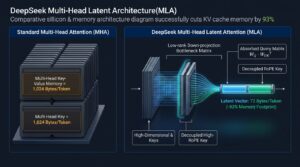
The two represents keys and values. Adjust the estimate for grouped-query attention, KV quantization, tensor parallel layout, allocator overhead and block size. The EyesTech DeepSeek MLA architecture audit shows why KV design changes the memory equation. vLLM’s PagedAttention can reuse matching prefix blocks, so “prompt caching is always 0%” is technically wrong. A newly generated reasoning path may not be reusable, while a stable system prompt or retrieved prefix may be.
Benchmark claims need an evidence boundary
The earlier AIME and SWE-bench percentages were presented as a reproducible experiment without a checkpoint, decoding parameters, dataset version, contamination controls, sample count, grader, hardware or raw logs. They should not be presented as an EyesTech benchmark. A calculated example is useful for intuition; measured results require a reproducible method, versioned inputs, raw outputs and uncertainty information.
A production control plane for reasoning budgets
Route deterministic transforms to the least expensive suitable model.
Set completion and reasoning budgets per workflow and tenant.
Use schemas, tests, compilers or domain checks.
Escalate only failed or high-risk cases with cancellation and retry controls.
Open source model examples: baseline, thinking and distillation
Open source models make the tradeoff measurable because the team controls the checkpoint, quantization, serving engine and output budget. The phrase open source still needs precision: weights, code, data and licenses differ by project. Treat the model card and license as part of the deployment record. For the hardware side, pair this section with our analysis of unified memory for local LLMs, then include GPU time, storage, power, engineering and operations when comparing self-hosting with an API bill.
| Model | Useful role | Measure |
|---|---|---|
| Llama 3.1 8B Instruct | Fast non-thinking baseline for extraction and routine code assistance | Does a reasoner improve validated-task success enough to justify extra decode work? |
| DeepSeek-R1-Distill-Qwen-7B | Small reasoning checkpoint for local routing tests | How many reasoning tokens appear before the answer validates? |
| Qwen3-32B | Switchable thinking and non-thinking comparison | What quality gain does thinking add, and what latency penalty? |
These are evaluation examples, not a universal ranking. Meta documents Llama 3.1 8B Instruct as an 8B text model with a 128K context window and grouped-query attention. DeepSeek publishes a distilled 7B checkpoint based on Qwen2.5-Math-7B. Qwen3 documents a hard switch between thinking and non-thinking modes with different decoding guidance. Verify the current card, revision and license before deployment.
Example: compare Qwen3 thinking on and off
from transformers import AutoTokenizer, AutoModelForCausalLM
import torch
model_id = "Qwen/Qwen3-32B"
tokenizer = AutoTokenizer.from_pretrained(model_id)
model = AutoModelForCausalLM.from_pretrained(model_id, torch_dtype=torch.bfloat16, device_map="auto")
messages = [{"role": "user", "content": "Solve this bounded planning problem and return JSON."}]
for thinking in (False, True):
    prompt = tokenizer.apply_chat_template(messages, tokenize=False, add_generation_prompt=True, enable_thinking=thinking)
    inputs = tokenizer(prompt, return_tensors="pt").to(model.device)
    output = model.generate(**inputs, max_new_tokens=1024)
    print(thinking, len(output[0]) - inputs.input_ids.shape[-1])
Run the same versioned task set in both modes. Record generated tokens, time to first token, time to last token, peak GPU memory, JSON validation rate and cost per validated task. This is a measurement template; adapt dtype, device placement and generation settings to the hardware and model card.
Example: use a small reasoner as an escalation route
Start routine requests with Llama 3.1 8B Instruct or Qwen3 in non-thinking mode. If a validator rejects the result, escalate the same request to DeepSeek-R1-Distill-Qwen-7B with a bounded maximum output. Carry a request ID, preserve the prompt version and stop after a fixed number of attempts. This makes reasoning a controlled exception path rather than the default cost for every request.
For serving, vLLM exposes an OpenAI-compatible server and supports model-specific reasoning parsers. Parser configuration matters because it determines whether thinking content is separated from the final answer in telemetry. Keep the parser, vLLM version, quantization format and hardware in the experiment record.
Open model references: Meta Llama 3.1 8B Instruct model card; DeepSeek-R1 repository and distilled checkpoints; Qwen3 32B model card and thinking switch; vLLM serve and reasoning parser documentation.
When does extra reasoning pay for itself?
The right comparison is cost per validated task, not cost per generated token. A cheaper model that fails schema validation twice can cost more than a larger model that succeeds on the first attempt. Track request spend, wall clock time, useful task completion, retries and human review together.
Consider an illustrative baseline that costs one unit and succeeds 70% of the time. If failed requests are retried once, expected request volume is 1.3 units before review. A reasoning route that costs 1.6 units but succeeds 90% of the time may be cheaper per successful task. Replace these example rates with production telemetry before making a routing decision.
A practical measurement plan
| Stage | Record | Decision |
|---|---|---|
| Baseline | Model, prompt version, tokens, latency and outcome | Is the task already good enough? |
| Reasoning sweep | Budget or effort level against quality | Where do returns flatten? |
| Production | Cost per validated task, p95 latency, retries and timeouts | Which route should receive traffic? |
Keep the evaluation set versioned and separate from prompts used for tuning. Include easy, typical and adversarial cases. Report the sample count and failure definition, and publish aggregate metrics where possible. A score without the decoding settings, checkpoint, evaluator and date is difficult for another engineer to reproduce or cite.
Implementation checklist for production teams
- Log provider request IDs, model IDs, price dates and token fields.
- Set separate budgets for input, output and reasoning where supported.
- Expose p50 and p95 time to first token and time to last token.
- Abort work when the deadline expires; do not retry blindly after a partial response.
- Validate structured output before marking a task successful.
- Alert on retry amplification, cache-hit changes and cost per validated task.
These controls improve citation quality. A future reader can identify the model, price card, software version and evaluation window behind a result. That audit trail is what turns a memorable claim into a referenceable engineering finding.
A decision workflow you can reproduce
The most useful output of a reasoning-cost study is a routing decision backed by measurements. Start with one task family, freeze the prompt and evaluation set, then compare a fast baseline with a bounded reasoning route. Our Claude Fable 5.1 cost audit applies the same accepted-artifact denominator to a hosted agent workflow, while the AI inference TCO guide expands the hardware cost side. Do not mix model, prompt and validator changes in one experiment; otherwise the result cannot explain what caused the quality difference.
Worked example: cost per validated task
Assume a baseline model costs 1.0 cost unit per request and produces a valid result on 70 of 100 tasks. Its cost per validated task is 100 ÷ 70 = 1.43 units. A reasoning route costs 1.6 units and validates 90 of 100 tasks, so its cost per validated task is 160 ÷ 90 = 1.78 units. In this example, reasoning improves quality but costs 24% more per successful task. It becomes financially preferable only when its success rate rises above about 112% of the baseline, which is impossible, or when it prevents a separate human review or business failure that has been assigned a monetary value.
This is a deliberately simple model. Add retry amplification, reviewer minutes, GPU idle time, queueing and the cost of an incorrect answer for a production decision. The calculation is valuable because every assumption is visible and can be replaced with measured values.
Experiment brief for a credible comparison
- Task set: freeze at least one versioned set with easy, typical and adversarial cases.
- Models: record exact repository revision, quantization, tokenizer and serving engine.
- Decoding: record temperature, top-p, maximum output and reasoning settings.
- Hardware: record GPU type, count, memory, batch size and concurrency.
- Outcomes: report valid-task rate, p50 and p95 latency, generated tokens, peak memory and retries.
- Evidence: retain prompts, outputs, validator logs and the date of the run.
Publish the denominator with every percentage. “90% accuracy” is not enough by itself; “90 of 100 versioned tasks passed the JSON and domain validator under these decoding settings” is auditable. This standard makes the article useful to engineers who need to reproduce, challenge or cite the result.
Choose the deployment pattern
| Pattern | Use it when | Main risk |
|---|---|---|
| Hosted API | Traffic is variable and time to market matters | Rate changes, quotas and data handling |
| Self-hosted open model | Traffic is predictable or data must stay inside the environment | GPU utilization, upgrades and operations |
| Hybrid escalation | Most requests are easy but failures are expensive | Routing complexity and inconsistent telemetry |
For a self-hosted route, calculate an hourly fully loaded GPU rate and divide it by validated requests per hour. For an API route, use the current rate card and measured tokens. Keep both calculations in the same currency and time window. The result is a business decision grounded in workload shape, not a generic claim that open models or hosted models are always cheaper.
The final decision rule
Reasoning is worth paying for when the added compute reduces the total cost of producing a correct, accepted artifact within the deadline. If quality improves but cost per validated task, p95 latency or review burden worsens beyond the product budget, keep reasoning as an escalation tier. That is the operational answer this article is designed to produce.
Frequently asked questions
Do reasoning tokens always cost the output rate?
They may be included in billable completion or reasoning usage, but the rule is provider and model specific. Check current pricing documentation.
Can prompt caching help reasoning workloads?
Yes for stable prefixes when supported. Measure cache hits instead of assuming zero.
What should an enterprise measure first?
Cost per validated task, p50 and p95 latency, timeout rate, retry amplification, cache-hit ratio and reasoning usage.
How Prithu Vardhan Mishra produced this audit
This is a source-led systems audit by Prithu Vardhan Mishra, Founder and Lead Systems Analyst at EyesTech Systems Lab. It is not presented as an independent model benchmark.
Translate “reasoning is expensive” into cost per validated task, latency and memory questions.
Check provider pricing, model cards, gateway limits and serving documentation.
Remove unsupported benchmark percentages and label calculated examples as estimates.
Turn the evidence into a model-routing workflow, experiment brief and production checklist.
Disclosure and update policy: No independent latency or quality benchmark was run for this article. All worked numbers are explicitly illustrative. Provider rates and model behavior should be rechecked at deployment time. Corrections follow the EyesTech editorial policy.
Sources: AWS API Gateway timeout documentation; Anthropic pricing and prompt caching; vLLM PagedAttention; OpenAI API pricing.