
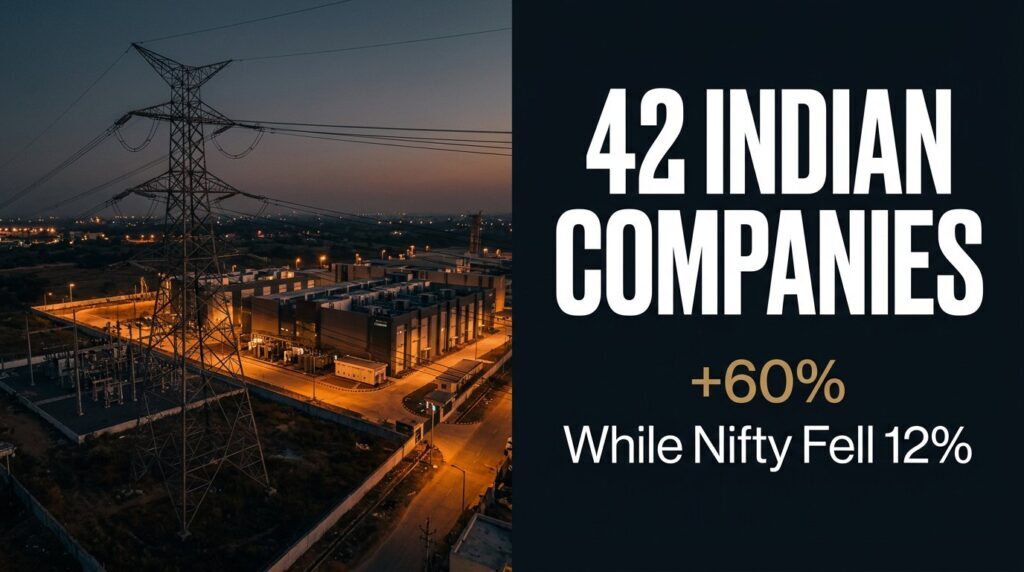

On September 17, 2026, Goldman Sachs Global Investment Research released a landmark equity strategy report that fundamentally dismantles one of the most pervasive macro misconceptions of the global AI supercycle: the classification of the Indian equity market as an “anti-AI” defensive trade.
A rigorously screened basket of 42 Indian companies, categorized by Goldman Sachs as “India AI Enablers”, has surged approximately 60% in 2026, opening up a staggering 72 percentage point alpha spread against the broader Nifty 50 benchmark (down ~12% YTD). Commanding an aggregate market capitalization exceeding $670 billion, the rally is uniquely backed by hard industrial reality: roughly 75% of the performance is driven by concrete earnings growth rather than speculative valuation multiple expansion.
1. The Macro Paradox: How the “Anti-AI India” Narrative Collapsed
For nearly two years, institutional capital allocators treated Indian equities as an inadvertent victim of generative AI. The initial thesis was simple, intuitive, and analytically shallow:
India’s legacy IT majors (TCS, Infosys, Wipro, HCLTech) represent over 14% of the Nifty 50 weighting. Rapid adoption of autonomous coding agents triggered fears that the billable headcount model was structurally impaired.
India lacked a domestic foundation model monopoly (an OpenAI, Anthropic, or DeepSeek) and leading-edge foundry silicon (an NVIDIA or TSMC), prompting global funds to underweight the market.
Cap-weighted ETFs (INDA, EEM, MSCI India) were structurally blind to mid- and small-cap industrial suppliers, completely missing the multi-quarter surge in power transformers and data center EPC.
Goldman Sachs emerging market equity strategist Sunil Koul identified that global hedge funds had spent early 2026 using India as a “funding short” to finance long positions in Taiwan and South Korea. As domestic industrial earnings accelerated, that consensus trade was brutally unwound.
2. The Quantitative Screening Architecture: From 1,800 to 42
To isolate genuine beneficiaries from speculative pretenders, Goldman Sachs developed a multi-tier quantitative filter across the Indian listed universe (NSE & BSE):
| Screening Stage | Filtration Criteria | Applied Threshold |
|---|---|---|
| Tier 1: Liquidity & Scale | Minimum market capitalization and institutional daily trading volume | Market Cap > $500M USD; 30-day ADTV > $5M USD |
| Tier 2: NLP Intent Scoring | Transcripts, annual filings, and investor presentations parsed for compute keywords | High density: “GPU cluster”, “immersion cooling”, “HVDC”, “OSAT”, “PUE <1.3” |
| Tier 3: Capex Acceleration | Year-on-year capital expenditure velocity directed toward AI-adjacent physical assets | YoY Capex Growth ≥ 25% allocated to power, cabling, or colocation |
| Tier 4: Order Book Attribution | Audited revenue attribution or contractual backlog with sovereign or hyperscale buyers | Contractual MoUs, confirmed tenders, or verified tier-1 equipment supply contracts |
3. The Tri-Pillar Architecture: Three Layers, 40–80% Returns Each
Goldman Sachs mapped the 42 companies across three fundamental infrastructure layers. Every single layer generated between 40% and 80% capital appreciation in 2026:
Layer 1 — Power: Generation, Transmission & High-Voltage Equipment
The Central Electricity Authority (CEA) forecasts India’s data center power demand surging to 17 GW by 2031–32 (from ~1.57 GW operational today) — a staggering 10.8× expansion in six years. Compute cannot scale without grid energization.
| Company | Ticker | AI Value-Chain Function | Key Catalyst & Order Book Metrics |
|---|---|---|---|
| Tata Power | TATAPOWER | Captive round-the-clock green power PPAs for hyperscalers | Multi-GW renewable pipeline with dedicated colocation supply contracts |
| NTPC Green Energy | NTPCGREEN | Utility-scale green energy baseload with FDRE supply | State-backed balance sheet; green hydrogen and BESS firming contracts |
| GE Vernova T&D India | GEV T&D | High-voltage GIS; 400kV–765kV step-down transformers | Order book: ₹20,800 Cr (+60% YoY); deliveries booked into Q4 FY2029 |
| Siemens India | SIEMENS | Substation automation, microgrids, industrial electrification | Order book: ₹18,430 Cr; joint NVIDIA Omniverse digital twin framework |
| Polycab India | POLYCAB | High-amperage data center cabling, bus ducts, OPGW | Domestic leader in high-temperature, low-loss industrial power transmission |
| HFCL / Sterlite Tech | HFCL / STLTECH | High-density fiber optic cables, 400G/800G optical transceivers | Inter-campus dark fiber interconnects for ultra-low latency AI cluster synchronization |
Layer 2 — Hyperscale Data Centers: EPC, Photonics & Specialty Cooling
| Company | AI Value-Chain Function | Key Catalyst & Order Book Metrics |
|---|---|---|
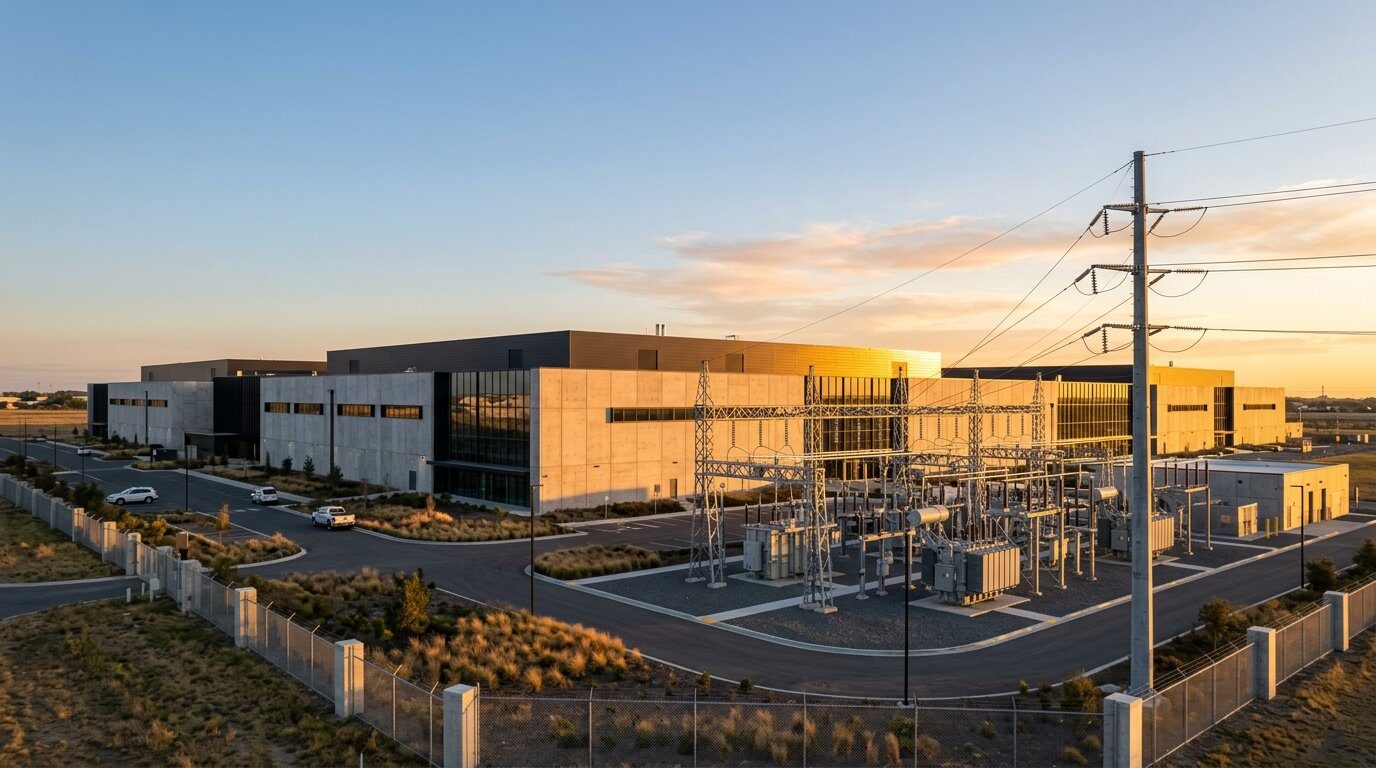
| Adani Enterprises (AdaniConneX) | Hyperscale colocation JV with EdgeConneX | 960 MW tied-up capacity; 400 MW order in Vizag; 2 GW target by 2030, 5 GW by 2035 |
| Anant Raj | Warehouse-to-Data Center conversions in NCR/Haryana | 300 MW pipeline; net operating income yields 5–8× above conventional warehousing |
| Bharti Airtel (Nxtra) | Carrier-neutral colocation and subsea cable landing owner | 14 hyperscale + 120 edge facilities; $1B capital commitment backed by Carlyle |
| Larsen & Toubro | Turnkey hyperscale EPC; modular data center construction | ₹10,000–₹15,000 Cr mega-order from Together AI (10,000 NVIDIA B300 GPUs at Chennai) |
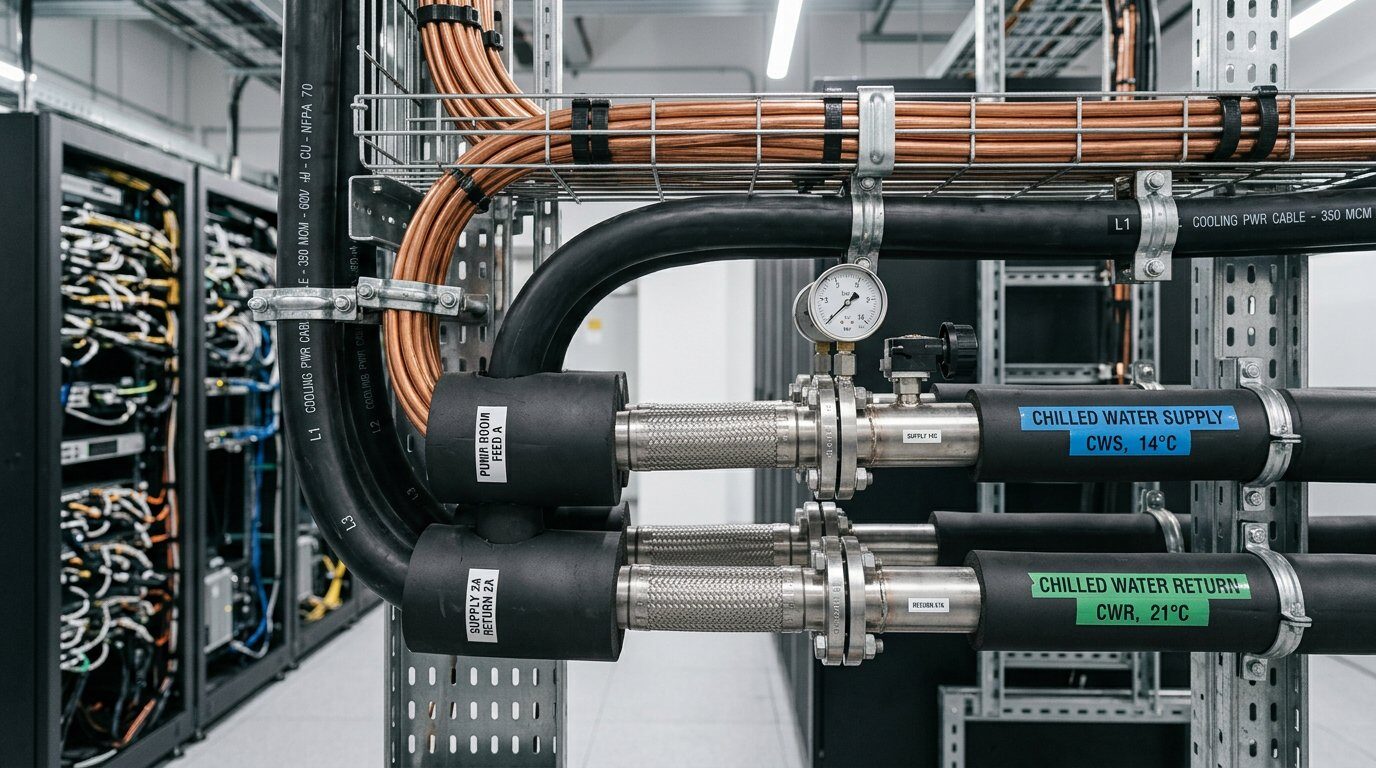
| Gujarat Fluorochemicals | Dielectric fluorochemical immersion cooling fluids & PVDF binders | Global supply squeeze on PFAS alternatives creates immense export and domestic moat |
Layer 3 — Semiconductor OSAT, EMS & Server Integration
| Company | AI Value-Chain Function | Key Catalyst & Order Book Metrics |
|---|---|---|
| Netweb Technologies | Sovereign AI server OEM; NVIDIA Elite Partner; Blackwell integration | Firm order book: ₹2,507 Cr + ₹10,410 Cr pipeline; AI systems represent 62% of revenue |
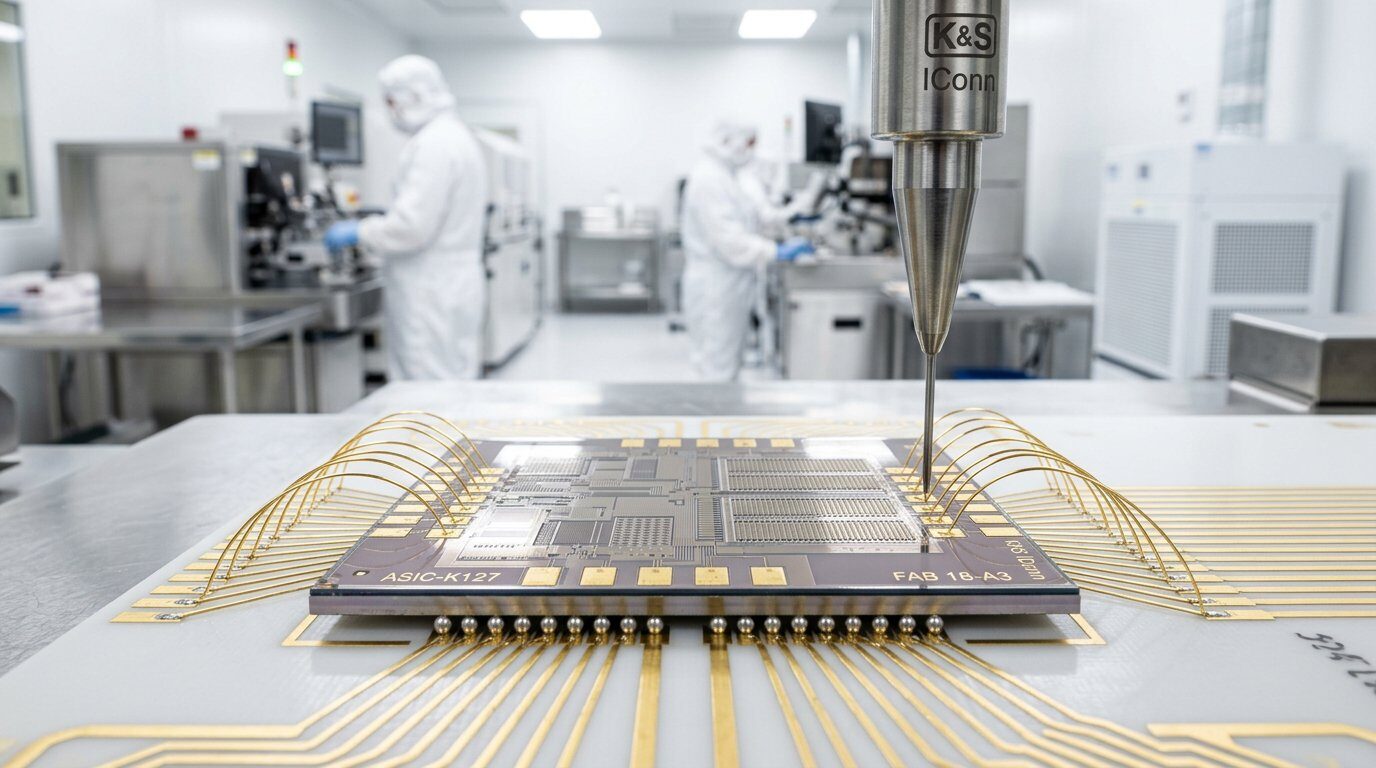
| Kaynes Technology | Sanand OSAT facility: advanced chip packaging & high-density PCBs | Semicon 2.0 capital subsidy recipient; co-packaged optics (CPO) and AI accelerator substrates |
| Dixon Technologies | Hyperscale server box-build and industrial electronics manufacturing (EMS) | PLI-incentivized scale platform capturing multi-tenant server chassis production |
4. Deep-Dive Case Studies: The Forensic Financials
On August 13, 2026, L&T announced a landmark mega-order (₹10,000–₹15,000 Cr) from US AI cloud provider Together AI. Through subsidiaries LTN Compute and Vyoma.AI, L&T is constructing India’s largest single-cluster facility at Chennai: hosting 10,000 NVIDIA B300 GPUs across a 250 MW campus.
Firm order book: ₹2,506.94 crore, backed by an active pipeline of ₹10,410 crore. In Q1 FY27, AI server systems contributed ₹510.57 crore (62%) of Netweb’s total revenue. Premium margins on $300k–$500k rack integration drop straight to EBIT.
AI training runs cannot tolerate millisecond drops without catastrophic checkpoint corruption. Data center backup power has grown from <2% of Cummins India’s revenue 7 years ago to over 14% of total revenue (35% of domestic Powergen). HHP gensets (QSK60/95) are indispensable.
AdaniConneX: 960 MW tied-up capacity, targeting 2 GW by 2030 and 5 GW by 2035. Yotta Data Services: Preparing a ₹6,000–₹8,000 crore IPO to fund procurement of 80,000+ NVIDIA GPUs across its 2 GW Greater Noida and Navi Mumbai platforms.
5. The Financial Mechanics: Earnings-Driven Rally, Not a Bubble
When an infrastructure basket surges 60% during a period when the headline index drops 12%, investors naturally question valuation excess. Goldman Sachs’ performance attribution conclusively refutes the “speculative bubble” theory:
| Financial Metric | 42 India AI Enablers | Benchmark Nifty 50 |
|---|---|---|
| 2026 YTD Price Performance | +60% | -12% |
| Rally Attribution: EPS Growth | ~75% | N/A |
| Rally Attribution: Multiple Expansion | ~25% | N/A |
| Raw Trailing P/E Multiple | ~38× | ~21× |
| Projected 3-Year EPS CAGR | >30% | ~13% |
| Growth-Adjusted PEG Ratio | ~1.15× (Valuation Discount!) | ~1.62× |
| Aggregate Capex CAGR | +38% | ~9% |
6. The Government Policy Stack: Sovereign Compute as Industrial Policy
7. India’s Data Center Scale: The Numbers Behind the Boom
| Infrastructure Metric | Operational (2026) | 2030 Baseline | 2031–32 (CEA Forecast) |
|---|---|---|---|
| Installed Data Center Power Capacity | ~1.57–1.75 GW | ~8.0 GW | 17.0 GW (Electricity Demand) |
| Active Committed Capital | $70 billion | — | — |
| Announced Pipeline + Long-Term Potential | +$90B announced | — | >$200 billion total potential |
8. Critical System Failure Modes: Four Structural Vulnerabilities
Delivery dates for 100–400 MVA transformers and 765kV gas-insulated switchgear now stretch to Q4 FY2029 due to global shortages of CRGO electrical steel. Finished data center shells cannot energize without transformers, stranding capital for up to 18 months.
Traditional evaporative cooling consumes 2–5 L/kWh (a 50 MW site consumes ~2B liters/year). Drought-prone states (Maharashtra, Telangana, UP) are imposing water audits. Transitioning to closed-loop liquid and two-phase immersion cooling adds 20–35% in upfront mechanical capex.
India relies entirely on imported frontier GPUs (Blackwell B200/B300, H100) subject to US Commerce Department export licensing. Indian buyers sit at Tier-2/Tier-3 allocation priority behind US hyperscalers and sovereign Gulf funds, creating shipment delays.
Data centers require Five-Nines (99.999%) uptime. Supplying 100% clean power via Round-the-Clock (RTC) contracts requires substantial Battery Energy Storage Systems (BESS), increasing levelized power costs by ~2.5× over plain solar PPAs.
9. Strategic Implications for Capital Allocators & Enterprise Architects
Passive market-cap-weighted emerging market exposure is systematically short the India AI infrastructure revolution. The 42 “AI Enablers” are predominantly outside the top-40 Nifty constituents — structurally inaccessible to INDA, EEM, and MSCI India ETFs.
The valuation mathematics presents an extraordinary dislocation: at a growth-adjusted PEG ratio of ~1.15× versus the MSCI India benchmark at ~1.62×, the 42 AI Enablers are simultaneously the highest-performing cohort in the market and the cheapest on growth-adjusted terms.
India is not playing the foundation model lottery. It is manufacturing, electrifying, cooling, cabling, packaging, and integrating the physical thermodynamic substrate without which frontier AI models cannot execute. In an era of exponential compute demand, ultimate compounding power belongs to those who control the electrons.
Sources: Goldman Sachs Global Investment Research, September 17, 2026; Economic Times; Business Standard; Financial Express; Business Today; IndiaIPO; Press Insider; Investing.com; PIB India (IndiaAI Mission, SHANTI Act); Central Electricity Authority; IBEF; JLL India Data Center Report H1 2026; Tradebrains; ConstructionWorld.