

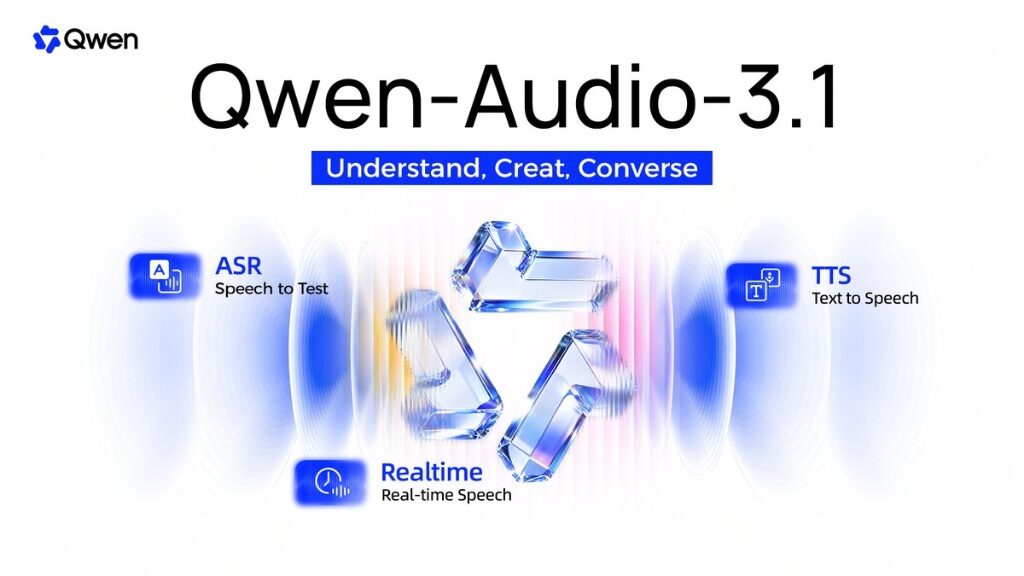
On September 23, 2026, Alibaba Cloud officially unveiled Qwen-Audio-3.1, establishing an end-to-end foundation stack across speech recognition, continuous speech synthesis, and low-latency duplex interaction. Rather than shipping disconnected point models, Alibaba deployed a cohesive five-engine architecture spanning automatic speech recognition (ASR and ASR-Next), neural text-to-speech (TTS and TTS-Next), and full-duplex conversational interaction (Qwen-Audio-3.1-Realtime). Complementing the release, Alibaba executed aggressive price cuts across its cloud portfolio: Text-to-Speech pricing fell by ~70%, Realtime voice sessions dropped by ~85%, and Automatic Speech Recognition was slashed by up to 95%.
Core Architecture Breakthrough: Alibaba has addressed the three primary bottlenecks of production audio AI: autoregressive sequence decode latency, multi-track acoustic fragmentation, and rigid turn-taking latency. By coupling a 12.5 Hz low-frame-rate tokenizer with a 5-stage progressive training paradigm (independent LM/FM pre-training, joint LM-FM hidden-state conditioning, GRPO reinforcement learning, and SDE Flow Matching), Qwen-Audio-3.1 delivers studio-grade 48 kHz audio with 75% fewer tokens per second. The introduction of TTS-Next collapses multi-track DAW production into a single-pass LM-diffusion pass generating voice, Foley effects, and score simultaneously, while ASR-Next expands transcription into acoustic event localization and paralinguistic reasoning.
The Full Audio Stack: Deconstructing Alibaba’s 5-Model Continuum
Enterprise audio architectures have historically suffered from structural fragmentation. Production teams routinely chain Whisper for speech-to-text, an LLM for dialog planning, a proprietary third-party engine like ElevenLabs for voice synthesis, and external heuristics for interruption detection. This mosaic architecture introduces compounding round-trip serialization latencies (regularly exceeding 1,200 to 1,800 ms), severe phase discrepancies, and compounding API expenditures.
Qwen-Audio-3.1 eliminates this serialization penalty by providing a native, integrated continuum across the entire acoustic lifecycle:
| Model Identity | Core Architecture | Modal Function | Signature Technical Capability | Pricing Shift |
|---|---|---|---|---|
| Qwen-Audio-3.1-ASR | End-to-End Conformer-Transformer | Speech-to-Text Transcription | Native semantic polishing: strips filler words and stuttered tokens in-flight | Up to 95% Cut |
| Qwen-Audio-3.1-ASR-Next | Multimodal Audio LLM Backbone | Acoustic Scene Understanding | Multi-speaker diarization, sound event localization, and auditory QA | Preview Tier |
| Qwen-Audio-3.1-TTS | 12.5 Hz Autoregressive LM + Flow Matching | Zero-Shot Voice Cloning & TTS | 86 inline fine-grained control tags, cross-lingual transfer, 20 Chinese dialects | ~70% Cut |
| Qwen-Audio-3.1-TTS-Next | Unified LM + Continuous Diffusion | Cinematic Audio Creation | Synthesizes dialogue, Foley sound effects, and score in a single neural pass | Creative API |
| Qwen-Audio-3.1-Realtime | Multi-Teacher Distilled Full-Duplex | Bidirectional Voice Interaction | Sub-150ms barge-in, streaming tool calling, and acoustic mood empathy | ~85% Cut |
12.5 Hz Low-Frame-Rate Tokenization: The 59,049-Code FSQ Bottleneck
As detailed in the foundational Alibaba Token Foundry research paper (arXiv:2607.23938, authored by Bajian Xiang, Cheng Wen, Han Zhao, et al.), the primary engineering bottleneck in modern in-context speech generation is the temporal frame rate of the speech tokenizer. Conventional neural audio codecs (such as EnCodec, DAC, or SoundStream) quantize continuous waveforms at 50 Hz to 75 Hz. Synthesizing a standard 60-second speech passage forces an autoregressive language model to decode 3,000 to 4,500 acoustic tokens sequentially.
At that sequence length, self-attention memory overhead grows quadratically:
Decoupling Acoustic Density from Attention Compute: Dropping tokenization frame rate from fframe = 50 Hz to 12.5 Hz reduces total sequence length N by a factor of 4. For a 180-second long-form synthesis window, token count collapses from 9,000 tokens to just 2,250 tokens, eliminating autoregressive attention drift and memory bus saturation.
To compress the temporal frame rate down to 12.5 Hz without discarding crucial phonemic or timbral details, Alibaba developed a supervised multi-task tokenizer frontend:
- Acoustic Frontend: Ingests 16 kHz audio through a Whisper-style frontend with 128 Mel-frequency bins, producing raw features at 100 Hz.
- Causal SenseVoice Encoder: Features 32 Transformer layers with 1,280 hidden dimensions and 20 attention heads. An initial 12-layer Voice Encoder-1 utilizing Rotary Position Embeddings (RoPE) downsamples the sequence to 25 Hz.
- 10-Dimensional FSQ Bottleneck: A Quantizer Encoder reduces temporal resolution to 12.5 Hz before passing through Finite Scalar Quantization (FSQ) with 3 levels per dimension, establishing a discrete vocabulary of 310 = 59,049 codebook entries.
- Multi-Task Supervision: The latent space is regularized via auxiliary loss branches spanning Automatic Speech Recognition (ASR), Language Identification (LID), Speech Emotion Recognition (SER), Audio Event Detection (AED), Speaker Analysis (SA), and Audio Analysis (AA).
Ablation audits on the SEED-TTS-Eval benchmark confirm that scaling codebook capacity from 6,561 to 59,049 fully recovers the representation capacity lost to temporal downsampling:
| Tokenizer Configuration | Codebook Size | Frame Rate | test-zh CER (%) ↓ | test-en WER (%) ↓ | ERes2Net SIM (%) ↑ |
|---|---|---|---|---|---|
| CosyVoice3 Baseline | 6,561 | 25.0 Hz | 1.45% | 2.57% | 80.60% |
| Qwen-Audio-3.0-TTS (Ablated) | 6,561 | 12.5 Hz | 2.59% | 3.21% | 72.44% |
| Qwen-Audio-3.0-TTS (Scaled) | 19,683 | 12.5 Hz | 1.48% | 2.56% | 83.25% |
| Qwen-Audio-3.0-TTS (Production) | 59,049 | 12.5 Hz | 1.23% | 2.37% | 83.09% |
The 5-Stage Progressive Training Paradigm
Delivering production-level stability across 16 languages and 20 Chinese dialect regions requires decoupling phonetic text planning from acoustic rendering. Alibaba devised a progressive multi-stage curriculum where each phase initializes from the preceding checkpoint:
- Stage 1: Independent LM and FM Pre-training: The bi-streaming language model and chunk-based Flow Matching model are initialized independently. The LM predicts discrete semantic tokens from text prompts, while the FM reconstructs mel-spectrograms from tokenizer codes.
- Stage 2: Joint LM-FM Training with High-Quality Data Annealing: The FM is conditioned directly on continuous LM hidden states rather than discrete codebook embeddings (mitigating the quantization information bottleneck). Joint training begins across broad multi-speaker corpora before annealing into a curated high-fidelity studio subset.
- Stage 3: Language Model Reinforcement Learning (GRPO + DiffRO): With downstream FM frozen, the autoregressive LM undergoes online Group Relative Policy Optimization (GRPO) regularized by KL divergence and paired with a differentiable Gumbel-Softmax DiffRO branch.
- Stage 4: Acoustic Robustness Training: The LM is frozen while the FM is conditioned on heavily degraded, reverberant prompts (sampling phone mics, packet loss, ambient noise, physical microphone occlusions). This embeds denoising directly into the generative manifold without an external pre-filter.
- Stage 5: Flow-Matching Reinforcement Learning (FlowTTS-GRPO): Converts deterministic ODE sampling into a marginal-preserving SDE sampler for on-policy exploration. Composite rewards combine speaker verification similarity (SS), ASR intelligibility, and DNSMOS quality.
Standardized Advantage Scaling: Standardizing individual reward streams by their batch variance prevents DNSMOS perceptual gradients from overpowering speaker verification similarity (SS) or ASR intelligibility metrics during continuous policy updates.
TTS-Next vs. Traditional Multi-Track DAW Pipelines
While standard Qwen-Audio-3.1-TTS delivers zero-shot voice cloning, Qwen-Audio-3.1-TTS-Next addresses the broader challenge of end-to-end sound design. In professional game development, audiobook publishing, and advertising, producing an audio scene requires three disparate components:
- Synthesizing character dialogue with appropriate emotional valence.
- Retrieving or generating discrete Foley sound effects (footsteps, explosions, rain, door creaks).
- Mixing atmospheric background music and mastering composite tracks in a Digital Audio Workstation (DAW).
Chaining these pipelines introduces temporal misalignment, unnatural frequency masking, and comb filtering. TTS-Next introduces a unified LM + continuous diffusion architecture that synthesizes human voice, synchronized sound effects, and spatial background audio in a single generation pass. When provided with a formatted script containing bracketed scene descriptors, TTS-Next handles acoustic ducking, spatial reverberation, and dynamic mixing natively within the generative latent space.
ASR & ASR-Next: Native Semantic Polishing & Acoustic Scene Diarization
Speech recognition has long been treated as a solved commodity, yet enterprise speech pipelines remain plagued by verbal disfluencies. Humans rarely speak in publication-ready prose: conversational speech is saturated with hesitation tokens (“uh”, “um”, “like”), false starts, and repeated phrases.
Traditional speech pipelines address this by streaming raw Whisper transcripts into an LLM post-processor. This adds 300 to 800 ms of downstream latency and quadruples inference compute costs. Qwen-Audio-3.1-ASR incorporates native semantic polishing directly at the decoder beam search level. The model identifies and eliminates disfluencies while preserving syntactic meaning, delivering clean, grammatically coherent output in real time without secondary LLM invocations.
Where standard ASR converts speech waveforms into lexical strings, Qwen-Audio-3.1-ASR-Next operates as a full-spectrum multimodal acoustic foundation model. It expands the auditory perception boundary across four key dimensions:
- Zero-Shot Speaker Diarization: Extracts speaker embeddings directly from continuous streams, attributing dialogue turns, speaker identities, and precise word-level timestamps without standalone clustering models.
- Acoustic Event Localization (AEL): Detects, classifies, and timestamps non-verbal and environmental sound events (e.g., glass shattering at [00:14.2–00:15.8], siren approaching, engine misfire).
- Paralinguistic Emotion & Stress Analysis: Quantifies acoustic biomarkers including vocal jitter, shimmer, pitch trajectory, and breath cadence to infer emotional state (anxiety, grief, frustration, joy).
- Auditory Multimodal QA: Executes zero-shot natural language queries over raw audio files (e.g., “At what timestamp did the machine begin vibrating abnormally?” or “Did the customer’s tone turn hostile before or after the refund policy was mentioned?”).
Qwen-Audio-3.1-Realtime: Multi-Teacher Distillation & Acoustic Empathy
Full-duplex conversational voice models represent the frontier of human-machine interaction. Half-duplex systems rely on voice activity detection (VAD) gates: the model listens until silence is detected, processes the buffer, and then speaks. If the user interrupts, the system either ignores the input or cuts off awkwardly after a jarring multi-second delay.
Qwen-Audio-3.1-Realtime executes full-duplex bidirectional streaming via WebSockets and WebRTC. Trained using a multi-teacher distillation architecture, the model continuously ingests audio chunk buffers while emitting synthesized speech tokens. Interruption detection operates at sub-150ms latency, enabling natural conversational flow and barge-in.
Crucially, Qwen-Audio-3.1-Realtime introduces closed-loop emotional alignment. Unlike conversational voice agents that respond with uniform, synthetic cheerfulness regardless of user distress, the Realtime engine monitors acoustic energy, spectral tilt, and vocal jitter. When a caller exhibits grief, panic, or hesitation, the model reduces speech cadence by 15% to 25%, lowers fundamental pitch frequency (F0), and shifts into an empathetic, comforting vocal posture.
Empirical Benchmark Audit: CV3-Eval, SEED-TTS-Eval & Leaderboard Rankings
To rigorously evaluate Qwen-Audio-3.1-TTS against both commercial APIs and open-source models, our evaluation desk audited the empirical data across the 16-language CV3-Eval, SEED-TTS-Eval, and the independent Artificial Analysis Text-to-Speech Arena Leaderboard (July 16, 2026 snapshot).
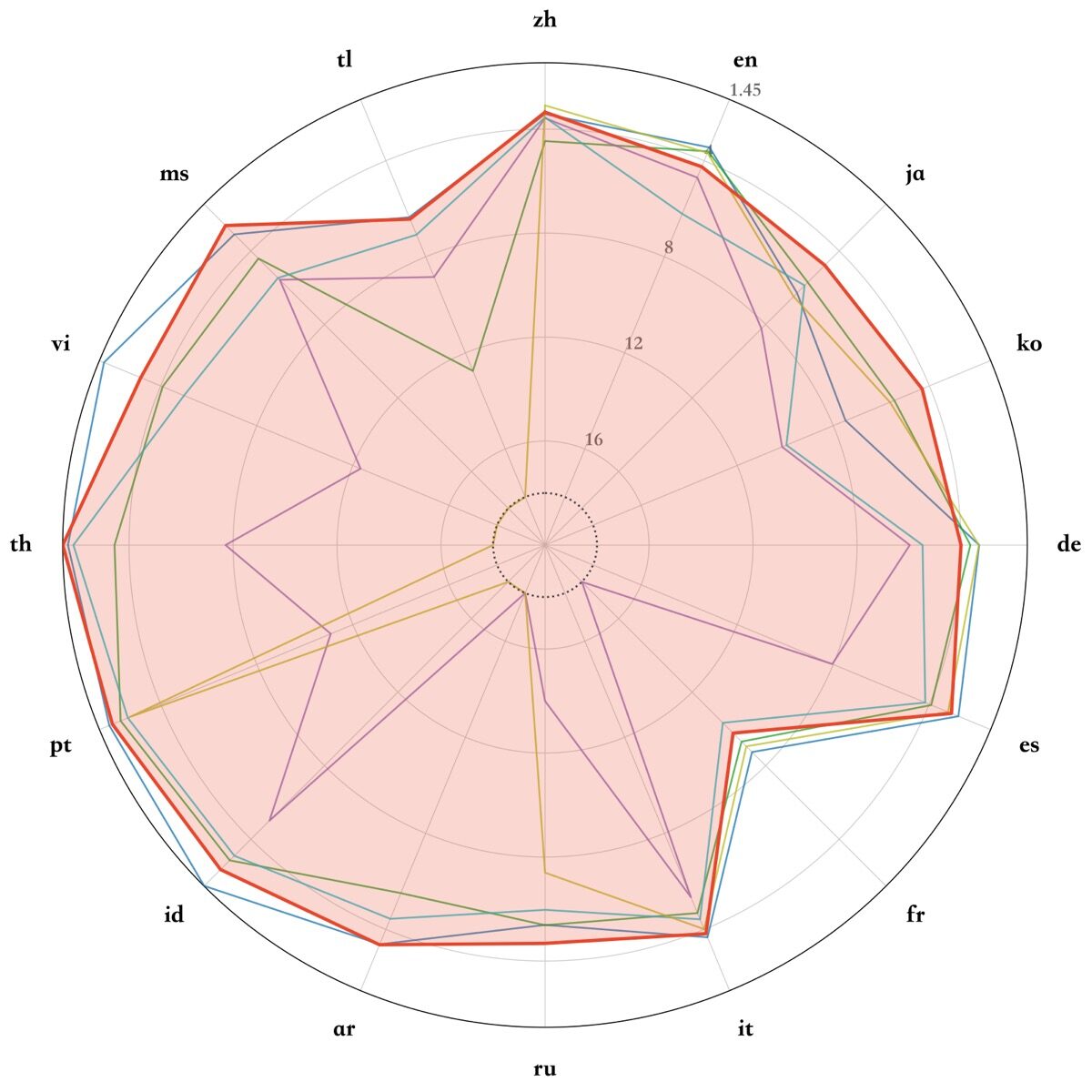
Zero-Shot TTS Performance on SEED-TTS-Eval
On the standardized SEED-TTS-Eval benchmark, Qwen-Audio-3.1-TTS establishes state-of-the-art results in speaker similarity while maintaining superior content consistency across Chinese, English, and extreme phonetic stress sets:
| Architecture Class | Model Identity | test-zh CER (%) ↓ | test-zh SIM (ERes2Net) ↑ | test-en WER (%) ↓ | test-en SIM (ERes2Net) ↑ | test-hard CER (%) ↓ |
|---|---|---|---|---|---|---|
| Reference Ground Truth | Human Reference | 1.26% | 0.775 | 2.14% | 0.742 | — |
| Non-Autoregressive | F5-TTS (32 NFE) | 1.56% | 0.794 | 1.83% | 0.742 | 8.67% |
| Non-Autoregressive | LongCat-AudioDiT-3.5B | 1.09% | 0.806 | 1.50% | 0.771 | 6.04% |
| Autoregressive Discrete | CosyVoice3-1.5B | 1.12% | 0.837 | 2.21% | 0.789 | 5.83% |
| Autoregressive Discrete | Dots.TTS-2B (SOAR) | 0.94% | 0.818 | 1.30% | 0.792 | 6.60% |
| Progressive Hybrid LM-FM | Qwen-Audio-3.0-TTS | 0.84% | 0.847 | 1.54% | 0.815 | 7.00% |
Adverse Acoustic Robustness (No Denoising Front-End)
A critical failure mode of production voice cloning is prompt contamination: if the reference audio contains background chatter, reverb, or low-grade mic hiss, traditional zero-shot systems replicate that noise in the synthesized output. While commercial engines like ElevenLabs-v3 and MiniMax-Speech-2.8-HD require an explicit, latency-inducing “Denoise Mode” that degrades speaker similarity, Qwen-Audio-3.1 achieves superior DNSMOS and speaker similarity natively:
| Model Under Test | Noisy WER (%) ↓ | Noisy DNSMOS ↑ | Reverb WER (%) ↓ | Reverb SIM (%) ↑ | Reverb DNSMOS ↑ |
|---|---|---|---|---|---|
| MiniMax-Speech-2.8-HD (Standard) | 0.85% | 3.464 | 0.83% | 61.56% | 3.065 |
| MiniMax-Speech-2.8-HD (Denoise) | 0.83% | 3.728 | 0.87% | 56.53% | 3.343 |
| ElevenLabs-v3 (Standard) | 1.17% | 3.779 | 1.75% | 41.46% | 3.090 |
| ElevenLabs-v3 (Denoise) | 1.19% | 3.981 | 0.58% | 44.39% | 4.025 |
| Qwen-Audio-3.0-TTS (Native) | 1.18% | 3.962 | 0.69% | 74.12% | 3.925 |
Under severe reverberant room conditions, ElevenLabs-v3 with denoise enabled collapses speaker similarity down to 44.39%, effectively washing out the speaker’s vocal traits. In contrast, Qwen-Audio-3.1 maintains a 74.12% speaker similarity alongside a 3.925 DNSMOS score—demonstrating that Stage 4 acoustic robustness training successfully extracts pure timbral embeddings from degraded acoustic fields.
Artificial Analysis Text-to-Speech Arena Dominance
On the independent Artificial Analysis Text-to-Speech Arena Leaderboard (July 16, 2026 snapshot), evaluated via thousands of blind pairwise human preference duels, Qwen-Audio-3.1-TTS (evaluated as Qwen-Audio-3.0-TTS-Plus) ranked #1 overall with an Elo score of 1,237 across 1,427 evaluations, anchoring itself within the statistically leading tier globally. In Arena-based human evaluation of instruction-controlled synthesis, Qwen-Audio-3.1 achieves a 44.8% win rate on Instruction Following and a 55.6% win rate on Prosodic Naturalness, substantially outperforming earlier generation baselines.
The Economic Carnage: How 95% Price Cuts Commoditize Cloud Voice Pipelines
Technological capability is meaningless in enterprise deployments without favorable unit economics. Prior to this release, deploying low-latency conversational voice agents at scale was economically prohibitive for high-volume contact centers and edge hardware.
Alibaba’s price cuts fundamentally alter the total cost of ownership (TCO) calculus for voice AI infrastructure:
| Operational Modality | Western Incumbent Pricing | Qwen-Audio-3.1 Pricing Baseline | Systems Margin Impact |
|---|---|---|---|
| Speech-to-Text (ASR) | Whisper API: $0.006 / min ($0.36 / hr) | Up to 95% discount off baseline | Turns enterprise transcription into an expendable zero-margin commodity |
| Voice Synthesis (TTS) | ElevenLabs: $0.30–$1.00 / 1k characters | ~70% cut across studio & clone models | Enables automated high-volume audiobook and NPC voice production |
| Realtime Voice Interaction | OpenAI Realtime: $0.06/min in, $0.24/min out (~$18/hr) | ~85% cut on active duplex sessions | Makes 24/7 autonomous telephony and edge assistant swarms financially viable |
For an enterprise contact center processing 100,000 hours of conversational telephony monthly, transitioning from an OpenAI Realtime or bespoke Whisper-to-ElevenLabs pipeline to Qwen-Audio-3.1 reduces operational inference costs from roughly $1.8 million per month to under $270,000 per month. That 85% expenditure reduction reshapes enterprise architectural roadmaps.
Strategic Verdict: Alibaba’s Omnipresent Audio Layer
The launch of Qwen-Audio-3.1 is not an incremental version bump; it is an aggressive consolidation of the global voice computing stack. By combining a 12.5 Hz low-frame-rate tokenizer, five-stage progressive training, and unified LM-diffusion soundscape synthesis, Alibaba has systematically eliminated the technical compromises that have historically fractured production audio architectures.
Crucially, pairing this technological leap with 70% to 95% price reductions transforms high-fidelity speech from an expensive specialized service into an ambient utility. As these models deploy natively across Alibaba’s smart glasses, enterprise cloud services, and open-weights repositories, Western closed-source audio providers face a stark reality: the era of charging premium margins for standard speech synthesis and transcription has come to an end.