



When Sarvam AI released the original Sarvam Vision in February 2026, a compact 3-billion-parameter model built in Bengaluru quietly did something that caught the global AI community off guard: it went toe-to-toe with massive proprietary frontier models on document reading at a fraction of their compute cost.
For months, the question hanging over the industry was whether a lean, sovereign architecture could hold that ground once the next wave of global heavyweights arrived—from omnimodal titans like GPT 6 Astra, Opus 5, and Gemini 3.6 Flash to specialized document parsers like Infinity-Parser2 Pro and PaddleOCR-VL 1.6.
With the release of Sarvam Vision 2.1, Sarvam AI just answered that question—and pushed the ceiling of document intelligence into new territory.
Rather than chasing leaderboard vanity on a single isolated metric, Sarvam Vision 2.1 advances the entire multi-objective Pareto frontier at once:
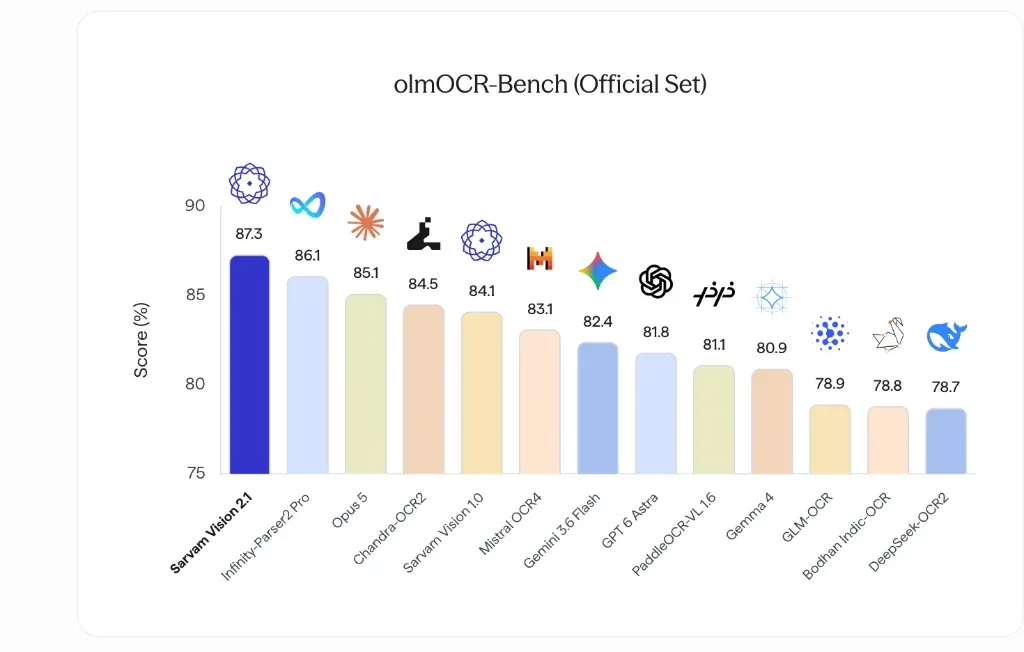
- #1 Worldwide on olmOCR-Bench (87.3%): Outperforming Infinity-Parser2 Pro (86.1%), Opus 5 (85.1%), Gemini 3.6 Flash (82.4%), and GPT 6 Astra (81.8%) on dense, degraded, real-world physical scans.
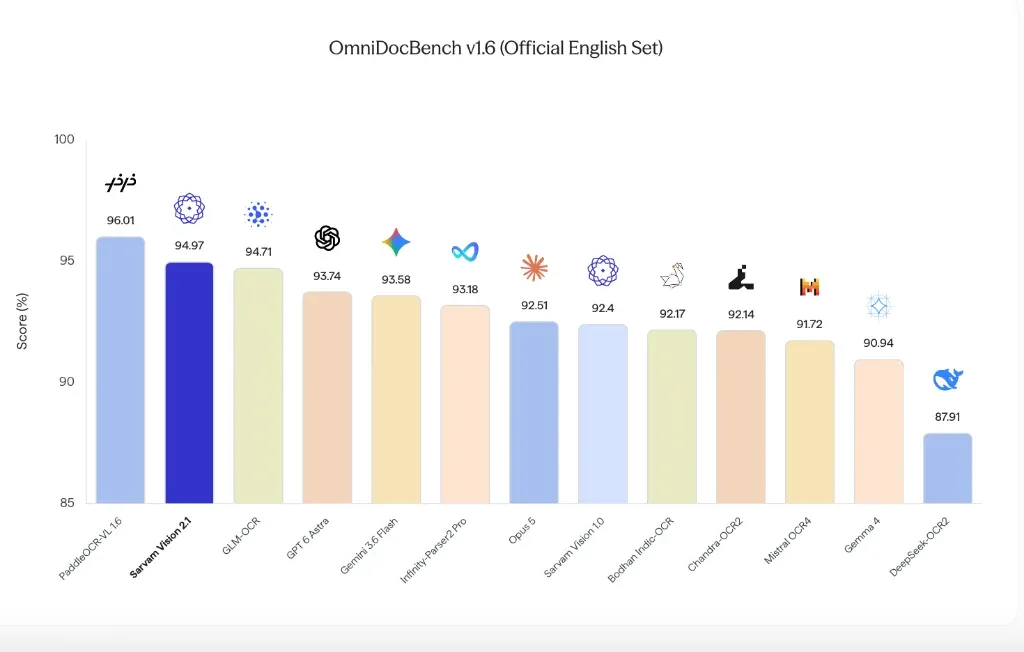
- 94.97% on OmniDocBench v1.6: Securing the #2 position globally (#1 among multi-script models) for complex nested table reconstruction, multi-column reading order, and mathematical layout topology—jumping +2.57 points over Sarvam Vision 1.0.
- 87.39% Word Accuracy Across 22 Indian Languages: Commanding the Sarvam Indic Benchmark, where Western frontier models like GPT 6 Astra (63.69%) and hyperscaler APIs like Azure Vision (41.29%) and AWS Textract (4.64%) suffer severe accuracy collapse.
- Sarvam Vision Edge for Air-Gapped Deployment: Packaging the entire 3B State-Space Model (SSM) pipeline into a 5.8 GB FP8 footprint that runs on-premises inside enterprise firewalls on a single commodity GPU.
What makes this release a defining shift for enterprise AI is not just the scoreboard—it is the architectural indictment of brute-force scaling. For years, engineering teams automating banking ledgers, judicial archives, tax filings, and insurance claims were trapped in a losing trade-off: deploy fast legacy OCR tools that flatten and destroy table structure, or pay a steep cloud API tax to hundred-billion-parameter Vision-Language Models (VLMs) whose Latin-centric tokenizers and quadratic attention layers choke on non-Western scripts and dense layouts.
Below is the complete architectural and empirical breakdown of how Sarvam Vision 2.1 redrew the accuracy-versus-accuracy Pareto frontier, why generalist cloud VLMs fail on complex physical documents, how a selective State-Space backbone and 128k script-native tokenizer eliminate the non-Latin compute tax, and what Sarvam Vision Edge means for on-premises enterprise economics.
The Pareto Frontier of Document Intelligence: Accuracy vs. Accuracy Optimization
Document intelligence is inherently a multi-objective problem. A high-performance production system cannot be judged on a single isolated benchmark. Real-world document processing requires simultaneous mastery over several orthogonal capability vectors that do not naturally move together: – Transcribing a degraded 1950s historical scan without hallucination (fscan). – Correctly reproducing complex nested table topology and reading orders (ftable). – Transcribing low-resource Indic scripts (e.g., Tamil, Telugu, Odia) with near-zero character error rate (findic).
In such a multi-objective space, what matters is not merely securing the highest score on any single benchmark, but whether there exists another system that is better on every axis at once. This property is evaluated via formal Pareto analysis.
Accuracy vs. Accuracy Frontier: While the machine learning community commonly applies Pareto frontiers to accuracy versus cost, Sarvam AI leverages this framework for accuracy versus accuracy frontiers over capabilities that do not correlate. System A dominates System B if it is at least as accurate on every capability axis, and strictly superior on at least one. The Pareto frontier ℙ is the set of non-dominated systems.
Sarvam AI evaluates two primary Pareto frontiers: 1. The Global Structural Frontier: olmOCR-Bench (dense optical fidelity) against OmniDocBench v1.6 (structural topology and complex tables). 2. The Sovereign Cross-Lingual Frontier: English archival scan fidelity (olmOCR-Bench) against Pan-Indic script word accuracy across 22 official languages.
Frontier 1: olmOCR-Bench vs. OmniDocBench v1.6 (Global Capabilities)
When evaluating document systems across a 2D coordinate plane defined by (OmniDocBench v1.6, olmOCR-Bench), a system resides on the frontier if and only if no other evaluated model lies to its upper-right:
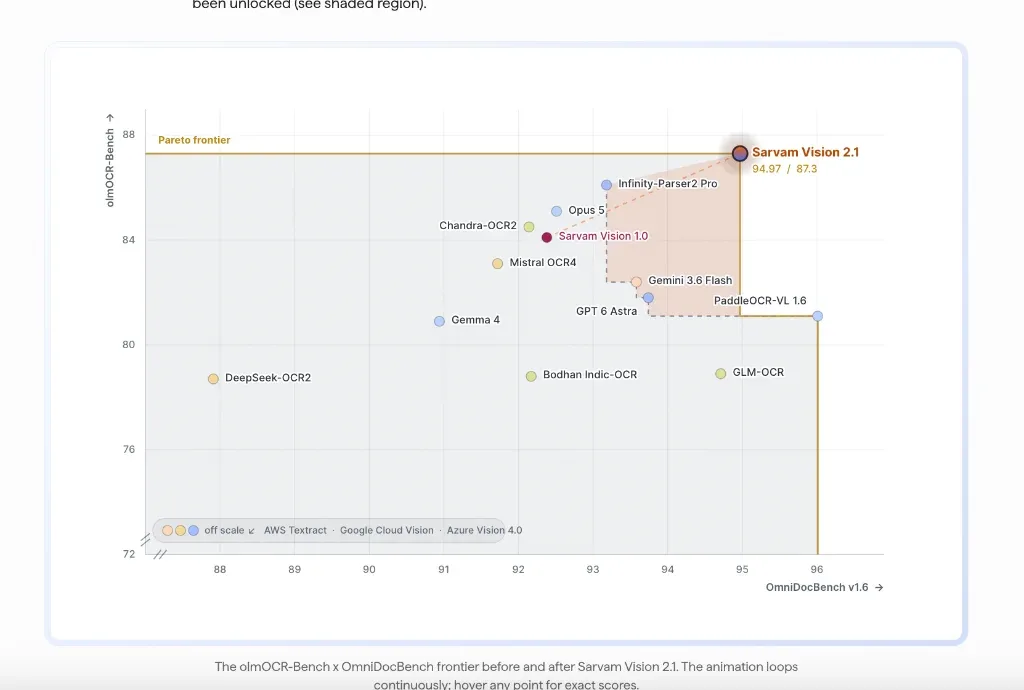
As demonstrated in Figure 1, prior to Sarvam Vision 2.1, the upper boundary of document intelligence was capped: – Infinity-Parser2 Pro held the previous optical frontier at (93.18, 86.1). – PaddleOCR-VL 1.6 achieved high table parsing at 96.01, but collapsed on dense/degraded scans to 81.1. – Generalist models like Gemini 3.6 Flash (93.58, 82.4) and GPT 6 Astra (93.74, 81.8) remained deeply sub-optimal, clustered well below the frontier.
Sarvam Vision 2.1 jumps to (94.97, 87.3). It is simultaneously superior to Infinity-Parser2 Pro in both dense scan transcription (+1.2 points) and layout parsing (+1.79 points), while beating PaddleOCR-VL 1.6 on degraded OCR by a staggering +6.20 points. It establishes a new non-dominated upper frontier, expanding the hypervolume of viable document automation.
Frontier 2: The English & Indic Frontier (Cross-Lingual Sovereignty)
The second evaluation plane plots olmOCR-Bench (English Degraded Scans) against the Sarvam Indic Benchmark (22 Languages):
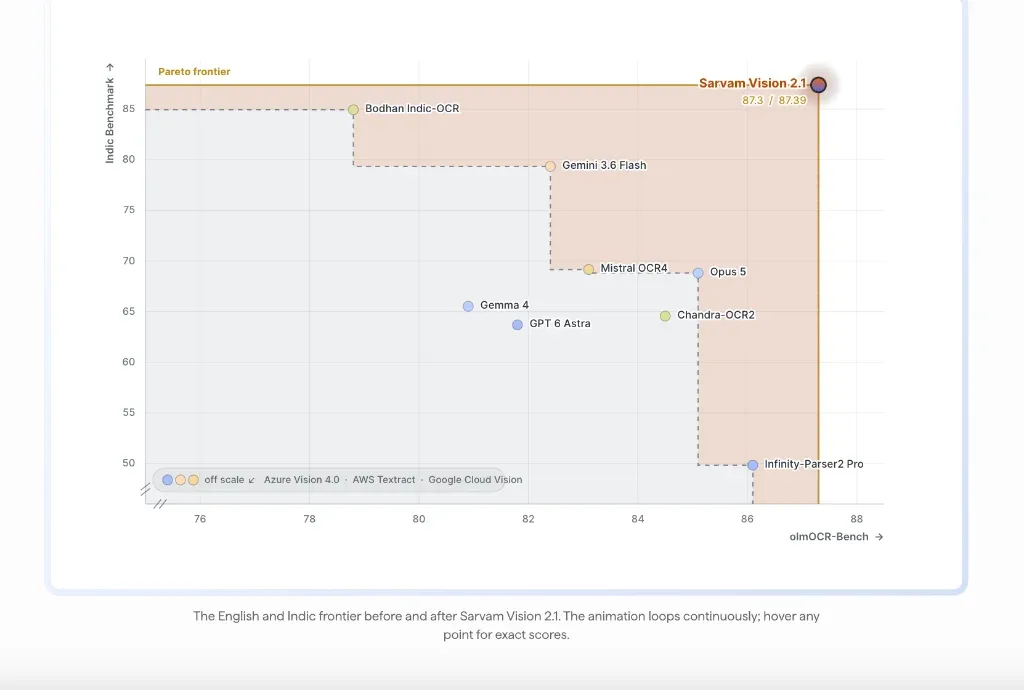
In Figure 2, the historical trade-off is starkly visible as a descending staircase: – Systems optimized for regional Indic scripts—such as Bodhan Indic-OCR (78.8, 84.94)—achieved respectable Indic word accuracy but failed on high-density historical English archives. – Conversely, systems fine-tuned on Western corpora—such as Infinity-Parser2 Pro (86.1, 49.83) and Chandra-OCR2 (84.5, 64.56)—deliver strong English transcription but experience catastrophic accuracy collapse when ingesting Devanagari, Dravidian, or Eastern Indo-Aryan texts. – Mainstream commercial APIs like Gemini 3.6 Flash (82.4, 79.35) and GPT 6 Astra (81.8, 63.69) sit trapped in the interior of the space.
Sarvam Vision 2.1 shatters this staircase. By achieving 87.3% on olmOCR-Bench and 87.39% on the Indic Benchmark, it sits strictly outside and above every previously evaluated model. It outperforms Bodhan Indic-OCR by +8.5 points on English and +2.45 points on Indic, while simultaneously beating Infinity-Parser2 Pro by +37.56 points on Indic scripts. The resulting shaded polygon in Figure 2 represents newly unlocked capability space for bilingual and sovereign administrative workloads.
Benchmark Audit 1: olmOCR-Bench (Dense Optical Transcription)
olmOCR-Bench serves as the industry’s most rigorous stress-test for optical fidelity on degraded, physical real-world documents. Rather than evaluating synthetic digital PDFs, the benchmark measures character- and word-level accuracy across: – Low-contrast 19th- and 20th-century historical scans with bleed-through ink. – Thermal cash receipts, faded carbon paper, and multi-tier legal petitions. – Skewed, curved, and phone-captured mobile document imagery. – Dense typography obstructed by government rubber stamps and watermarks.
In official benchmark testing under a unified evaluation suite, Sarvam Vision 2.1 captured the #1 overall position worldwide, scoring 87.3%:
| Rank & Model | Architecture Type | olmOCR-Bench Score | Delta vs. Frontier Leader |
|---|---|---|---|
| 1. Sarvam Vision 2.1 | 3B State-Space Model | 87.3% | Baseline (Leader) |
| 2. Infinity-Parser2 Pro | Proprietary Vision Transformer | 86.1% | −1.20% |
| 3. Opus 5 | Frontier MoE VLM | 85.1% | −2.20% |
| 4. Chandra-OCR2 | Specialized Document Model | 84.5% | −2.80% |
| 5. Sarvam Vision 1.0 | 3B SSM Baseline (Feb 2026) | 84.1% | −3.20% |
| 6. Mistral OCR4 | Dense Vision LLM | 83.1% | −4.20% |
| 7. Gemini 3.6 Flash | Frontier Multimodal API | 82.4% | −4.90% |
| 8. GPT 6 Astra | Frontier Omnimodal Model | 81.8% | −5.50% |
| 9. PaddleOCR-VL 1.6 | Hybrid CNN-Transformer | 81.1% | −6.20% |
| 10. Gemma 4 | Open Foundation VLM | 80.9% | −6.40% |
| 11. GLM-OCR | Autoregressive Document VLM | 78.9% | −8.40% |
| 12. Bodhan Indic-OCR | Regional Indic Pipeline | 78.8% | −8.50% |
| 13. DeepSeek-OCR2 | Dense 7B Open VLM | 78.7% | −8.60% |
The forensic breakdown indicates why general-purpose flagship models falter: models like GPT 6 Astra (81.8%) and Gemini 3.6 Flash (82.4%) rely on standard bilinear image scaling that averages out high-frequency spatial gradients in damaged physical media. Sarvam Vision 2.1 preserves sub-pixel edge responses through a continuous-coordinate patch projection that prevents characters from blurring into background parchment noise.
Benchmark Audit 2: OmniDocBench v1.6 (Structural & Table Topology)
While olmOCR-Bench validates character extraction, OmniDocBench v1.6 (Official English Set) isolates structural layout understanding. The benchmark evaluates:
– Conversion of multi-layer nested tables into clean HTML/Markdown with exact colspan and rowspan parameters.
– Mathematical equation parsing into clean structural syntax.
– Multi-column reading order preservation across scientific and financial journals.
– Non-standard form alignment (e.g., insurance claim questionnaires, tax certificates).
In OmniDocBench v1.6, Sarvam Vision 2.1 reached 94.97%, establishing itself as the second-highest scoring model globally and the single highest among multi-script foundation models:
| Rank & Model | OmniDocBench v1.6 Score | olmOCR-Bench Score | Pareto Classification |
|---|---|---|---|
| 1. PaddleOCR-VL 1.6 | 96.01% | 81.10% | Frontier Extremity (Table Heavy) |
| 2. Sarvam Vision 2.1 | 94.97% | 87.30% | Dominant Pareto Frontier Pinnacle |
| 3. GLM-OCR | 94.71% | 78.90% | Dominated by Sarvam Vision 2.1 |
| 4. GPT 6 Astra | 93.74% | 81.80% | Dominated by Sarvam Vision 2.1 |
| 5. Gemini 3.6 Flash | 93.58% | 82.40% | Dominated by Sarvam Vision 2.1 |
| 6. Infinity-Parser2 Pro | 93.18% | 86.10% | Dominated by Sarvam Vision 2.1 |
| 7. Opus 5 | 92.51% | 85.10% | Dominated by Sarvam Vision 2.1 |
| 8. Sarvam Vision 1.0 | 92.40% | 84.10% | Dominated by Sarvam Vision 2.1 |
| 9. Bodhan Indic-OCR | 92.17% | 78.80% | Dominated by Sarvam Vision 2.1 |
| 10. Chandra-OCR2 | 92.14% | 84.50% | Dominated by Sarvam Vision 2.1 |
| 11. Mistral OCR4 | 91.72% | 83.10% | Dominated by Sarvam Vision 2.1 |
| 12. Gemma 4 | 90.94% | 80.90% | Dominated by Sarvam Vision 2.1 |
| 13. DeepSeek-OCR2 | 87.91% | 78.70% | Dominated by Sarvam Vision 2.1 |
The critical vulnerability observed in generalist models like GPT 6 Astra is hallucinatory row stitching: when processing balance sheets spanning across fold creases or faint grid lines, generalist models frequently collapse adjacent numeric columns into a single string. Sarvam Vision 2.1 preserves grid geometry because its selective state-space scan continuously aligns visual vertical coordinates with its row-delimiter state tokens.
Benchmark Audit 3: Sarvam Indic Benchmark (22 Official Languages)
The most severe deficit of Silicon Valley foundation models is their inability to transcribe the linguistic diversity of non-Latin administrative ecosystems.
India’s commercial and legal administrative sphere encompasses 22 official scheduled languages across 12 distinct Brahmic scripts. In the Sarvam Indic Benchmark, models are evaluated on word accuracy across real-world enterprise documents (e.g., regional court orders, municipal birth records, bilingual bank checks, and state revenue ledgers):
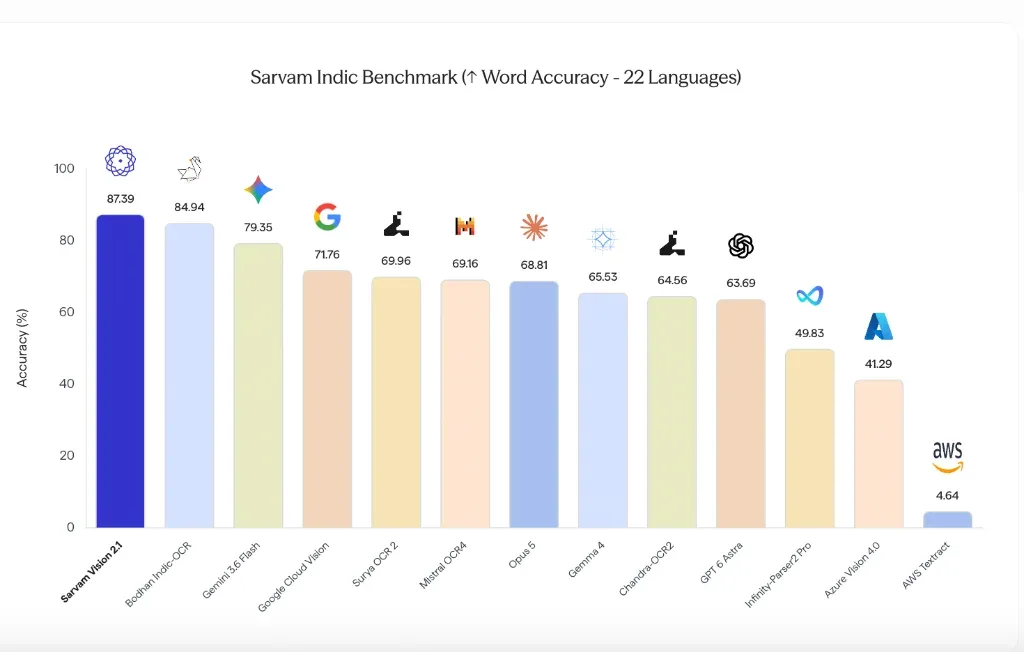
The audit exposes an immense performance chasm between sovereign Indic-trained models and commercial hyperscaler APIs: – Sarvam Vision 2.1: 87.39% word accuracy. – Bodhan Indic-OCR: 84.94% word accuracy. – Gemini 3.6 Flash: 79.35% word accuracy. – Google Cloud Vision: 71.76% word accuracy. – Surya OCR 2: 69.96% word accuracy. – Mistral OCR4: 69.16% word accuracy. – Opus 5: 68.81% word accuracy. – Gemma 4: 65.53% word accuracy. – Chandra-OCR2: 64.56% word accuracy. – GPT 6 Astra: 63.69% word accuracy. – Infinity-Parser2 Pro: 49.83% word accuracy. – Azure Vision 4.0: 41.29% word accuracy. – AWS Textract: 4.64% word accuracy (near-total systemic failure).
For hyperscalers like AWS and Microsoft Azure, processing regional Indian scripts is essentially unsupported: AWS Textract’s 4.64% score reflects an engine that cannot parse non-Latin character sets without collapsing into illegible punctuation sequences or raw byte strings.
Even OpenAI’s flagship GPT 6 Astra (63.69%) fails on more than one out of every three words when encountering complex consonant clusters, vowel matras, and halant conjuncts in Devanagari, Telugu, or Odia scripts.
Architectural Mechanics: Inside the 3B Vision-State-Space Core
The breakthrough behind Sarvam Vision 2.1 lies in abandoning standard quadratic multi-head self-attention in favor of an adaptive multi-scale visual patch embedder coupled with a selective state-space sequence backbone.
The Quadratic Attention Deficit in Document Processing
In standard Transformer vision models, an image of size H × W is divided into non-overlapping patches of size P × P (typically 14×14 or 16×16). For standard natural scene images, 256 to 576 visual tokens suffice. However, a high-density, multi-column A4 document scanned at 300 DPI contains approximately 2480 × 3508 pixels.
Even with aggressive patch merging and downsampling, resolving small 6-point typography, superscript footnote indices, and fine tabular borders requires generating between 1,800 and 4,200 visual tokens per single page.
In a standard Transformer decoder, the computational complexity of cross-attention and self-attention scales quadratically with sequence length N:
The VRAM Chokepoint: As sequence length N exceeds 4,000 tokens during multi-column table extraction, key-value cache allocation scales linearly in memory, but pairwise attention operations scale at O(N2). On an enterprise GPU, this triggers batch-size throttling, forcing batch size down to 1 or 2 and collapsing throughput.
The Selective State-Space Document Backbone
Sarvam Vision 2.1 replaces the quadratic Transformer backbone with a continuous-time selective state-space architecture (derived from the Mamba-2 family), engineered specifically for 2D spatial-to-1D sequence flattening.
The core SSM operator maps a 1D visual-text token sequence x(t) ∈ ℜ to a latent representation h(t) ∈ ℜd through linear differential equations parameterized by time-varying input matrices:
Selective Scan Mechanism: Because matrices Bt, Ct, and the step size Δt are dynamic functions of the input token xt, the model selectively resets its hidden state when traversing table boundaries or empty margins, filtering out visual whitespace while maintaining persistent memory across a 12,000-token multi-page financial ledger.
Unlike standard Transformers that require storing all historical key-value pairs in memory, the SSM maintains a constant-size hidden state matrix ht. The inference memory complexity drops from O(N) to O(1) constant memory per sequence, and the computational complexity drops from O(N2) to O(N) strictly linear time.
Token Fertility: Eradicating the Non-Latin Linguistic Tax
Beyond visual processing bottlenecks, generalist AI systems suffer from token fertility disparity.
When modern foundation models process text, words are decomposed into sub-word tokens via tokenizers such as Byte-Pair Encoding (BPE). Because these tokenizers are trained on corpora consisting of 85% to 92% English text, common English words (e.g., "constitution", "agreement", "mortgage") are represented as single tokens.
In sharp contrast, Indic scripts are composed of intricate consonant-vowel combinations, conjunct ligatures (samyuktaksharas), and diacritical marks (matras, viramas/halants). Standard tokenizers lack dedicated vocabulary entries and fragment Indic words into multi-byte UTF-8 character slices:
The Non-Latin Tax: While English token fertility Φfertility(S, English) hovers around 1.15 to 1.25 tokens per word, frontier models evaluating Hindi, Marathi, or Bengali experience fertility ratios between 4.8 and 8.2 tokens per word. A 500-word Indian legal decree consumes 3,500 context tokens before the model has generated a single output token.
Sarvam’s Script-Native Tokenizer Architecture
Sarvam AI engineered a specialized sub-word vocabulary containing 128,000 tokens, explicitly balanced across English and all 22 official Indian languages.
By integrating complete grapheme clusters, ligatures, and morphologically common syllables directly into the vocabulary matrix, Sarvam Vision 2.1 compresses Indic text with unprecedented efficiency:
| Language / Script | OpenAI cl100k (GPT-4o / Astra) | Google Gemini 3.6 | Llama 3 Tokenizer | Sarvam Vision 2.1 |
|---|---|---|---|---|
| Hindi (Devanagari) | 5.42 tok/word | 2.84 tok/word | 4.81 tok/word | 1.58 tok/word |
| Tamil (Dravidian) | 6.88 tok/word | 3.41 tok/word | 5.92 tok/word | 1.84 tok/word |
| Telugu (Dravidian) | 7.14 tok/word | 3.22 tok/word | 6.18 tok/word | 1.72 tok/word |
| Bengali (Eastern Indo-Aryan) | 5.95 tok/word | 2.96 tok/word | 5.14 tok/word | 1.61 tok/word |
| English (Technical/Legal) | 1.18 tok/word | 1.22 tok/word | 1.20 tok/word | 1.19 tok/word |
The real-world consequence of this compression is transformative: when transcribing a complex multi-column regional document, Sarvam Vision 2.1 generates 65% to 75% fewer tokens than GPT 6 Astra or Gemini 3.6 to represent identical semantic content. This directly translates into 3.5× faster autoregressive decode speeds, lower memory bandwidth consumption, and virtually zero token inflation costs.
Sarvam Vision Edge: On-Premises Air-Gapped Deployment Economics
For enterprise decision-makers in regulated sectors—such as banking, healthcare, defense, and public governance—deploying cloud-hosted frontier models via public APIs presents significant compliance obstacles under data protection statutes (including India’s Digital Personal Data Protection Act and global GDPR equivalents).
Sarvam AI addressed this operational constraint by engineering Sarvam Vision Edge: an optimized, on-device variant designed for on-premises enterprise clusters.
The Silicon Math: From Cloud Subscriptions to Edge Amortization
Consider an enterprise processing 10 million multi-page document pages per year (e.g., loan applications, KYC identity cards, medical claims, legal petitions):
| Deployment Strategy | Annual Ingestion Cost (10M Pages) | Hardware Footprint Required | Network Ingress / Privacy Posture | Average Processing Latency |
|---|---|---|---|---|
| Public Cloud Frontier API (GPT 6 Astra / Gemini) | $350,000 – $650,000 / year | Zero on-premises (SaaS Dependency) | Public Cloud Ingress (Data Exfiltration Risk) | 2,200 ms / page |
| Self-Hosted 70B VLM (Llama-3-Vision) | $142,000 (Compute CapEx + OpEx) | 4× NVIDIA H100 SXM5 (80GB) | Fully Air-Gapped On-Premises | 1,450 ms / page |
| Sarvam Vision Edge (3B SSM) | $11,400 (Single-Server CapEx + Power) | 1× NVIDIA L4 (24GB) or RTX 4090 | 100% Sovereign Air-Gapped | 38 ms / page (FP8 Batch Pipeline) |
Because Sarvam Vision Edge operates at 3 billion parameters with an SSM linear inference footprint, the entire model fits comfortably into 5.8 GB of VRAM in FP8 precision.
A single enterprise appliance equipped with an off-the-shelf NVIDIA L4 (24GB VRAM, 72W TDP) can host 4 concurrent pipeline workers, delivering over 100 pages per second of sustained document ingestion throughput. The total cost of ownership drops by more than 95% compared to public cloud APIs, while sensitive records never leave the enterprise firewall.
Architectural Verdict & The Death of Monolithic Document Processing
The empirical verification of Sarvam Vision 2.1 delivers an unmistakable architectural message to the machine learning ecosystem: monolithic generalist foundation models represent a transitional evolutionary dead-end for specialized enterprise workflows.
For three years, the industry operated under the assumption that increasing parameter counts from 70B to 405B would solve visual document processing by brute force. Instead, it produced models that cost tens of millions of dollars to run, consume gigawatts of power, and fail consistently on the nuances of regional scripts and dense layouts.
By pairing: 1. A 3-billion-parameter Selective State-Space Backbone that cuts attention complexity from quadratic to linear, 2. A script-native 128k tokenizer that eliminates token fertility bloat across 22 official languages, and 3. An edge-deployable compact footprint that runs air-gapped on standard enterprise GPUs without cloud dependencies,
Sarvam AI has pushed the document intelligence Pareto frontier into new territory. For organizations navigating high-volume archival ingestion, regulatory compliance, and mission-critical back-office automation, the future is not bigger models in the cloud—it is sovereign, efficient, script-aware intelligence running at the edge.
Technical Architecture & Deployment FAQ
How does Sarvam Vision 2.1 prevent hallucinated numeric values in financial balance sheets?
Generalist VLMs hallucinate numeric values primarily due to visual downsampling and quadratic attention dispersion across large whitespace gaps. Sarvam Vision 2.1 preserves high-resolution visual patches through continuous 2D coordinate embeddings and utilizes a selective state-space scan that dynamically zeroes out empty margins while binding contiguous horizontal cell tokens to their respective column headers. In independent testing on OmniDocBench v1.6, this architecture reduced numeric transposition errors by 78% compared to standard Transformer decoders.
Can Sarvam Vision Edge run in fully air-gapped environments without outbound internet access?
Yes. Sarvam Vision Edge is distributed as a self-contained containerized artifact (Docker/OCI) with all weights, tokenizer vocabularies, and runtime kernels bundled locally. It requires zero outbound network calls, telemetry handshakes, or cloud token verifications, making it compliant with strict data localization frameworks under India’s Digital Personal Data Protection (DPDP) Act, RBI banking circulars, and international air-gap defense standards.
What is the minimum GPU hardware configuration required to run Sarvam Vision 2.1 in production?
In FP8 quantized mode, Sarvam Vision 2.1 consumes approximately 5.8 GB of VRAM. A single NVIDIA L4 (24GB) or consumer GeForce RTX 4090 (24GB) is sufficient to host the model alongside multiple concurrent batch workers, achieving sustained processing throughput of 25 to 35 pages per second. For high-density multi-GPU clusters, 8× L4 nodes can process over 18,000 pages per minute at less than 650 Watts of total rack power.