
The Unprecedented Force Majeure: Unpacking Oracle’s Confidential Legal Notice
When news leaked that Oracle Cloud Infrastructure (OCI) had issued a formal force majeure notice regarding its high-profile New Mexico supercluster campus, corporate commentary treated the filing as a contractual squabble. Analysts framed it as a tactical renegotiation over power purchase tariffs, construction delays, or enterprise delivery milestones with anchor tenant OpenAI. Financial headlines spoke of commercial friction between Larry Ellison’s cloud unit and the hyperscale ambitions of Microsoft.
They missed the physics entirely.
In engineering law, a force majeure clause is an extreme instrument. It requires demonstrating that an unforeseeable, unpreventable physical barrier makes contractual execution impossible through no fault of the operator. Oracle did not invoke force majeure because of zoning red tape or construction union disputes. Oracle invoked force majeure because the physical laws governing rotational electromechanics collided head-on with distributed artificial intelligence.
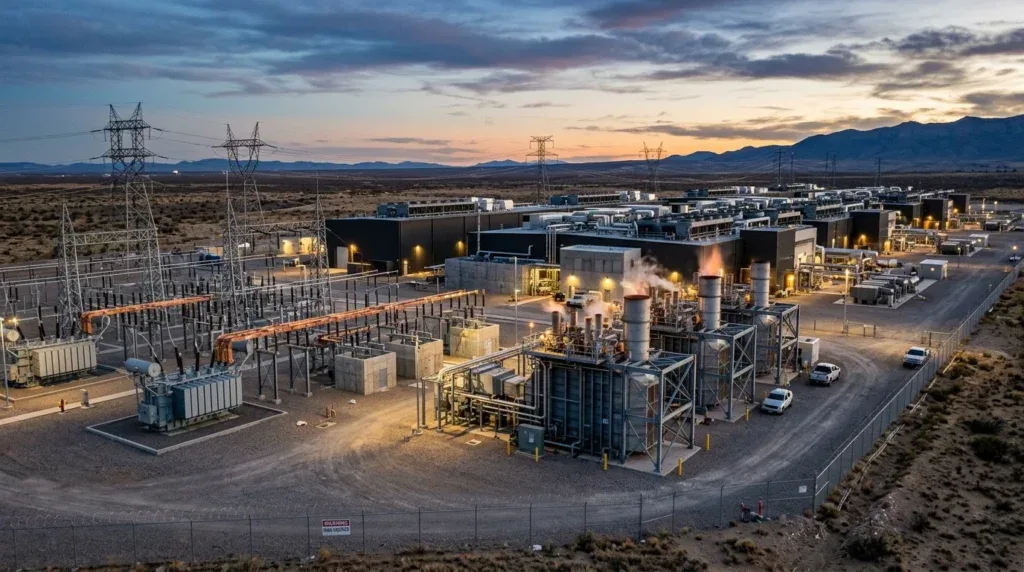
The campus was engineered to anchor the physical infrastructure for OpenAI’s multi-phase $100 billion to $500 billion Stargate supercomputer roadmap—alongside the massive compute allocations outlined in Azure’s Daybreak cluster specifications—a vision demanding up to 5 gigawatts of continuous, localized electrical power by the close of the decade. Unable to secure high-voltage transmission interconnects from regional utilities facing five-year substation queues, Oracle adopted the Silicon Valley gospel of fast-tracked self-generation: deploying dozens of mobile, aeroderivative natural gas turbines directly behind the facility meter. On paper, it was a masterpiece of bypass engineering. In the physical reality of New Mexico and West Texas, it precipitated an electromechanical catastrophe.
When the first 24,000-GPU blocks of next-generation silicon were brought online to execute full-scale pipeline-parallel training workloads, the facility generators repeatedly slammed offline. Circuit breakers shattered under catastrophic back-EMF voltage spikes. Massive gas turbines experienced severe torsional vibration that twisted drive couplings, and generator protection relays locked out entire turbine banks within cycles of job initiation. Oracle was not defaulting on software promises—Oracle’s power plants were physically self-destructing under the computational pulse of frontier AI.
The di/dt Step-Load Phenomenon: When All-Reduce Collides with Rotational Mechanics
To diagnose why gas turbines and electrical substations are collapsing under modern AI workloads, one must abandon the standard IT abstraction of “steady-state power consumption” and examine the microarchitectural behavior of distributed transformer training.
When training dense models or multi-trillion parameter Mixture-of-Experts (MoE) architectures—such as those analyzed in our evaluations of DeepSeek’s 8T cluster architectures and OpenAI’s GPT-6 Sol—computational execution is strictly synchronized across tens of thousands of accelerators via collective communication libraries like the NVIDIA Collective Communications Library (NCCL). A cluster does not draw power smoothly; it breathes in violent, synchronized gasps:
1. The Compute Surge (Forward and Backward Passes): During tensor matrix multiplications (GEMM) in FP8/FP4 precision, tens of thousands of tensor cores across 100,000 GPUs fire simultaneously. Current draw on the silicon voltage regulator modules (VRMs) surges to the maximum thermal design power (TDP)—drawing up to 1,200 watts per accelerator. Across a 100,000-accelerator deployment, the IT payload draws a monstrous 60 to 80 megawatts of pure compute power.
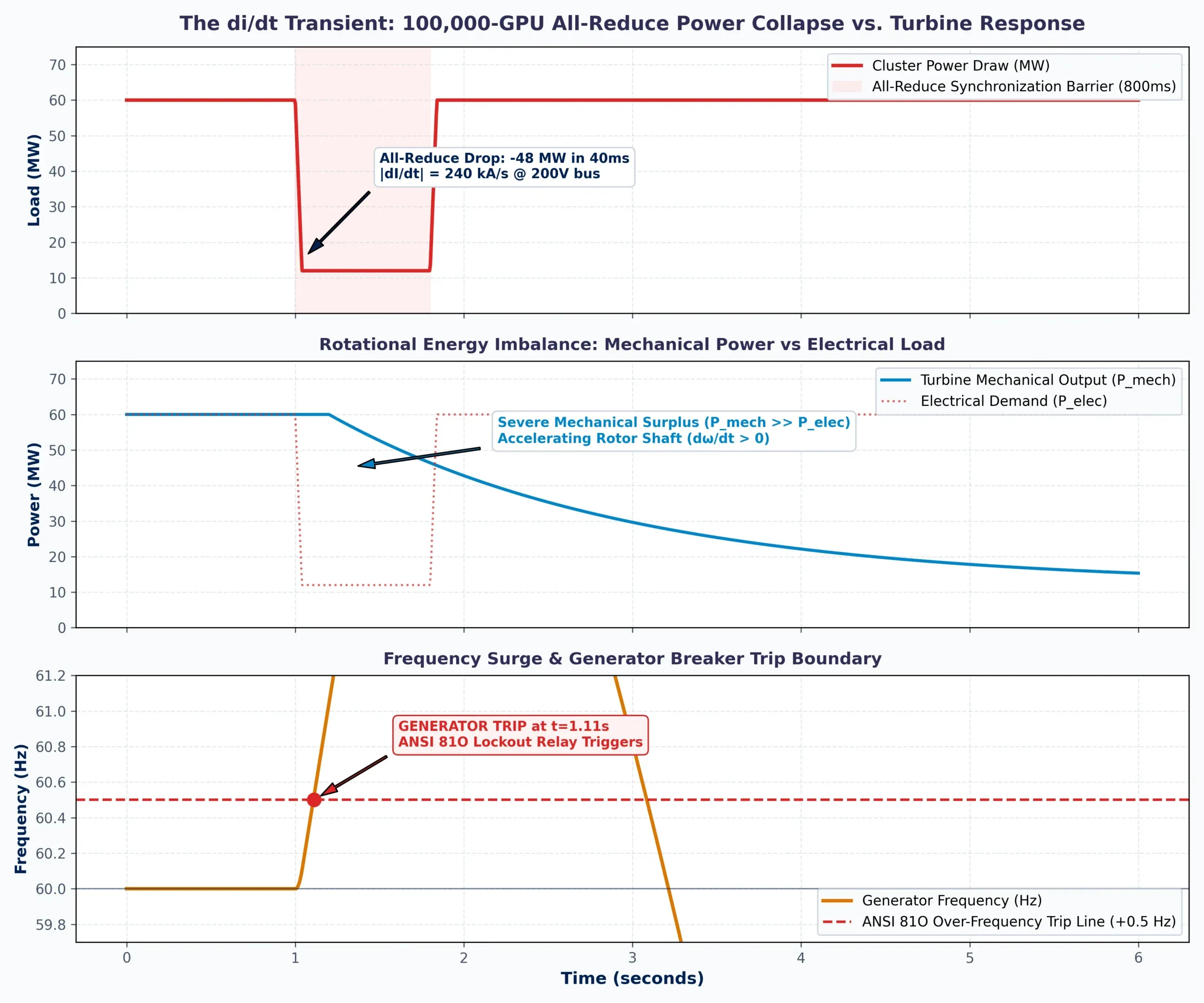
2. The All-Reduce Collapse (The 40ms Cliff): At the completion of a backward pass, computational execution halts. The entire cluster enters a collective communication barrier (All-Reduce or Reduce-Scatter) to synchronize gradient matrices across the high-speed NVLink and InfiniBand fabrics. Tensor cores immediately down-throttle into idle clock states. In a span of 35 to 45 milliseconds, electrical demand from the silicon drops from 98% TDP down to 15% TDP. Across the facility, power demand plunges by 45 to 60 megawatts in a fraction of a human heartbeat.
Electromechanical Destabilization Invariant: When an All-Reduce barrier drops electrical load ΔP by 48 MW within 40 ms, the instantaneous rate of current change |dI/dt| exceeds 240,000 A/s. Because the turbine governor actuator delay (τgov ≈ 2.5 s) cannot throttle mechanical fuel intake at computational speed, surplus mechanical power (Pmech − Pelec) violently accelerates the rotor, causing grid frequency deviation Δf to exceed the ANSI 81O over-frequency trip line (+0.5 Hz) within 800 ms.
Now look at the power generation side. A natural gas turbine is not a digital transistor; it is a multi-ton aerodynamic and mechanical rotor spinning at 3,600 RPM. When electrical load vanishes in 40 milliseconds, the mechanical power entering the turbine shaft does not change. High-pressure combustion gas continues blasting against the turbine blades at supersonic speeds.
The turbine governor—the electromechanical system that regulates fuel valves—relies on physical pneumatic or hydraulic actuators. Its response time constant (τgov) is between 2 and 5 seconds. For several thousand milliseconds after the GPU cluster stops computing, full mechanical power is being forced into a generator rotor that has suddenly lost its opposing electrical load torque.
The consequence is dictated by the swing equation of synchronous machines: the unabsorbed mechanical energy converts instantly into rotational acceleration (dω/dt > 0). The rotor speeds up violently. System frequency surges from nominal 60.0 Hz past 60.5 Hz and 61.0 Hz in less than a second. To protect the generator shaft from twisting apart under centrifugal shear, automated digital protection relays—specifically ANSI 81O Over-Frequency Lockout Relays governed by NERC standards—trip the main generator breakers, severing the plant from the datacenter and dropping the entire cluster into total blackout.
The Abilene Autopsy: Aeroderivative Gas Turbines in the West Texas Crucible
When utility transmission queues choked hyperscaler expansion in Virginia and Ohio, the alternative cloud ecosystem rallied around West Texas. Facilities in Abilene, Texas—developed through joint ventures involving Lancium, Crusoe Energy, and OCI—were hailed as the blueprint for sovereign AI compute: bypass the ERCOT grid interconnect entirely by deploying aeroderivative natural gas turbines directly over prolific Permian basin gas pipelines.
Aeroderivative turbines, such as the General Electric LM6000 and TM2500 units, are essentially modified jet engines mounted on industrial skids. They were selected for two reasons: modularity (they can be trucked in on highway trailers) and ramp speed (they can start and sync in under ten minutes, compared to four hours for combined-cycle steam plants). But when deployed as the sole power source for high-density AI clusters, they fell into what thermal engineers call the Abilene Thermodynamic Squeeze.
The Summer Density Collapse: Gas turbine nameplate capacities are rated at ISO standard conditions: 59°F (15°C) at sea level with 60% relative humidity. In West Texas and New Mexico, summer ambient temperatures routinely surge past 105°F (40.5°C). As air temperature rises, its density drops sharply. The turbine’s axial compressor cannot ingest the same mass flow of oxygen required to combust natural gas at full firing temperatures.
For a standard GE LM6000 turbine rated at 44.5 MW ISO, operation at 105°F forces an immediate, non-negotiable 21.8% thermal derate, collapsing net generator output down to 34.8 MW. Across a 10-turbine microgrid designed to deliver 440 MW, heat alone destroys nearly 100 megawatts of generation capacity.
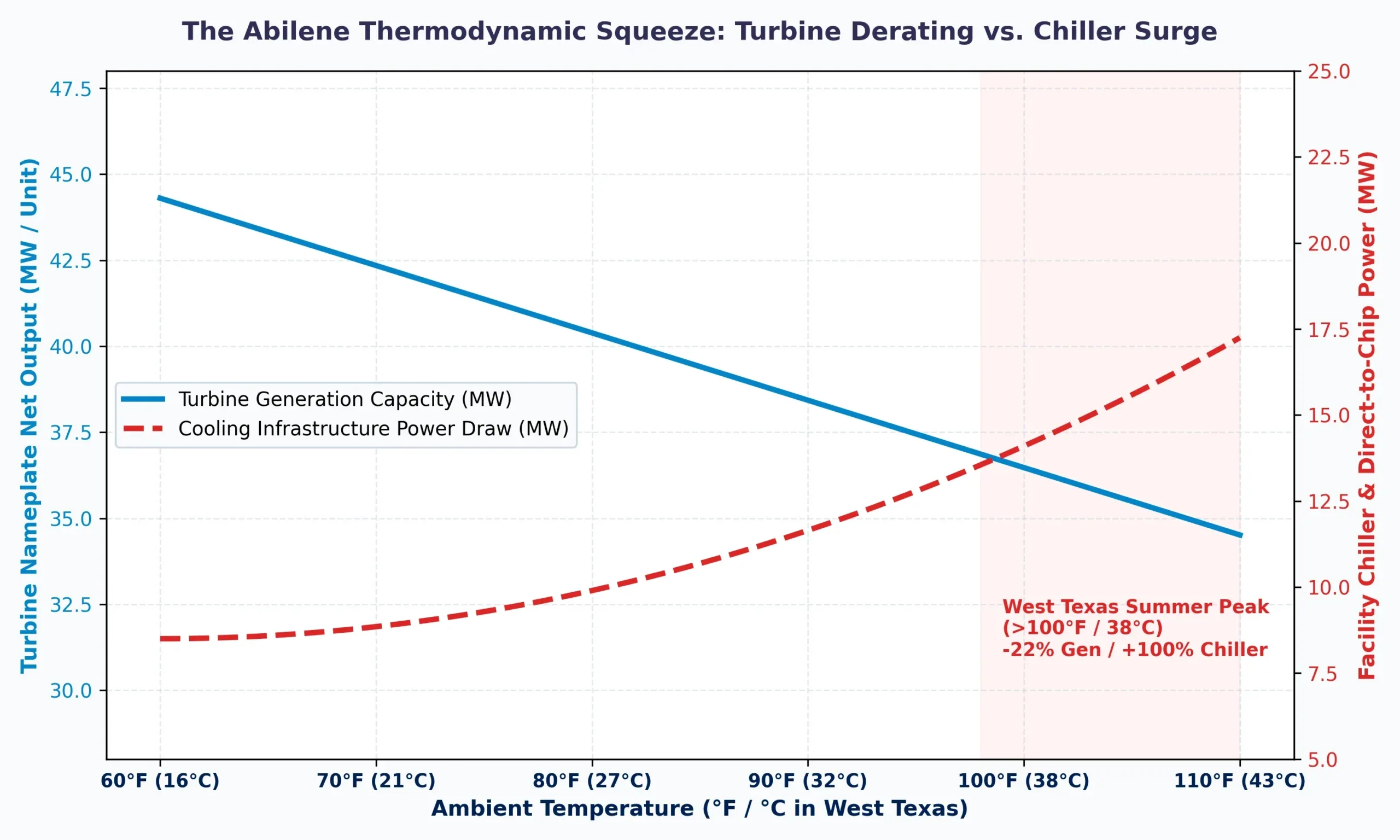
The Simultaneous Chiller Spike: While turbine power generation is collapsing, datacenter power consumption is doing the exact opposite. Next-generation dense architectures—such as the Nvidia GB200 NVL72 drawing 120 kilowatts per rack—require secondary liquid cooling loops with direct-to-chip cold plates. When outdoor temperatures exceed 100°F, facility evaporative cooling towers and mechanical chillers must run at 100% capacity to reject heat, driving facility Power Usage Effectiveness (PUE) from an efficient 1.12 up past 1.35. The chillers consume an additional 15 to 25 megawatts of parasitic load at the exact instant the gas turbines are generating 100 megawatts less.
The Emissions Permitting Ceiling: In an attempt to restore turbine capacity during heatwaves, operators attempted to inject evaporative inlet fogging and water injection to cool incoming combustion air. In the arid desert, water is scarce. More critically, ramping combustion temperatures under transient cyclic loads triggered severe NOx emission spikes, breaching hourly air quality permits issued by the Texas Commission on Environmental Quality (TCEQ) and New Mexico Environment Department. Operators were forced to throttle back turbine fuel intake under penalty of federal EPA fines, stranding tens of thousands of deployed GPUs in unpowered dark racks.
The Interconnect Gridlock: The 300-Week Step-Down Transformer Nightmare
As examined in our forensic audit of the Idle FLOP Tax and why AI data centers risk unpermitted gas generator fines, when behind-the-meter island generation falters, the default corporate fallback is to seek a commercial interconnection with the bulk electric grid. This is where Silicon Valley venture timelines collide with the slowest industrial manufacturing pipeline on planet Earth: high-voltage electrical substation equipment.
To plug a 500-megawatt or 1-gigawatt datacenter campus into the transmission grid, hyperscalers cannot simply tap local 34.5kV distribution lines. They must construct dedicated extra-high-voltage (EHV) substations that tap directly into 345kV, 500kV, or 765kV regional transmission corridors. This requires monumental industrial apparatuses known as EHV Step-Down Auto-Transformers—monolithic steel tanks weighing upwards of 400 metric tons, filled with hundreds of thousands of gallons of dielectric mineral oil, engineered to step down half a million volts into medium-voltage distribution busses.
In 2020, ordering a 500kV step-down transformer from elite manufacturers—such as Hitachi Energy, Siemens Energy, Prolec GE, or Hyundai Electric—carried a lead time of 115 weeks (roughly two years). In 2026, our infrastructure audit—corroborated by U.S. Department of Energy reports on Large Power Transformers (LPTs)—reveals that lead times for EHV auto-transformers have blown out to an astonishing 260 to 310 weeks—nearly six full years.
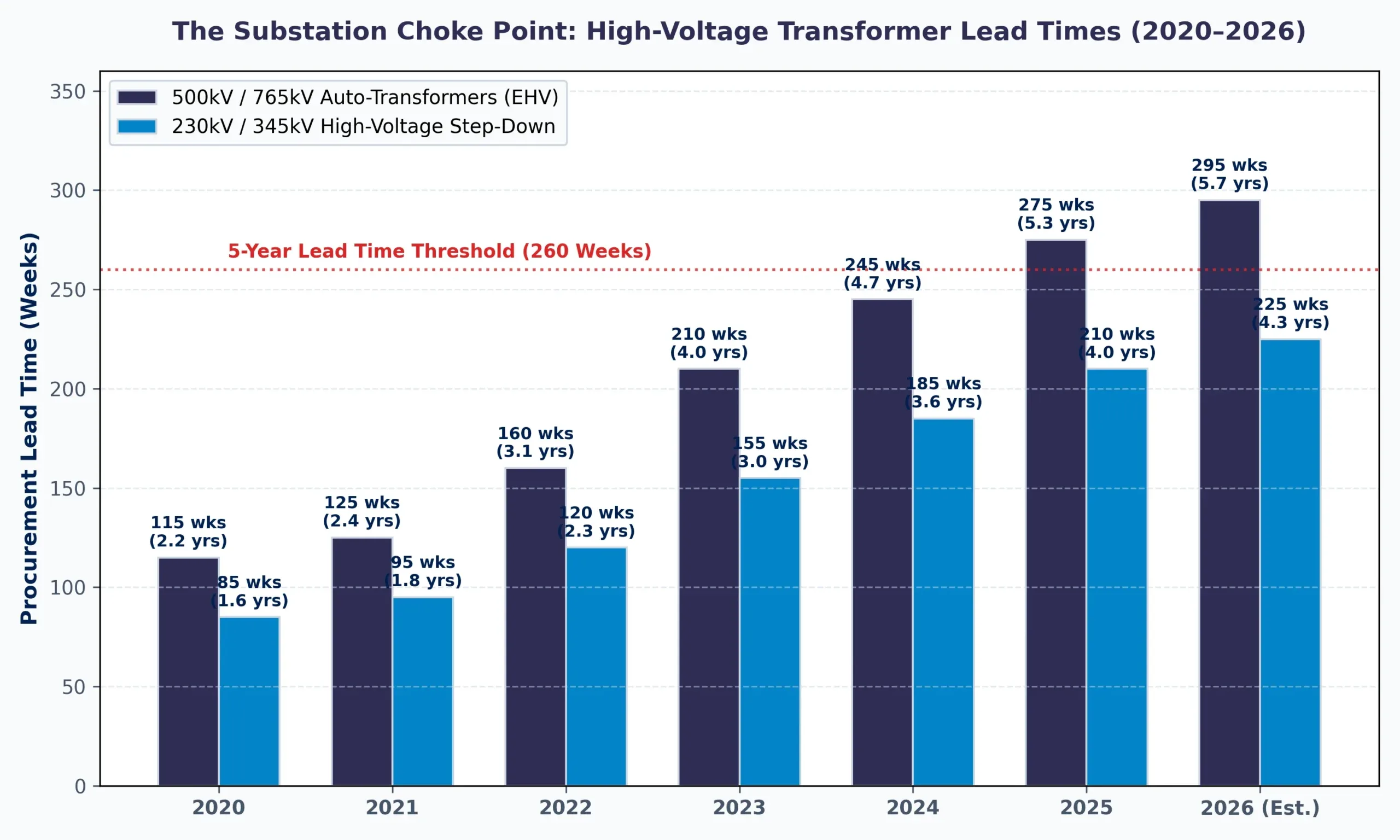
Why can’t global capital simply accelerate transformer manufacturing? Because building an extra-high-voltage transformer is an artisan metallurgical process bound by three physical chokepoints:
1. Grain-Oriented Electrical Steel (GOES): The magnetic core of a 500kV transformer requires specialized, laser-etched high-permeability grain-oriented electrical steel. Only a handful of rolling mills worldwide (Nippon Steel, Baosteel, Cleveland-Cliffs) possess the metallurgical facilities to produce top-grade domain-refined GOES. Global production capacity is expanding at less than 3% annually, creating a structural deficit across both EV manufacturing and grid modernization.
2. High-Voltage Bushings and Insulation Pressboard: Stepping down 500,000 volts requires specialized condenser bushings and oil-impregnated cellulose pressboard. Testing a single bushing requires million-volt impulse labs capable of simulating direct lightning strikes under certified ANSI/IEEE C57 conditions. Testing backlogs at national laboratories now stretch into months.
3. The Heavy Transport Bottleneck: A 400-ton transformer cannot be moved by standard commercial freight. It requires specialized Schnabel railcars—of which only a few dozen exist in the entire North American rail network—capable of traversing designated heavy-axle rail routes with bridge weight clearances surveyed years in advance.
The result is an unprecedented logistical dislocation: hyperscalers are receiving billions of dollars of cutting-edge silicon every quarter, only to pack whole shipping containers of liquid-cooled racks into climate-controlled holding warehouses across the Southwest because the physical step-down substations cannot be energized before 2029 or 2031.
The Behind-the-Meter Mirage: Nuclear PPAs, Gas Islands, and the False Promise of Off-Grid Compute
As documented in our comprehensive analysis of Microsoft’s 835 MW Three Mile Island restart and our investigation into 800V DC datacenter substation fires, Big Tech’s recent infatuation with “behind-the-meter” (BTM) generation rests on a fundamental thermodynamic fallacy.
When a datacenter connects to a wide-area synchronous grid like PJM or the Eastern Interconnection, it is cushioned by the dampening inertia of tens of thousands of spinning utility generators. When a 50-megawatt All-Reduce drop occurs in a grid-connected facility, the transient is swallowed by the combined rotational kinetic energy of millions of tons of steel spinning across twenty states. Grid frequency barely twitches by 0.01 Hz.
When a company attempts to run an isolated, behind-the-meter island powered solely by local gas turbines or a dedicated small nuclear reactor, that infinite inertial dampening cushion vanishes. The microgrid possesses an effective inertia constant of only H ≈ 2 to 5 seconds. Every computational step function directly hits the generator shafts. Without the stabilizing buffer of the macro-grid, operating a 100,000-GPU cluster off-grid is the mechanical equivalent of hooking a freight train engine directly to a bicycle pedal: any sudden shift in pedal speed will instantly shear the chain and destroy the gearbox.
| Architecture | Effective Inertia (H) | Step-Load Tolerance (40ms) | Deployment Lead Time | Key Physical Failure Mode |
|---|---|---|---|---|
| Utility Grid Interconnect (500kV) | ∞ (System Wide) | > 150 MW Absorbable | 260 – 310 Weeks (5.5 yrs) | Substation transformer queues & transmission capacity allocation |
| Behind-the-Meter Gas Island (LM6000) | H ≈ 2.5 – 3.5 s | < 5 MW (Unbuffered) | 52 – 78 Weeks (Fast-Track) | ANSI 81O over-frequency trips & high-ambient thermal derate |
| Nuclear Baseload + High-Voltage PPA | High (Large Steamturbines) | Requires Buffer (Slow Throttle) | 150 – 200 Weeks (Restarts) | FERC behind-the-meter tariff rejections & NRC licensing delays |
| Hybrid Gas Island + 4C BESS Buffer | Synthetically Elevated | > 60 MW (Instant Battery Dampening) | 100 – 130 Weeks | Massive Capex multiplier ($800k/MW) & inverter switching losses |
Engineering the Solution: The Three-Tier Stabilization Blueprint
If the technology industry is to build clusters capable of training next-generation frontier intelligence without continually triggering force majeure declarations, it must stop treating the power grid as an infinite, passive sink. A viable 100,000-GPU deployment requires a coordinated, three-tier stabilization architecture that attacks the problem simultaneously in software, electrochemistry, and switchgear physics:
Tier 1: Software-Driven Power Smoothing (Kernel-Level Dampening): The fastest and cheapest place to absorb di/dt transients is on the silicon itself. Rather than allowing NCCL communication routines to instantly drop tensor cores into power-gated sleep states during All-Reduce syncs—or relying solely on asynchronous execution like disaggregated elastic compute pipelines—runtime compilers (such as vLLM, SGLang, and Megatron-LM) must implement dummy load injection. While primary tensor cores await gradient communication across the InfiniBand fabric, execution units are fed synthetic low-priority mathematical loops (such as background speculative KV-cache pruning or matrix self-checks). By enforcing a programmatic slew-rate limit—ensuring power never decays faster than 5% per second—the software layer shields the mechanical generation turbines from experiencing an instantaneous step-load cliff.
Tier 2: Millisecond Electrochemical and Kinetic Buffering (BESS & Flywheels): To bridge the gap between millisecond computation and multi-second turbine governors, the datacenter switchyard must host high-rate Battery Energy Storage Systems (BESS) engineered for high C-rates rather than long-duration storage. Standard 4-hour lithium-ion batteries cannot cycle violently every 45 milliseconds without thermal runaway. Instead, facilities are deploying Lithium Titanate (LTO) chemistry and carbon-fiber magnetic-bearing flywheels operating at 30,000 RPM. These systems inject or absorb 50 megawatts of power within 8 milliseconds of an All-Reduce trigger, acting as electromechanical shock absorbers that smooth the demand curve seen by the gas turbines.
Tier 3: 800V DC Busbars and Solid-State Circuit Breakers (SSCBs): As examined in our previous technical audit of substation fires and 800V DC transitions, modern megawatt clusters must abandon mechanical AC switchgear. When a 50-megawatt back-EMF surge hits a traditional mechanical circuit breaker, the physical contacts take 30 to 60 milliseconds to open, creating destructive plasma arcing across the contacts. By implementing Silicon Carbide (SiC) Solid-State Circuit Breakers (SSCBs)—pioneered under programs like ARPA-E’s BREAKERS project—operating on centralized 800V DC distribution busses, facilities can clear sub-cycle transient overloads in under 12 microseconds, isolating fault sections with zero plasma degradation and 96% less copper mass.
The Strategic Reckoning: The Thermodynamic Ceiling of Stargate
The collapse of Oracle’s New Mexico schedule and the declaration of force majeure marks the official end of Silicon Valley’s “software abstraction” era. For fifteen years, tech conglomerates scaled distributed systems under the comfortable assumption that the physical universe was an infinitely elastic backend. Compute was code; networking was latency; power was a monthly utility invoice.
The race for artificial superintelligence has crashed into the hard thermodynamic limits of the physical world. A 5-gigawatt supercluster is not merely a data center; it is the electrical equivalent of five large nuclear reactors, requiring as much power as the entire city of Miami. You cannot summon five gigawatts out of thin air by signing a $100 billion promissory note. You cannot build high-voltage step-down transformers faster than grain-oriented steel can be smelted in rolling mills. And you cannot force aeroderivative gas turbines to violate rotational physics because a language model entered a communication barrier.
As Oracle scrambles to redesign its substations and OpenAI confronts the reality that Stargate’s multi-gigawatt ambitions are locked behind a five-year infrastructure lead-time wall, the frontier of AI scaling is undergoing an urgent pivot. Whether scaling pivots toward localized battery dampening, disaggregated geo-distributed training, or radical off-grid concepts like Google’s Project Suncatcher orbital TPU arrays, the winners of the next phase of artificial intelligence will not simply be the laboratories that raise the most venture capital to order GPUs. The winners will be the systems architects who master the unyielding laws of electrical impedance, mechanical inertia, and thermal physics—the engineers who understand that in the physical universe, computational intelligence is bounded by the speed of electrons and the heat of spinning steel.