
The Atomic Taboo Shatters: Why Big Tech Is Awakening America’s Most Notorious Nuclear Site
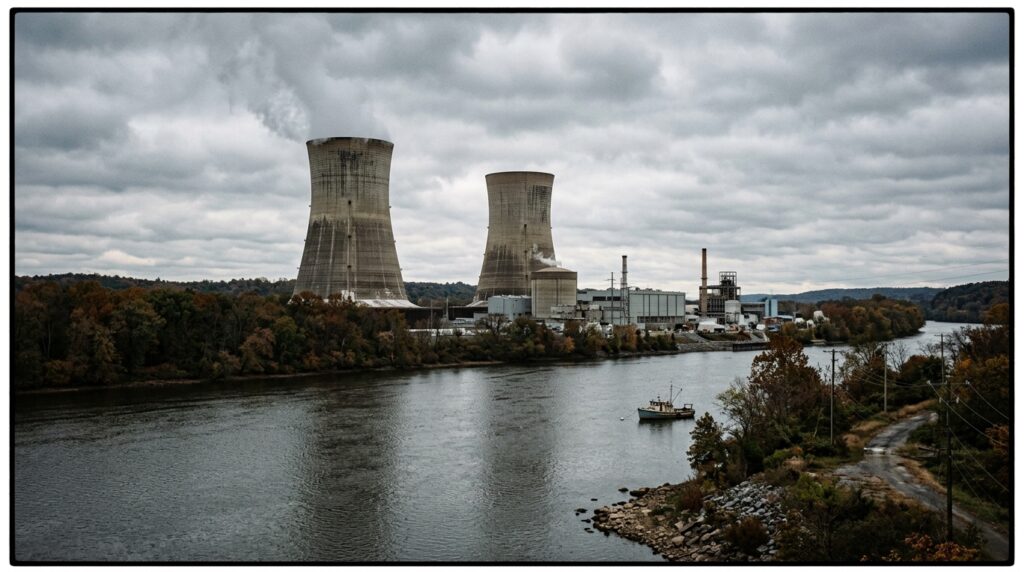
For forty-five years, Three Mile Island was the ultimate cultural boogeyman of American technology. It was the disaster that froze the United States nuclear ambition in amber, ignited global protests, and turned the twin concrete cooling towers looming over the Susquehanna River into the international monument for atomic peril. Generations of engineers were taught that once a nuclear site closes its gates, its containment domes become permanent mausoleums.
Then, artificial intelligence ran out of electricity.
Behind the polished keynotes in Silicon Valley, a visceral panic has gripped the hyperscalers. Frontier reasoning clusters—systems training GPT-6, Claude Opus 5.5, and Gemini Ultra—are no longer software algorithms running on ephemeral cloud instances. They are thermal monsters. A modern 100,000-accelerator AI datacenter draws upwards of 150 to 300 megawatts of continuous, uninterruptible power. In Northern Virginia’s “Data Center Alley,” local utilities slammed the emergency brake: transmission interconnect queues are choked until 2031, substation step-down transformers are blowing out under violent computational load spikes, and regional grids are rationing electrons.
The green corporate fiction—that planetary-scale neural networks could be powered on intermittent desert solar arrays and four-hour lithium packs—evaporated on contact with winter physics. When the sun sets at 4:30 PM in Pennsylvania and temperatures plunge below freezing, solar generation drops to zero while multi-billion-dollar GPU clusters continue demanding 2,400 megawatt-seconds of uninterrupted power. Facing the terrifying prospect of multibillion-dollar silicon fleets idling as depreciating paperweights, Microsoft did the unthinkable: it broke the greatest taboo in modern energy history and agreed to awaken Three Mile Island.
The transaction is an earthquake across Wall Street, the energy sector, and environmental policy. By signing a binding 20-year Power Purchase Agreement (PPA) with Constellation Energy to restore 100% of Unit 1’s 835 MW output—rebranded as the Crane Clean Energy Center—Microsoft is staking $16 billion on atomic power. Satya Nadella didn’t merely procure clean electrons; he officially declared that in the race for artificial superintelligence, kilowatts dictate intelligence.
The Physics of the Awakening: Separating Unit 1 Engineering from Unit 2 Folklore
To understand why Constellation can legally and physically pull off this resurrection, one must dismantle the media sensationalism and examine the concrete layout on Londonderry Township’s river island. Three Mile Island is not a single reactor; it is two distinct, physically separated generation stations:
Unit 2 was the ill-fated reactor that suffered a coolant loss and partial core meltdown on March 28, 1979. Its damaged fuel was extracted and entombed at Idaho National Laboratory decades ago. Unit 2 is owned by an entirely separate entity, EnergySolutions, and is currently in the final phases of permanent radiological decontamination. It will never generate another watt.
Unit 1, in contrast, is an 835-megawatt-electric (MWe) Babcock & Wilcox pressurized water reactor (PWR) that entered commercial service in 1974. Following the Unit 2 incident, Unit 1 was subjected to the most rigorous engineering retrofits in atomic history. It operated for the next 45 consecutive years with an extraordinary safety record, maintaining an average annual capacity factor exceeding 93.0%. Unit 1 did not close in September 2019 because of mechanical failure, radiation leaks, or regulatory penalties; it closed because cheap, fracked shale gas in the Marcellus basin cratered PJM wholesale electricity prices down to $25/MWh, making an unsubsidized single-unit nuclear plant unprofitable by tens of millions of dollars annually.
| Parameter | Three Mile Island Unit 1 (Crane Center) | Utility-Scale Solar + 4h Battery | Advanced SMR Cluster (e.g. NuScale/X-Energy) |
|---|---|---|---|
| Net Nameplate Capacity | 835 MWe (Single Shaft Turbine) | 835 MW Nameplate (~200 MW Avg Output) | 300 to 600 MWe (Multi-Module) |
| Annual Capacity Factor | >93.0% (Continuous Baseload) | 22.0% – 27.0% (Intermittent) | 90.0% – 94.0% (Projected) |
| PPA Contract Duration | 20 Years (Firm Take-or-Pay) | 10 – 15 Years | Unproven in Commercial PPA |
| Effective LCOE / Strike Price | $100 – $115 / MWh (Estimated) | $55 – $75 / MWh (Unfirm) | $130 – $180 / MWh (FOAK Estimates) |
| Time to Commercial Operation | 2028 (NRC 10 CFR 50 Restoration) | 2026 – 2027 (Queue Constrained) | 2032 – 2035 (Licensing Bottlenecks) |
| Land Footprint Required | ~150 Acres (Existing Industrial Footprint) | >6,500 Acres (Photovoltaic Arrays) | 50 – 100 Acres |
Why Hyperscale Inference Collapsed the Renewable Consensus
For the past decade, Big Tech public relations promoted a convenient fiction: that multi-gigawatt cloud platforms could achieve 100% renewable operations through virtual renewable energy certificates (RECs) and unbundled solar-wind PPAs. In accounting spreadsheets, a company could purchase solar megawatt-hours generated at noon in rural Arizona and use those credits to balance diesel generators or coal-heavy grid draws powering servers in Ashburn, Virginia at midnight.
The emergence of frontier reasoning models destroyed this accounting sleight-of-hand. As examined in our analyses of test-time compute scaling dynamics and multi-modal architectures like Claude Opus 5.5, generative AI workloads exhibit electrical consumption profiles fundamentally incompatible with solar and wind intermittency:
1. Astronomical Capital Depletion from Idle Silicon: A modern hyperscale AI cluster hosting 100,000 Nvidia Blackwell (GB200 NVL72) or AMD Instinct accelerators represents between $3.5 billion and $5.0 billion in depreciable hardware. Accounting schedules depreciate frontier silicon over three to four years before next-generation compute densities make older nodes uneconomic. Under these capital conditions, running GPUs at a 30% solar capacity factor—or throttling cluster training jobs when the wind stops blowing—inflicts catastrophic financial losses. Hyperscalers demand continuous, 99.999% baseload availability at constant nominal voltage.
2. The Hourly Matching Mandate (24/7 CFE): Both Microsoft and Google have committed to true 24/7 Carbon-Free Energy (CFE) by 2030, meaning every kilowatt-hour consumed on any regional grid must be matched by a zero-carbon kilowatt-hour generated on the same regional transmission organization (RTO) during that exact hour. Solar generation in PJM collapses to zero for 14 hours every winter day. Four-hour lithium-ion batteries merely shift the evening peak; they cannot bridge five-day multi-state winter Dunkelflaute events. Nuclear power is the only commercially mature, non-emitting asset capable of providing 8,760 hours of annual capacity.
Engineering the Restart: Overcoming the NRC 10 CFR Part 50 Gauntlet
Restarting a shuttered nuclear facility is not an administrative toggle; it is a complex physical and regulatory reconstruction. When Constellation defueled Unit 1 in 2019, it transitioned the operating license under Nuclear Regulatory Commission (NRC) regulations to 10 CFR 50.82(a)(1)(i) and (ii), certifying that fuel was permanently removed from the reactor vessel. Re-entering active commercial status requires an unprecedented regulatory reversal under NRC 10 CFR 50.90 license amendments.
Constellation’s $1.6 billion technical deployment is directed at four critical engineering workstreams:
1. Reactor Pressure Vessel (RPV) Metallurgy & Embrittlement: Unit 1 was licensed to operate through 2034. During its 45-year operational lifecycle, the low-alloy carbon steel vessel was subjected to continuous neutron flux, causing neutron embrittlement of the core beltline welds. Constellation must extract surveillance capsules, perform Charpy V-notch impact tests, and submit fracture toughness analyses to the NRC to validate pressurized thermal shock (PTS) safety margins before applying for a Subsequent License Renewal (SLR) that extends operations to 2054.
2. Steam Generator Tube Nondestructive Examination: The plant utilizes two once-through steam generators (OTSGs). Because the secondary side has sat in dry preservation since 2019, Constellation must perform automated eddy-current inspections across thousands of Inconel alloy tubes to verify zero stress-corrosion cracking or pitting degradation before re-introducing 2,150 psi primary coolant water.
3. Secondary Turbine Island & Main Step-Up Transformer: Nuclear steam turbines operating on saturated steam suffer from wet-steam erosion-corrosion. Constellation’s capital budget allocates significant expenditure to rewinding the main 24kV/500kV step-up transformers, overhauling high-pressure and low-pressure turbine rotors, and replacing obsolete analog instrumentation with digital control systems (DCS) qualified under IEEE 603 standards.
4. Uranium Fuel Fabrication & Enrichment Supply Chains: Re-coring an 835 MWe reactor requires procuring approximately 177 fresh fuel assemblies consisting of uranium dioxide (UO2) enriched up to 4.95% U-235. With Russian enriched uranium imports banned under the Prohibiting Russian Uranium Imports Act (H.R. 1042), Constellation must secure domestic enrichment allocation through Centrus Energy or European providers (Urenco), placing orders more than 24 months in advance of the 2028 fuel loading deadline.
Phase 1 (Q4 2024 – Q2 2025): Submission of Formal Reinstatement Application under 10 CFR 50.90 to rescind the permanent defueling certification.
Phase 2 (Q3 2025 – Q4 2026): Environmental Assessment (EA) and Final Safety Evaluation Report (FSER) by NRC staff; primary and secondary component eddy-current validation.
Phase 3 (2027): Delivery of fresh fuel assemblies to Middletown site; cold hydrostatic pressure testing of primary loop.
Phase 4 (2028): Hot functional testing, core reload, low-power physics testing, and final 500kV switchyard PJM interconnection synchronization.
Front-of-Meter vs. Behind-the-Meter: Navigating the FERC Interconnection Minefield
A central reason Microsoft’s Three Mile Island agreement differs structurally from Amazon’s controversial $650 million acquisition of the Cumulus data center at Talen Energy’s Susquehanna nuclear station is the choice of electrical interconnection architecture.
In the Talen-Amazon deal, Amazon built servers directly “behind the meter” (BTM) on the generator’s switchyard, tapping 960 MW of power before it ever crossed onto the public transmission grid. This triggered immediate, aggressive regulatory opposition at the Federal Energy Regulatory Commission (FERC). Regional utilities—including American Electric Power (AEP) and Exelon—filed formal protests arguing that diverting 960 MW of baseload nuclear energy directly to a private technology corporation without paying network transmission transmission tariffs forces ordinary residential ratepayers to subsidize grid stability while removing clean capacity from the public market.
Microsoft executed an alternative strategy. Rather than co-locating servers on the island, the Crane Clean Energy Center contract is structured as a front-of-the-meter PPA:
Unit 1 will inject 100% of its 835 MW output onto the 500kV bulk transmission system managed by PJM Interconnection. Microsoft purchases the financial output, matching it against the consumption of its regional datacenters distributed across Pennsylvania, Maryland, and Virginia. This structure provides three immediate advantages:
Zero FERC Co-Location Challenges: Because the electricity flows through the public grid and pays full PJM transmission service tariffs, utility rivals cannot accuse Microsoft of shifting transmission network service (TNS) costs onto consumers.
Additionality Without Land Restrictions: The reactor was previously decommissioned and dead. Bringing it back adds 835 MW of new, incremental carbon-free baseload to PJM, directly countering criticisms that hyperscalers are cannibalizing existing grid capacity.
Flexibility Across Distributed Clusters: Rather than forcing tens of thousands of GPUs onto a single physically constrained island surrounded by the Susquehanna River, Microsoft can disperse its compute infrastructure across multiple resilient metropolitan campuses while retaining full contract volume credit.
The Physical Collision: Instantaneous Digital Spikes vs. 800-Ton Nuclear Turbines
While Wall Street celebrates the reunion of Big Tech and nuclear energy, electrical engineers face an acute mechanical reality: the dramatic physical mismatch between how AI chips consume electricity and how nuclear turbines generate it.
Consider what happens inside a 100,000-accelerator AI cluster during distributed training. When the entire cluster pauses between processing steps, power demand drops. Then, in less than fifty milliseconds, all 100,000 processors simultaneously resume calculation. In that tiny fraction of a second, the facility’s power demand surges by over 120 megawatts. That sudden leap in electrical current is the equivalent of switching on the lights, air conditioners, and appliances of an entire mid-sized city all at the exact same instant.
Now look at the power generation side. A nuclear power station is a massive thermodynamic machine. Deep inside the turbine hall, an 800-ton steel shaft carrying hundreds of precision turbine blades spins at 1,800 revolutions per minute under high-pressure steam. Nuclear reactors are designed for steady, unwavering equilibrium. Their mechanical steam throttle valves can only safely modulate power output at a gradual pace of about one to two percent per minute.
The physical conflict is immediate: the computer cluster shifts its electricity appetite thousands of times faster than a nuclear steam turbine can physically respond. If a 120-megawatt computational surge hit a nuclear generator directly without a buffer, the sudden mechanical back-torque would twist the turbine rotor, warp the shaft, and trigger emergency automatic safety shutdowns to prevent catastrophic mechanical failure.
This reality dictates how Microsoft and Constellation must engineer the system. The Crane Clean Energy Center will not attempt to chase millisecond computing spikes. The reactor will run at an unyielding, 100% steady state, pouring a calm river of baseload electricity into the high-voltage transmission grid. Meanwhile, at the datacenter campuses, engineers install massive localized Battery Energy Storage Systems (BESS) and high-speed electrical flywheels. These systems act as giant electrical shock absorbers: they swallow the millisecond computational surges locally, allowing the remote nuclear plant to spin in quiet, undisturbed mechanical equilibrium.
The Death of the SMR Pipe Dream: Why Gen II Restarts Beat Gen IV Startups
For five years, Silicon Valley venture capitalists poured hundreds of millions of dollars into Small Modular Reactor (SMR) startups, promising factory-fabricated 50 MW to 300 MW reactors deployed directly behind datacenter perimeters. Pitch decks promised commercial operations by 2026 at an LCOE under $60/MWh.
The reality has proven grim. NuScale’s flagship Carbon Free Power Project (CFPP) collapsed in late 2023 when projected capital costs escalated from $58/MWh to $89/MWh and finally exceeded $130/MWh. Advanced reactor concepts utilizing High-Assay Low-Enriched Uranium (HALEU) face critical fuel supply shortages, while the NRC’s licensing review process under 10 CFR Part 52 remains a multi-year bureaucratic slog. No commercial SMR in North America will deliver meaningful megawatt-scale power to a production datacenter before 2032.
Microsoft’s decision to revive Three Mile Island Unit 1 is an explicit vote of no-confidence in the near-term timeline of SMRs. A decommissioned Generation II/III large-scale reactor possesses three decisive advantages that no modern nuclear startup can match:
1. Existing Heavy Civil Infrastructure: The containment building, cooling towers, cooling water intake structures on the Susquehanna River, turbine hall, and emergency diesel generator bays are already built and licensed. Rebuilding these concrete structures from scratch today requires seven to ten years of environmental impact litigation.
2. High-Voltage Interconnection Rights: The Middletown site already possesses a 500kV switchyard with established transmission rights-of-way into PJM. In an era where new generation assets wait five to seven years in PJM’s interconnection queue, retaining grandfathered grid access is worth hundreds of millions of dollars.
3. Proven Licensing Envelope: Because Unit 1 was previously licensed and operated safely for 45 years, the technical baseline is fully characterized in NRC regulatory archives. Evaluating an amendment to resume operations carries a fraction of the regulatory risk associated with certifying an entirely novel First-Of-A-Kind (FOAK) pebble-bed or molten-salt reactor architecture.
Economic Teardown: PPA Premiums vs. The Cost of Silicon Starvation
The financial terms of the Microsoft-Constellation contract highlight the staggering willingness of hyperscalers to pay for power certainty. While official pricing remains proprietary under non-disclosure agreements, Wall Street equity analysts calculate the contracted strike price at approximately $100 to $115 per megawatt-hour ($0.10 to $0.115 per kWh), escalating with inflation over 20 years.
To put this figure in context: wholesale round-the-clock power in PJM’s Western Hub typically trades between $35 and $50 per MWh. Microsoft is voluntarily paying a 100% to 150% green baseload premium over wholesale merchant electricity. Over the 20-year term, purchasing 835 MW at an average of $110/MWh represents a gross capital commitment of approximately $16 billion.
| Hyperscaler Agreement | Energy Asset & Partner | Capacity / Volume | Interconnection Structure | Key Regulatory Hurdle |
|---|---|---|---|---|
| Microsoft – Constellation | Three Mile Island Unit 1 (PWR) | 835 MWe (100% Output) | Front-of-the-Meter (PJM Wholesale) | NRC 10 CFR 50 Restoration & Subsequent License Renewal |
| Amazon Web Services – Talen | Susquehanna Station (BWR) | Up to 960 MWe | Behind-the-Meter (Direct Co-Location) | FERC Interconnection Service Agreement (ISA) Protests |
| Holtec – State of Michigan | Palisades Nuclear Plant (PWR) | 800 MWe | Front-of-the-Meter (MISO Cooperative) | DOE Loan Programs Office ($1.52B) & NRC Inspections |
Why does paying $110/MWh make rational balance-sheet sense for Microsoft? Because in frontier AI training and inference, electricity costs remain a minority fraction of total operational expenditure compared to idle hardware depreciation.
Consider an 800 MW datacenter facility housing 200,000 top-tier accelerators. Hardware Capex approaches $7 billion. A difference in power price between $50/MWh and $110/MWh equates to an incremental $420 million per year. However, if power constraints delay cluster deployment by just 18 months—or force a 25% curtailment during peak hours—the depreciation penalty and lost AI software subscription revenues easily exceed $1.5 billion annually. Microsoft is not purchasing cheap power; it is purchasing an insurance policy against compute starvation.
The Sovereign Strategic Shift: Kilowatts Dictate Intelligence
The reopening of Three Mile Island Unit 1 is not an isolated corporate headline; it is the opening salvo of a profound geopolitical transformation. Over the past three decades, the technology industry operated under the assumption of unconstrained, abstract scalability. Code was deployed to ephemeral cloud instances; fiber lines routed data around congested nodes; compute was treated as an infinitely elastic resource.
That abstraction has shattered against the physical limits of the North American electric grid. As OpenAI, Anthropic, Google, and Microsoft push models past $1 billion training runs—epitomized by frontier clusters training OpenAI’s GPT-6 Sol and hyperscale state programs like Alibaba’s 20 GW Zhenwu ASI cluster—the limiting factor of artificial intelligence is no longer FLOPs, dataset curation, or algorithmic architecture. The limiting factor is the physical availability of dispatchable electrons.
By locking down 835 MW of dedicated nuclear power for the next twenty years, Microsoft has established the template for the next era of industrial competition. Hyperscalers are no longer merely cloud providers; they are becoming sovereign energy conglomerates. As NextEra explores restarting the Duane Arnold reactor in Iowa, and Holtec advances the federal loan guarantees for Palisades in Michigan, the message to enterprise architects and policymakers is unmistakable: the future of artificial intelligence will not be decided solely in Silicon Valley research labs, but at the cooling towers, high-voltage switchyards, and containment domes of the civilian nuclear fleet.