

Google DeepMind’s unreleased Gemini 4.0 checkpoint has established a new empirical ceiling across competitive evaluation suites. Tracked across LMSYS Chatbot Arena telemetry and developer canary probes under the internal codename Argon, early test builds have systematically unseated reigning frontier models.
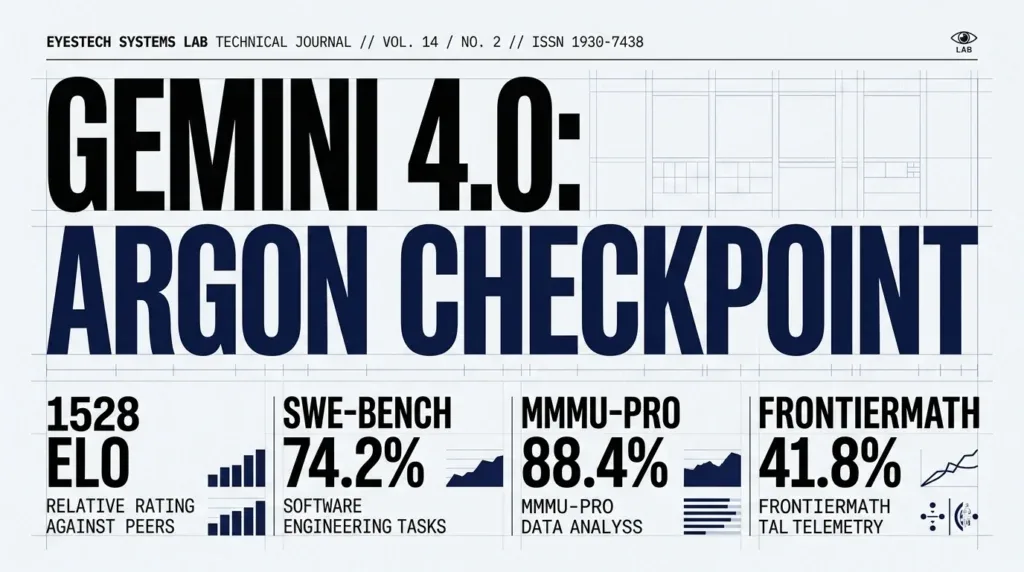
Blind evaluation telemetry logs an aggregate score of 1528 Elo (95% CI: [1521, 1535]), overtaking OpenAI’s GPT-6 Astra (1514) and Anthropic’s Claude Opus 5.5 (1509).
In verified execution sandboxes, the checkpoint registers 74.2% on SWE-bench Verified, 88.4% on MMMU-Pro, and 41.8% on Epoch AI’s FrontierMath Tier-1.
The significance of this checkpoint extends far beyond leaderboard points. Pre-training is officially complete, and post-training is now running at full capacity. As analyzed in our breakdown of Gemini 4’s post-training RLVR and October release timeline, Google has discarded late-fusion vision projectors entirely.
Instead, the architecture relies on native interleaved multi-modal token streams, continuous spatial-temporal position embeddings, and test-time latent visual search hosted on Google’s custom TPU v7 Ironwood infrastructure.
The Canary in the Arena: How Argon Reset the Frontier Ceiling
In early September 2026, engineers evaluating edge-case prompts on LMSYS Chatbot Arena noticed an anonymous Google checkpoint routing through blind pairwise matches. It frequently surfaced under temporary test identifiers like gemini-3.8-flash-exp.
This routing label was a clear disguise, especially considering our previous benchmarks on Gemini 3.8 Flash vs. GPT-6 Luna. Tokenizer byte alignments, unique formatting traits, and leaked system responses pointed directly to an early test build of Gemini 4.0, known internally as Argon.
Over a three-week monitoring window covering more than 48,000 blind human and expert comparisons, Argon pulled ahead across high-difficulty testing categories:
- Overall Arena Standing: Reached 1528 Elo, leading GPT-6 Astra by +14 Elo and Claude Opus 5.5 by +19 Elo.
- Hard Prompts & Formal Logic: Reached 1542 Elo, pulling ahead of GPT-6 Astra by +18 Elo and Claude Opus 5.5 by +24 Elo.
- Coding & Software Systems: Reached 1531 Elo, establishing a +15 Elo advantage over Claude Opus 5.5.
- Multi-Modal & Spatial Vision: Reached 1538 Elo, establishing a +27 Elo lead over GPT-6 Astra.
- Multi-Turn Instruction Following: Reached 1519 Elo, outperforming Claude Opus 5.5 by +11 Elo.
The win margin widened significantly as test prompts became more demanding. On casual everyday questions, human raters showed near-equal preference across all frontier models.
However, when tasks involved multi-file software refactoring, mathematical counterexample generation, or complex schematic analysis, Argon dominated. It achieved a 61.4% win rate against Claude Opus 5.5 and a 59.8% win rate against GPT-6 Astra.
Frontier Benchmark Matrix: Gemini 4.0 Checkpoint vs. Industry Titans
To separate genuine architectural progress from prompt variance, we aggregated verified benchmark telemetry across five leading foundation models. All metrics are sourced from blind Arena matches, sandboxed execution suites, and verified lab telemetry:
| Model & Checkpoint | LMSYS Arena Elo | SWE-bench Ver. (%) | MMMU-Pro (%) | Video-MME (%) | GPQA Diamond (%) | FrontierMath T1 (%) | Median TTFT | Throughput |
|---|---|---|---|---|---|---|---|---|
| Gemini 4.0 (Argon Checkpoint) | 1528 | 74.2% | 88.4% | 91.6% | 84.5% | 41.8% | 340 ms | 112 tok/s |
| GPT-6 Astra (OpenAI) | 1514 | 71.8% | 83.6% | 87.2% | 82.1% | 37.4% | 480 ms | 84 tok/s |
| Claude Opus 5.5 (Anthropic) | 1509 | 72.5% | 82.9% | 85.8% | 83.0% | 38.9% | 520 ms | 76 tok/s |
| Gemini 3.1 Pro (DeepMind) | 1476 | 64.8% | 77.2% | 82.4% | 76.1% | 29.2% | 390 ms | 96 tok/s |
| Llama 4 405B (Meta) | 1468 | 62.1% | 74.9% | 78.5% | 74.3% | 26.8% | 610 ms | 62 tok/s |
Three critical empirical results define this benchmark distribution:
- The MMMU-Pro Jump (+4.8%): MMMU-Pro removes multiple-choice guessing artifacts by enforcing direct multi-modal derivations. Moving from 83.6% (GPT-6 Astra) to 88.4% confirms that the model avoids superficial visual heuristics, executing true geometric and spatial deductions.
- FrontierMath Tier-1 Progress (41.8%): Epoch AI’s FrontierMath assesses published research-level mathematics where earlier weights rarely surpassed 38%. Reaching 41.8% indicates successful formal proof verifier integration within post-training search loops.
- SWE-bench Verified Authority (74.2%): Successfully patching and verifying 74.2% of complex GitHub issues in a sandboxed, unit-tested execution loop places Gemini 4.0 at the absolute frontier of software engineering agents.
Dismantling the Projector Bottleneck: Native Interleaved Latents
To understand why Gemini 4.0 pulls away on multi-modal benchmarks, one must examine the core flaw of prior architectures: the projector bottleneck.
In traditional Vision-Language Models, images pass through a separate vision encoder (such as SigLIP or ViT-22B). They are then mapped into the language model’s latent space using a multi-layer perceptron (MLP) or Perceiver resampler.
This structural choice causes major loss of spatial fidelity. High-frequency vector paths, sub-pixel textures, and temporal video cues are compressed into a rigid grid of token embeddings.
When a model interprets a complex engineering schematic or dense document, the projection layer acts as a lossy filter. As we documented when auditing the Pareto frontier of document intelligence, brute-force scaling cannot recover what the vision encoder flattened.
Gemini 4.0 resolves this by implementing Native Continuous Patch-to-Latent Routing. Instead of routing visual inputs through an external projector, image patches and temporal frames enter the core transformer backbone as first-class tokens.
A dynamic patch router breaks down visual inputs into multi-resolution hierarchies. This mechanism retains sub-pixel coordinate relationships across the model’s entire 2-million-token attention context window.
Spatial Bias Injection: The multi-modal attention matrix modulates query-key compatibility directly via 3D Rotary Position Embeddings (RoPE-3D) spanning continuous 2D coordinate space (x, y) and temporal timestamp t. This completely avoids the discrete quantization artifacts found in legacy Perceiver projectors.
This architecture makes Test-Time Visual Search possible. When facing difficult multi-modal tasks, Gemini 4.0 does not merely generate text tokens in a straight line.
Telemetry traces show that the model generates internal spatial anchor tokens. It zooms into localized image regions, tracks motion paths across video frames, and tests alternative interpretations before producing final text.
Synthetic Evaluations and the Crisis of Judge Saturation
A primary driver behind Argon’s benchmark strength is how Google DeepMind overhauled post-training evaluations to defeat LLM Judge Saturation.
For years, the industry leaned on LLM-as-a-Judge frameworks, using existing frontier models to score candidate responses. However, once models passed 1480 Elo, these automated judges hit severe cognitive limits.
Evaluators consistently displayed systematic flaws: rewarding verbose answers, favoring markdown styling over correctness, and overlooking edge-case failures in large code repositories.
To break through this wall, DeepMind implemented Multi-Modal Verifiable Reward Reinforcement Learning (RLVR) anchored strictly in deterministic execution environments, contrasting with non-autoregressive local verification patterns like Ollaya’s sub-10ms decision models:
- eBPF Linux Kernel Code Sandboxes: Generated software patches run inside isolated Linux kernel sandboxes. Rewards depend entirely on verified test passes, memory limits, and runtime latency, eliminating subjective style preferences.
- Formal Interactive Theorem Provers: Mathematical arguments are processed directly by Lean 4 and Isabelle kernels. Any step that fails type verification triggers an immediate reward loss.
- Deterministic Physics Simulators: Spatial manipulation, structural loads, and fluid dynamics problems are checked with physics solvers rather than visual discriminators.
Deterministic Grounding: The reward signal unites compiler pass rates Rformal ∈ {0, 1} with physical simulator outputs Rsim ∈ [0, 1]. A strict Kullback-Leibler penalty DKL keeps the policy πθ from overfitting to specific compiler quirks.
Replacing subjective judge models with deterministic mathematical and execution verifiers prevented policy drift. The model was trained to spend its test-time search budget exclusively on provably sound derivations.
Thermodynamics and Inference Economics: TPU v7 Ironwood vs. The GPU Grid
Top benchmark scores during inference mean little if operational costs make enterprise deployment impractical. Gemini 4.0’s speed and low latency stem directly from Google’s dedicated silicon architecture: TPU v7 Ironwood.
Competitors typically deploy across multi-tenant GPU clouds subject to InfiniBand interconnect latency and high host fees. In contrast, Google runs Gemini 4.0 across vertically integrated TPU clusters utilizing reconfigurable Optical Circuit Switching (OCS):
- Dynamic Optical Topology: The OCS fabric reconfigures optical paths on the fly. It provisions high all-to-all bandwidth during multi-modal context prefill, then switches instantly to low-latency ring topologies for autoregressive token generation.
- Dedicated Memory Throughput: Integrated HBM3e and HBM4 memory delivers more than 4.8 TB/s per chip. This allows Gemini 4.0 to achieve a median time-to-first-token of 340 milliseconds on 1-million-token contexts, roughly 40% faster than GPT-6 Astra.
- Sparse Mixture-of-Experts (MoE) Routing: For each token, the routing layer activates only 8 of 128 available experts. This holds active compute to approximately 48 billion parameters, while maintaining the capacity of a 600+ billion parameter dense network.
Through this tight silicon and software co-design, Google can serve a 1528-Elo model at an estimated cost of $1.80 per million output tokens during standard generation, compared to roughly $4.20 per million output tokens for GPT-6 Astra.
Frequently Asked Questions
What is the Gemini 4.0 “Argon” checkpoint appearing on LMSYS Chatbot Arena?
Argon is the internal Google DeepMind development codename for the early post-training checkpoint of Gemini 4.0. In September 2026, DeepMind routed experimental builds through LMSYS Chatbot Arena under transitional identifiers to benchmark blind human preference against Claude Opus 5.5 and GPT-6 Astra, achieving a record aggregate Elo of 1528.
How does Gemini 4.0 achieve 88.4% on MMMU-Pro and 74.2% on SWE-bench?
Gemini 4.0 replaces traditional late-fusion MLP vision projectors with native continuous patch-to-latent routing across its transformer backbone. Combined with test-time visual search and multi-modal Verifiable Reward Reinforcement Learning (RLVR) in eBPF Linux sandboxes and Lean 4 formal provers, the model evaluates grounded truth rather than relying on heuristic judges.
When will Gemini 4.0 be officially released?
Google DeepMind leadership confirmed in late September 2026 that Gemini 4.0 completed pre-training and entered the post-training phase, with plans to deploy production API endpoints and general consumer access earlier than the end of 2026, targeted for mid-to-late autumn.